
Table of Contents
- Introduction: Why Manufacturing Technician Training Management Matters in 2026
- Defining the Modern Manufacturing Technician Role and Levels
- From Skills Gap to Roadmap: Designing Manufacturing Technician Training Programs
- Building Effective Hands-On Training and Real-World Experience
- Managing Apprenticeships and Structured Pathways for Industrial Manufacturing Technicians
- Compliance, Reporting, and Certification Tracking
- Using Technology and Data to Run Manufacturing Technician Training at Scale
- Common Mistakes in Manufacturing Technician Training Management (and How to Avoid Them)
- Why Choose a Dedicated Work-Based Learning Platform for Manufacturing Technician Training
- Next Steps: Turning Your Manufacturing Technician Training Strategy into Action
- FAQs: Manufacturing Technician Training Management
Introduction: Why Manufacturing Technician Training Management Matters in 2026
The skills gap in the manufacturing industry is no longer a forecast – it is the daily reality for employers struggling to staff production lines. The U.S. needs roughly 1.2 million new technicians by 2029, yet current pipelines satisfy less than half of annual openings. Manufacturing technicians earn an average salary of $52,000 per year, making these roles attractive for job seekers pursuing a new career, but only if employers can build the training infrastructure to develop them.
Manufacturing technician training management covers the full lifecycle: defining roles, designing curriculum, delivering hands on training and classroom education, tracking competencies, maintaining regulatory compliance, and scaling across sites. Managing training programs for manufacturing technicians requires safety compliance and continuous upskilling – not just scheduling courses. This article walks employers, apprenticeship sponsors, schools, and workforce boards through every stage of that process, from entry level onboarding to advanced manufacturing technician level development.
Want to Learn More About Your Registered Apprenticeship Opportunities?
BOOK A FREE CONSULTATION
Defining the Modern Manufacturing Technician Role and Levels
Effective training management starts with a clear picture of what the job actually requires. Today’s manufacturing technician operates CNC machines and automated production lines, interprets digital work instructions, performs quality checks with measurement tools, enters data into MES and ERP business systems, and executes preventive maintenance awareness tasks.
Typical tiers include:
- Entry level production workers or industrial manufacturing technician roles (minimal baseline, safety-focused onboarding)
- Manufacturing technician level 1 (MT1-style baseline: equipment setup, quality measurement, basic troubleshooting)
- Advanced roles supporting process engineering, maintenance, or leadership
Job profiles differ by sector. Medical device manufacturing demands cleanroom procedures and FDA documentation. Food and beverage requires HACCP and hygiene. Metals involves heavy machinery and robustness. Training program design must adapt to these differences across a broad range of manufacturing processes.
Key technical skills clusters include safety protocols (OSHA-10, lockout/tagout), measurement and product quality tools, production equipment setup, basic PLC awareness, reading schematics, and troubleshooting. Safety training must be embedded in technical training, not treated separately, and safety protocols should be integrated into every operational module. Equally important are non-technical skills – communication during shift handoffs, documentation accuracy, teamwork, and problem-solving. Soft skills training prepares technicians for supervisory roles and future leadership responsibilities.
From Skills Gap to Roadmap: Designing Manufacturing Technician Training Programs
A strong training program starts with structured design, not disconnected online courses. Begin with a training needs analysis focused on specific job families: industrial manufacturing technician, certified production technician, or maintenance tech support. Map competencies to concrete learning outcomes – for example, “perform a first-article inspection using digital calipers within ±0.001 in” rather than vague goals like “understand quality.”
Organize content into a clear sequence:
- Foundational safety and quality
- Core production operations
- Equipment-specific procedures
- Advanced topics, cross-training, and manufacturing technology
The IMT program is recognized as an industry standard for manufacturing training. It is competency-based and nationally recognized, developed through a collaborative sector strategy approach. Blended learning combines digital modules with hands on training, and courses feature state-of-the-art e-learning simulations. Microlearning breaks down complex procedures into bite-sized lessons, and using a mix of training formats caters to different learning styles. Expert instructor training is available for high-quality education delivery.
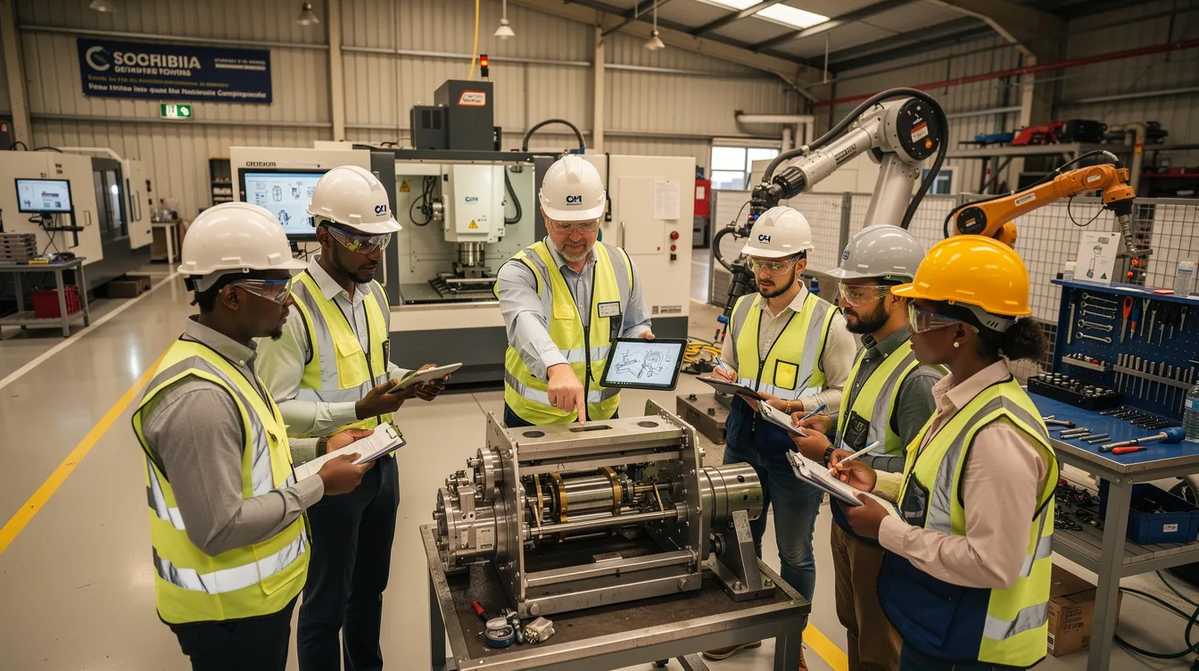
Align with external credentials where useful: MT1 certification enhances participants’ career prospects in manufacturing, and certified production technician credentials validate core technical expertise. Recruiting and onboarding strategies should align with business goals, and training programs should prepare technicians for leadership roles in manufacturing. Clear career pathways improve technician retention and morale.
Address different learner profiles: high school diploma holders in pre-apprenticeships need scaffolded instruction; adult entry level hires benefit from bridging modules in math and schematics; incumbent machine operators upskilling need modular, just-in-time resources. Typical timeframes range from 4–8 weeks for onboarding to 12–18 months for full apprenticeship completion.
Building Effective Hands-On Training and Real-World Experience
Manufacturing technician roles cannot be learned through eLearning alone. Hands on experience at the machine is essential, and hands-on, equipment-specific training improves technicians’ performance directly.
Structure OJT by defining specific tasks – changeovers, TPM checks, gauging parts – assigning qualified trainers per shift, and setting required practice hours with sign-off criteria. Pairing new technicians with experienced mentors enhances knowledge transfer significantly. Structured onboarding includes clear milestones for new technicians at 30, 60, and 90 days.
Lab and shop activities for schools and training centers include CNC mill setup, soldering and basic electronics assembly, robotics cell operations, and VR simulations of line changeovers. One community college program using VR in their certified production technician curriculum reported a 50% reduction in time to productivity.
Cross-training technicians increases operational flexibility and reduces equipment downtime. Competency-based assessments verify a technician’s ability to diagnose and repair faults. Assessment methods should include competency checklists, task observations, timed performance tests, and quality metrics. Blend OJT with related technical instruction in a weekly rhythm – for instance, 4 hours per week of classroom or online learning plus full time employment on the production floor.
Managing Apprenticeships and Structured Pathways for Industrial Manufacturing Technicians
Apprenticeship programs offer a scalable way to grow manufacturing technician talent in-house. The IMT program includes 2,000 hours of on-the-job training and IMT apprentices complete 200 hours of online curriculum. The IMT Apprenticeship lasts for 18 months with 4 hours of class weekly, and some advanced pathways require participants to complete 3,000 hours of on-the-job training for more complex roles.
The IMT program is registered with the US Department of Labor, and participants receive journey worker papers from the US Department of Labor upon successful completion. Competency-based skill matrices detail specific milestones for technician progression through each manufacturing technician level.
Example apprenticeship structure:
- 12–18 month duration
- 2,000+ OJT hours mapped to specific production tasks
- 200+ RTI hours delivered via online courses and in-person instruction
- Milestones tied to wage increases and credential attainment
Coordinate stakeholders carefully: HR, production supervisors, community colleges, workforce boards, and state apprenticeship agencies all need clear roles. Mentorship and coaching should be integral to leadership development programs, and progression paths must be visible – from entry level hire to industrial manufacturing technician to higher-level quality, maintenance, or process tech roles. Employers like Trane Technologies scaled from 25 to 200+ apprentices across 30 states in two years with 86% retention by getting this coordination right.
Compliance, Reporting, and Certification Tracking
OJT tracking is essential for compliance with apprenticeship standards, and compliance reporting includes tracking OJT and RTI hours across every participant. Sponsors of registered programs must report through systems like RAPIDS for program registration and WIPS for performance data, with data elements aligned to PIRL for workforce-funded programs.
A strong compliance approach tracks:
- OJT hours by occupation, task, and apprentice
- RTI hours by course and delivery mode (in-house, online, college)
- Certifications earned: manufacturing technician level 1, certified production technician, OSHA-10
- Wage progression milestones and completion dates
Periodic skills assessments help identify training needs before gaps become production problems. Connecting training to performance metrics measures its effectiveness and justifies continued investment. Manual spreadsheets lead to lost records, inconsistent data, and missed deadlines – standardize data fields and workflows early in program design.
Using Technology and Data to Run Manufacturing Technician Training at Scale
Manual coordination breaks down once companies operate multiple plants, cohorts, or training partners. A learning management system handles content delivery and tests, but a dedicated work-based learning platform manages OJT tracking, stakeholder coordination, scheduling, and apprenticeship-friendly compliance reporting.
Key capabilities to look for:
- Real-time dashboards showing OJT and RTI progress by apprentice, cohort, and site
- Digital competency checklists for manufacturing technician tasks
- Automated alerts for overdue evaluations, incomplete hours, or expiring certifications
- Multi-stakeholder access with role-based permissions for employers, schools, and trainees
- Mobile-friendly logging so technicians and mentors can record training at the machine
Consider a concrete scenario: a three-plant operation running two annual cohorts of industrial manufacturing technicians needs to know which apprentices are ready for MT1 or certified production technician exams and who is behind on OJT hours. Without a centralized platform, that visibility simply does not exist at scale. Training data also feeds workforce planning – projecting how many entry level technicians to recruit each quarter based on retirement, turnover, and production expansion targets.

Common Mistakes in Manufacturing Technician Training Management (and How to Avoid Them)
Leaders who want to avoid wasting time and budget should watch for these missteps:
- Launching without clear job profiles or competency maps → convene a cross-functional design team before selecting any tools or courses
- Focusing only on classroom hours while neglecting structured hands on skills sign-offs → embed OJT tasks with mentor approvals into every schedule
- Treating apprenticeships as HR projects rather than production-critical initiatives → give supervisors co-ownership and recognition for coaching
- Tracking hours and certifications with spreadsheets → adopt a dedicated platform that supports RAPIDS and WIPS reporting
- Failing to build career progression beyond entry level → define levels, credentials, and wage bands so employees see job opportunities ahead
Why Choose a Dedicated Work-Based Learning Platform for Manufacturing Technician Training
A specialized work-based learning platform is built for organizations managing real OJT plus RTI – not just eLearning content.
For employers, it consolidates tracking of OJT and RTI across multiple sites and cohorts, simplifies compliance reporting, and provides clear visibility into pipeline health for manufacturing technician and industrial manufacturing technician roles across all sectors.
For schools and training providers, it aligns coursework with employer-defined competencies, streamlines communication with mentors and apprentices, and reduces manual coordination with local manufacturers.
For apprentices and trainees, it offers mobile access to checklists, schedules, and progress tracking. Trainees gain a clear understanding of what is required to move from entry level to the next manufacturing technician level, with visibility into every certification and credential earned.
Unlike generic HR or LMS tools, a purpose-built platform supports task-level OJT logging, mentor approvals, wage progression tracking, and apprenticeship-friendly reporting – the features that actually matter for manufacturing supports and workforce development at scale.
Next Steps: Turning Your Manufacturing Technician Training Strategy into Action
You have walked through defining roles, designing training programs, structuring hands on training, managing apprenticeships, and leveraging technology and data. Now audit your current approach: Are roles defined with competency maps? Are OJT tasks documented with sign-off criteria? Is compliance reporting automated? Are progression paths visible to every employee?
Outline a 90-day plan: standardize one role profile (such as industrial manufacturing technician), map its competencies and OJT tasks, choose or refine a training management system, and launch a pilot cohort. Start small, measure results, and iterate before scaling.
If you are ready to move from strategy to execution, explore a modern work-based learning platform that consolidates tracking, compliance, and stakeholder coordination. Contact our team to schedule a demo or consultation and start building your manufacturing technician pipeline with confidence.

FAQs: Manufacturing Technician Training Management
Below are answers to practical questions employers, schools, and workforce partners ask when building manufacturing technician pathways.
What is the first step to launching a manufacturing technician training program?
The first step is defining target roles – such as industrial manufacturing technician or certified production technician – and building a competency map before choosing courses or tools. Involve production supervisors, quality leads, and maintenance in a short working session to agree on must-have technical skills and safety expectations for entry level workers.
How long should an entry level manufacturing technician training program last?
Basic onboarding modules typically run 4–8 weeks. A full apprenticeship-style development path to a higher manufacturing technician level takes 12–18 months. Duration depends on equipment complexity, the regulatory environment, and whether students are new to the manufacturing industry.
Do we need formal apprenticeships to train industrial manufacturing technicians?
Formal apprenticeships are not mandatory but bring advantages: structured wage progression, state and federal recognition, and potential access to funding. Companies can start with an internal structured training program and later register it as an apprenticeship once outcomes and processes are proven.
How can we give hands on training without disrupting production?
Dedicate a training cell, use off-shift or low-volume windows, leverage VR or simulators for risky tasks, and pair new hires with mentors on a planned rotation. Schedule training time into labor plans rather than expecting it to happen informally around production demand.
What metrics should we track to know if our training programs work?
Track time-to-competency for entry level techs, first-year retention, rework and scrap rates on trained lines, safety incidents, certification pass rates, and apprenticeship completion rates. Use dashboards to compare cohorts over time and by site so leaders can refine both technical skills content and coaching practices. Productivity gains on lines staffed by trained employees are a strong indicator of program value.
How do external certifications like MT1 or Certified Production Technician fit into our internal training?
External certifications serve as milestones within the broader training journey, validating core competencies while internal training covers plant-specific procedures and production equipment. Map internal modules to certification exam domains so learners see a clear path from daily training tasks to recognized credentials, supporting both career development and employer confidence.