
CNC machinist training management covers every step of planning, delivering, tracking, and improving training for CNC machinists, operators, and programmers. This guide walks through the full process, from workforce analysis to compliance reporting.
Table of Contents
- Introduction: Why CNC Machinist Training Management Matters in 2026
- Understanding the CNC Talent Pipeline: Roles, Skills, and Career Paths
- Designing a CNC Machinist Training Program: From Goals to Curriculum Map
- Core Curriculum for CNC Machinists: What Every Program Should Cover
- Balancing Classroom, Lab, and Shop Floor: RTI vs. OJT in CNC Machining Training
- Online CNC Classes vs. In-Person Labs: Choosing the Right Mix
- Centralizing CNC Machinist Training Management: Tracking Hours, Skills, and Progress
- Compliance and Registered Apprenticeships for CNC Machinists
- Measuring ROI and Performance in CNC Machinist Training
- Scaling CNC Machinist Training Across Multiple Sites and Partners
- Technology Trends Shaping CNC Machinist Training Through 2030
- Common Mistakes in CNC Machinist Training Management (and How to Avoid Them)
- Why Choose GoSprout for CNC Machinist Training Management
- Next Steps: Launching or Upgrading Your CNC Machinist Training Program
- FAQs About CNC Machinist Training Management
Introduction: Why CNC Machinist Training Management Matters in 2026
CNC stands for computer numerical control, a technology first developed in the 1950s at MIT that now drives precision manufacturing across aerospace, automotive, medical, and energy sectors. CNC machines produce complex parts with high precision, and CNC machining improves automation in manufacturing processes at every scale. Yet the people who run these machines are retiring faster than new talent enters the pipeline. The Bureau of Labor Statistics projects about 29,500 annual job openings for machinists through 2034, driven almost entirely by retirements and transfers rather than growth. Reshoring initiatives, CHIPS Act investments, and supply chain resilience projects are adding demand on top of that gap.
This article is for training managers at manufacturers, workforce and apprenticeship coordinators, community and technical colleges, and workforce development boards who need to move from ad-hoc CNC machinist training to a repeatable, trackable system. You will learn how to design a CNC machinist training program, choose between online CNC classes and hands-on labs, manage OJT and RTI hours, stay compliant with Registered Apprenticeship standards, and use software to track progress across multiple sites. The goal is to give you a blueprint you can adapt to your machines, your people, and your production targets.
Want to Learn More About Your Registered Apprenticeship Opportunities?
BOOK A FREE CONSULTATION
Understanding the CNC Talent Pipeline: Roles, Skills, and Career Paths
A typical advanced manufacturing plant in 2026 runs a three-tier talent ladder. Each tier carries different responsibilities and requires its own training path.
- CNC operator: The entry-level role. CNC operators run pre-written programs and load parts. CNC operator training is the shortest and most beginner-friendly, focusing on machine operation, basic safety, and part loading sequences.
- CNC machinist: The mid-level role. CNC machinists perform setup, measurement, and troubleshooting tasks. CNC machinist training includes manual machining and metrology, teaching trainees to handle offsets, workholding, tool changes, and first-article inspection.
- CNC programmer: The highest-skill tier in CNC roles. CNC programmers create G-code and CAD/CAM toolpaths, optimize cycle times, and verify programs before production runs.
Most programs blend manual machining with CNC machining in early semesters because a machinist who understands how a manual mill or engine lathe behaves will diagnose CNC problems faster. A machinist manually sets tool offsets and workholding on manual equipment before transitioning to semi automated tools and full CNC machine operation.
Core skill domains that your training management plan must cover include blueprint reading, GD&T, CNC programming, precision measurement, CNC mill and CNC lathe setup, tooling and tool materials, offsets, machine maintenance, preventive maintenance routines, and safety. Common career pathways run 3 to 7 years: CNC operator to journeyman CNC machinist to lead machinist or CNC programmer. Without structured progression and competency tracking, people stall, quit, or get promoted past their actual skill level.
Designing a CNC Machinist Training Program: From Goals to Curriculum Map
Most CNC machining training efforts fail because they rely on unstructured job shadowing, inconsistent OJT, and zero documented standards. A machinist gain from structured programs is measurable; a machinist gain from “watch and learn” is not.
CNC machinist programs typically require 1,070 clock hours. Programs can last from a few weeks to 9 months or longer depending on scope and delivery format. Admission requires a high school diploma or GED equivalent, and graduates must complete 80% of clock hours with a 2.0 GPA. Effective management of CNC machinist training programs requires aligning competency-based curricula with industry standards.
Key design steps:
- Define outcomes by level. A Level 1 CNC operator should load, run, and inspect basic parts after 90 days. A Level 2 CNC machinist should handle full setups, offsets, and troubleshooting after 12 to 18 months. A CNC programmer should write and optimize programs after 2 to 3 years.
- Align with production needs. Map your part families, materials (aluminum, stainless, titanium), tolerances, and machine mix (3-axis mills, 2-axis lathes, multi-axis or Swiss machines) to training priorities.
- Build program components. Include RTI (classroom and online CNC classes), OJT checklists on actual CNC machines, competency assessments, NIMS or similar credentials, and periodic performance reviews.
- Create a curriculum map. Sequence topics over time: safety and shop math in Month 1, basic CNC mill operation in Months 2 to 3, CNC lathe in Months 4 to 5, introductory CNC programming by Month 6.
Progressive skill development helps align training with operational demands. Structured training programs benefit from advisory boards with local industry representatives who validate that curriculum matches what the shop floor actually needs. This map should live in a centralized training management platform, not a binder on someone’s desk.
Core Curriculum for CNC Machinists: What Every Program Should Cover
While facilities, machines, and local industries differ, strong CNC machinist training programs share a consistent core curriculum. CNC machinist training includes blueprint reading and machining mathematics. CNC machinists learn blueprint reading and interpretation as a foundational competency. CNC machinists must understand machining mathematics for accuracy, including trigonometry, feeds and speeds calculations, and metric/imperial conversion.
Theory topics:
- Machining math (trigonometry, feed rates, speeds)
- Blueprint reading with GD&T
- Material science: common alloys (carbon steel, stainless, aluminum, titanium, brass, plastics) and their machining processes
- Safety and OSHA standards; competency-based programs prioritize safety as the foundation of their curriculum, and safety training should be embedded into every practical exercise
- Metal cutting fluids selection, handling, and disposal

CNC machine operation:
- Training includes CNC mill and lathe operation skills. Students learn to operate CNC mills and lathes during training.
- Control panel overview for common controllers: FANUC CNC controls optimize machining processes in aerospace; Haas CNC controls enhance productivity in automotive manufacturing; Mazak CNC controls are used in the medical device industry. CNC machines can be open-loop or closed-loop systems.
- Machine startup/shutdown, workholding setups, tool presetting, offsets, probing cycles, and basic troubleshooting
- Fanuc mill and Mazak mill controls, Haas Automation controllers, Mazak lathe and CNC lathe operation across platforms
CNC programming fundamentals:
- CNC machinists learn basic CNC programming and G-code. G code programming covers coordinate systems, canned cycles, and toolpaths.
- CAD software creates detailed digital models for CNC machining. CAM software translates CAD models into machine-readable code. CAD/CAM integration reduces material waste in manufacturing processes. CNC machining utilizes CAD for complex geometries and tight tolerances.
- Post-processing, simulation, and program verification before cutting
Quality and inspection:
- Precision measurement with micrometers, calipers, height gauges, CMM basics
- Grinding processes inspection methods and surface finish testing
- SPC charting, first-pass yield tracking, and documenting inspection results in digital systems
NIMS machining standards organize competencies across multiple areas, giving programs a recognized framework for credentialing. CNC machining reduces material waste during production, CNC technology enables rapid prototyping of components, and CNC machining allows for intricate geometries and tight tolerances; these advantages make training investments directly visible on the shop floor.
Balancing Classroom, Lab, and Shop Floor: RTI vs. OJT in CNC Machining Training
Related Technical Instruction (RTI) covers classroom, lab, and theory instruction. On-the-job training (OJT) covers work-based training under mentor supervision. Most Registered Apprenticeship standards for CNC machinists require both. According to data from the American Apprenticeship Initiative, manufacturing apprenticeships average about 537 hours of RTI and 5,191 hours of OJT. State programs vary; Oregon requires 528 to 720 RTI hours, and Washington’s IAM/Boeing apprenticeship requires about 640 hours.
Effective RTI formats:
- Evening CNC classes at local community colleges
- Online CNC machining training modules for programming metallurgy machining theory
- Virtual machine simulators for CNC programming practice
- Instructor-led labs on campus milling machines and lathes
OJT best practices:
- Structured task lists for common setups on specific CNC machines
- Shadow-and-do sequences with assigned mentors
- Capturing real production hours on specific machines against competencies
- Structured on-the-job training paired with mentorship enhances real-world troubleshooting skills
Integration of hands-on training with theory improves learning effectiveness. Hands-on practice with supervision is essential for developing core machining skills, because hands-on training builds decision-making and muscle memory skills that no classroom can replicate. Real machine access is essential for full machinist readiness. Students complete 1,070 clock hours in CNC machinist training, split across RTI and OJT.
Training managers should decide which content belongs in RTI (theory, math, programming logic) and which belongs in OJT (actual setup, tool changes, machine recovery from alarms). Document both RTI and OJT hours in a single system instead of spreadsheets or paper logs to keep apprentices, schools, and employers aligned.
Online CNC Classes vs. In-Person Labs: Choosing the Right Mix
Hybrid models are now standard in 2026 for CNC machining training. An online CNC machinist course covers theory and introductory programming at the learner’s own pace. In-person labs cover everything that requires chips, coolant, and physical feedback.
Advantages of online CNC training:
- Flexible scheduling for working apprentices and CNC lathe operators on shift rotations
- Lower travel burden for rural learners
- Repeatable self-paced modules on CNC programming and machining math
- Quick onboarding for new CNC operators and machine operators
Advantages of in-person labs:
- Hands-on CNC training enhances safety and equipment operation skills
- Real-time coaching on setup, inspection, and lathe operation
- Ability to simulate production pressure on actual CNC mill and CNC lathe equipment
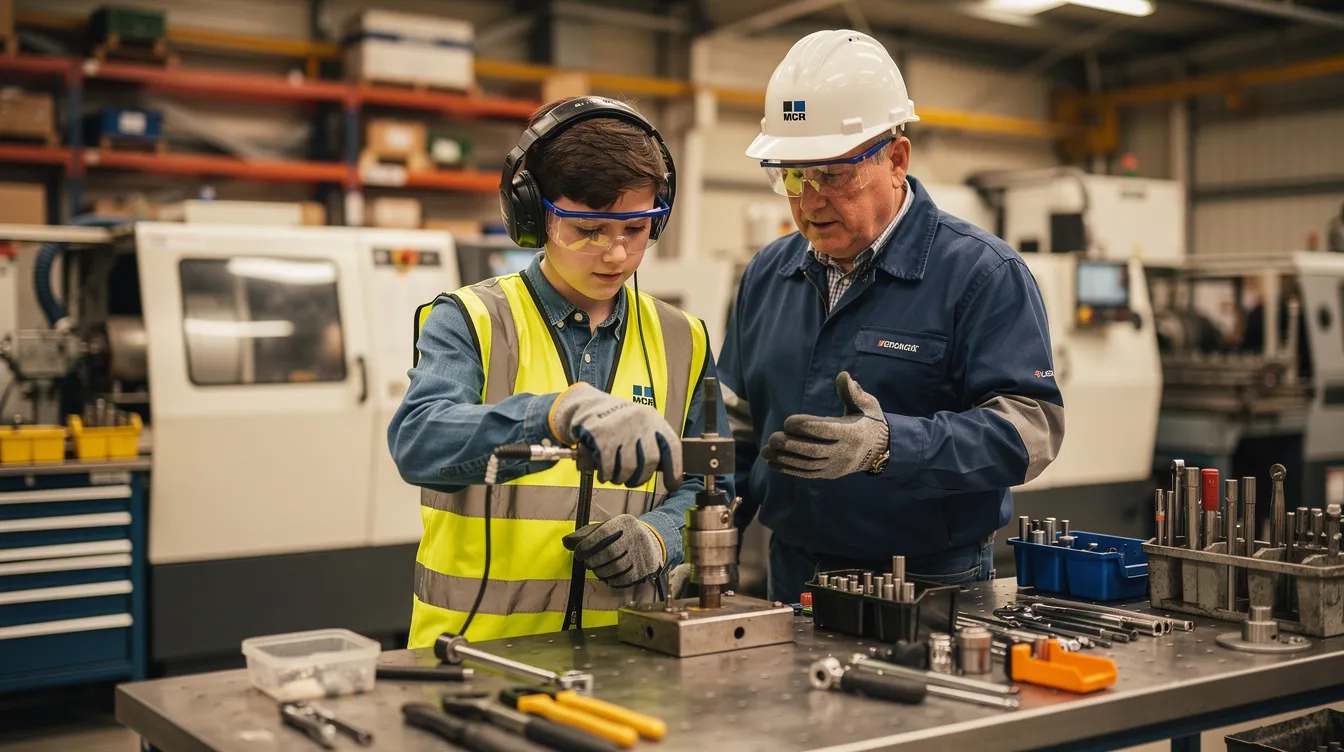
Incorporating simulation tools enhances the learning experience for CNC training, letting learners test toolpaths virtually before cutting metal. Exposing trainees to various modern controllers increases workforce adaptability; a trainee who has touched Fanuc, Haas, and Mazak controls can transfer between shops. The best blended-learning strategies pair online CNC programming simulations as homework with in-lab sessions for verifying programs on actual CNC mills and lathes the same week. Document which competencies can be reliably validated online and which require hands on training lab sign-off.
Centralizing CNC Machinist Training Management: Tracking Hours, Skills, and Progress
The typical pain of uncoordinated CNC machinist training: separate spreadsheets for hours, paper sign-off sheets for tasks, email chains between employers and schools, and no single view of where any apprentice stands.
An effective training management system should capture:
- OJT hours by machine type and task (e.g., CNC mill setup, CNC turning program, threading)
- RTI coursework completion and grades from community colleges or online CNC machinist course providers
- Competency sign-offs by mentors, tied to specific practical skills
- Credentials earned (NIMS, college certificates, job syllabus abrasives competencies)
Utilizing a Learning Management System improves tracking of training progress. Real-time dashboards show who is on track, who is behind in CNC machining training, and which competencies are lagging across cohorts. Embedding quality assessments in training ensures measurable performance criteria at each milestone. Competency-based milestones focus on demonstrated mastery rather than strict seat time.
Automated reminders and workflows help: alerts when an apprentice is due for a CNC programming evaluation, when RTI hours fall below schedule, or when a supervisor hasn’t signed off a setup competency. A mobile app lets CNC machinists and CNC operators log training tasks directly at the machine, with supervisors approving on the spot. This is a direct platform support feature that eliminates end-of-week batch paperwork.
Compliance and Registered Apprenticeships for CNC Machinists
CNC machinist training often runs as Registered Apprenticeship Programs in the U.S. Compliance matters for funding, wage progression, and credibility with regulators and workforce development boards.
Key compliance elements:
- Documenting OJT and RTI hours against approved work-process schedules
- Maintaining up-to-date standards and wage progression tables
- Retaining signed records by mentors and apprentices
- Federal and state reporting (RAPIDS, WIPS, PIRL); centralized training management tools can automate much of this reporting
- Working with multiple stakeholders: employers, community colleges offering CNC classes, workforce boards, and apprenticeship sponsors need shared visibility into training plans
Accreditation integration ensures program outcomes align with recognized frameworks. Schedule periodic internal audits of CNC machinist training records, quarterly or semi-annually, so data is ready for agency reviews and gaps in CNC machining training coverage surface early.
Measuring ROI and Performance in CNC Machinist Training
Leaders expect CNC machinist training to show measurable impact on productivity, scrap, rework, and retention.
Practical metrics to track:
- Time-to-proficiency for new CNC operators (days until they run parts independently)
- Setup time reduction on key CNC machines; one aerospace shop reduced changeover on Swiss-type lathes from 4.5 hours to 55 minutes after targeted training
- Scrap and rework rates: another Ohio aerospace shop cut scrap on titanium impellers from 14% to 3.2% after a 40-hour advanced 5-axis course
- Internal promotion rates from CNC machine operator into CNC programmer roles
- Retention improvement and reduced hiring costs; Richards Industries invested $2,800 per participant in structured training and calculated roughly $27,300 in savings per employee by reducing time-to-full productivity, yielding an ROI of approximately 875%.
Link training records to operational KPIs: relate completion of an advanced CNC programming module to improved cycle time on a specific part family. Use cohort comparisons (2024 vs. 2025 apprentice classes) and site comparisons to find where CNC machinist training processes are strongest or weakest. Regular reviews of training effectiveness help refine curricula based on performance metrics and feedback. Preventative maintenance routines are crucial for minimizing machine downtime, and training on those routines should be tracked as part of the overall program.
Present ROI in plain language: “Our 2025 CNC machinist training program reduced average setup time on our 3-axis mills by 18% within 6 months.”
Scaling CNC Machinist Training Across Multiple Sites and Partners
Manufacturers and educational consortia that run CNC machining training across multiple plants, campuses, or regions face a consistency problem. What counts as “competent on a 3-axis CNC mill” at Plant A may differ from Plant B.
- Standardize CNC machinist competency models and curriculum frameworks while allowing local customization for specific CNC machine brands, part types, and customer requirements
- Use shared digital curricula (common CNC machining modules, standardized OJT checklists) to support consistency while letting instructors add site-specific examples for their Mazak mill, Fanuc mill, or Haas automation equipment
- Implement role-based access in a training management platform so each stakeholder sees and updates the right data
- Onboard new partners (a new community college or a new small manufacturer) using templates, starter curricula, and preconfigured reports
Additional training is necessary whenever new processes or equipment are introduced at any site. Continuous instructor upskilling keeps faculty current on technical knowledge; an instructor who last programmed on a Fanuc 18i will struggle to teach Fanuc 31i features without refresher training. More advanced manufacturing courses can be developed centrally and deployed to all sites, covering specific advanced manufacturing skills and advanced manufacturing topics relevant to the network.
Technology Trends Shaping CNC Machinist Training Through 2030
Industry 4.0 is reshaping what CNC machinist training must include. The advanced manufacturing definition itself is expanding to cover robotics, data analytics, and digital twins alongside traditional manufacturing methods and traditional manufacturing definition concepts like manual mill work and engine lathe operation.
Emerging content areas for CNC machinist training courses:
- Digital twins for virtual setups: NIST published a framework based on ISO 23247 for building digital twins of CNC machine tools, enabling simulation and analytics. Siemens and Heller developed the Tokn, a miniature 5-axis CNC with a Sinumerik One controller and its digital twin, letting apprentices experiment with CAD/CAM and error detection before touching production equipment.
- AR/VR for CNC programming and machine operation: systematic reviews show extended reality (XR) reduces learning time, lowers material waste, and increases safety by letting learners test virtual setups.
- AI-enabled tools that suggest next skills based on performance and surface patterns, such as which CNC classes best predict long-term machinist success.
- Data literacy for reading machine dashboards, OEE metrics, and process improvement techniques.
- Lean manufacturing and sustainable manufacturing practices, including managing raw stock inventories and coolant recycling to control costs; manufacturing fire safety awareness.
The first CNC machine was created in the 1950s. Seventy years later, the fundamentals of precision and safety remain unchanged. Treat these tools as complements, not replacements, for hands-on practice and experienced mentors. Modern manufacturing still depends on machinists who can feel chatter, hear a dull tool, and react to an unexpected alarm. CNC relation to production quality depends on people, not just code.
Common Mistakes in CNC Machinist Training Management (and How to Avoid Them)
This is a practical checklist for training coordinators and plant managers refining or relaunching their CNC machining training program.
Operational mistakes:
- Underestimating required hours. Standards demand 500 to 700+ RTI hours and 5,000+ OJT hours for full competency. Short-cutting this produces CNC operators, not CNC machinists.
- Focusing only on CNC programming and neglecting setup and inspection. A CNC programmer who cannot troubleshoot a crashed tool or verify a first-article measurement is a liability.
- Failing to train mentors. Experienced machinists often lack formal instructional training, leading to inconsistent performance sign-offs.
- Ignoring costs and budgeting. CNC training costs range from $1,250 to $16,795. Eastern Florida State College’s CNC program costs around $1,250 plus lab fees. College of Lake County charges approximately $1,400 for CNC training. Midlands Technical College’s total estimated cost is about $4,908. NTMA’s comprehensive trade school program costs $16,795 total. Know what you are buying before you commit a cohort.
Administrative mistakes:
- Running the hours career training program on spreadsheets and paper logs, making data loss likely and compliance audits painful
- Not updating curricula when new CNC machines or materials are introduced; an annual curriculum review tied to capital equipment upgrades fixes this
- Ignoring learner feedback from apprentices and CNC operators about what content helped and what did not
- Failing to streamline business operations around training scheduling, leading to conflicts between production deadlines and RTI sessions
For each mistake, the corrective action is straightforward: create standardized OJT task lists per machine type, schedule annual curriculum reviews, train mentors on how to assess and document competency, and move tracking into a centralized platform. CNC machinist training management is iterative. Review, adjust, and improve annually based on data and stakeholder input. Manage raw stock inventories and coolant recycling to control costs alongside your training budget.
Why Choose GoSprout for CNC Machinist Training Management
GoSprout is a specialized work-based learning management platform built for CNC machining training, apprenticeships, and internships.
- Purpose-built tools for managing CNC machinist, CNC operator, and CNC programmer pathways with separate competency tracks
- Integrated OJT and RTI tracking in a single platform; no more separate spreadsheets for hours and paper for sign-offs
- Real-time dashboards for employers and schools showing progress, gaps, and compliance status
- Automated compliance reporting for Registered Apprenticeship Programs, including RAPIDS, WIPS, and PIRL
- Competency libraries for CNC mills and CNC lathes, support for multiple training providers and worksites, and mobile-friendly logging so machinists can record tasks at the machine
- Onboarding support for employers and schools, help mapping existing CNC classes and advanced manufacturing courses into structured learning paths, and guidance on report templates that tie training to production KPIs
GoSprout reduces administrative overhead so training managers can focus on mentoring and improving CNC machining skills instead of chasing paperwork.

Next Steps: Launching or Upgrading Your CNC Machinist Training Program
Moving from ad-hoc training to structured CNC machinist training management is a competitive advantage. The manufacturers who build repeatable, trackable training systems now will have the skilled workforce their competitors are still scrambling to find.
- Audit current CNC machining training practices and identify what is formal vs. informal
- Define role-based competencies for CNC operator, CNC machinist, and CNC programmer
- Map existing CNC classes and OJT tasks into a draft curriculum using a centralized platform
- Capture baseline metrics (scrap rate, time-to-setup, vacancy duration for CNC roles) before launching so improvements are visible
- Pilot with a small cohort before scaling across sites
Schedule a consultation or demo with GoSprout to review your current CNC machinist training program, see how centralized tracking works, and discuss how to integrate your existing CNC machining training resources. Whether you run a 10-person job shop or a multi-site precision manufacturing operation, structured training management fits your machines, your people, and your growth goals.
FAQs About CNC Machinist Training Management
These questions come up frequently from manufacturers, schools, and workforce organizations building CNC machining training programs.
How long does it take to develop a competent CNC machinist?
A reliable CNC operator can run pre-written programs within 3 to 6 months with structured training. A well-rounded CNC machinist who handles full setups, measurement, and troubleshooting takes 1 to 3 years. Reaching advanced CNC programmer level typically requires 2 to 4 years, assuming consistent RTI and OJT with good mentorship.
Can we manage CNC machinist training entirely online?
Core theory, machining math, and introductory CNC programming can be delivered through online CNC classes. Full readiness as a CNC machinist requires supervised hands-on practice on actual CNC mills and lathes. An online CNC machinist course is a strong start; it is not a complete program on its own.
What is the difference between a CNC operator, CNC machinist, and CNC programmer in training plans?
A CNC operator loads parts and runs programs. A CNC machinist handles setup, offsets, inspection, and troubleshooting. A CNC programmer writes and optimizes G-code and CAM toolpaths. Training management systems should track separate competency sets and learning paths for each role, even when they share foundational CNC machining modules. A CNC mill operator and CNC lathe operator may share safety modules but diverge on machine-specific competencies.
How do we know if our CNC machinist training program is working?
Key indicators: faster onboarding, fewer machine crashes, improved first-pass yield in quality control, reduced reliance on external recruiters, and positive feedback from supervisors and apprentices. Track these through your training management platform and compare cohort over cohort.
What should we look for in CNC machining training software?
Capabilities that matter: OJT and RTI tracking, competency frameworks, real-time dashboards, multi-stakeholder access (employers, schools, sponsors), mobile logging, and automated compliance reporting for Registered Apprenticeship Programs.
Can small shops benefit from structured CNC machinist training management?
Yes. Even shops with 10 to 50 employees reduce rework, cross-train team members on CNC mill and CNC lathe tasks, and improve retention by adopting scaled-down versions of the same structured approach used by larger manufacturers. The hours and business operations involved are smaller, but the principles are identical.