
Table of Contents
- What Is CNC Programming and Who Is a CNC Programmer?
- What Does a CNC Programmer Actually Do Day to Day?
- Key CNC Programming Skills and Tools Every CNC Programmer Needs in 2026
- How to Become a CNC Programmer: Education, Training, and Entry Paths
- Salary, Job Outlook, and Career Growth for CNC Programmers
- How CNC Programmers Improve Manufacturing Quality, Cost, and Speed
- Training New CNC Programmers Through Work-Based Learning and Apprenticeships
- What to Consider Before Hiring or Promoting Someone into a CNC Programmer Role
- Why Choose a Structured, Work-Based Path to Develop CNC Programmers
- Next Steps: How to Move Forward if You’re Interested in CNC Programming
- FAQs About CNC Programmers and CNC Programming
What Is CNC Programming and Who Is a CNC Programmer?
A CNC programmer is a specialist who translates engineering designs into digital instructions for automated machines. CNC programming is the process of creating those instructions—most often G-code and M-code—that tell CNC machines how to cut, drill, or shape materials like aluminum, steel, plastics, and composites into finished parts. CNC programming is essential for precision manufacturing across industries that demand repeatable accuracy at scale.
CNC programmers play a vital role in industries such as aerospace, automotive, and medical devices. One programmer might develop a 5-axis toolpath for an aerospace turbine blade, another might code a surgical implant with micron-level tolerances, and a third could be producing EV drivetrain components with tight material yield targets. CNC technology allows for complex designs in various materials, making the programmer’s role central to modern production.
How does this role differ from others on the shop floor? CNC operators run machines using existing programs—they load parts, change tools, and monitor cycles. A machinist may bridge both roles, handling setup, manual machining, and some programming. The CNC programmer, by contrast, plans and codes the entire machining strategy. In 2026, that work increasingly involves advanced CAM software, 5-axis machines, digital twins, and AI-assisted toolpath generation rather than manual G-code typing alone.
What Does a CNC Programmer Actually Do Day to Day?
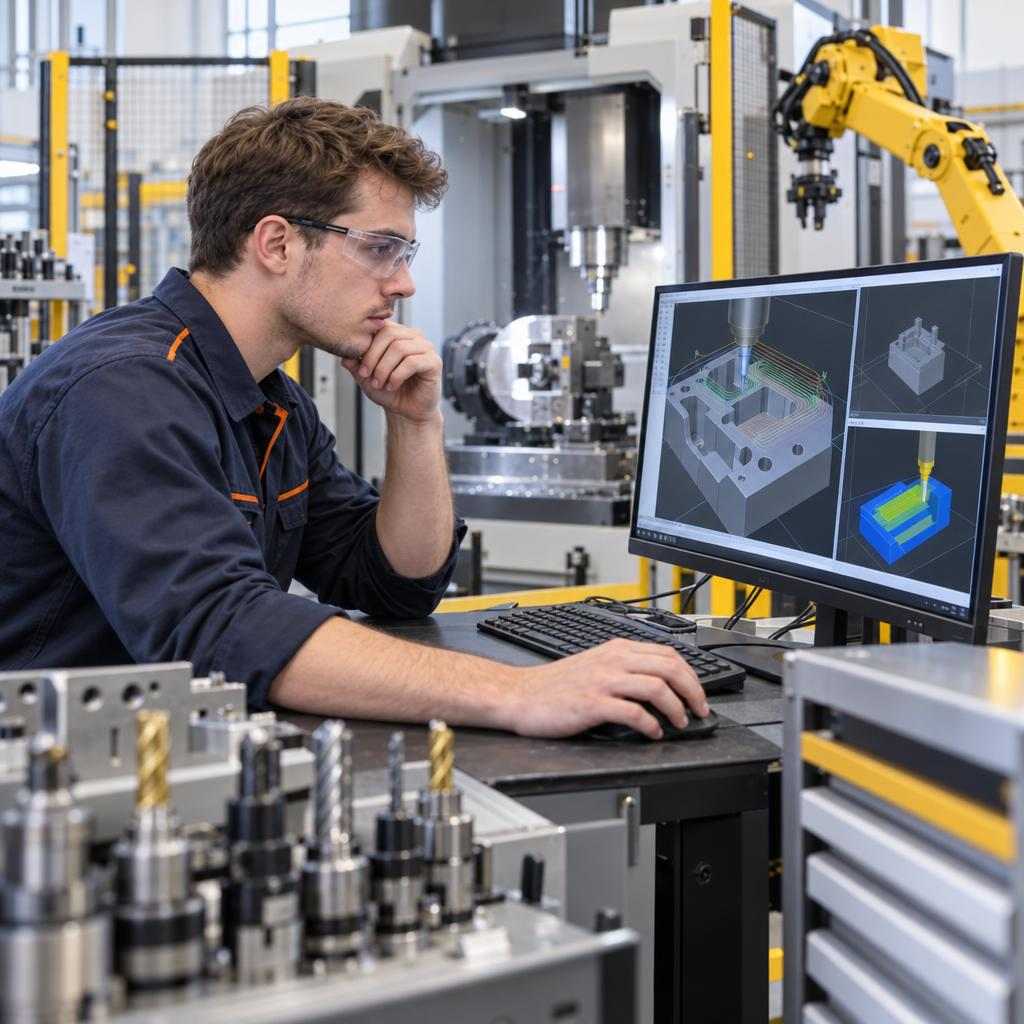
CNC programmers translate 3D models and engineering drawings into efficient programs that CNC machines can execute safely and accurately. Their day starts with careful consideration of part geometry, tolerances, surface finish requirements, and material properties before a single line of code is written.
Core daily tasks include reviewing engineering drawings, selecting tools and fixtures, choosing machining strategies (roughing vs. finishing), and generating toolpaths in CAM software. CNC programmers create and edit G-code programs, set feeds and speeds, define coordinate systems, and sequence operations for milling, turning, drilling, and multi-axis work. They verify process flow and prepare CAD geometry to ensure the program matches design intent. CNC programming involves writing G-code and M-code for machine operation, and CNC programmers optimize G-code for efficiency and accuracy throughout this process.
Consider the difference between programming a batch of 500 identical brackets and a one-off prototype mold. For the brackets, the priority is cycle time, repeatability, and minimizing tool changes. For the mold, planning shifts toward exploratory toolpath testing, slower feed rates, more frequent simulation, and potentially redesigning geometry for manufacturability.
Collaboration is constant. They collaborate with design teams to translate CAD models into machinable reality, coordinate with quality teams on inspection plans, and work directly with CNC operators to resolve print issues—missing dimensions, unclear tolerances, surface finish requirements. Effective communication between programmers and machinists enhances production efficiency considerably. Quality control checks are necessary to ensure parts meet specified tolerances before signing off on a run.
Experienced CNC programmers also troubleshoot chatter, poor surface finish, or tool breakage by adjusting the program and process. CNC programmers must troubleshoot and resolve machining issues during production, performing root cause analysis and incorporating solutions back into future programs. Documentation—updating travelers, maintaining version control, recording why a feed rate changed or a tool was swapped—is a quiet but crucial part of the job.
Key CNC Programming Skills and Tools Every CNC Programmer Needs in 2026
Modern CNC programming blends hands-on machining experience, mathematics, and software proficiency. This is not just typing code into a computer—it requires understanding how metal behaves under a cutter, how heat affects tolerances, and how a fixture design can make or break a setup.
Core technical skills include a strong foundation in mathematics and geometry, spatial reasoning for multi-axis orientation, and tool selection based on material behavior. Blueprint interpretation is essential for determining machining specifications and tolerances. Technical drawing literacy includes understanding geometric dimensioning and tolerancing (GD&T), which governs how programmers read and apply engineering intent. Successful CNC programmers understand machining processes and mathematics deeply enough to anticipate problems before they happen.
On the software side, CNC programmers use CAD and CAM software to generate toolpaths. Popular platforms include Mastercam, Fusion 360, SolidWorks CAM, HyperMill, and Siemens NX. Familiarity with CNC machine controllers—Fanuc, Siemens, Haas—and simulation tools for collision detection is required. CNC programmers must be proficient in various CNC programming software, and in 2026 that increasingly means AI-assisted toolpath modules and cloud-based collaboration tools.
Knowledge of different CNC machine types matters: 3-axis and 5-axis mills, CNC lathes, mill-turn centers, Swiss machines, and sometimes laser, plasma, or waterjet cutters. Material knowledge—how titanium differs from aluminum or engineering plastics under high feeds and speeds—directly affects programming decisions.
Soft skills cannot be overlooked. Communication skills are essential for CNC programmers to collaborate effectively with designers, quality teams, and operations staff. Attention to detail, disciplined documentation for traceability (especially under ISO or AS9100), and the ability to assess ambiguous prints and ask the right questions all distinguish a good programmer from a great one.
How to Become a CNC Programmer: Education, Training, and Entry Paths
There is no single path into CNC programming. People enter from trade school, community college, registered apprenticeships, military technical roles, or by promotion from CNC operator or machinist positions. What matters most is a combination of formal knowledge and real-world experience.

Typical education options include 1–2 year machining or CNC technology certificate programs, associate degrees with CAD/CAM coursework, and focused CNC programming certificates. Programs like AJAC’s CNC Programmer Apprenticeship combine roughly 6,000 OJT hours over three years with approximately 45 college credits of related technical instruction covering GD&T, CAM, multi-axis programming, and shop math. CNC programming careers often require a strong foundation in mathematics and geometry, and these programs build that deliberately.
On-the-job learning remains the backbone. A realistic early-career path: start as a CNC operator, learn setups, then move into editing tool offsets and minor feed changes, and finally into creating full programs under supervision. Continuous improvement practices aim to reduce cycle time and enhance tool life, and tracking those improvements builds a compelling portfolio. CNC programmers should have relevant certifications to demonstrate expertise; credentials from NIMS, SME, or machine-specific training providers validate competency and open doors. Building a portfolio of sample programs, CAM toolpath screenshots, photos of finished parts, and notes on cycle time improvements is equally valuable.
Salary, Job Outlook, and Career Growth for CNC Programmers
CNC programmers are in steady demand in 2026, driven by reshoring, advanced manufacturing adoption, and the retirement of experienced machinists. Experienced CNC programmers command higher fees due to expertise, and the salary range reflects that clearly.
Based on Bureau of Labor Statistics data (SOC 51-9162.00), the median annual salary for CNC tool programmers is approximately $68,120, or about $32.75 per hour. The 10th percentile sits around $47,530, while the top 10% exceed $100,320. Entry-level programmers typically earn in the mid-$40,000s to low $50,000s. Mid-career roles with multi-axis experience and process optimization portfolios reach $65,000–$80,000. Senior or specialized programmers in aerospace, medical implants, or mold and die work can exceed $90,000–$110,000, especially in high-cost regions.
By comparison, CNC operators average closer to $50,000, and mechanical drafters land near the mid-$60,000s, placing the programmer role squarely in the higher-skill, higher-pay tier of manufacturing. Regional variation is significant: aerospace hubs and advanced manufacturing corridors pay premiums. The job outlook through 2030 shows modest overall manufacturing growth but stronger relative demand for programmers who can handle 5-axis, hybrid, and AI-assisted tools. Career steps typically follow: junior programmer, CNC programmer, senior or lead programmer, then into manufacturing engineering, process engineering, or programming supervision.
How CNC Programmers Improve Manufacturing Quality, Cost, and Speed
A skilled CNC programmer is a force multiplier. CNC programming increases manufacturing efficiency significantly by reducing cycle times, extending tool life, and minimizing machine wear. CNC machines produce highly accurate parts with minimal human intervention when the underlying program is well-designed.
Smart toolpath strategies—high-efficiency roughing, adaptive milling—directly lower per-part cost. CNC programming reduces material waste and tool wear, and shops using AI-assisted optimization have reported roughly 20% reductions in roughing cycle times and 30% fewer tool breakages on difficult alloys like Inconel and titanium. CNC programmers optimize G-code for efficient machine operations, choosing correct cutting parameters, using probing cycles, and designing setups that reduce stack-up errors.
On the quality side, programmers work with design engineers to adjust features that are difficult to machine, suggesting small model changes that simplify processing without hurting function. They also improve safety by simulating programs to prevent crashes and standardizing proven programs and setup sheets. Version control and robust post-processors ensure code matches machine limits, reducing risk of costly incidents.
Training New CNC Programmers Through Work-Based Learning and Apprenticeships
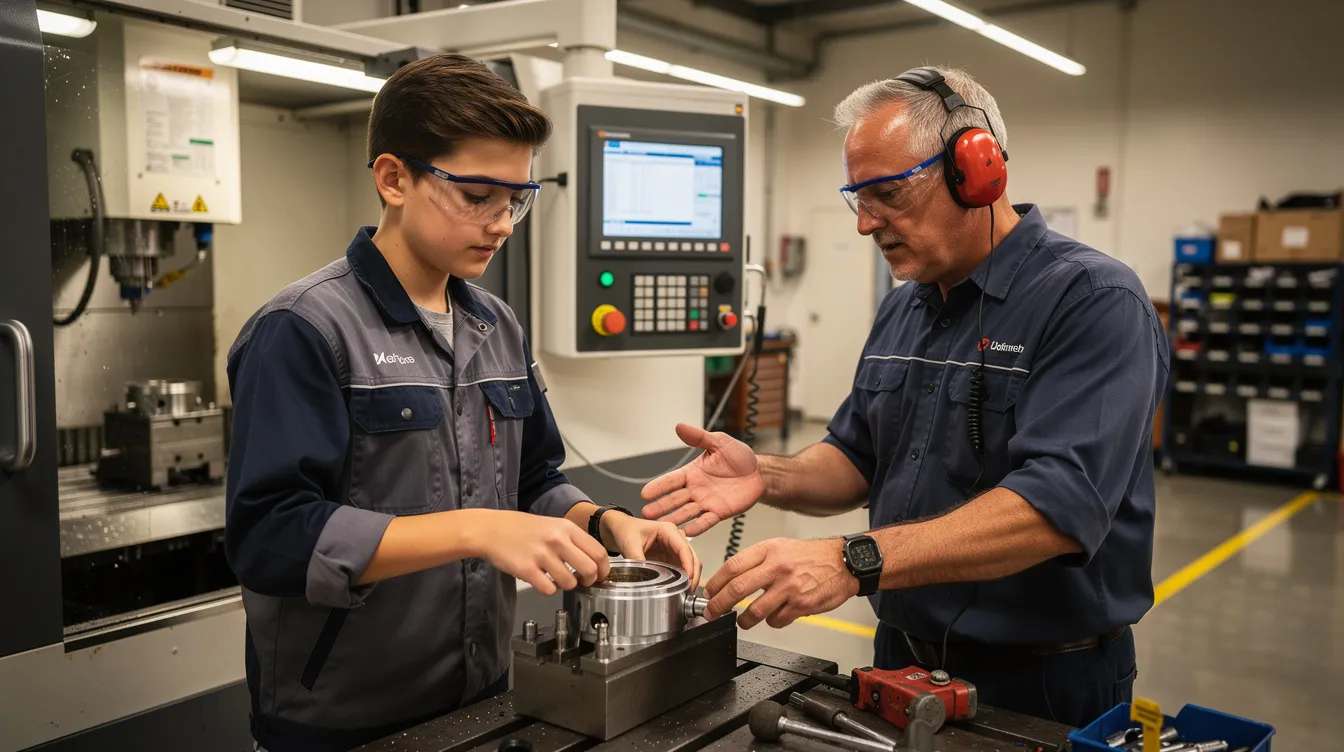
The most reliable way to build a pipeline of CNC programmers is through structured work-based learning: internships, pre-apprenticeships, and registered apprenticeship programs. These models combine classroom instruction (RTI) in CAD/CAM, shop math, and GD&T with OJT where apprentices shadow experienced programmers and gradually take on independent programming tasks.
Tracking OJT hours and competencies ensures apprentices progress from basic editing to full program creation and optimization. Employers, schools, and workforce organizations can coordinate to create CNC programming tracks aligned with local industry needs—whether that means aerospace in Washington state, precision medical in the Midwest, or automotive suppliers in the Southeast.
In 2026, many organizations use digital platforms to manage apprenticeship standards, log RTI hours, and share learning resources, cutting administrative overhead dramatically. The benefits run both ways: employers get a customized talent pipeline with reduced turnover, and learners gain paid, real-world experience with a clear path into a high-skill role in the field of manufacturing.
What to Consider Before Hiring or Promoting Someone into a CNC Programmer Role
Choosing the right CNC programmer affects machine utilization, quality, and customer satisfaction. Selection requires careful consideration beyond “knows G-code.” Evaluate depth of hands-on machining experience, exposure to multiple materials, familiarity with your specific CNC controls, and comfort with your CAD/CAM stack. Review sample programs and setup sheets, and ask about concrete results—cycle time reductions, scrap reduction, process improvements—rather than years alone.
Complex projects increase CNC programmer costs significantly, and CNC programming software costs can affect overall project expenses. When weighing whether to hire locally or remotely, keep these tradeoffs in mind: local programmers allow for face-to-face communication and local talent can respond faster due to shared time zones. Local CNC programmers may have higher costs due to market rates. Remote CNC programmers often offer more competitive rates, and remote programmers provide access to a larger talent pool. But remote work can lead to communication challenges. To mitigate those, establish clear communication channels for remote collaboration, including email, and make sure your internal account owner or main contact coordinates with the remote programmer. Use cloud storage for file sharing and version control, set milestones and deadlines to track project progress, ensure regular progress updates to prevent misunderstandings in projects, and build rapport with remote programmers to enhance collaboration.
You may also need to choose between freelance and agency support. Freelance programmers are generally more cost-effective than agencies and freelancers offer greater flexibility in scheduling and availability. In a smaller or fast-moving case, a freelancer may be the better fit. However, agencies provide access to a team of experts for complex projects and agencies ensure greater stability and reliability for project management. On the other hand, freelancers may lack resources for large-scale projects compared to agencies. The right choice depends on project scope, timeline, and how much ongoing support you need, in addition to strengths like responsiveness and adaptability.
Why Choose a Structured, Work-Based Path to Develop CNC Programmers
CNC programming is both a technical and craft-based role, best learned through real projects, mentorship, and systematic training rather than theory alone. Employers, schools, and workforce organizations benefit from coordinated pathways: consistent skills, faster onboarding, better retention. Modern digital tools make it easier to track competencies, log OJT and RTI hours, and align training with federal or state apprenticeship standards, bringing trust, accountability, and clear documentation to every program. If you agree that building people is as important as making parts, structured work-based learning is the most reliable way to grow CNC programming talent at scale.
Next Steps: How to Move Forward if You’re Interested in CNC Programming
If you are an individual, start by exploring local machining programs, apprenticeships, and entry-level CNC roles in your area. Read job descriptions, identify skill gaps, and begin building a portfolio. If you are an employer, assess your current workforce, identify where CNC programming talent is thin, and consider launching or joining a registered apprenticeship. Educators and workforce organizations should connect with local manufacturers to design curricula that map directly to real shop needs. Finally, evaluate digital platforms that can help you manage CNC-focused work-based learning programs—tracking hours, competencies, and compliance in one place. CNC programming is a learnable, high-value skill with clear pathways for advancement. In conclusion, the best time to start is now.
Want to Learn More About Your Registered Apprenticeship Opportunities?
BOOK A FREE CONSULTATION
FAQs About CNC Programmers and CNC Programming
What is the difference between a CNC operator and a CNC programmer?
A CNC operator runs machines, loads parts, and monitors production using existing programs. A CNC programmer designs and writes the programs, selects tools, and plans how parts will be machined. In smaller shops one person may do both, but in larger facilities these are distinct roles with different pay and responsibilities.
Do you need a degree to become a CNC programmer?
A four-year degree is rarely required. Many CNC programmers come from trade school, community college, or apprenticeship programs. Employers typically value demonstrated machining skill, accurate programs, and a strong portfolio over formal degrees.
How long does it take to learn CNC programming well enough for a job?
With intensive training and daily shop exposure, a motivated learner can reach entry-level programmer responsibilities in 1–3 years. Mastering advanced multi-axis programming and complex materials can take several additional years of experience.
Which software do CNC programmers use most often?
Common CAD/CAM systems include Fusion 360, Mastercam, and SolidWorks-based tools. The choice depends on industry, company size, and machine controllers. Strong fundamentals in machining and programming principles transfer between platforms.
Can CNC programmers work remotely, or do they need to be on-site?
Many CNC programmers can create and simulate programs remotely if they have accurate CAD models, prints, and machine specifications. On-site time remains valuable for initial process development, troubleshooting complex parts, or training operators on new programs.
Is CNC programming a good long-term career with automation and AI growing?
While automation and AI are changing how programs are generated, skilled CNC programmers are still needed to define strategies, validate toolpaths, and handle complex or safety-critical parts. Those who continue learning new software, multi-axis methods, and automation tools are likely to see strong long-term demand.


