
Metal fabricator training management determines whether a shop produces consistent, safe work or burns through new hires and rework budgets. With 74 percent of manufacturing companies reporting a shortage of skilled workers in 2025, fabrication shops and schools can no longer afford informal training. This article walks operations leaders, training managers, and apprenticeship coordinators through a practical system for building, tracking, and scaling metal fabrication training programs.
Table of Contents
- Why Metal Fabricator Training Management Matters Now in the Metal Fabrication Industry
- Core Skills and Fabrication Techniques Every Metal Fabrication Training Program Should Cover
- Designing a Structured Metal Fabrication Training Model
- Assessing Candidates and Tracking Progress in Training Programs
- Minimizing Poaching Risk and Maximizing Training ROI
- Blending Classroom, Shop Floor, and Online Learning
- Managing Apprenticeships and Work-Based Learning in Metal Fabrication
- Choosing and Implementing a Digital Training Management Platform
- Common Metal Fabricator Training Mistakes to Avoid
- Why Choose a Dedicated Work-Based Learning Platform for Metal Fabrication Training
- Next Steps: Build a Scalable Metal Fabricator Training System
- FAQs About Metal Fabricator Training Management
Why Metal Fabricator Training Management Matters Now in the Metal Fabrication Industry
The metal fabrication industry faces a convergence of pressures: an aging workforce, growing demand for sheet metal and structural steel in construction, energy, and infrastructure, and a projected gap of 1.9 million manufacturing workers globally by 2033. Over 96,500 active registered apprentices worked in U.S. manufacturing in 2024, a 27 percent increase over five years, signaling that organizations are turning to structured programs to fill the gap.
Unstructured training leads to rework when parts fail tolerances, safety incidents from improper welding PPE or hot work procedures, and inconsistent quality across shifts. Managing training programs in metal fabrication requires integrating safety compliance and skill mastery into one coordinated system. Between 2024 and 2026, expanded funding for registered apprenticeship, federal emphasis on work-based learning, and pressure to document OJT and RTI hours for regulators have made structured programs a baseline requirement, not a nice-to-have.
Core Skills and Fabrication Techniques Every Metal Fabrication Training Program Should Cover
A training program that produces capable metal fabricators covers concrete skill areas tied to real production work, not abstract theory modules. Metal fabrication includes bending, forging, casting, and machining techniques, and each requires distinct hands-on competency. Metal fabrication is one of many skilled trades where structured, trackable training makes the difference.
Fundamental fabrication techniques:
- Cutting: plasma arc cutting, oxy-fuel cutting, laser cutting, waterjet cutting
- Forming: bending techniques manipulate sheet metal into desired shapes and angles using press brakes, roll bending, and hammering
- Machining: machining uses drills and milling machines for precise metal shaping, including punching, reaming, and CNC operations
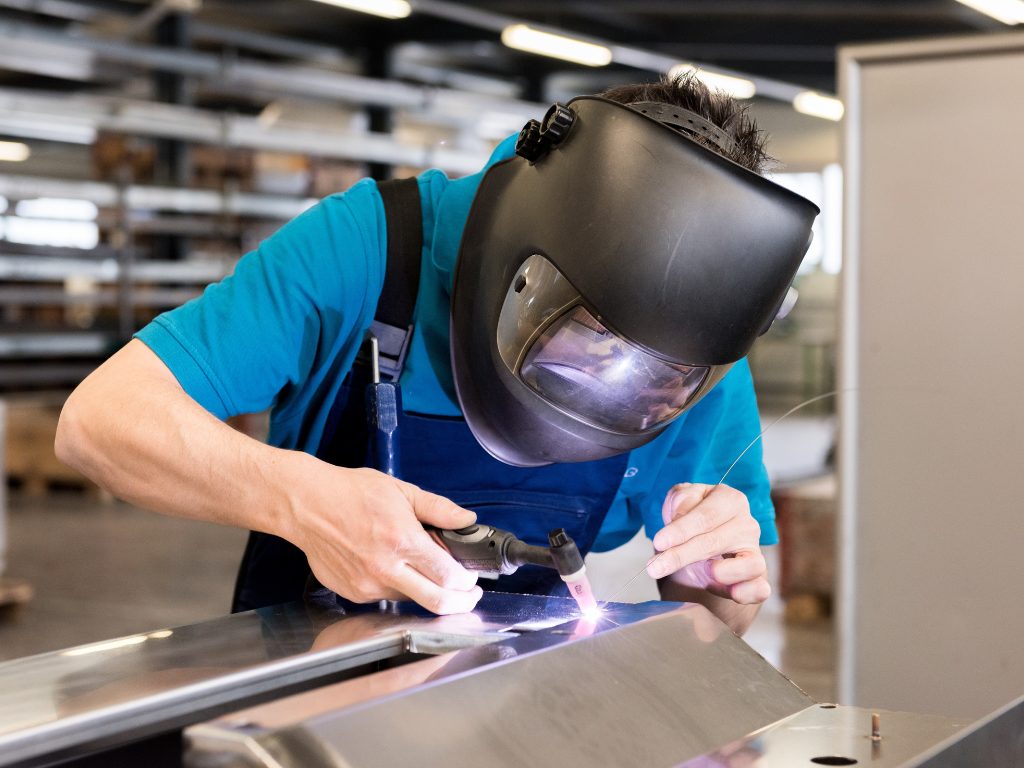
- Welding: MIG (GMAW), TIG (GTAW), stick (SMAW), brazing, and spot welding; practical training accelerates welding skill development
- Finishing: grinding, deburring, coatings, and seam cleaning
Sheet metal vs. structural steel skills:
- Sheet metal: layout (parallel, radial, triangulation), blanking, bending, fastening, HVAC duct fabrication
- Structural steel: fit-up of joists, columns, and base plates; beam coping; bracing; alignment with jigs and cranes
Every fabricator must read blueprints and interpret welding symbols per the American Welding Society A2.4 standard. Measurement and inspection basics round out the skill set: using calipers, micrometers, height gauges, weld gauges, and a tape measure, with understanding of tolerances such as ±0.010 in for precision sheet metal enclosures. Safety topics (arc welding PPE, confined space rules, lockout/tagout, hot work permits, material handling for plate and beams) must be woven into every module. Safety culture must be integrated into technical training modules in fabrication, not treated as a separate checkbox.
Hands-on training is essential for mastering complex techniques. Consider how key skills bundle together: training a new hire to fabricate a standard guard rail bracket requires reading the print, cutting plate, bending a rail on a press brake, welding fillet joints, grinding the finish, and checking tolerances. Practical training is essential for mastering metal fabrication techniques across these steps.
Designing a Structured Metal Fabrication Training Model
Moving from ad-hoc shadowing to a defined model improves consistency and throughput. A three-tier technician framework works well for most shops:
| Level | Role | Focus | Timeline |
|---|---|---|---|
| Level I | Entry operator | Follows work instructions, basic cutting and forming | 0–6 months |
| Level II | Setup and troubleshoot | Runs equipment independently, moderate complexity welding and layout | 6–18 months |
| Level III | Process owner / trainer | Owns jobs end-to-end, trains others, codes and standards expertise | 18–36 months |
Vander-Bend’s CNC operator training program, started in 2017, follows a similar structure: the program includes three skill levels for operators, and over 80 people completed CNC operator training since 2017. Vander-Bend assesses candidates based on four key qualities before entry. Competency-based progression ties advancement to demonstrated mastery of practical skills, not just hours logged.
Map each job role (press brake operator, fitter, welder, laser operator, structural fabricator) to a skills matrix. A skills matrix helps in identifying skill gaps among workers and planning targeted instruction. Creating standard work instructions helps retain knowledge and reduce reliance on memory. Integrate classroom RTI (codes, welding symbols, print reading, metallurgy, fabrication math) with on-the-job training tasks tied to live jobs so students see the science behind what they do on the shop floor. A structured onboarding process for new employees promotes consistency and safety from day one.
Training paths should align with each person’s career goals: helper to certified structural welder, entry-level sheet metal worker to lead fabricator, or shop floor operator to manufacturing technology specialist. These pathways prepare the next generation for a rewarding career and a fulfilling career in the metal fabrication industry.
Assessing Candidates and Tracking Progress in Training Programs
Structured assessment prevents wasting materials and time training the wrong skills or the wrong candidates. Pre-training evaluations should cover mechanical aptitude, spatial reasoning, basic math for layout and fit-up, and ability to follow written and verbal instructions.
Practical evaluations include shop floor exercises: reading a simple print, interpreting welding symbols, setting up a basic cut on a bandsaw, or tacking a fillet weld under supervision. Hands-on competency verification is a critical aspect of training in metal fabrication. Standardized assessment rubrics eliminate subjective bias in evaluation and make promotion decisions transparent.
Behavior matters too: curiosity, asking clarifying questions, willingness to work safely, and consistency in quality checks. Track ongoing progress through digital logs of completed OJT tasks, RTI hours, test scores, and sign-offs by supervisors or mentors. Shared dashboards make wage progression decisions easier. Vander-Bend reduced training time from 10 months to 4 months by using dedicated trainers and structured tracking. Dedicated trainers can reduce training time from 10 months to 4 months when paired with clear competency milestones.
Minimizing Poaching Risk and Maximizing Training ROI
Every organization that invests in metal fabrication training worries about losing talent to competitors. Practical training leads to high-quality work and low turnover when paired with clear advancement. Structure career pathways (helper to structural fitter to lead to supervisor) with scheduled pay steps at each level. Developing internal trainers and mentors is key for effective skill transfer and strengthens loyalty.
Written training agreements, mentorship programs, and internal certifications (for welding symbols interpretation, press brake setup, structural steel layout) deepen attachment. Cross-train multiple team members in critical fabrication techniques so knowledge does not leave when one person does.
Track long-term ROI: reduction in rework rates, faster onboarding, improved on-time delivery, and higher shop utilization. Collecting metrics related to training can demonstrate its impact on production efficiency. For employment outcomes, 103 recent Wisconsin program graduates found jobs within six months of completing training. Graduates from Mid-State’s metal fabrication program earn a median salary of $55,000, demonstrating the value of structured education for professionals entering the trade.
Blending Classroom, Shop Floor, and Online Learning
Blended learning models combine digital and hands-on training for effective skills development. Modern metal fabrication courses include three delivery modes:
- Classroom RTI: welding theory, metallurgy, blueprint reading, welding symbols, codes and standards (AWS D1.1), and fabrication math. Students develop the understanding and knowledge that informs every shop decision.
- Shop floor OJT: supervised work on real parts such as sheet metal enclosures, structural beams, and brackets. Mentors demonstrate best practices and safety while apprentices gain hands on experience with raw materials, equipment, and tools.
- E-learning: on-demand courses and modules reinforce classroom content. The Fabricators & Manufacturers Association (FMA) offers self-paced e-learning courses accessible 24/7; their Precision Press Brake course includes 11 hours of training. Mid-State’s metal fabrication program takes one year to complete and blends all three modes.
For employers, trade schools, and apprenticeship sponsors managing larger cohorts, 24/7 access to online content, progress tracking, and quizzes reduce scheduling conflicts and let learners advance without waiting for the next in-person session.

Managing Apprenticeships and Work-Based Learning in Metal Fabrication
Registered apprenticeship and structured internships support long-term workforce development in metal fabrication. Typical programs for structural steel or sheet metal workers run 2 to 4 years, with a minimum of 2,000 hours of OJT and at least 144 hours of RTI annually per federal guidelines.
Compliance reporting includes tracking OJT and RTI hours accurately. RAPIDS, WIPS, and PIRL are key compliance reporting standards that sponsors and employers must satisfy. Tracking certifications is essential for compliance with safety regulations. Automated reporting tools streamline compliance tracking for apprenticeship programs, and effective compliance reporting enhances apprenticeship program success rates.
Partnerships between employers, high schools, and technical colleges align curriculum with real fabrication techniques and local hiring needs. For example, a community college welding and fabrication degree program in an industrial corridor can feed trained students directly into nearby custom fabrication shops, reducing recruiting costs and giving students a clear path to employment and a great choice for their future.
Choosing and Implementing a Digital Training Management Platform
Spreadsheets and paper sign-offs break down once a shop or school has more than a handful of learners. Training management systems should integrate compliance tracking with practical assessments. Digital tools can enhance the efficiency of training management in fabrication settings.
Key features to evaluate:
- OJT and RTI hour tracking with supervisor sign-offs
- Competency management with role-specific skill matrices
- Mobile app access so apprentices log hours from the shop floor
- Centralized document storage for procedures, safety policies, and code references
- Automated compliance reports for state and federal apprenticeship systems
Different users need different views: employers see workforce readiness dashboards, schools align courses to shop needs, sponsors monitor multiple programs from one place. Continuous evaluation and optimization of training programs is necessary for improvement, and a good platform supports that cycle.
Recommend a phased rollout: start with one job family (such as welders or press brake operators), validate templates, then expand to other fabrication roles.
Common Metal Fabricator Training Mistakes to Avoid
- No documented standards: without written work instructions and assessment criteria, trainers vary and skills stay inconsistent
- Inconsistent trainers: if mentors lack formal preparation themselves, they teach habits that do not match code or company specs; best practices for metal fabrication training emphasize safety and technical skills integration
- Ignoring soft skills: attitude, communication, and safety posture directly affect retention and incident rates
- Skipping assessment before critical tasks: granting independent responsibility for structural steel welds or complex forming without verifying competency leads to costly rework
- Training only on current equipment: failing to teach transferable fabrication techniques limits flexibility when new machines arrive
- Not aligning training with career goals: learners who cannot see a path forward leave the trade or move to competitors
Why Choose a Dedicated Work-Based Learning Platform for Metal Fabrication Training
Generic HR or LMS tools lack the workflows that metal fabrication training demands. A dedicated work-based learning platform provides real-time dashboards for OJT and RTI, role-specific competency libraries for metal fabrication jobs, and collaboration tools that connect employers, schools, and sponsors in one place.
Mobile access lets apprentices log hours and tasks directly from the shop floor without extra paperwork. Centralized data supports audits, funding requirements, and continuous improvement of training programs. When comparing platforms, evaluate them based on metal fabrication-specific workflows (competency sign-offs, compliance exports, skill matrices for welders and fabricators) rather than generic course hosting features.
Want to Learn More About Your Registered Apprenticeship Opportunities?
BOOK A FREE CONSULTATION
Next Steps: Build a Scalable Metal Fabricator Training System
Structured training management improves quality, safety, and retention for metal fabrication teams. Start by documenting current roles, key fabrication techniques, and existing informal training, then map these into a formal training program with clear levels and competency checklists.
Pilot a small cohort of apprentices or new hires using a digital training management approach and expand once results are validated. If you are ready to build or scale your program, reach out to GoSprout for a demo or consultation on structuring metal fabrication training and apprenticeships for your organization.
FAQs About Metal Fabricator Training Management
Below are answers to the questions training managers and shop leaders ask most often.
How long does it take to train a competent metal fabricator?
Basic shop proficiency in cutting, forming, and simple welding typically takes 3 to 6 months. Independent work on standard sheet metal or structural steel parts requires 12 to 18 months. Full journey-level capability through apprenticeship takes 3 to 4 years. Effective training programs should balance safety and quality with knowledge transfer to shorten time to productivity without cutting corners.
What is the difference between on-the-job training and formal training programs?
On-the-job training involves real production work under supervision on the shop floor. Formal training programs add planned curriculum, assessments, and documented competencies. The most effective metal fabrication strategies integrate both: RTI in the classroom and structured OJT linked to that theory, so learners develop both practical skills and technical knowledge.
How do we align training with employees’ career goals?
Use structured learning paths (fabrication helper, sheet metal fabricator, structural steel fabricator, lead) with clear requirements, timelines, and wage steps. Annual development conversations where supervisors and learners review progress data and choose next skills or certifications to pursue keep everyone focused and prepare each person for advance in the organization.
What metrics should we track to measure training success?
Track reduced rework and scrap, improved first-pass yield, faster onboarding time, safety incident rates, and retention or promotion rates of trainees. Tracking completed competencies by role gives a quick view of bench strength for upcoming projects or expansion across industries like aerospace, construction, and manufacturing.
Can small fabrication shops manage structured training without a full HR department?
Even 10 to 30 person shops can start with simple role-based checklists, standardized work instructions, and basic digital tracking tools. Focus first on high-risk areas such as welding, structural steel fit-up, and press brake operations, then expand the system over time. The fundamentals of a complete program do not require a large team to produce results.
How often should metal fabrication training content be updated?
Core skills like blueprint reading, welding symbols, and basic fabrication techniques change slowly, but procedures should be reviewed annually. Updates are triggered by new equipment, revised codes or standards, safety incidents, or changes in product mix (such as more stainless sheet metal or heavy structural work). Keeping content current ensures training stays focused and relevant.