

Table of Contents
- Introduction: What You Really Need to Become a Welder
- Understanding the Field of Welding
- Minimum Education Requirements: High School Diploma, GED, and Useful Classes
- Hands-On Training: Welding School, Apprenticeships, and On-the-Job Learning
- Welding Certifications: From Beginner to AWS Certified Welder
- Essential Skills and Personal Qualities for Aspiring Welders
- How Long Does It Take to Become a Welder?
- Career Paths, Pay, and Long-Term Advancement in Welding
- Next Steps: How to Start Your Welding Journey Today
- Common Questions About How to Become a Welder
Introduction: What You Really Need to Become a Welder
A career in welding typically requires a combination of technical training, hands-on experience, safety knowledge, and practical skills. But the path to get there is more accessible than many people assume. You don’t need a four-year degree. You need commitment, practice, and the right training environment.
Here’s the short version of what you need to become a welder: a high school diploma or GED, hands on training through a welding school or apprenticeship, foundational knowledge of safety practices, and at least one industry recognized certification. Welding techniques include MIG (gas metal arc welding), TIG (gas tungsten arc welding), and stick (shielded metal arc welding), and most training programs cover all three alongside other welding processes.
Aspiring welders can reach entry level positions in under 12 months with focused formal training. But a welding career path doesn’t stop at the first job. Experienced welders continue building skills, stacking certifications, and moving into specialized or supervisory roles over decades. Whether you’re looking at becoming a certified welder, exploring the AWS Certified Welder program, or weighing formal education against on the job training, this guide walks you through every step.

Understanding the Field of Welding
On a typical day, welders read engineering drawings and welding symbols, measure and cut metal components, set up welding equipment (selecting correct amperage, gas mixture, and electrode type), fit and clamp materials, perform welds in various positions, then inspect their finished seams. Welders utilize tools such as grinders, torches, and measuring equipment in their work. It’s precise, physical, and deeply technical.
Where do skilled welders actually work? Construction sites, fabrication shops, shipyards, automotive plants, energy facilities including oil and gas pipelines, chemical refinery welding industries, and maintenance departments across manufacturing. Conditions range from climate-controlled shops to exposed outdoor environments, confined vessel interiors, and elevated structural steel.
The core arc welding processes you’ll encounter:
- Shielded metal arc welding (SMAW or stick welding) – rugged and portable, ideal for structural steel and outdoor repair
- Gas metal arc welding (GMAW or MIG) – faster deposition, common in automotive repair and manufacturing, great for a MIG welder starting out
- Gas tungsten arc welding (GTAW or TIG welding) – extremely precise, preferred for thin stainless steel and aerospace work, the process every TIG welder masters for clean finishes
- Flux-cored arc welding (FCAW) – high deposition for heavy fabrication and pipeline work, performs well in windy outdoor settings
Safety in welding is non-negotiable. Common welding hazards include electrical shock and burns, exposure to toxic fumes, UV radiation, and working in confined spaces. Safety training is essential for preventing welding injuries, and every aspiring professional must learn to wear protective gear before ever striking an arc. Total welder employment in the U.S. will exceed 437,000 by 2032, and welding jobs are projected to grow steadily, with roughly 40,300 annual openings driven by retirements and replacement needs across the welding industry.
Minimum Education Requirements: High School Diploma, GED, and Useful Classes
A high school diploma or GED is typically required for most welding schools, apprenticeships, and employers. It’s the baseline credential that unlocks access to formal training and structured career advancement.
Why do most employers and training programs care about a school diploma or GED? Because welding demands more than hand skills. Proficiency in basic math, geometry, and algebra is needed for accurate measurements in welding. Blueprint reading is essential for interpreting technical drawings and welding symbols. Without solid reading comprehension, you can’t parse codes or safety protocols.
High school courses that give aspiring welders a head start:
- Algebra and geometry – voltage calculations, angles, layout work
- Basic physics – understanding heat transfer and electricity
- Shop or CTE classes – metalwork, manufacturing, drafting
- Chemistry – how different metals and alloys behave under heat
For adults who left school early, earning a GED opens the door to formal education, apprenticeships, and significantly better long-term earning potential in a career in welding. While some very basic helper roles exist without a diploma, career advancement into certified welder or welding supervisor roles is much harder without that baseline credential. Many employers prefer candidates with formal welding training, and that training almost always requires proof of secondary education.
Hands-On Training: Welding School, Apprenticeships, and On-the-Job Learning
No one becomes a welder from textbooks alone. Hands on training is the core requirement for developing real-world welding skills and safety competence.
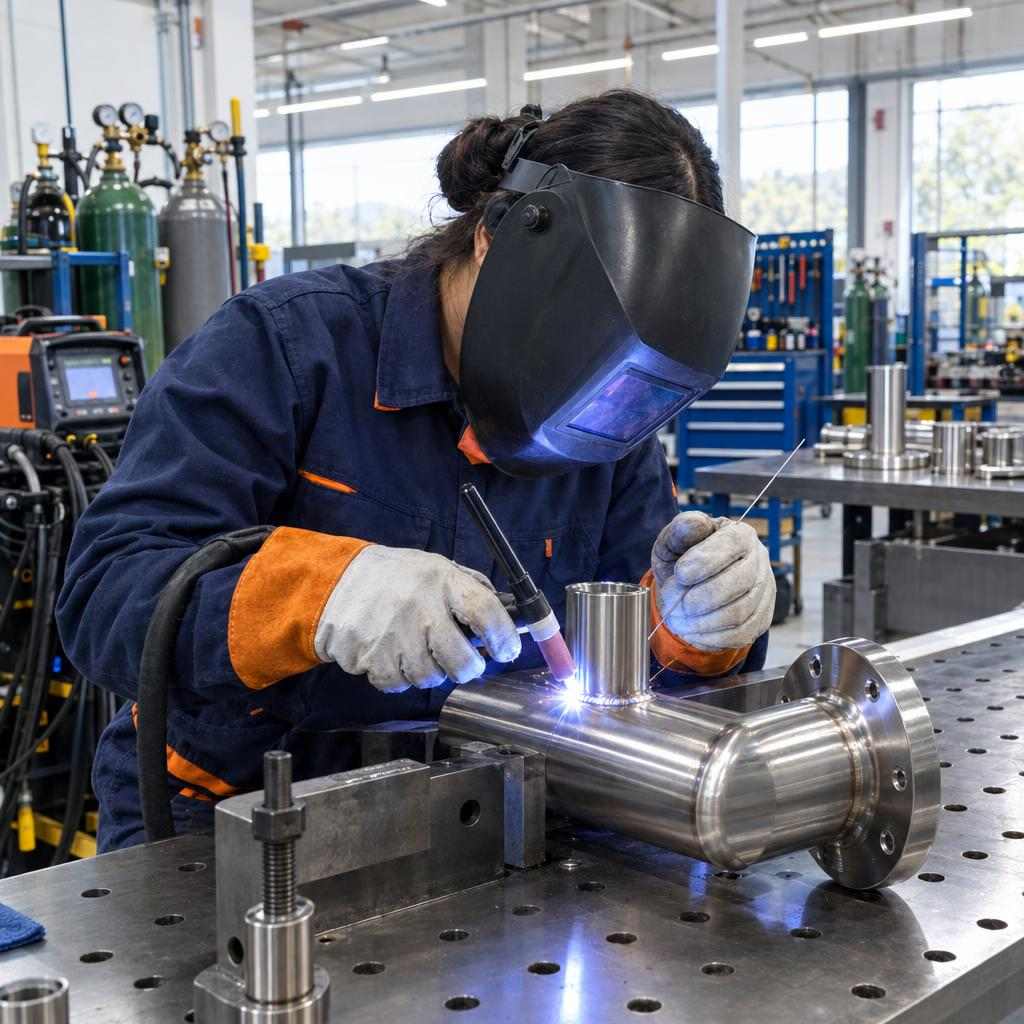
Welding schools and community college programs offer structured paths. Vocational training involves completing a certificate or associate degree program at a trade school or technical college to learn core welding processes. A welding technology program or welding program at a community college typically runs from short modules (5–8 weeks) to full certificate programs lasting 9–12 months. Welding training programs can last from a few weeks to several months depending on scope. Curriculum covers safety practices, various welding techniques, blueprint reading, metallurgy basics, and welding symbols. Many welding programs incorporate practical components focusing on hands-on experience and specific welding processes. Look for programs with SENSE accreditation from the American Welding Society, which ensures industry-consensus standards in welding courses and welding classes.
Apprenticeships combine paid work with structured learning. Apprenticeship programs provide paid, supervised on the job training alongside experienced professionals. Registered programs typically require a minimum of 2,000 hours of on-the-job training (OJT) and 144 hours of related technical instruction (RTI) per year, often spanning two to four years. Many employers prefer candidates with apprenticeship experience because apprenticeships provide hands-on experience in welding under real production conditions.
Comparing the two: Classroom training builds foundational knowledge, theory, and structured practice across multiple processes. On the job training is crucial for developing welding skills like speed, adaptability, and problem-solving under real conditions. Real-world experience enhances job readiness for welders. The strongest outcomes come from combining both—practical training in a school setting followed by field or shop experience.
When evaluating a training program, look for programs that cover SMAW, GMAW, FCAW, and GTAW, train students in multiple positions (flat, vertical, overhead), track competencies rather than just hours, and prepare students directly for recognized welding test performance qualifications.
Welding Certifications: From Beginner to AWS Certified Welder
Being a certified welder means you’ve passed a practical performance test welded to a specific code or standard, witnessed and documented by a qualified inspector. Welders must demonstrate proficiency through certifications from organizations like the American Welding Society (AWS). Welding certifications validate skills in specific processes and materials—they’re proof you can produce sound welds to industry standards.
The AWS Certified Welder program offers multiple certifications across various processes, materials, and positions. AWS Certified Welder tests are performance-based, not written. AWS Certified Welder certification requires no formal education prerequisites—any candidate can attempt the test. Candidates must pass a welding performance qualification test at an AWS Accredited Test Facility. AWS certification is nationally recognized and transferable, meaning it follows you across employers and states. In states like California, which relies on industry-recognized certifications instead of a state-issued license, having an AWS certified welder credential is particularly valuable.
Common certifications that support career advancement include:
| Certification/Code | Industry Application |
|---|---|
| AWS D1.1 | Structural steel (bridges, buildings) |
| ASME Section IX | Boilers, pressure vessels, power piping |
| API 1104 | Oil and gas pipeline welding |
| AWS D17.1 | Aerospace welding |
| Underwater welding certs | Maritime welding and subsea work |
Common certifications include qualifications in structural, pipe, and underwater welding. The certification process follows a clear path: get baseline specialized training, choose a code and process, practice with test coupons, schedule your welding test at an accredited facility, pass, then maintain continuity. Certification remains valid as long as continuity is maintained every six months through documented welding activity.
Professional welders often continue learning and may pursue advanced certifications for specialized roles. Many experienced welders accumulate certifications over time—an AWS certified welding inspector credential, welding engineer qualifications, or the Certified Robotic Arc Welding (CRAW) credential for robotic welding. Potential employers often pay for additional tests once you’ve proven yourself on the job.
Essential Skills and Personal Qualities for Aspiring Welders
Beyond formal education and industry certifications, becoming a skilled professional requires specific abilities. Physical stamina and strength are important for welders to handle physical labor throughout their workday—standing for hours, kneeling, working overhead, and lifting heavy metal components. Steady hand-eye coordination and good vision (with correction if needed) are essential for every aspiring welder.
Attention to detail is crucial in welding for inspecting welds and ensuring safety standards are maintained. Comfort with measurements and basic math, the ability to follow detailed procedures, and strong safety awareness around electricity, fumes, and confined spaces separate competent welders from excellent ones.
Safety compliance is critical for welders, requiring strict adherence to protective measures and safety protocols. Welding safety knowledge includes the proper use of personal protective equipment (PPE) and understanding fume hazards. Welders must understand PPE usage—helmets with proper shade, flame-resistant clothing, gloves, and respiratory protection. OSHA offers 10-hour and 30-hour safety training courses for welders, and the 1-Hour Welding and Cutting course covers essential safety protocols for quick foundational learning.
Concrete examples of these skills in action: an experienced welder catching a hairline crack in an overhead weld before finishing, preventing costly rework or structural failure. Or a pipe welder double-checking gas settings and electrode choice before striking an arc to meet ASME code requirements. Patience, willingness to accept feedback from experienced welders, and commitment to repeating the same bead until it produces a sound weld—these qualities can all be developed with guided practice, even if you don’t consider yourself naturally handy.
How Long Does It Take to Become a Welder?
Many people reach entry-level employability in 6 to 12 months of consistent training. More advanced roles and multiple certifications can take several additional years.
Realistic timeline examples:
- 9–10 month intensive welding program – covers multiple processes, positions, and prepares for first certification
- 2–4 year apprenticeship – combines earning with comprehensive OJT and classroom training
- Part-time training while working another job – may extend total time to 18–24 months but keeps income flowing
The timeline depends on starting skill level, weekly training hours, and whether you’re targeting the fastest entry-level route or building a more comprehensive foundation. Once certified, welders must keep welding regularly—most codes require no gaps longer than six months—to avoid needing to retest.
Think beyond “how fast can I start” and consider “how solidly can I build my welding skills for the next decade” when choosing between vocational training programs.
Career Paths, Pay, and Long-Term Advancement in Welding
Common entry-level welding jobs include production welder and fabrication shop welder, along with maintenance welder, fitter-welder helper, and welder’s apprentice positions. These entry level positions typically involve working under direct supervision while building speed and consistency.
The median annual wage for welders is approximately $50,000–$60,000, with the Bureau of Labor Statistics reporting a 2025 median of $53,750. Entry-level welders in California earn around $20 per hour, while the highest-paid experienced professionals exceed $77,530. Specialized welders can earn between $110,240 to $114,400 annually in niches like pipeline welding, aerospace, or underwater and maritime welding.
Welding career paths extend well beyond the hood. Long-term career advancement options for industry professionals include:
- Welding supervisor or foreman overseeing crews and projects
- AWS certified welding inspector ensuring code compliance and quality
- Welding instructor or educator at trade schools and community colleges
- Welding engineer roles combining technical depth with design
- Robotic welding programming and system maintenance
- Sheet metal welders and fabrication shop managers
Ongoing education—additional certifications, advanced processes like orbital welding, and staying current with code updates—keeps employment opportunities expanding rather than stalling. Labor statistics projects continued demand through at least 2035, and career prospects remain strong for welders who invest in continuous growth.
Next Steps: How to Start Your Welding Journey Today
The path to become a welder follows a clear sequence: finish or verify your high school diploma or GED, research local welding schools and apprenticeship programs, commit to hands-on and classroom training covering multiple processes, then aim for your first welding certification.
Visit nearby schools and talk to working welders. Ask specific questions about welding equipment, instructor experience, and how well programs prepare students for certification tests. Evaluate whether the training program tracks competencies—not just hours—and covers the processes that match your career goals.
Create a simple personal timeline. For example: “Within 12 months, I will complete training and take my first certified welder test.” Write it down and revisit it monthly.
Welding is a learnable trade that rewards consistent practice, safety discipline, and the right training environment. With structured support—whether from a trade school, apprenticeship sponsor, or workforce development program that tracks your OJT and RTI hours—aspiring welders can build a stable, well-paying career in welding and keep growing for years to come. The welding industry needs skilled welders now, and the demand isn’t slowing down. Your next step is the one that matters most.
Want to Learn More About Your Registered Apprenticeship Opportunities?
BOOK A FREE CONSULTATION
Common Questions About How to Become a Welder
Can I become a welder without a high school diploma?
While it’s sometimes possible to find very basic helper roles without a diploma, most reputable welding programs and most employers expect at least a high school diploma or GED. Without it, access to formal training, apprenticeships, and welding specialization is severely limited. Prioritize earning a GED if you don’t have one—it usually opens doors to better long-term opportunities and higher pay in welding jobs.
Are online welding courses enough to start a welding career?
Online welding courses can supplement your learning with theory on welding symbols, safety principles, and basic metallurgy. But they cannot replace in-person practice with real welding equipment and materials. Employers and certifying bodies expect documented hands on training. Treat online lessons as a useful add-on, not a substitute for practical training at a welding school.
How physically demanding is welding work?
Welding involves standing for long periods, kneeling, working overhead, handling awkward components, and enduring hot or outdoor environments. Good ergonomics, proper PPE, and physical conditioning help. Some specialized roles like bench or precision TIG welding are less strenuous than heavy structural field work, so aspiring professionals can find roles that match their physical capabilities.
Do I need to decide on a welding specialization before I start training?
No. Beginners don’t need to pick a welding specialization immediately. Introductory programs expose you to multiple specific welding processes and positions first. Pay attention to what you enjoy—structural, pipe, thin sheet, repair work—and then pursue targeted certifications once you’ve had enough experience to make an informed choice.
Is welding a stable long-term career?
Welding supports infrastructure, manufacturing, energy, and maintenance work that can’t be entirely automated or outsourced. National projections show steady demand with regular replacement needs as experienced welders retire. While specific industries and regions fluctuate with the economy, the welding industry as a whole offers solid career stability for aspiring welders who stay current.
How important is certification compared to experience?
Both matter significantly. Industry certifications open doors and satisfy code requirements that potential employers demand. Real experience proves you can produce sound welds consistently, safely, and on schedule under varied conditions. Employers prefer candidates who bring both. Pursue at least one recognized welding certification early, then build a track record of quality work while gradually adding advanced qualifications.