
This guide covers how to design, manage, track, and scale tool and die maker training programs for employers, schools, sponsors, and apprentices.
Table of Contents
- Overview of Tool and Die Maker Training in 2026
- Structuring a Modern Die Maker Apprenticeship Program
- Managing Hands-On Training and On-the-Job Experience
- Designing Related Technical Instruction (RTI) for Die Making
- Core Competencies: From Blueprint Reading to Analytical Skills
- Compliance, Reporting, and Funding for Apprenticeships
- Common Training Challenges and Practical Solutions
- Why Choose a Structured, Software-Supported Approach to Training Management
- Next Steps: Building or Improving Your Tool and Die Maker Training Program
- FAQs About Tool and Die Maker Training Management
Overview of Tool and Die Maker Training in 2026
A tool and die maker builds, maintains, and repairs the tooling, dies, molds, jigs, and fixtures that drive the manufacturing industry. Tool and die making involves high-tolerance machining and complex tooling design, demanding technical expertise that goes well beyond general machining. Experienced tool and die makers remain an important part of the manufacturing workforce, with employers needing trained workers to replace journeyworkers who retire or leave the occupation.
Unlike a die machinist or general machinist who produces machine parts to spec, die makers must understand how components integrate into complete tooling assemblies, handle die casting and stamping processes, manage die maintenance, and troubleshoot failures under production stress. Typical industries include automotive, aerospace, medical devices, and custom metal parts production.
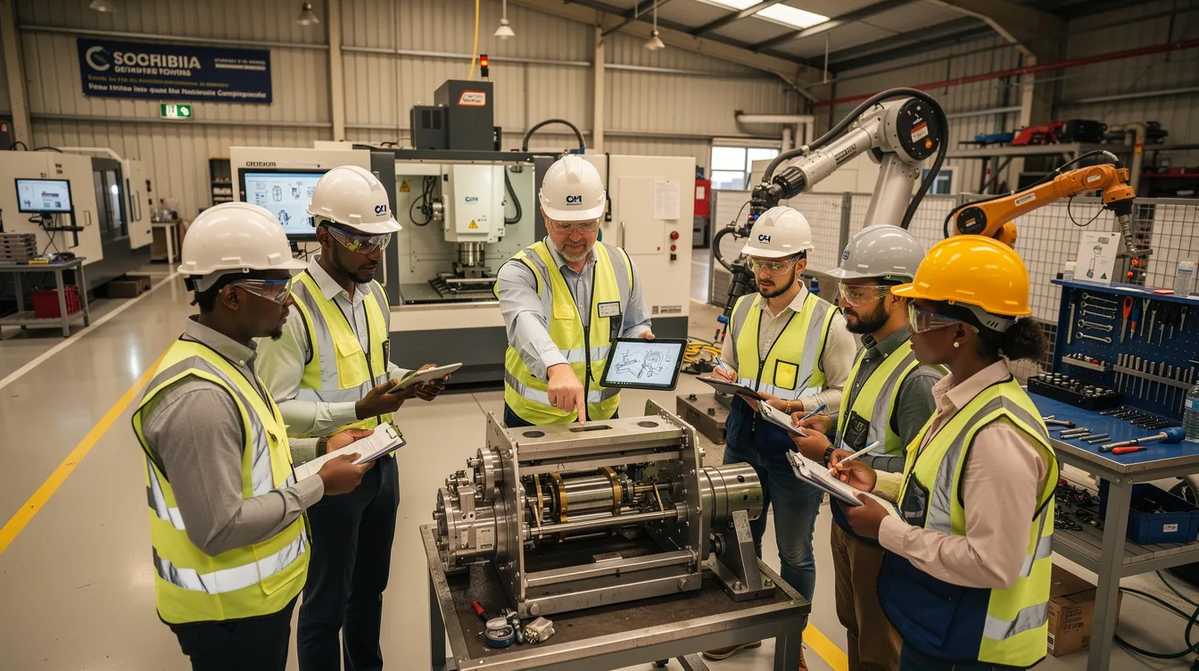
Most workers enter through a structured die maker apprenticeship program that blends hands on training with related technical instruction. Structured apprenticeship programs are essential for training tool and die makers. The required knowledge spans blueprint reading, analytical skills, physical stamina, math skills (crucial for layout and measurement tasks), computer aided design and CAD designs, and CNC machine tools operation. CNC programming is essential for tool and die makers, and they must understand CAD/CAM technology to remain competitive. The integration of modern technologies in training enhances the learning experience across all of these areas. The rest of this article focuses on how to design, manage, and scale that training, not just list the job skills.
Structuring a Modern Die Maker Apprenticeship Program
Tool and die maker apprenticeships last 5 years in most registered programs. Common structures range from 8,000 to 10,000 hours of on the job training paired with 576 or more hours of related technical instruction. For example, one well-known technical college runs a 5-year maker apprenticeship program with 9,888 OJT hours and 576 RTI hours. Apprentices complete 10,000 hours of hands-on experience in many programs, with competency-based milestones becoming standard by 2026.
Training programs must integrate classroom instruction with hands-on shop floor experience. Employers and schools choose between three structures:
- Time-based: Track hours per domain. Easier to administer, predictable, but may not guarantee skill mastery.
- Competency-based: Apprentices advance by proving skills. Requires well-defined rubrics, more supervisory effort.
- Hybrid: Minimum hours per area plus competency checkpoints. Balances structure with flexibility.
A sample 5-year progression might look like this:
| Year | Focus Areas | Milestone |
|---|---|---|
| 1 | Shop safety, basic machining, measurement, blueprint reading | Operate manual lathe and mill independently |
| 2 | Precision machining, metal properties, CNC basics | Read blueprints and set up basic dies |
| 3 | Die design, assembly, advanced CNC programs | Build simple die assemblies to spec |
| 4 | Die casting, stamping, maintenance, troubleshooting | Diagnose and repair minor die failures |
| 5 | Journey-level skills, mentoring, advanced heat treatment | Independently design and test completed tools |
Alignment with recognized apprenticeship standards ensures training credibility. Competency-based milestones are crucial for tracking apprentice progress at each stage. Apprenticeships often require a high school diploma or equivalent for entry, and technical instruction is provided by local community colleges. Henry Ford College, for instance, offers a 10-credit hour tool and die maker program. Structured mentoring under experienced professionals enhances training outcomes significantly. Training management software helps employers keep all stakeholders aligned on standards, schedules, and apprenticeship agreements without manual tracking errors.
Managing Hands-On Training and On-the-Job Experience
Hands on experience is the core of die maker training. Tool and die makers require 10,000 hours of hands-on experience to reach journey-level skill. Hands-on shop training should include supervised practice using real machines, and apprentice training requires supervised operation of conventional and advanced machinery, including precision tools, cutting tools, and advanced machinery like a Haas mill or EDM equipment.
Break OJT into defined task lists with target hours:
- Manual machining (lathe, mill, grinder): 1,400–1,600 hours
- CNC machine tools setup and operation: 1,200+ hours
- Die assembly, maintenance, and repair: 1,000+ hours
- Tool layout, design, and die casting support: 800–1,000 hours
- Precision grinding and finishing: minimum 200 hours
- Quality inspection and measurement: ongoing throughout
Precision machining requires accuracy to within .0001 of an inch, which means apprentices need repeated practice under supervision before handling complex tooling independently. Building physical stamina and safe work habits early is essential, as die makers work long shifts with heavy components. Systematically build conditioning through progressive exposure, ergonomics training, and realistic previews of shop conditions.
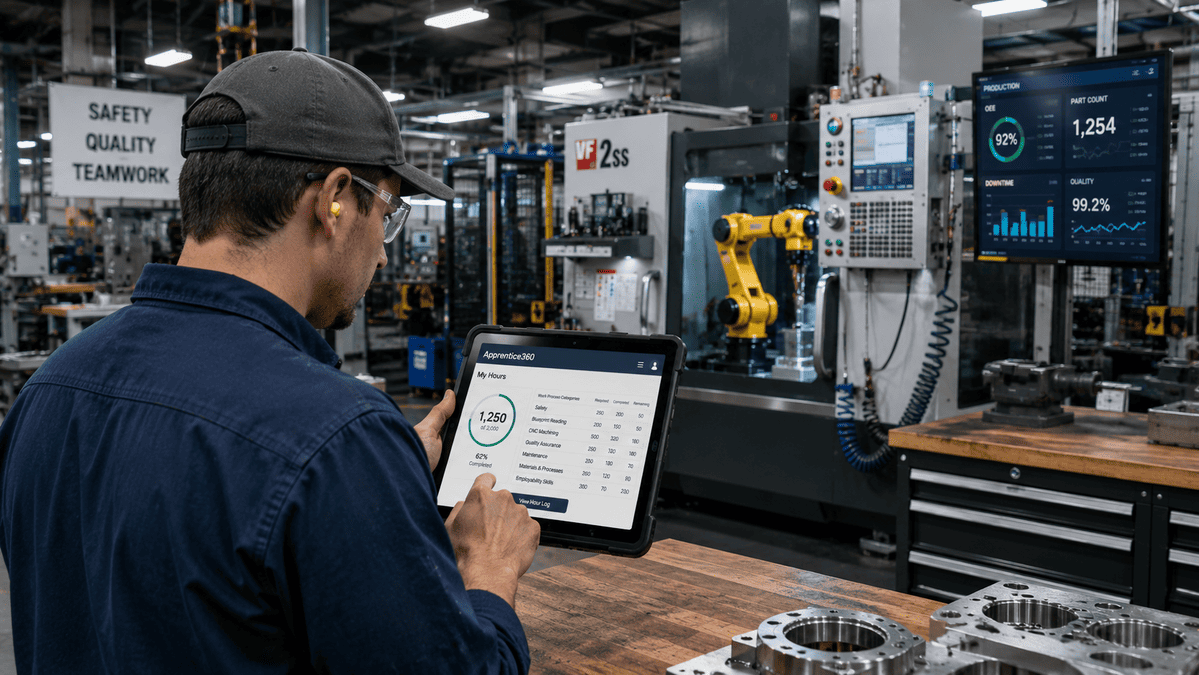
Document OJT through daily logs with supervisor sign-offs, or better yet, mobile time and competency capture to avoid missed hours and paper log errors. Rotate apprentices across departments: tool room, press room, quality, and design. Seeing how a die behaves in production, how maintenance decisions affect die life, and how quality inspection feeds back into design helps a toolmaker gain confidence and develop stronger analytical skills.
Designing Related Technical Instruction (RTI) for Die Making
Related technical instruction provides the theory behind hands on training and is typically delivered by high schools, colleges, or in-house training centers. Safety and compliance protocols are vital in tool and die maker training programs, and RTI is where much of that foundation is built.
Core RTI modules include:
- Blueprint reading and interpret blueprints exercises
- Shop math, trigonometry, and G code programming fundamentals
- Metallurgy, mechanical properties, physical properties, and heat treatment
- CNC programming and learn workholding techniques
- Geometric dimensioning and tolerancing (GD&T)
- Quality control, safety, and die casting theory
Classes are held one evening per week for apprentices in many programs, with tuition for apprenticeship classes running around $450 per class. Mixing delivery formats works well: evening sessions, asynchronous self paced online modules where apprentices can perform common online tasks like completing forms, downloading files, and navigate websites, plus short in-shop demonstrations during regular business hours. An intensive overview course early in the program orients apprentices to the full tool and die process from design to finished metal parts. This requires basic computer skills, as much of the coursework uses web based tools and an online tool environment.
Align RTI outcomes with OJT milestones. For example, the blueprint reading die maker course should be completed before apprentices are assigned independent die setup tasks. Schools and employers should coordinate schedules and share progress data so apprentices don’t repeat or miss essential content.
Core Competencies: From Blueprint Reading to Analytical Skills
Training management should be built around measurable competencies, not just seat time. Competency checklists and skills demonstrations help measure apprentice progress, and accurate assessment and feedback mechanisms are essential for continuous improvement in training.
Key competency groups for a tool die maker include:
- Technical machining: Read blueprints, adjust parts to tolerance, operate CNC machines and manual machine tools, disassemble conventional tooling for maintenance, and create CAD designs
- Analytical skills: Diagnose flashing, wear patterns, or misalignment in dies; improve cycle times through tooling changes; understand how steel hardness affects cracking
- Safety and quality: PPE discipline, hazard awareness, shop organization, measurement with precision tools, inspection documentation
- Communication: Explaining tool problems to engineers, mentoring newer apprentices, collaborating with production and quality teams
Tool and die certification verifies skills in specialized technical areas. Related credentials matter too: the Master of Die Casting Technology certification lasts for three years, while a Certified Welding Engineer requires 1 to 15 years of experience depending on education level. These certifications demonstrate proven competency beyond the apprenticeship itself.
Assess competencies through supervisor evaluations, skills tests on sample parts, and project-based assessments such as building a complete stamping die to spec. Track progression over time so managers see who is ready for more complex work or needs additional support.
Compliance, Reporting, and Funding for Apprenticeships
Registered apprenticeships must meet federal and state requirements in 2026, including documentation of OJT and RTI hours, apprentice agreements, completion records, and periodic compliance reports. Digital tools and automated reporting are increasingly utilized in managing apprenticeship programs, reducing audit risk through accurate, time-stamped records.
Program evaluation should include monitoring performance metrics and apprentice retention. Clean data supports access to public funding, tax credits, and workforce grants for die maker apprenticeship and pre-apprenticeship programs. Assign a specific training coordinator to own compliance, supported by automated dashboards and reminders. Industry collaboration is important for developing effective apprenticeship programs, especially when multiple employers or schools share resources.

Common Training Challenges and Practical Solutions
Managing training programs for tool and die makers requires a blend of rigorous technical instruction and structured mentorship. Common problems include inconsistent mentoring, unclear expectations, gaps between RTI and OJT, and apprentices dropping out due to financial strain or misalignment with the career path.
Frequent mistakes to avoid:
- Leaving apprentices on repetitive, low-skill tasks without exposure to complex tooling
- Tracking hours but not skills, so gaps go unnoticed
- Teaching blueprint reading in class but never connecting it to real metal parts on the shop floor
Practical solutions include formal mentor training so journeyworkers know how to coach and evaluate, structured rotations to build breadth, quarterly skill reviews to catch gaps early, and wage progression tied transparently to skill attainment. Involving apprentices in troubleshooting real production issues builds ownership and helps skilled artisans emerge faster. Use centralized tools to communicate schedules, share resources, and capture feedback from apprentices, supervisors, and instructors.
Why Choose a Structured, Software-Supported Approach to Training Management
Managing a die maker apprenticeship with spreadsheets, paper logs, and disconnected systems creates gaps, errors, and compliance risk. An integrated platform provides real-time dashboards, automated OJT and RTI tracking, centralized competency records, and streamlined communication across all stakeholders.
Employers benefit from faster skill growth and less administrative overhead. Schools gain clear alignment with industry needs. Apprentices see transparent progress and expectations, which supports retention and engagement. For context, tool and die makers earn an average of $30.79 per hour, making this a successful career path worth investing in properly. A structured system supports long-term workforce planning, helping employers replace retiring journeyworkers and expand capacity in precision machining and die making across multiple locations and shifts.
Next Steps: Building or Improving Your Tool and Die Maker Training Program
Well-managed die maker training protects production quality and creates stable, high-wage career paths for the next generation of skilled artisans. Start with a concrete action plan: audit your current training, define competencies, align OJT and RTI schedules, select tracking tools, pilot with a small cohort, then scale.
Involve supervisors, instructors, and current apprentices in redesigning training so it matches real shop needs. Review your existing apprenticeship structures, explore modern training management platforms, and take the next step toward building a program that produces journey-level die makers your shop can rely on.
Want to Learn More About Your Registered Apprenticeship Opportunities?
BOOK A FREE CONSULTATION
FAQs About Tool and Die Maker Training Management
How long does it typically take to train a tool and die maker?
A typical die maker apprenticeship runs 4 to 5 years, with most programs requiring 10,000 OJT hours plus RTI. Competency-based programs can adjust pace for faster learners while still ensuring mastery.
What entry requirements are common for a die maker apprenticeship?
Most programs require a high school diploma or equivalent, proficiency in algebra and geometry, basic blueprint reading exposure, mechanical aptitude, and the ability to meet the physical demands of shop work. Some programs also expect candidates to manage windows-based computers and perform common online tasks.
How much hands-on training should a die maker apprentice receive?
Hands on training makes up 80–90% of total program time. It should include structured exposure to machining, die assembly, CNC setup, die casting support, and troubleshooting across the full hours career training program.
How do we evaluate whether apprentices are ready to run complex dies?
Use a combination of supervisor sign-offs, skills tests on sample machine parts, quality metrics like scrap and rework rates, and demonstration of consistent blueprint reading and decision-making under pressure.
Can smaller shops realistically manage a formal apprenticeship program?
Yes. Small and mid-sized shops can partner with schools, regional sponsors, or industry groups to share RTI delivery, templates, and reporting tools. This reduces administrative burden while maintaining program credibility and opening access to a new career pipeline.
What is the difference between a machinist and a tool and die maker in training?
Machinist training focuses on producing parts to spec using lathes, mills, and CNC machines. Tool and die maker training adds die design basics, assembly, maintenance, control panel setup, and more analytical troubleshooting of tooling under production stress. Die makers work across the full lifecycle of tooling, playing an integral role in manufacturing processes.