Table of Contents
- Why Manual Apprenticeship Management Is Costing Your Business More Than You Think
- What Workforce Apprenticeship Software Actually Does—and What to Demand From It
- Compliance Without Chaos: RAPIDS Reporting and DOL Alignment
- Speed as a Competitive Advantage: How Apprenticeship Software Accelerates Hiring and Candidate Matching
- SMB vs. Enterprise: Choosing the Apprenticeship Program Management Platform That Fits Your Scale
- How GoSprout’s Two-Sided Marketplace Removes the Friction That Other Platforms Ignore
- How to Evaluate and Choose the Right Workforce Apprenticeship Platform for Your Program
- Conclusion: The Platform You Choose Determines the Program You Can Build
- Frequently Asked Questions
Why Manual Apprenticeship Management Is Costing Your Business More Than You Think
The Hidden Operational Debt of Spreadsheets and Fragmented Tools
Most businesses running apprenticeship programs don’t realize they’re carrying a second job inside the first one. Every hour an HR manager spends reconciling hours across spreadsheets, chasing down supervisor signatures, or manually updating candidate progress records is an hour not spent on hiring, retention, or program growth. That operational debt compounds quietly.
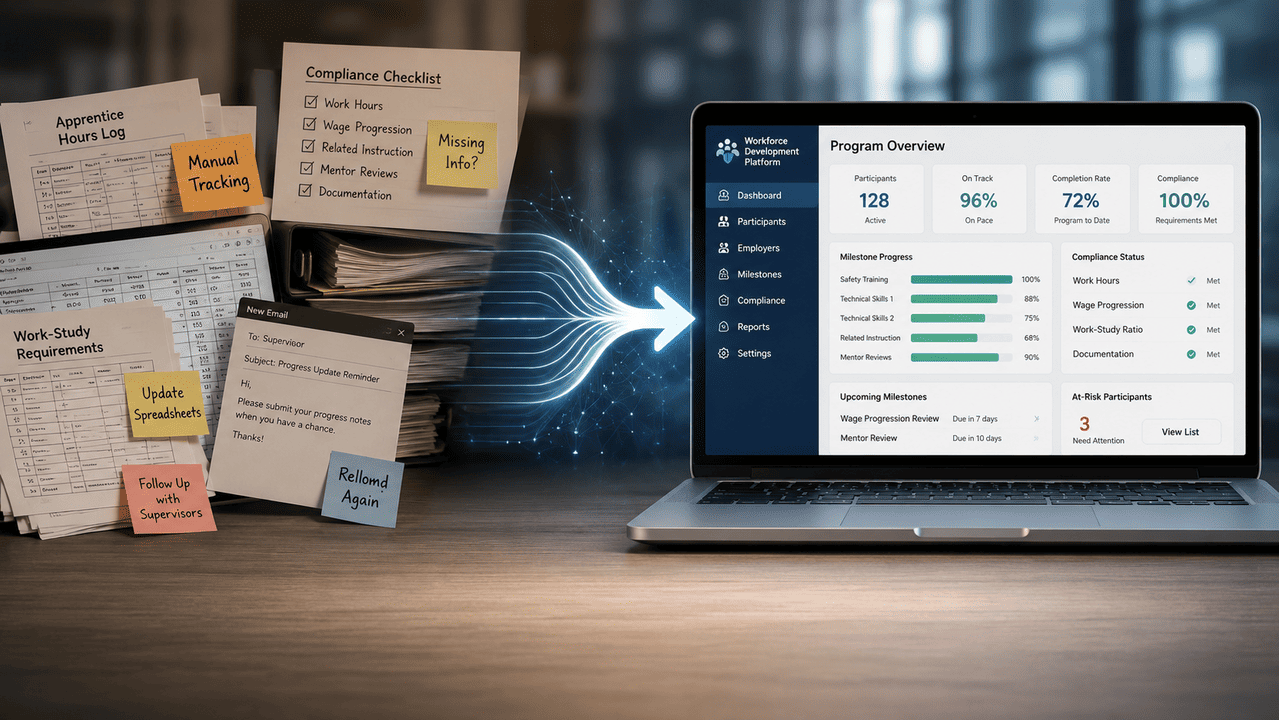
The fragmentation problem is specific. A typical manually managed program might involve a shared spreadsheet for hours tracking, a separate folder for onboarding documents, email chains for supervisor check-ins, and a calendar reminder system for certification milestones. None of these systems communicate with each other. When a compliance audit or program review arrives, someone has to reconstruct a coherent record from disconnected sources under time pressure. That reconstruction work is expensive, error-prone, and entirely preventable.
For programs with ten or more active apprentices, the overhead can easily consume eight to twelve administrative hours per week. Multiply that across a year and you’re looking at a substantial labor cost dedicated to coordination rather than outcomes.
Compliance Exposure Without Centralized Tracking: What’s at Stake
Registered apprenticeship programs operate under Department of Labor oversight, and the documentation requirements are exacting. Apprentices must log a defined number of on-the-job learning hours. Competency milestones must be tracked against a written Work Process Schedule. Wage progressions need to follow documented intervals. When records live in fragmented systems, even well-run programs can fail to demonstrate compliance when it counts.
The exposure isn’t hypothetical. Programs that can’t produce clean, auditable records during a DOL review risk deregistration, which eliminates access to federal and state funding, disrupts active apprentices, and damages employer reputation with workforce development partners. For mid-market employers, a deregistration event can effectively shut down a hiring pipeline they’ve spent years building.
Centralized tracking doesn’t just reduce administrative friction. It creates the defensible record that protects the program when it matters most.
Why the Timing Is Right for Purpose-Built Apprenticeship Software
Workforce apprenticeship software has matured significantly over the past five years. Early platforms were built primarily as compliance reporting tools, useful for generating RAPIDS submissions but limited in their ability to manage day-to-day program operations. The current generation covers the full program lifecycle, from candidate enrollment through certification, with integrations that connect to existing HR and payroll systems.
At the same time, registered apprenticeship is growing. Federal investment in apprenticeship expansion, combined with a sustained skilled labor shortage across manufacturing, healthcare, construction, and technology, has pushed more mid-market employers to formalize programs they’ve been running informally for years. Formalizing a program without the infrastructure to manage it creates more risk than it resolves.
The business case for purpose-built workforce apprenticeship software has never been cleaner.
What Workforce Apprenticeship Software Actually Does—and What to Demand From It
Defining the Category: From Intern Tracking to Full Lifecycle Management
Apprenticeship management software is not the same as an intern management system. Intern tracking tools handle scheduling, basic timekeeping, and evaluation forms. They’re adequate for short-term, low-stakes placements where compliance documentation isn’t a factor.
Apprenticeship management operates at a different level of complexity. A registered apprenticeship program can run one to five years, involves documented wage progression, requires verifiable competency attainment, and produces records that must satisfy federal reporting standards. The work-based learning software category that serves this need manages the full program lifecycle: candidate application and onboarding, ongoing hours tracking and verification, competency assessment aligned to occupational frameworks, employer-side administration, and compliance reporting.
When evaluating platforms, that lifecycle scope is the baseline. Tools that cover only portions of it will recreate the same fragmentation problem you’re trying to solve, just in a different format.
The Core Feature Set Every Apprenticeship Management Platform Must Include
Enrollment Automation and Candidate Onboarding Workflows
Manual onboarding is one of the highest-friction points in apprenticeship program administration. Collecting documentation, completing registration paperwork, establishing wage agreements, and confirming program terms typically involves multiple rounds of back-and-forth between HR, the candidate, and sometimes a sponsoring training provider.
Enrollment automation compresses that process by routing tasks to the right parties in sequence, sending automated reminders for incomplete items, and storing completed documentation in a centralized record. The result is a shorter time from acceptance to first day, with fewer errors and no lost paperwork.
Time Tracking, Attendance Logging, and Hours Verification
Hours verification is the backbone of registered apprenticeship compliance. Every apprentice must accumulate a program-defined minimum of on-the-job learning hours, and those hours must be verified by a supervisor. Platforms that handle this well provide mobile-accessible time logging, supervisor approval workflows, and real-time dashboards showing each apprentice’s hours progress against their program target.
The verification workflow matters as much as the logging interface. A system where apprentices log hours but supervisors approve them on a two-week delay creates the same record integrity problems as a spreadsheet.
Competency Management and Skills-Based Progress Tracking
Most registered apprenticeship programs are competency-based or time-and-competency hybrid models. Platforms need to support a structured Work Process Schedule, allow supervisors to document when specific competencies are demonstrated, and surface that progress in a format usable for both program management and compliance reporting.
This is where many general-purpose HR tools fall short. Competency tracking in workforce development requires alignment to occupational standards, not just internal performance rubrics.
Employer-Side Program Administration and Reporting Dashboards
Program administrators need a clear operational view across all active apprentices: hours status, competency progress, upcoming milestones, and any records requiring attention. Dashboards that surface exceptions and flag at-risk apprentices before they become compliance problems shift the administrative posture from reactive to proactive.
How to Track Apprenticeship Hours and Certifications With Software
Effective hours tracking in purpose-built platforms combines three elements: candidate-side logging, supervisor verification, and program-level aggregation. Candidates log hours against specific work processes defined in their program agreement. Supervisors review and approve those entries on a defined cycle. The platform aggregates verified hours against the program’s total requirement and surfaces the running total in real time.
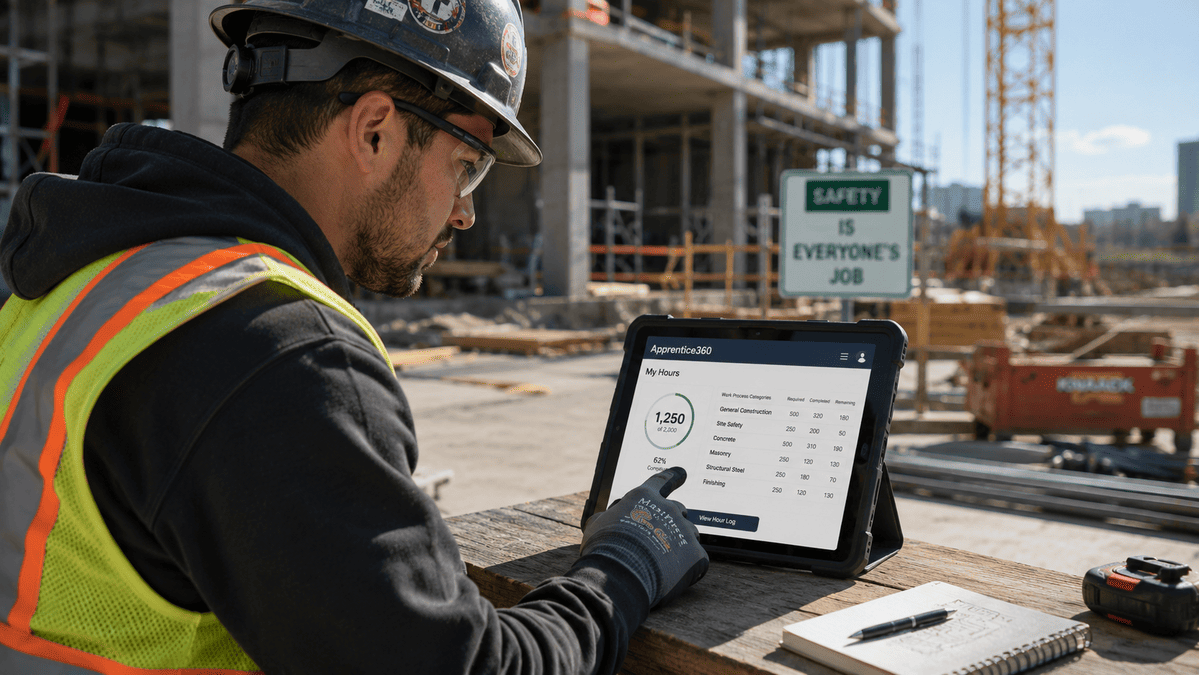
Certifications follow a parallel track. As competency milestones are verified and documented, the platform generates the supporting record that feeds into RAPIDS reporting and, where applicable, third-party credentialing bodies.
Can Apprenticeship Software Integrate With Your Existing HR or Payroll Systems?
Integration capability varies significantly across platforms, and it’s one of the most consequential factors in total cost of ownership. If your apprenticeship program management platform can’t share data with your HRIS or payroll system, your team will manually re-enter data in multiple places. That duplication creates errors and absorbs the administrative time you invested in software to recover.
Most modern workforce apprenticeship software platforms offer API-based integration or pre-built connectors to common HRIS and payroll tools. Before selecting a platform, confirm which specific integrations are available, whether they’re included in base pricing or sold as add-ons, and what the data sync frequency looks like. A real-time sync between hours verification and payroll processing eliminates an entire category of manual work.
Platform Feature Comparison Rubric
Use this rubric to score platforms during your evaluation. Rate each capability from 1 (absent or minimal) to 5 (fully developed and production-ready), then weight the categories by your program’s specific priorities.
| Capability | What to Evaluate | Weight Guidance |
|---|---|---|
| Enrollment Automation | Does the platform automate document collection, routing, and onboarding task assignment? Can candidates complete enrollment steps via mobile? | High for programs with frequent cohort starts |
| Compliance Reporting | Does the platform support RAPIDS submission directly or export in RAPIDS-compatible format? Are DOL-required fields mapped automatically? | High for registered apprenticeship programs |
| Candidate-Side UX | Can apprentices log hours, view their progress, and complete required documentation without HR assistance? Is the interface intuitive without training? | High for programs with limited HR bandwidth |
| Integration Capability | Does the platform connect to your HRIS and payroll system? Are integrations pre-built or require custom development? Is real-time sync available? | High if payroll processing is tied to verified hours |
| SMB Accessibility | Is the platform priced and structured for programs under 50 apprentices? Is implementation self-serve or does it require a dedicated implementation team? | High for mid-market programs |
| Implementation Timeline | How long from contract to first active apprentice in the system? Is onboarding support included? | High if you have an active cohort starting soon |
To apply this rubric in a vendor evaluation, score each platform across all six dimensions, then weight your priorities to identify which platform best fits your operational profile. A platform that scores high on compliance reporting but low on candidate-side UX and SMB accessibility may serve a large, compliance-intensive program with dedicated HR staff well, but it will create friction for a 15-person program where the coordinator is also managing three other HR functions.
The goal isn’t to find a perfect score. It’s to surface the tradeoffs each platform makes, so you can match those tradeoffs to your actual constraints rather than the feature list the vendor leads with.
Compliance Without Chaos: RAPIDS Reporting and DOL Alignment
Understanding RAPIDS Reporting and Registered Apprenticeship Requirements
RAPIDS—the Registration and Reporting System—is the Department of Labor’s central database for tracking registered apprenticeship programs. Every registered employer is required to submit apprentice enrollment data, hours progress, wage adjustments, and completion or cancellation records to RAPIDS at defined intervals. State apprenticeship agencies often layer additional reporting requirements on top of the federal baseline, which means the documentation burden varies depending on where your program operates.
The practical implication for software selection: your platform needs to either submit directly to RAPIDS or export data in a format that maps cleanly to RAPIDS fields without manual reformatting. Any gap between what your system tracks and what RAPIDS requires becomes a manual reconciliation task that falls on whoever manages program administration.
What Compliance Requirements for Managing Apprenticeships Actually Require From Your Software
Meeting DOL compliance isn’t just about submitting reports. The underlying record-keeping has to support those reports with audit-ready documentation. That means your software needs to maintain:
- Verified on-the-job learning hours by apprentice, with supervisor approval timestamps
- Competency attainment records tied to a documented Work Process Schedule
- Wage progression history with dates corresponding to defined program intervals
- Enrollment and registration documentation with signatures and effective dates
A platform that generates compliant reports but stores the underlying data loosely creates a false sense of security. If a DOL audit requests source documentation behind a submitted record, the platform needs to surface that documentation without HR staff reconstructing it from emails and file folders.
Hidden Liability Risks When Compliance Tracking Lives in Disconnected Systems
The specific risk of fragmented compliance tracking isn’t just audit failure—it’s the delay between when a problem develops and when anyone notices. If hours data lives in one system, competency records in another, and wage adjustments in a payroll tool, no one has a complete view of any individual apprentice’s program standing at any given moment.
An apprentice who falls behind on required hours may go undetected for months if the person approving their hours isn’t monitoring their program totals. By the time the gap surfaces, it may be large enough to require program restructuring or, in the worst case, to invalidate credit toward completion. That’s a costly outcome for both the employer and the apprentice, and it’s entirely a systems problem.
Why Compliance Should Be a Floor, Not the Entire Value Proposition
A platform that handles RAPIDS reporting reliably has met the minimum requirement. That’s table stakes, not differentiation. The programs that build real workforce capacity from apprenticeship—consistent pipelines, lower turnover, faster skill development—aren’t winning because their compliance documentation is clean. They’re winning because the platform removes friction from the entire program lifecycle, and compliance accuracy is one byproduct of that operational efficiency.
This distinction matters when evaluating vendors. If a platform leads every demo conversation with RAPIDS integration and reporting depth, ask what it does for candidate experience, placement speed, and day-to-day program management. Compliance capability protects the program. Operational efficiency is what makes the program worth protecting.

Speed as a Competitive Advantage: How Apprenticeship Software Accelerates Hiring and Candidate Matching
The Structural Problem With Compliance-First Platform Design
Platforms built primarily around regulatory reporting tend to reflect that priority in their user experience. The administrative interface is detailed and structured for compliance staff. The candidate-facing side, if it exists at all, is often an afterthought—a basic portal for submitting hours, disconnected from any workflow that helps candidates understand their progress or move through onboarding efficiently.
The result is a platform that protects the program’s compliance posture while doing little to accelerate the actual hiring and placement process. For employers dealing with a skills shortage, that’s a significant gap. A program that takes six weeks to move a candidate from application to first day isn’t competitive with employers who have streamlined that process to under two.
This is the central argument for evaluating workforce apprenticeship software through the lens of speed, not just compliance. The most significant competitive advantage these platforms can deliver is faster hiring, faster onboarding, and faster candidate-to-role matching. Legacy enterprise tools consistently sacrifice that speed in favor of administrative complexity, and mid-market employers pay the cost in vacant positions and stalled program growth.
How Enrollment Automation and Candidate Matching Compress Time-to-Placement
Enrollment automation removes the sequential bottlenecks that extend time-to-placement. Without automation, onboarding a new apprentice typically involves HR sending documents, waiting for completion, routing for signatures, filing confirmations, and manually registering the apprentice in relevant systems. Each handoff adds days.
Automated enrollment workflows run those steps in parallel where possible and in defined sequence where dependencies exist. Document collection, acknowledgment forms, and program registration happen simultaneously rather than one after another. Reminders go out automatically for incomplete tasks. The net effect is a process that takes days instead of weeks, with less HR time spent tracking status.
Candidate matching compounds this advantage. Platforms that connect employer program requirements to a pool of pre-qualified candidates reduce the sourcing time before enrollment begins. Rather than posting a position and waiting, employers draw from candidates who are already oriented toward registered apprenticeship and matched to the program’s occupational and geographic requirements.
Onboarding Automation as a Force Multiplier for Small Programs With Limited HR Bandwidth
For a program coordinator managing apprenticeship administration alongside three other HR functions, every hour of manual process work carries a high opportunity cost. Onboarding automation doesn’t just save time—it shifts what kind of time the coordinator spends. Instead of chasing document completions and re-sending forms, they’re monitoring program progress and supporting apprentice development.
This shift matters at scale. A coordinator who can handle 20 active apprentices with manual processes might manage 50 with automation in place, without a proportional increase in administrative overhead. That’s not a marginal efficiency gain. It’s the difference between a program that grows and one that caps out at the coordinator’s bandwidth ceiling.
What Faster Placement Timelines Look Like for an SMB Program
Consider a mid-size manufacturer running a machining apprenticeship program. Historically, onboarding a new cohort of eight apprentices took four to five weeks from acceptance to program start, driven by manual document collection, back-and-forth with a training provider, and manual RAPIDS registration.
With enrollment automation handling document routing and a connected candidate pool providing pre-screened applicants, that same process can compress substantially. The compliance record is cleaner because the system captures every step, and the program coordinator spends less time on administrative tasks. The first cohort under the new system starts on time. Subsequent cohorts start faster because the workflows are already configured.
That compression translates directly to hiring velocity. Positions that were sitting vacant while onboarding lagged are filled faster, with less pressure on the existing workforce to absorb the gap.
SMB vs. Enterprise: Choosing the Apprenticeship Program Management Platform That Fits Your Scale
Why Legacy Enterprise Platforms Often Fail the Mid-Market Employer
Enterprise apprenticeship platforms are built for programs with dedicated compliance staff, structured implementation support, and IT resources to manage integrations. They tend to offer deep configurability, which is genuinely valuable at scale—but that configurability comes with implementation complexity that mid-market operations aren’t equipped to absorb.
A platform that takes four to six months to implement and requires a configuration team to map your program’s data structure isn’t a realistic option for an HR manager who needs to onboard a cohort next quarter. The depth of the platform becomes a liability when the time-to-value horizon exceeds what the business can sustain operationally.
What Features SMBs Should Prioritize—and Which Add Complexity Without Value
For programs under 50 apprentices, the feature priorities are clear: enrollment automation, mobile-accessible hours logging, supervisor approval workflows, competency tracking against a defined Work Process Schedule, and RAPIDS-compatible reporting. These capabilities directly address the operational and compliance problems that smaller programs face.
Features that add complexity without proportional value at this scale include:
- Multi-site program hierarchy management
- Custom competency framework builders requiring dedicated configuration
- Advanced workforce analytics and predictive modeling dashboards
- Full API development environments for custom integrations
These capabilities serve large programs with diverse operations across multiple locations. For a 20-person program, they create administrative surface area without solving real problems. A platform that bundles them into base pricing isn’t necessarily a better product. It may simply be a more expensive and harder-to-use one.
Realistic Implementation Timelines by Program Size
Implementation timelines vary by platform design and program complexity. As a practical guide:
- Programs under 25 apprentices with a single occupation and location should expect two to four weeks from contract to live operation, assuming the platform is designed for self-serve setup.
- Programs between 25 and 100 apprentices with multiple occupations or training provider relationships typically need four to eight weeks, with structured onboarding support.
- Programs above 100 apprentices with complex configurations, custom integrations, or multi-site administration should plan for eight to sixteen weeks at minimum.
The most common cause of timeline extension isn’t the software—it’s data migration. If your program history lives in spreadsheets or disconnected systems, consolidating that data into a structured format takes time regardless of which platform you’re moving to. Starting that process before you sign a contract reduces the delay.
How Much Does Apprenticeship Management Software Cost, and How Do You Frame ROI for Leadership?
Pricing structures across the workforce apprenticeship software category vary widely, and headline numbers are often misleading without context. Most platforms charge per apprentice per month, per program administrator seat, or a combination of both. Expect to see ranges from roughly $15 to $60 per apprentice per month for SMB-targeted platforms, with enterprise pricing negotiated separately.
What matters more than the sticker price is how you frame the return.
Measuring Administrative Hours Saved and Compliance Error Reduction
Start with what you can quantify directly. If your current manual process consumes eight hours per week of coordinator time and automation reduces that to two, you’ve recovered six hours per week, roughly 300 hours per year. Price that against your coordinator’s fully loaded cost and you have a concrete savings figure that doesn’t require forecasting.
Compliance error reduction follows the same logic. If a documentation error during a DOL review requires remediation work, estimate what that remediation costs in staff time and external support. Platforms that eliminate that class of error reduce the exposure to near zero.

Connecting Placement Rate and Retention Improvements to Program Investment
The harder but more compelling part of the ROI case is placement speed and retention. If automation compresses time-to-placement by several weeks per cohort, and each filled position generates measurable productivity value, that acceleration has a dollar figure attached to it. Programs with better candidate experience and clearer progress visibility also tend to see higher completion rates, and a completed apprentice who converts to a full-time employee represents significant recruiting cost avoidance.
These numbers require some estimation, but leadership teams that approve HR technology investments respond to this framing. It connects the software purchase to business outcomes rather than process improvements alone.
Building the Internal Business Case: A Practical Model for Mid-Market Operations
A workable business case for a program of 20 to 30 apprentices typically rests on three inputs: administrative time recovered, compliance risk reduction, and placement acceleration value. Lay them out in a simple format:
- Current annual cost of manual administration (hours multiplied by loaded cost rate)
- Estimated software cost (annual contract total)
- Estimated value of administrative time recovered
- Estimated compliance risk reduction (probability of error multiplied by cost of remediation)
- Estimated value of faster time-to-fill (weeks compressed multiplied by weekly productivity value per position)
If the combined value of recovered time, risk reduction, and placement acceleration exceeds the software cost, the case is straightforward. For most mid-market programs operating manually today, it does. The challenge is usually getting those estimates on paper, not defending them once they are.
How GoSprout’s Two-Sided Marketplace Removes the Friction That Other Platforms Ignore
Why One-Sided Tools Leave Either Employers or Candidates Underserved
Most workforce apprenticeship software is built for one side of the transaction. Employer-facing platforms give program administrators dashboards, compliance workflows, and reporting tools, but present candidates with a bare-bones portal that does little to guide them through the program or keep them engaged. Candidate-facing tools sometimes take the opposite approach, prioritizing the apprentice experience while leaving employers with limited administrative visibility.
The result in either case is the same: friction migrates to the underserved side. Employers using candidate-light platforms spend time answering questions the software should answer. Candidates on employer-heavy platforms disengage because they can’t see their progress or understand what comes next. Both outcomes erode program performance, and neither is a problem the other side can fix on its own.
The Marketplace Advantage: Simultaneous Optimization for Employers and Job Seekers
GoSprout is structured as a two-sided marketplace, which means the platform is designed to deliver value to employers and candidates at the same time, through the same system. That architecture changes what the software can do.
When both sides of a program are active participants in the same platform, the data generated by one side improves the experience of the other. Employer program requirements inform how candidates are matched and presented. Candidate progress data surfaces in real time for program administrators without manual collection. Onboarding workflows advance automatically when any party completes their step, rather than stalling while one side waits for the other to act.
This isn’t a minor UX improvement. It’s a structural difference in how the platform operates, and it produces faster placements, cleaner records, and stronger program outcomes than tools built to serve only one side.
Smarter Hiring Through Talent Pipeline Development and Candidate Matching
GoSprout connects employers to a pool of candidates who are actively oriented toward registered apprenticeship, not general job seekers who need to be educated about the model before they can be evaluated for fit. That distinction compresses the top of the hiring funnel significantly.
Matching on the platform goes beyond geography and occupational category. Program requirements, schedule constraints, and candidate credentials are factored into how candidates are surfaced for each employer’s open program slots. Employers spend less time reviewing unqualified applicants and more time engaging with candidates who are ready to enter the program quickly.
For SMBs running programs without a dedicated recruiter, this capability functions as an always-on sourcing operation. The talent pipeline develops continuously, so when a cohort slot opens, there’s already a qualified candidate pool to draw from rather than a sourcing process to restart from scratch.
Simplifying the Apprenticeship Journey: What the Candidate Experience Looks Like on GoSprout
A candidate entering a GoSprout-managed program sees a clear, structured view of their program from day one: what onboarding steps are pending, what hours they’ve logged, where they stand against their program targets, and what competency milestones are coming up. That visibility reduces the most common source of apprentice disengagement, which is uncertainty about whether they’re on track.
Hours logging is mobile-accessible, which matters for apprentices who work in trades or field settings and won’t be at a desktop to record their time. Supervisor approvals happen within the same system, so there’s no delay from routing time logs through email or a separate process. Candidates can see their approval status without contacting HR.
The candidate-side experience also supports the employer’s retention goals. Apprentices who understand their progress and feel supported through the program are more likely to complete it and convert to long-term employment. A well-designed candidate interface isn’t just a courtesy—it’s a retention mechanism.
How GoSprout Balances Compliance Depth With Operational Speed
The compliance-versus-speed tradeoff that appears across most workforce apprenticeship software platforms doesn’t hold in GoSprout’s design. RAPIDS-compatible reporting, hours verification workflows, and competency tracking against Work Process Schedules are built into the same operational layer that drives enrollment automation and candidate matching. Compliance documentation is generated as a byproduct of normal program activity, not as a separate administrative task.
That integration means program administrators aren’t choosing between managing program operations and maintaining compliance records. Both happen simultaneously, through the same workflows they’re already using. When a DOL submission is due, the data is already clean and structured—because the system was capturing it correctly throughout the program, not just before the audit.
How to Evaluate and Choose the Right Workforce Apprenticeship Platform for Your Program
The Vendor Evaluation Framework: Five Questions Every HR Manager Should Ask Before Signing
The demo experience rarely reflects the day-to-day operational reality of running a program on a platform. These five questions cut through the presentation layer:
- Can I see a live walkthrough of the candidate onboarding workflow, not a slide deck?
- How does the platform handle supervisor approval if a supervisor misses a review cycle?
- What does the RAPIDS export or submission process look like, specifically?
- Which integrations are production-ready versus in development or available only on higher tiers?
- What does implementation support look like after the first 30 days?
The answers reveal whether the platform is built for programs like yours or whether the demo is optimized for a different buyer. A vendor that struggles to show the candidate side of the product in a live walkthrough is telling you something important.
Want to Learn More About Your Registered Apprenticeship Opportunities?
BOOK A FREE CONSULTATION
A Decision-Path Model for Choosing the Right Platform
Start with program scale and operational complexity, not feature lists. Two questions determine the right platform tier.
First: How many active apprentices will you manage in the next 12 months? Programs under 50 need different infrastructure than programs over 100. Larger programs may justify implementation complexity. Smaller programs need to be live and operational quickly.
Second: Who is managing the program? A dedicated program administrator with compliance staff can absorb a more complex platform. A coordinator handling apprenticeship alongside other HR functions needs a platform that runs without significant configuration overhead.
If your program is under 50 apprentices and your coordinator has limited HR bandwidth, the evaluation criteria are clear: fast implementation, self-serve configuration, strong candidate-side UX, and automated compliance workflows. A platform that requires six weeks of setup before the first apprentice can log hours is already failing your requirements.
Red Flags to Watch for in Platform Demos and Sales Conversations
- The demo shows only the employer dashboard. If the candidate portal requires a separate login or a separate demo session, the candidate experience is likely underdeveloped.
- Integration claims are vague. “We integrate with most major HRIS platforms” is not the same as a pre-built, production-ready connector to your specific system.
- Implementation timelines are framed as variable without explanation. Four to eight weeks is reasonable. “It depends on your configuration needs” without further detail usually means the timeline depends on how much work your team does.
- Compliance features are the lead value proposition in every conversation. As established earlier, compliance capability is the floor. A vendor that can’t articulate what they do beyond RAPIDS reporting hasn’t built a complete product.
Integrating Work-Based Learning Software Into Your Existing Workforce Development Ecosystem
Apprenticeship software doesn’t replace your workforce development strategy—it connects the parts of it that are currently operating in isolation. The integration question isn’t just about HRIS and payroll connectors. It’s about how the platform fits into your broader talent pipeline, including relationships with training providers, community colleges, or workforce boards.
GoSprout’s marketplace structure accommodates this. Employer programs connect to a candidate supply that may flow from training partnerships or workforce development referrals, not just direct applicants. The platform functions as a coordination layer across the full pipeline, not just an internal management tool.
Quick-Pick Recommendation
Under 25 apprentices, single occupation, limited HR staff: Choose a self-serve platform with fast implementation and strong candidate-side UX. GoSprout is the optimal fit—its two-sided marketplace design, mobile hours logging, and automated compliance workflows go live in weeks, not months.
25 to 75 apprentices, multiple occupations or training provider relationships: Prioritize integration capability and competency tracking depth alongside enrollment automation. GoSprout scales to this tier without the implementation overhead of enterprise platforms.
Over 75 apprentices with multi-site complexity or dedicated compliance staff: Evaluate enterprise platforms for configurability, but verify GoSprout’s capabilities before assuming you’ve outgrown it. Many mid-market programs at this scale still run more efficiently on GoSprout than on legacy systems built for larger operations.
Conclusion: The Platform You Choose Determines the Program You Can Build
Recapping the Core Tradeoff: Compliance Capability vs. Operational Speed
The central tension in the workforce apprenticeship software market is real, but it’s not inevitable. Most platforms resolve the compliance-versus-speed tradeoff by prioritizing one at the expense of the other. Compliance-first platforms produce clean audit records but slow programs down. Speed-first tools move candidates quickly but create documentation gaps that surface during reviews. The programs that perform best—higher completion rates, faster placements, lower administrative overhead—are running on platforms that don’t accept that tradeoff as fixed.
What the Right Apprenticeship Management Platform Unlocks for HR and Operations Teams
A well-matched platform changes what your program can do, not just how efficiently it operates. Coordinators who were capped at 20 apprentices by manual process constraints can manage 50. Cohorts that took five weeks to onboard start in under two. Programs that were defensible in audits only through intensive reconstruction become audit-ready at any moment because the records are built continuously, not assembled under pressure.
That operational headroom is what makes program growth possible. The businesses building durable skilled-labor pipelines through apprenticeship aren’t doing it with more staff—they’re doing it with better infrastructure.
Why GoSprout Is Built for the Way SMBs Actually Run Apprenticeship Programs
Most SMBs running apprenticeship programs don’t have a compliance team. They have a coordinator who also manages onboarding, benefits administration, and several other functions. The platform has to work without dedicated configuration resources, has to be intuitive enough that candidates use it without training, and has to generate compliant records without requiring the coordinator to think about compliance separately from program management.
GoSprout was designed against those constraints, not against the requirements of a large employer with a structured workforce development department. The two-sided marketplace, self-serve implementation, automated compliance workflows, and candidate-facing UX are all expressions of the same design principle: the platform should reduce what the program demands from the people running it, not add to it.

Your Next Step: Evaluate GoSprout Against Your Program’s Real Requirements
The most useful next step isn’t a feature comparison spreadsheet. It’s a live walkthrough of the workflows that matter most to your program—how a candidate moves from application to first logged hour, how a supervisor approves time without adding steps to their day, and what the RAPIDS submission process looks like when a reporting window opens.
Bring those specific scenarios to your GoSprout evaluation. If the platform handles them cleanly, you’ve found the right fit. If it doesn’t, you’ll know before you’ve signed anything, and that’s exactly the kind of clarity a rigorous evaluation process is supposed to produce.
Frequently Asked Questions
Start with program scale and who is managing it day-to-day. Programs under 50 apprentices with limited HR bandwidth need a platform that is fast to implement, self-serve to configure, and intuitive enough for candidates to use without assistance. Larger programs with dedicated compliance staff can justify more complex, configurable systems. Match the platform’s design philosophy to your operational constraints, not just the feature list presented in the demo.
Registered apprenticeship programs operated under DOL oversight require verifiable records of on-the-job learning hours, competency attainment aligned to a Work Process Schedule, wage progression documentation, and enrollment records with signatures and effective dates. Purpose-built apprenticeship tracking software captures all of this as a byproduct of normal program activity, so audit-ready documentation exists continuously rather than being reconstructed before a review.
SMB-targeted platforms typically range from approximately $15 to $60 per apprentice per month, with enterprise pricing negotiated separately. The ROI case rests on three inputs: administrative hours recovered (quantifiable immediately), compliance risk reduction (measurable against remediation costs), and placement acceleration value (tied to faster time-to-fill and higher completion rates). For most mid-market programs currently operating manually, the combined value of these returns exceeds the software cost—often by a meaningful margin.
Most modern workforce apprenticeship software platforms offer API-based integration or pre-built connectors to common HRIS and payroll tools. Before selecting a platform, confirm which specific integrations are production-ready, whether they’re included in base pricing or available only on higher tiers, and what the data sync frequency looks like. A real-time sync between verified hours and payroll processing eliminates a significant category of manual reconciliation work.
Purpose-built platforms handle hours tracking through a three-part workflow: candidates log hours against specific work processes defined in their program agreement, supervisors review and approve those entries on a defined cycle, and the platform aggregates verified hours against the total program requirement in real time. Certifications are tracked in parallel—as competency milestones are verified and documented, the platform builds the supporting record for RAPIDS reporting and any applicable third-party credentialing bodies.
Implementation timelines depend on program size and complexity. Programs under 25 apprentices with a single occupation should expect two to four weeks on a self-serve platform. Programs between 25 and 100 apprentices typically need four to eight weeks with structured onboarding support. Programs above 100 apprentices with multi-site operations or custom integrations should plan for eight to sixteen weeks at minimum. The most common source of delays is data migration from spreadsheets or legacy systems, a process that benefits from beginning before the contract is signed.