Table of Contents
- When Spreadsheets Stop Working: Naming the Pain HR Managers Are Actually Feeling
- What an Apprenticeship Software Platform Actually Is—and What It Should Do
- Essential Features Every Apprenticeship Management Platform Must Have
- RAPIDS Integration and Regulatory Compliance: What to Demand From Your Platform
- Apprenticeship Software vs. General HR Software: Why the Distinction Matters
- The Overlooked Side of Apprenticeship Software: Talent Matching and the Apprentice Experience
- How the Best Platforms Reduce Administrative Burden Without Sacrificing Compliance
- How to Evaluate and Select the Right Apprenticeship Software Platform: A Buyer’s Framework
- Conclusion: The Half-Solved Problem Is Costing You More Than You Think
- Frequently Asked Questions
When Spreadsheets Stop Working: Naming the Pain HR Managers Are Actually Feeling
The Administrative Collapse Point
Most apprenticeship programs don’t fail because of poor intent. They fail because the administrative weight of running them manually outpaces the capacity of the team managing them. A typical manually managed program means tracking hours across emailed timesheets, storing enrollment documents in shared folders that no one fully trusts, and chasing supervisors for OJT sign-offs that were supposed to happen two weeks ago.
When a program has five apprentices, this is inconvenient. When it reaches fifteen or twenty, the system collapses. Records become inconsistent, deadlines get missed, and the person responsible for compliance is spending their Fridays reconciling spreadsheets instead of building the program.
Want to Learn More About Your Registered Apprenticeship Opportunities?
BOOK A FREE CONSULTATION
Compliance Risk Is a Present Problem, Not a Future One
Many HR managers treat compliance exposure as a risk to manage later, once the program is more established. That framing is backwards. The moment a registered apprenticeship program is active, the compliance clock is running. The Department of Labor’s reporting requirements don’t wait for a program to scale before they apply. OJT hours need to be documented. Progress milestones need to be verified. Wage increases tied to competency thresholds need to happen on schedule.
A missed filing or an undocumented hours log isn’t just an administrative oversight. It can put the program’s registered status at risk and expose the employer to audit findings. The spreadsheet that worked last quarter is not a compliant record-keeping system.
Why Disconnected HR Tools Create a Two-Layer Problem
The instinct for most organizations is to assemble a toolkit: an HRIS for employee records, a scheduling tool for hours, and a shared drive for documents. This approach creates the illusion of coverage while generating a second, hidden problem. When data lives in multiple systems that don’t communicate, reconciliation becomes a manual job. Someone has to cross-reference the HRIS against the timesheet log against the document folder every time a report is due.
This is the two-layer problem. The first layer is the administrative burden of managing apprentices. The second layer is the burden of managing the tools meant to help. A disconnected toolset doesn’t reduce work. It redistributes it into less visible corners of the organization, where it accumulates until something breaks.
What Most Buyers Assume They Need—and the Capability They’re Missing
Buyers approaching the apprenticeship software market for the first time typically know exactly what they want to stop doing: manual tracking, document chasing, and compliance anxiety. What they don’t yet know they’re missing is a talent-facing layer. Most platforms are built exclusively for the employer side of program management, which means they solve the back-office problem while leaving the front-end problem entirely unaddressed. Finding and onboarding quality apprentices remains manual work.
The buyer who purchases a compliance-only platform discovers this gap about six months into implementation, when they realize the software manages apprentices well but offers no help identifying, attracting, or structuring the onboarding experience for the next cohort.
What an Apprenticeship Software Platform Actually Is—and What It Should Do
Defining the Apprenticeship Management System in Plain Terms
An apprenticeship management system is purpose-built software for administering work-based learning programs from enrollment through completion. At its core, it centralizes apprentice records, automates OJT hour tracking and verification, manages competency progression tied to program standards, and maintains the documentation infrastructure required for regulatory reporting.
What separates an apprenticeship management system from a general HR tool isn’t just feature overlap. It’s the underlying data model. An apprenticeship software platform is structured around the apprenticeship lifecycle: registration, on-the-job training milestones, related technical instruction, wage progression, and program completion. General HR systems are structured around employment status and payroll. The two architectures serve different purposes.
How Apprenticeship Software Differs From General HR Software
Why General HR Platforms Fall Short for Work-Based Learning
General HR platforms manage employees. They track start dates, compensation, performance reviews, and benefits eligibility. That infrastructure has no natural place for OJT hour accumulation, competency-based wage increases, or DOL reporting schedules. Adapting a general HR platform to manage a registered apprenticeship program means building workarounds for every workflow the system wasn’t designed to support.
The result is usually a patchwork of custom fields that don’t enforce logic, manual reminders that substitute for automated triggers, and compliance reports assembled by hand from data the system stores inconsistently.
The Registered Apprenticeship Program Compliance Requirement That Changes Everything
A Registered Apprenticeship Program carries federal and state reporting obligations that are structurally unlike anything a general HR platform handles. RAPIDS, the Registered Apprenticeship Partners Information Data System, requires structured data submissions at defined intervals. Program sponsors must document every apprentice’s hours, competency attainments, wage adjustments, and completion status in a format the system accepts.
This isn’t a reporting preference. It’s a compliance requirement tied to the program’s registered status. A registered apprenticeship program software platform built for this compliance environment treats these data structures as native fields, not custom workarounds.
The Two-Sided Architecture Most Platforms Ignore
The vast majority of apprenticeship management platforms are built for one audience: the employer administrator. They manage what happens after an apprentice is enrolled. What they don’t address is how that apprentice got there, what their onboarding experience looked like, or how the organization will find the next cohort.
A two-sided platform serves both the program operator and the apprentice. On the employer side, that means compliance tracking, document management, and reporting automation. On the apprentice side, it means a structured onboarding experience, transparent progress visibility, and a pathway that connects candidates to programs before they’re enrolled. Most platforms on the market today are built for one side only.
What End-to-End Lifecycle Management Means in Practice
End-to-end lifecycle management starts before enrollment and continues through program completion. That means talent discovery and matching, not just record-keeping once a hire is made. It means structured onboarding workflows that reduce early attrition, not just a document repository. And it means competency tracking tied to real program standards, not generic skill tagging.
A platform that covers only post-enrollment workflows manages half a program. Getting the right people into the program and keeping them engaged through it requires a different kind of architecture entirely.
Feature Evaluation Matrix: Employer-Side Admin vs. Apprentice-Side Experience
The matrix below maps core platform capabilities across two dimensions: what the platform does for the employer administrator, and what it does for the apprentice. Use this to evaluate any platform you’re considering against the full scope of what your program actually requires.
Employer-Side Admin Capabilities
- Enrollment and registration management with automated data capture
- OJT hour tracking and supervisor verification workflows
- Competency and skills progression tied to program standards
- RAPIDS-ready compliance reporting and audit documentation
- Document storage with version control and expiration alerts
- Wage progression triggers linked to milestone attainment
- Multi-site or multi-trade program administration
Apprentice-Side Experience and Talent-Matching Capabilities
- Candidate discovery and program matching before enrollment
- Structured digital onboarding with task checklists and document collection
- Progress dashboards that give apprentices visibility into their own advancement
- Communication tools that connect apprentices to supervisors and program coordinators
- Engagement features that reduce friction and support early retention
What Most Platforms Deliver vs. What the Best Platforms Deliver
| Capability Area | Compliance-Only Platform | Full-Lifecycle Platform |
|---|---|---|
| OJT tracking and verification | Yes | Yes |
| RAPIDS and DOL reporting | Yes | Yes |
| Document management | Yes | Yes |
| Talent matching and discovery | No | Yes |
| Apprentice onboarding workflows | Minimal | Structured |
| Apprentice-facing progress tools | No | Yes |
| Pipeline management pre-enrollment | No | Yes |
A platform that checks every row in the left column is a functional tool. A platform that checks every row across both columns is a program-building system.
Essential Features Every Apprenticeship Management Platform Must Have
Enrollment Automation and Apprentice Data Organization
Manual enrollment is where data quality problems start. When an apprentice’s information is entered by hand across multiple systems, errors compound quickly. A capable apprenticeship software platform automates enrollment data capture from the point of application, validates required fields, and populates a centralized record that feeds every downstream workflow, from OJT tracking to compliance reporting.
The practical test: can a new apprentice be fully enrolled, with a complete and compliant record, without an administrator manually re-entering data from a paper form or email?
On-the-Job Training Tracking and Hours Verification
OJT tracking is the operational core of any registered apprenticeship program. The platform needs to capture hours worked against specific competency categories, route verification to the appropriate supervisor, and maintain a time-stamped audit trail. A system that simply logs total hours without linking them to program standards doesn’t satisfy DOL requirements and won’t survive an audit.

Verification workflows matter as much as the logging itself. Hours that are recorded but not formally verified are not compliant documentation.
Competency and Skills Tracking Tied to Program Standards
Apprenticeship programs are structured around the acquisition of defined competencies, not the passage of time alone. A platform that tracks hours but doesn’t map them to specific skills attainment misses the core of how registered programs are evaluated. Competency tracking needs to align with the program’s registered standards, support both time-based and competency-based progression models, and generate evidence of attainment that satisfies sponsor and DOL review.
Document Management and Audit-Ready Record Keeping
Every apprenticeship program generates a substantial document trail: apprenticeship agreements, training plans, progress evaluations, wage determination records, and completion certificates. These documents need to be stored in a structured, retrievable format, linked to the correct apprentice record, and accessible at the moment of an audit without a manual search across file systems.
Expiration tracking matters here too. Training plans get updated. Agreements get amended. A document management system that doesn’t surface expiring or outdated records creates a quiet compliance risk.
Scheduling, Time Tracking, and Progress Reporting
Scheduling and time tracking serve a dual purpose: operational coordination and compliance documentation. The platform should connect scheduling directly to OJT hour accumulation so that logged time contributes to verified training records without a separate reconciliation step.
Progress reporting needs to serve multiple audiences. Program coordinators need aggregate views across cohorts. Supervisors need individual apprentice snapshots. Apprentices need visibility into their own advancement. A reporting layer that serves only the administrator misses two-thirds of the audience.
Integration With Existing HR and Training Systems
No platform operates in isolation. Payroll systems need wage progression data when an apprentice hits a milestone. HRIS records need to reflect enrollment status changes. Related technical instruction providers may maintain their own completion records that need to feed into the program’s overall competency picture.
A platform that doesn’t integrate creates the same reconciliation burden it was purchased to eliminate. At minimum, look for documented integrations with major HRIS and payroll platforms, plus an API that supports custom connections to training and LMS systems.
The Non-Negotiable Feature Checklist for 2026
The feature list for a capable apprenticeship management software platform in 2026 is not long, but every item on it is non-negotiable for a program operating under registered apprenticeship standards.
- Automated enrollment with centralized, validated apprentice records
- OJT hour tracking with supervisor verification and audit trail
- Competency tracking aligned to program standards, supporting both time-based and competency-based models
- Document management with structured storage, record linking, and expiration alerts
- Scheduling and time tracking connected directly to compliance documentation
- Progress reporting for administrators, supervisors, and apprentices
- RAPIDS-compatible reporting
- Integration capability with existing HR, payroll, and training systems
A platform that delivers all of these on the employer side is a competent administrative tool. A platform that also addresses talent matching, structured onboarding, and apprentice-facing engagement is the infrastructure for a program that scales.
RAPIDS Integration and Regulatory Compliance: What to Demand From Your Platform
What RAPIDS Is and Why It Is Non-Negotiable for Registered Programs
RAPIDS, the Registered Apprenticeship Partners Information Data System, is the federal database the Department of Labor uses to track every active registered apprenticeship program in the country. When your program is registered, your data lives in RAPIDS. Apprentice enrollment records, OJT hours, wage progression, and completion status must all be submitted in a format the system accepts, on a schedule the DOL sets.
This isn’t optional infrastructure. A program that can’t produce RAPIDS-compatible submissions on time is a program at risk of losing its registered status. The practical implication for platform evaluation is direct: if a platform can’t generate structured RAPIDS submissions from its native data, your compliance team will spend hours manually translating records into the required format every reporting period.
How Apprenticeship Software Reduces Compliance Risk
Compliance risk in an apprenticeship program is primarily a documentation problem. The DOL doesn’t audit intent. It audits records. Hours must be logged, attributed to the right competency categories, verified by a qualified supervisor, and retrievable on demand. When any part of that chain breaks, the program is exposed.
A purpose-built apprenticeship software platform closes those gaps by making compliant documentation the default, not the exception. Automated OJT logging routes directly to supervisor verification. Wage progression triggers fire when milestone thresholds are reached. Audit trails are time-stamped and immutable. The platform doesn’t just store data. It enforces the processes that make that data defensible.
Department of Labor Reporting Requirements Buyers Frequently Overlook
Most buyers focus on the headline requirements when evaluating compliance capability: hours tracking, RAPIDS submissions, and program registration. What they frequently overlook are the downstream reporting obligations that compound over time.
- Interim progress reports documenting competency attainment against the registered training outline
- Wage determination records showing each scheduled increase and when it was applied
- Related Technical Instruction completion records, maintained separately from OJT hours but tied to the same apprentice record
- Apprenticeship agreement amendments when program terms change
Each of these generates documentation that must be stored, linked to the correct apprentice, and producible without manual reconstruction. A platform that handles RAPIDS submissions but doesn’t manage these secondary records leaves your compliance posture incomplete.
Automated Compliance Workflows vs. Manual Reporting
Consider a program with 25 active apprentices. Manual compliance management typically requires a coordinator to reconcile OJT logs, verify supervisor sign-offs, confirm RTI completions, and format RAPIDS submissions by hand each reporting period. A conservative estimate for that cycle runs to several hours per reporting period, not counting the time spent chasing missing documentation.
Automated compliance workflows compress that significantly. The platform flags incomplete verifications before the reporting window closes, pre-populates RAPIDS submission fields from existing records, and alerts coordinators to wage milestones before they become overdue. At scale, with fifty apprentices across multiple trades and sites, the gap between manual and automated widens considerably. The time savings are real, but the compliance reliability is the more consequential benefit.
Sponsor Vetting and Compliant Program Setup
A registered apprenticeship program doesn’t start with enrollment. It starts with sponsor approval. The program’s standards must be reviewed and accepted by the DOL or a state apprenticeship agency before any apprentice can be registered. A platform that supports compliant program setup helps sponsors structure their training outlines, occupation classifications, and wage schedules in formats that meet registration requirements from the start, rather than requiring revision after submission.
This matters most for organizations launching a new program. The setup phase is where structural errors get locked in, and correcting them after the fact requires amendment filings that delay program activity. A platform with compliant program templates and setup guidance reduces that friction before it occurs.
Apprenticeship Software vs. General HR Software: Why the Distinction Matters
The Structural Mismatch: Applicant Tracking Systems Are Not Apprenticeship Tools
An applicant tracking system is built to move candidates through a hiring funnel and convert them to employee records. Once that conversion happens, the ATS’s job is done. The apprenticeship program’s work, on the other hand, is just beginning. OJT tracking, competency progression, wage milestones, and RAPIDS reporting have no natural home in an ATS architecture.
Trying to run a registered apprenticeship program through an ATS means building manual bridges between systems at every stage. The ATS doesn’t know what a competency threshold is. It can’t generate a DOL-compliant progress report. It won’t alert you when an apprentice’s wage adjustment is overdue.
Why Generic Tools Cannot Meet Intern and Apprenticeship Tracking Requirements
Generic HR tools face a similar structural problem. An HRIS tracks employment status, compensation bands, and performance cycles. None of those data models accommodate the specific requirements of a work-based learning program: time-based or competency-based progression, OJT hour accumulation by category, RTI completion linked to specific training standards, or RAPIDS submission formats.
The gap isn’t addressable through custom fields or workarounds. The underlying data architecture of a general HR platform doesn’t treat apprenticeship progression as a native concept, which means every compliance workflow requires manual intervention to produce a result the system wasn’t designed to generate.
When Integration Is the Right Answer—and When It Isn’t Enough
Integration between an apprenticeship software platform and an existing HRIS makes sense for specific data flows: payroll systems receiving wage progression updates, employee records reflecting apprentice status changes, and LMS platforms contributing RTI completion data. These are additive connections that reduce reconciliation work.
What integration cannot fix is a missing capability. If a platform doesn’t support RAPIDS reporting natively, integrating it with an HRIS won’t create that capability. If it has no apprentice-facing progress tools, connecting it to a scheduling system won’t change the apprentice’s experience. Evaluate integration as a way to extend a capable platform’s reach, not as a substitute for core functionality the platform lacks.

The Overlooked Side of Apprenticeship Software: Talent Matching and the Apprentice Experience
The Talent Discovery Gap Most Platforms Leave Open
Most platforms on the market today do one thing well: manage apprentices who are already enrolled. Finding those apprentices remains a manual process. Job postings, resume reviews, and interviews are conducted entirely outside the platform, with hiring decisions made before the software is ever involved.
A platform that includes a talent-matching layer changes that sequence. Employers can post program opportunities, define candidate criteria, and receive matched candidates from a pool of active program seekers. The hiring workflow begins inside the platform rather than outside it, which means candidate data flows directly into enrollment records without re-entry.
The consequence of leaving this gap unaddressed isn’t just inconvenience. It’s a quality problem. When candidate sourcing happens through generic job boards and unstructured screening, programs frequently enroll candidates who are poorly matched to the program’s pace, trade requirements, or commitment expectations. Early attrition often traces back to a mismatched intake, not a program delivery failure.
Two-Sided Marketplace Design and Why It Produces Better Outcomes
A two-sided marketplace connects supply and demand on a shared platform: employers with program openings on one side, prospective apprentices seeking opportunities on the other. The platform creates value for both sides simultaneously. Employers get access to a pool of motivated, pre-qualified candidates. Job seekers get structured visibility into programs that match their goals.
This architecture produces better program outcomes for a structural reason: better-matched apprentices stay longer, advance faster, and complete at higher rates. The matching layer isn’t a recruitment convenience. It’s a retention investment. Programs that start with well-matched candidates spend less time managing early exits and more time delivering on the program’s workforce development purpose.
Onboarding Automation From the Apprentice’s Perspective
Structured Onboarding Workflows That Reduce Early Attrition
The first 30 days of an apprenticeship carry disproportionate attrition risk. A new apprentice who can’t find their training plan, doesn’t know who to contact with questions, or hasn’t completed required documentation on time is already at risk of disengaging. Structured onboarding workflows address this directly by giving the apprentice a clear, sequenced set of tasks from day one: documents to submit, orientation modules to complete, introductions to navigate, and milestones to hit.
When that sequence is automated and delivered through the platform, it removes the coordinator from the role of manual task dispatcher and removes ambiguity from the apprentice’s first experience.
Engagement Tools and Progress Visibility for Apprentices
An apprentice who can see their own progress, hours accumulated, competencies earned, and milestones remaining, is more likely to stay engaged through the full program duration. Progress visibility turns abstract program standards into a concrete, personal roadmap. Platforms that expose this data only to administrators miss the motivational value it carries for the apprentice.
Communication tools that connect apprentices directly to their supervisor or program coordinator within the platform also reduce friction. Questions that previously required an email thread or a hallway conversation get resolved faster, which keeps training momentum intact.
Pipeline Management: From First Contact to Fully Enrolled Apprentice
Pipeline management treats apprentice acquisition as a structured process rather than a one-time event. From the moment a prospective apprentice expresses interest, through a marketplace listing, a referral, or a program inquiry, their record should exist in the platform, trackable through each stage of the intake process: application, screening, interview, offer, and enrollment.
This matters for program planning as much as individual program cycles. A visible pipeline tells program coordinators how many candidates are in each stage, where candidates are dropping off, and how long the intake process actually takes. That visibility makes cohort planning more predictable and reduces the gap between program openings and filled seats.
How the Best Platforms Reduce Administrative Burden Without Sacrificing Compliance
Automation That Serves Compliance, Not Just Convenience
There’s a meaningful distinction between automating for efficiency and automating for compliance. Efficiency automation reduces clicks and saves time. Compliance automation ensures that the actions being automated produce records that satisfy regulatory requirements. The best platforms do both simultaneously, but compliance integrity should never be traded for workflow speed.
A practical example: automated OJT hour logging is an efficiency gain. But the automation only has compliance value if the logged hours are tied to the correct competency category, routed through a documented supervisor verification, and stored in an audit-ready format. A platform that automates logging but skips verification creates faster documentation that doesn’t hold up under review.
Centralizing Program Management: From Fragmented Tools to a Single Source of Truth
When apprentice data is distributed across a spreadsheet, an HRIS, a shared drive, and a scheduling tool, no single record is definitively authoritative. Program coordinators spend time reconciling versions instead of managing the program. A centralized platform establishes one record per apprentice that all workflows read from and write to. Enrollment, OJT hours, competency attainments, documents, and reporting all reflect the same underlying data.
This isn’t just an organizational preference. When an auditor requests documentation for a specific apprentice’s program history, a centralized system produces it in minutes. A fragmented toolset produces it in hours, if it produces it accurately at all.
Time and Cost Savings From Automating Apprenticeship Management
The answer depends on program size and current state, but the directional answer is consistent across programs that have made the transition. Administrative time spent on compliance documentation, reporting, and record reconciliation typically drops substantially when a purpose-built platform replaces manual processes. For a program coordinator spending ten hours per week on these tasks, recovering even half of that time each week creates meaningful capacity to redirect toward program quality, apprentice support, or expansion.
Cost savings compound when you account for reduced audit risk. A compliance finding that puts a program’s registered status at risk carries costs, including legal review, corrective action filings, and delayed apprentice registrations, that consistently exceed annual platform fees when they occur.
Scaling an Apprenticeship Program Without Scaling the Administrative Headcount
Manual program management scales linearly with apprentice count: more apprentices mean more spreadsheet rows, more document folders, more supervisor check-ins to chase. A platform with automated workflows breaks that linear relationship. Adding a new apprentice to a well-configured system triggers the same automated sequence as the previous enrollment, with no proportional increase in coordinator workload.
This is the structural argument for platform investment at any program size, but it becomes decisive when growth is the goal. A program that wants to expand from 20 apprentices to 60 cannot do so without either hiring additional administrative staff or replacing the manual infrastructure with something that scales automatically.
Migrating From Spreadsheets: A Practical Transition Framework
The most common barrier to platform adoption isn’t cost or feature gaps. It’s the prospect of migrating existing records while managing an active program. A practical transition minimizes disruption by sequencing the work deliberately.
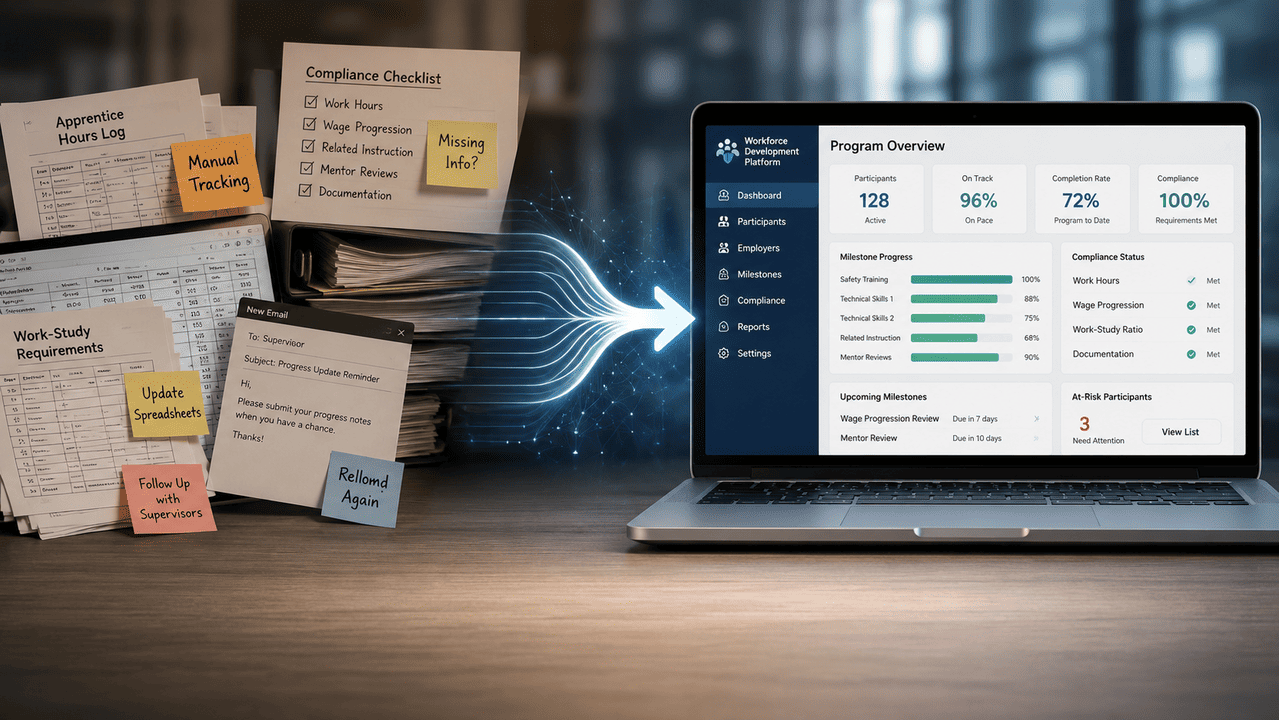
- Start with current apprentices: migrate active records first, beginning with the data fields that feed compliance reporting, specifically OJT hours, competency attainments, and enrollment dates.
- Set the platform up in parallel before cutting over: run the new system alongside existing tools for one reporting period so coordinators can verify that platform outputs match manual calculations.
- Migrate historical records in a second phase: closed program records and alumni data can follow after the active program is stable on the new system.
- Use the platform’s onboarding support: the implementation resources a vendor provides are most valuable in this transition window.
Most teams complete the critical migration in four to six weeks when they follow a structured handoff rather than attempting a simultaneous cutover.
How to Evaluate and Select the Right Apprenticeship Software Platform: A Buyer’s Framework
Mapping Your Program’s Current State to the Capability Gap
Before evaluating any platform, map where your program actually stands. A new program in setup mode has different gaps than a 40-person program running on spreadsheets. The evaluation criteria shift depending on where you are.
Ask three diagnostic questions: Where does your compliance documentation break down first? Where does your intake process lose candidates? And where do apprentices disengage or exit early? The answers identify which capability gaps are urgent and which are secondary. A program with no compliance infrastructure needs a platform that enforces process from day one. A program that loses candidates between application and enrollment needs a talent-matching and pipeline layer. A program struggling with early attrition needs structured onboarding tools.
Knowing your specific gap prevents you from purchasing a platform optimized for someone else’s problem.
The Four Evaluation Dimensions That Separate Comprehensive Platforms From Point Solutions
Employer-Side Compliance and Admin Depth
Evaluate whether the platform treats RAPIDS submissions, OJT verification, and competency tracking as native workflows or bolt-on features. Native means the data model is built around these requirements. Bolt-on means someone adapted a general system with custom fields. The distinction shows up immediately when you try to generate a DOL-compliant report or trigger a wage increase milestone. Native systems do this without manual intervention.
Apprentice-Side Experience and Engagement Design
Ask the vendor to show you what an apprentice sees on day one. If the answer is a login page and a document folder, the platform was built exclusively for administrators. A platform with genuine apprentice-side design presents a structured onboarding checklist, a progress dashboard showing hours and competencies earned, and a communication channel to the program coordinator. These aren’t premium features. They’re retention infrastructure.
Talent Matching and Marketplace Connectivity
This is the dimension most buyers don’t know to ask about. Does the platform help you find apprentices, or only manage the ones you’ve already hired? A platform with marketplace connectivity lets you post program openings, define candidate criteria, and receive matched candidates from a pool of active program seekers. This transforms hiring from an external, manual process into a workflow that begins inside the platform.
Scalability, Integration, and Setup Timeline
A platform that works for 15 apprentices but degrades at 60 is a short-term fix. Confirm the platform’s architecture supports multi-site and multi-trade programs before you need that capacity. Verify documented integrations with your existing HRIS and payroll systems. And ask specifically about the setup timeline. A platform that requires six months of configuration before it’s usable is a risk for a program with active compliance obligations.
How Long Does It Take to Launch a Program Using Apprenticeship Software?
Setup timelines vary by program complexity and vendor, but most well-designed platforms allow an active program to be running within four to eight weeks of contract execution. The critical path typically runs through three phases: data migration of active apprentice records, configuration of OJT and competency tracking to match your registered program standards, and verification that the platform’s compliance outputs match your existing documentation.
Vendors who offer structured implementation support compress this timeline. Vendors who hand you a knowledge base and expect self-service extend it. Ask specifically what the vendor’s onboarding team does during those first weeks, and what the handoff looks like when setup is complete.
What the Best Option for Small Businesses and Growing Programs Looks Like
Small businesses and growing programs have a specific constraint: limited administrative capacity means the platform has to work well without a dedicated configuration team. The best option for this profile is a platform with pre-built program templates aligned to common registered apprenticeship occupations, straightforward enrollment workflows that don’t require specialist setup, and compliance reporting that runs automatically rather than requiring manual assembly.
Scale readiness also matters here. A small program that chooses a platform built only for its current size will face a re-platforming decision as soon as it grows. The better investment is a platform that handles 10 apprentices efficiently today and 100 apprentices without a structural overhaul later.
A Platform That Serves Both Sides: The Differentiator Worth Demanding
The capability gap that separates point solutions from comprehensive platforms comes down to one question: does the platform serve only the employer administrator, or does it serve both the employer and the apprentice? Most platforms answer that question with their architecture before you ever open a sales conversation.
A platform built for both sides produces measurably different outcomes. Better-matched candidates enter the program. Structured onboarding reduces early exits. Apprentice-facing progress visibility sustains engagement through the full program duration. These outcomes affect completion rates, workforce development ROI, and the long-term viability of the program itself. Demand this architecture. It exists.
Quick-Pick Recommendation Guide
| Your program stage and primary pain point | Prioritize these platform criteria |
|---|---|
| New program, no compliance infrastructure yet | Pre-built program templates, RAPIDS-native reporting, compliant setup workflows |
| Active program, manual tracking and audit risk | OJT verification automation, centralized document management, compliance audit trail |
| Active program, losing candidates before enrollment | Talent matching layer, pipeline management, structured intake workflows |
| Growing program, early attrition problem | Apprentice onboarding automation, progress dashboards, engagement tools |
| Scaling program, admin headcount constrained | Multi-site support, HR/payroll integrations, automated milestone triggers |
Use this to identify your first-priority dimension, then confirm the platform you’re evaluating delivers it natively, not through a workaround.
Conclusion: The Half-Solved Problem Is Costing You More Than You Think
Recapping the Two-Layer Problem Every Buyer Should Evaluate Against
The two-layer problem this article opened with is worth naming one final time in precise terms. The first layer is the administrative burden of managing an active apprenticeship program: OJT tracking, compliance documentation, RAPIDS reporting, and the coordination overhead that comes with all of it. The second layer is the talent lifecycle problem that sits upstream: finding qualified candidates, moving them through a structured intake, and keeping them engaged long enough to complete the program.
Most platforms solve the first layer. None of the administrative efficiency gains they deliver change the fact that the second layer remains entirely manual.
Why the Talent Lifecycle Lens Changes the Platform Decision
When you evaluate platforms only through the lens of administrative efficiency, every apprenticeship management software solution that handles OJT tracking and RAPIDS reporting looks roughly equivalent. The differentiation disappears into feature comparison tables. But when you evaluate through the talent lifecycle lens, from first candidate contact through program completion, a different question emerges: which platforms can actually support the full arc?
That question narrows the field significantly. A platform that connects talent discovery, structured onboarding, compliance tracking, and apprentice engagement in a single architecture is a fundamentally different investment than one that automates the paperwork and stops there.
The GoSprout Differentiator: Built for Both Sides of the Apprenticeship Marketplace
GoSprout is built as a two-sided platform from the ground up. Employers get the full employer-side infrastructure: RAPIDS-compatible reporting, OJT verification workflows, competency tracking, document management, and multi-program administration. Apprentices get a structured onboarding experience, progress visibility, and a pathway that connects them to program opportunities before they’re enrolled.
The marketplace layer means employers aren’t starting candidate sourcing from scratch each cohort. The apprentice-facing tools mean engagement doesn’t drop off after day one. And the compliance infrastructure means the program remains audit-ready without requiring manual reconciliation. That combination is what a genuine two-sided apprenticeship software platform looks like in practice.
Your Next Step: Evaluate Your Program Against the Full Capability Framework

Use the evaluation dimensions from this guide as your baseline. Map your program’s current pain points to the capability gaps they represent. Then evaluate any platform you’re considering against both sides of the equation: what it does for the employer administrator, and what it does for the apprentice.
If a platform can’t answer both questions with specifics, it’s solving half the problem. That half-solved problem is already costing you more than you think, in coordinator hours, compliance exposure, and apprentices who don’t make it to completion. The right apprenticeship software platform closes both gaps simultaneously. That is the standard worth holding every vendor to.
Frequently Asked Questions
Apprenticeship software is purpose-built to manage the full work-based learning lifecycle, from enrollment and OJT hour tracking to competency progression, wage milestones, and DOL compliance reporting. General HR software manages employment status and payroll. It has no native data model for apprenticeship-specific requirements like RAPIDS submissions or competency-based wage increases, which means every compliance workflow becomes a manual workaround rather than an automated process.
Compliance risk in a registered apprenticeship program is primarily a documentation problem. A purpose-built platform reduces that risk by making compliant documentation the default at every step: OJT hours are automatically routed to supervisor verification, wage progression triggers fire when milestones are reached, and audit trails are time-stamped and stored in a retrievable format. The platform enforces the processes that make records defensible, rather than simply storing data that may be incomplete or inconsistently formatted.
Most platforms on the market today manage apprentices only after enrollment. A full-lifecycle apprenticeship software platform with a talent-matching and marketplace layer goes further, allowing employers to post program openings, define candidate criteria, and receive matched candidates from a pool of active program seekers. This shifts hiring from an external, manual process into a structured workflow that begins inside the platform, and better-matched candidates consistently show stronger retention and completion rates.
A capable apprenticeship management platform should include automated enrollment with centralized record-keeping, OJT hour tracking with supervisor verification and an audit trail, competency tracking aligned to registered program standards, document management with expiration alerts, RAPIDS-compatible compliance reporting, scheduling tools connected to compliance documentation, and integration capability with existing HRIS and payroll systems. Platforms that also include talent-matching tools, structured onboarding workflows, and apprentice-facing progress dashboards offer the infrastructure needed to manage not just compliance, but program quality and retention.
The savings depend on program size and current process, but programs transitioning from manual management consistently report significant reductions in the administrative time spent on compliance documentation, record reconciliation, and reporting. For coordinators spending several hours per week on these tasks, a purpose-built platform typically recovers a meaningful portion of that time each cycle. The more consequential financial benefit, however, is reduced audit risk. A single compliance finding requiring legal review, corrective filings, or program suspension carries costs that routinely exceed the annual investment in a capable platform.
The four primary apprenticeship models are time-based, competency-based, hybrid, and front-loaded programs. Time-based programs advance apprentices when they accumulate a set number of OJT hours. Competency-based programs advance apprentices when they demonstrate defined skills regardless of time served. Hybrid programs combine both criteria. Front-loaded programs deliver related technical instruction at the outset before transitioning to on-the-job training. A capable apprenticeship software platform supports all four by design, with OJT tracking that logs hours and maps them to competency categories. Platforms that track only total hours cannot support competency-based or hybrid programs in a compliant way.