
Managing a registered apprenticeship program in 2026 demands more than spreadsheets and email chains. Between tracking individual apprentice milestones, documenting wage progressions, and meeting DOL reporting deadlines, organizations need purpose-built tools. This article breaks down what apprenticeship database software actually does, how RAPIDS fits into the picture, and what to prioritize when selecting a platform.
This article references concrete dates including the 2017 RAPIDS modernization, FY 2019–2020 pandemic impacts, and the 2024 system refresh.
Table of Contents
- What Is Registered Apprenticeship Program Database Software?
- How RAPIDS Fits Into the Apprenticeship Data Ecosystem (2017–2026)
- Core Capabilities of Apprenticeship Database Software
- Apprenticeship Data and Reporting (with Real Metrics)
- Specialized Apprenticeship Data Domains (States, Federal, Military)
- Choosing and Implementing Apprenticeship Database Software
- Frequently Asked Questions (FAQs)
What Is Registered Apprenticeship Program Database Software?
Apprenticeship database software is a specialized case management system for tracking apprentices, sponsors, occupations, related technical instruction, and program outcomes. In the United States, these platforms are critical for Registered Apprenticeship programs overseen by the U.S. Department of Labor and State Apprenticeship Agencies.
Centralized case management stores documents, case notes, and communication logs for each apprentice—replacing fragmented paper files with an auditable system of record. These systems also manage other relevant program information such as occupations and job openings, enabling organizations to manage compliance without drowning in administrative work. Advanced apprenticeship database software can provide disaggregated data, allowing organizations to analyze apprenticeship participation and outcomes at a more granular level.
Typical users include:
- State apprenticeship staff overseeing thousands of apprentices
- Employer sponsors logging OJT hours and milestones
- Intermediaries coordinating multi-employer programs
- Community colleges tracking related technical instruction
- Federal programs like the Office of Apprenticeship
National systems like RAPIDS serve as the primary platform for managing all relevant program information related to registered apprenticeships, including apprentices, occupations, and job openings, and display registered apprenticeship data across participating states, while organization-level tools often integrate or export data to meet state and federal requirements.

How RAPIDS Fits Into the Apprenticeship Data Ecosystem (2017–2026)
RAPIDS—the Registered Apprenticeship Partners Information Database System—is a specialized apprenticeship database software managed by the Employment and Training Administration within the Department of Labor. RAPIDS data provides detailed, disaggregated information on apprentices and programs, allowing for more precise insights into apprenticeship participation and demographics. The Employment and Training Administration funds and maintains this platform.
RAPIDS was modernized in 2017 with a transition to a cloud-based architecture and was most recently updated in 2024 with front-end and infrastructure improvements.
Key details:
- RAPIDS serves 25 Office of Apprenticeship states plus multiple remaining federally recognized SAAs as of the early-to-mid 2020s
- It stores individual apprentice records, sponsor data, occupations, job openings, and other relevant program information
- RAPIDS provides disaggregated data, allowing for additional specificity in analyzing apprenticeship trends and metrics
- The Registered Apprenticeship data is derived from 25 federally-administered states and 16 federally-recognized State Apprenticeship Agencies, which provide individual apprentice and sponsor data through RAPIDS
RAPIDS serves as the primary platform for managing apprentices, occupations, job openings, and other relevant program information in states that utilize it.
National statistics combine the federal workload (a federal subset from RAPIDS) with limited aggregate data submitted on a quarterly basis by SAA states and the military apprenticeship program (USMAP). This means software choosers need tools that integrate with RAPIDS or can export data compatible with federal reporting rules.
Core Capabilities of Apprenticeship Database Software
Any modern apprenticeship database should cover these functional areas:
| Capability | What It Does |
|---|---|
| Apprentice lifecycle management | Register apprentices, track status changes (active/suspended/completed), capture start/end dates |
| Sponsor and employer management | Store contact data, agreements, occupation lists, compliance documents |
| Occupation and program standards | Define work processes, required hours, related instruction for specific occupations |
| Related instruction tracking | Log classroom or online training hours from community colleges, unions, or private providers |
| Wage progression and milestones | Wage progression automation triggers required pay increases as apprentices reach specific milestones |
| Compliance and audit history | Built-in compliance tools help programs adhere to Department of Labor standards to prevent audit failures |
| Secure role-based access | Stakeholder portals provide secure, role-based dashboards for sponsors, employers, mentors, and apprentices |
Competency tracking allows mapping specific skill benchmarks to training tasks for apprentices. Real-time progress tracking provides immediate visibility into apprentices meeting milestones and those at risk. Mobile access and visual roadmaps enhance apprentice engagement by showing training progress and upcoming requirements.
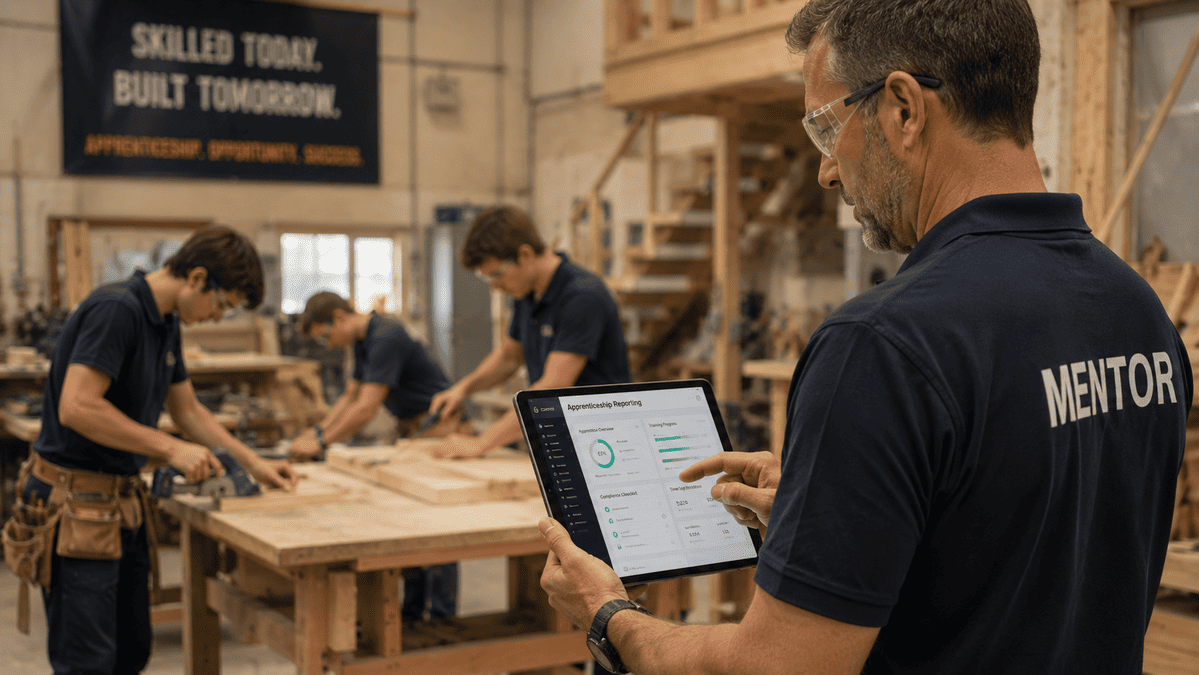
Automated compliance systems often feature built-in reporting for the U.S. Department of Labor, collecting necessary evidence for audits. Automation of administrative tasks can free up staff for high-value coaching in apprenticeship programs.
Apprenticeship Data and Reporting (with Real Metrics)
High-quality apprenticeship software is fundamentally about how data is collected, structured, and reported at individual and aggregate levels.
The COVID-19 pandemic resulted in a 12% decline in the number of new apprentices in FY 2020 compared to FY 2019, although FY 2020 still recorded the third-highest number of new apprentices ever for the Registered Apprenticeship program. In FY 2020, the U.S. Department of Labor’s Office of Apprenticeship used a combination of individual records and aggregate state reports to calculate national totals for active apprentices, new apprentices, graduates, active programs, and new programs.
Key definitions your software should mirror:
- New apprentices: Registration start date falls within the reporting period
- New programs: Programs registered during that period
- Active apprentices/programs: Registered, suspended, or reinstated at period end
- Completers: Completion dates fall inside the reporting period
Programs receiving federal funding, like WIOA, must comply with automated reporting requirements. Recommended reporting features include exportable data files (CSV/Excel) for state and federal reporting, dashboards for tracking trends across fiscal years, and demographic filters for equity analysis without exposing PII.
Specialized Apprenticeship Data Domains (States, Federal, Military)
Apprenticeship databases serve overlapping domains with their own set of requirements:
- State apprenticeship data: States track active apprentices, new apprentices, completers, and programs by fiscal year. Some manage data directly in RAPIDS; others maintain separate systems and provide limited aggregate data quarterly.
- Federal apprenticeship data: The DOL’s Office of Apprenticeship compiles the national data set from 25 OA states plus national programs and federally administered programs in SAA states.
- Military apprenticeship data (USMAP): Active duty Navy, Coast Guard, and Marines can earn civilian-recognized completion while serving, leading to a DOL Certificate of Completion for occupations like “USMAP Electrician (Navy).”
Effective software should distinguish between program type (state, federal, military), capture fields specific to military occupations and duty stations, and generate distinct reports for different stakeholders with greater detail and additional specificity where needed.
Choosing and Implementing Apprenticeship Database Software
By 2026, many apprenticeship sponsors are replacing spreadsheets with purpose-built platforms. Centralized communication serves as a single source of truth, consolidating communication between apprentices, mentors, and employers. Real-time analytics assist in identifying struggling apprentices and underutilized resources for proactive adjustments.
Selection criteria:
- Compliance alignment: Map fields to DOL and SAA definitions
- RAPIDS and state integration: Export/import data conforming to federal specifications
- Scalability: Handle growth leveraging cloud infrastructure
- Security: Role-based access, encryption, logging per federal standards
- Usability: Standardized workflows and templates allow organizations to manage large apprenticeship programs without increasing manual work
- Analytics: Built-in visualizations for high level metrics like year-over-year apprentice starts
Ecosystem integration connects with existing HRIS, payroll, or Learning Management Systems to reduce data silos. Top-tier platforms generally offer mobile apps that allow apprentices to log hours and upload evidence from job sites. Real-time logging of on-the-job training and related technical instruction hours can be done from any device.
Wage management features in some platforms can automatically notify administrators of required increases as apprentices complete skill benchmarks.
Want to Learn More About Your Registered Apprenticeship Opportunities?
BOOK A FREE CONSULTATION
Frequently Asked Questions (FAQs)
RAPIDS is the federal system serving 25 OA states as the official case management system. Vendor software like ApprentiScope or myOneFlow integrates with or exports to RAPIDS for compliance.
No. States with their own systems submit aggregate data quarterly. However, RAPIDS-compatible exports simplify federal reporting.
Most employers and sponsors report to SAAs or DOL on a quarterly basis, with several different sources combined for national statistics.
Yes. Modern platforms support both models, tracking hours alongside competencies for differing abilities and occupation requirements.
The 12% registration decline highlighted the need for robust tracking. The 2017 RAPIDS modernization and 2024 refresh improved capacity to search, process, and analyze data provided during disruptions.
Encryption, role-based access, and audit logs meeting federal data protection standards are non-negotiable for full compliance.
Records should be stored indefinitely for audits, employment verification, and certificate validation per DOL guidance.
Start with discovery and data mapping, pilot with limited sponsors, train staff using FY 2022 samples, then cut over at a fiscal year boundary for clean data from the development phase forward.


