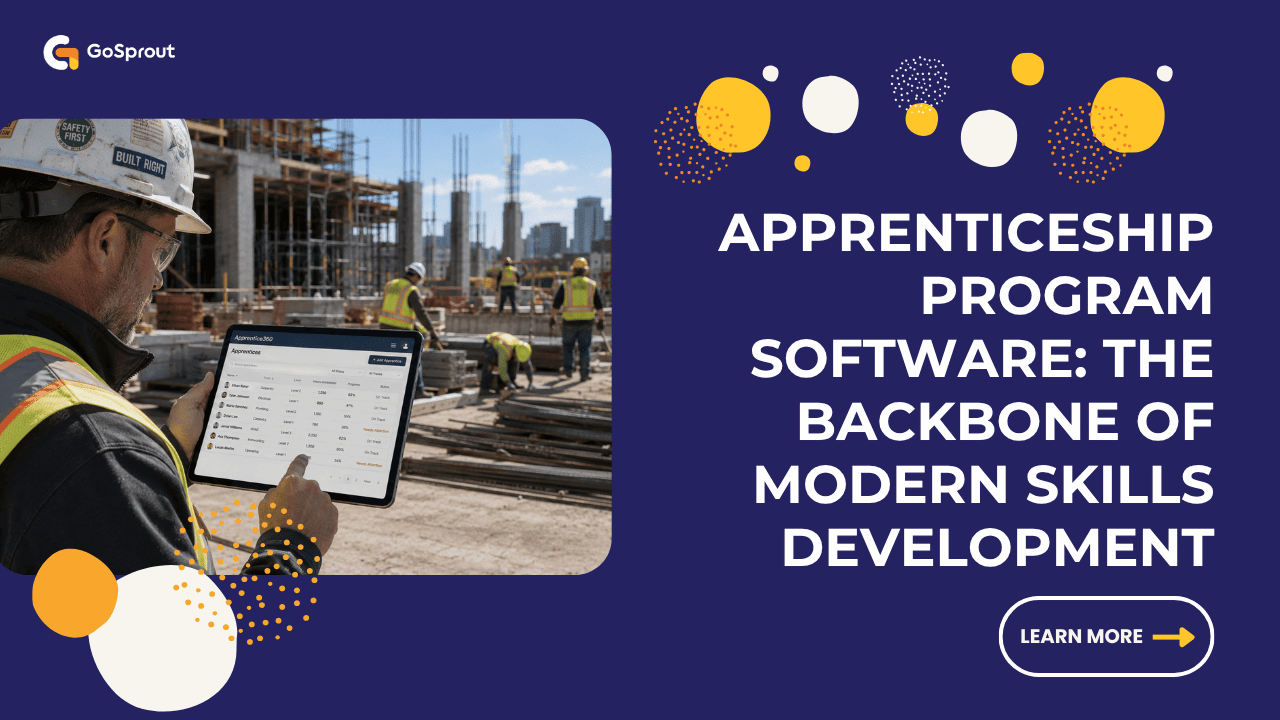
Managing an apprenticeship program with spreadsheets works until it doesn’t. Once your cohort exceeds 20-30 participants, scheduling conflicts multiply, compliance gaps emerge, and coordinators spend more time on logistics than on developing talent. Apprenticeship programs are increasingly recognized as a scalable solution to close the skills gap in various industries, and strong partnerships with organizations and communities have supported these programs in the past, demonstrating their long-term impact and historical significance.
This guide walks you through what apprenticeship program software actually does, how to evaluate vendors, and why engaging communities and partners is essential for successful scaling and implementation.
Table of Contents
- What Is Apprenticeship Program Software?
- Key Challenges in Managing Apprenticeship Programs Manually
- Core Capabilities of Apprenticeship Program Software
- Scheduling and Managing In-Person Training at Scale
- Designing Structured Learning Pathways (Technical & Professional Tracks)
- Measuring Outcomes and Proving ROI
- How It Works in Practice
- Implementation Checklist for HR and L&D Teams
- How to Choose the Right Apprenticeship Program Software Vendor
- Why Choose Our Apprenticeship Program Software
- Frequently Asked Questions About Apprenticeship Program Software
- Conclusion and Next Steps
What Is Apprenticeship Program Software?
Apprenticeship program software is a centralized digital system designed to plan, deliver, and track earn-and-learn programs across departments and locations. It replaces the patchwork of spreadsheets, email threads, and manual tracking that HR, L&D, and program managers typically wrestle with.
Want to Learn More About Your Registered Apprenticeship Opportunities?
BOOK A FREE CONSULTATION
Leading platforms emerged between 2015-2022 to support large-scale professional development programs, extending beyond traditional trades into the tech industry, healthcare, finance, and manufacturing. Typical users include HR teams, talent acquisition, L&D professionals, government-funded providers, and employers running programs for roles like software developer, data analyst, or cybersecurity specialist. Apprenticeship program software helps apprentices gain industry-specific knowledge through real-world projects and mentorship, enabling them to develop practical skills and understanding by working alongside experts.
Apprenticeship programs in technology fields often require candidates to be at least 18 years old and possess a high school diploma or equivalent, with many programs actively seeking applicants without a four-year degree. Many technology apprenticeship programs offer a blend of on-the-job training and formal education, allowing apprentices to gain practical experience while also earning academic credits towards a degree, a dual approach often facilitated by partnerships with educational institutions and employers.
Key Challenges in Managing Apprenticeship Programs Manually
Manual management breaks down once programs exceed about 20-30 apprentices per cohort. Here’s where things typically fall apart:
- Scheduling chaos: Double-booked rooms, missed sessions, and last-minute instructor cancellations become routine when planning calendars by hand
- Compliance risk: Proving logged hours, competencies, and assessment records to regulators or funding bodies becomes nearly impossible with scattered data
- Fragmented data: Apprentice information split across HRIS, LMS, spreadsheets, and paper forms slows reporting and introduces errors
- Inconsistent experience: Apprentices receive different training, mentorship, and assessments across sites because processes aren’t standardized
- High admin workload: Coordinators spend dozens of hours per cohort on logistics instead of improving program quality
Without standardized best practices, manual management often leads to inconsistent experiences and inefficiencies, making it difficult to scale apprenticeship programs effectively.
For a 100-apprentice cohort, coordinators can easily spend 200+ hours on scheduling and attendance tracking alone without software.
Core Capabilities of Apprenticeship Program Software
Modern platforms should deliver these essential features:
| Capability | What It Does |
|---|---|
| Apprentice lifecycle management | Centralized profiles from application through completion |
| Curriculum and pathway design | Tools to map frameworks and standards to role-based pathways |
| Scheduling and resource management | Automate timetables, allocate instructors, book rooms |
| On-the-job learning tracking | Log work projects, hours, and mentor sign-offs |
| Assessment and evidence collection | Digital assessments, portfolio uploads, supervisor reviews |
| Compliance tools | Configurable rules, audit-ready reports, automated alerts |
| Communication | Announcements, reminders, mentor-apprentice messaging |
| Analytics and reporting | Dashboards for completion rates, costs, satisfaction scores |
| Integrations | Connect with HRIS, ATS, payroll, LMS, and SSO |
| Search capabilities | Robust search functions allow users to quickly find information, track progress, or identify patterns in apprentice performance. |
System integration is important for syncing with existing Learning Management Systems or Human Resource Information Systems to prevent data silos. Time tracking is essential for logging both On-the-Job Training and Related Technical Instruction hours. Automated notifications can signal when an apprentice reaches a milestone that triggers a mandated pay increase.
Automated reporting tools should generate audit-ready documentation such as Department of Labor forms or RAPIDS reporting dashboards for compliance. Competency tracking maps specific skills and sub-competencies to learning objectives to ensure apprentices master their trade. Role-based dashboards provide tailored portals for apprentices, mentors, employers, and sponsors to access relevant data, which can lead to improved outcomes such as higher rates of apprentices transitioning to full-time positions.
A mobile-first approach is critical for apprentices to log hours and check roadmaps on site.
Scheduling and Managing In-Person Training at Scale
In-person training logistics present the biggest scaling challenge. Here’s how software helps:
- Coordinators see all cohorts, rooms, and instructors in a single calendar view to avoid conflicts
- Build recurring schedules for classroom blocks, bootcamps, and lab sessions months ahead
- Automated waitlists and capacity management prevent overbooking limited-seat workshops
- Capture attendance in real time via web, QR code, or mobile sign-in
- Track required safety or regulatory sessions and flag apprentices who fall behind
- Connect room utilization, instructor hours, and vendor costs to calculate true training cost per apprentice
Apprenticeship management software can significantly reduce administrative work associated with scheduling training. The use of apprenticeship management software allows for quick assignment of instructors and management of apprentices’ learning resources. Organizations typically see 30-50% reduction in scheduling admin time compared to spreadsheets.

Designing Structured Learning Pathways (Technical & Professional Tracks)
Pathways transform ad-hoc training into consistent, repeatable, role-based development. Companies like JP Morgan, IBM, Amazon, and General Assembly have built programs that create clear career paths for apprentices.
Key pathway features include:
- Year-by-year or phase-based roadmaps (Year 1 foundations, Year 2 specialization in software engineering, cybersecurity, or data analytics)
- Defined competencies, learning objectives, and milestones aligned to job roles
- Connect each competency to specific courses, projects, assessments, and mentoring activities
- Support multiple tracks—network engineering, business analysis, IT consultancy—under one program umbrella
- Individualized learning plans tailored to apprentices’ interests, career aspirations, and prior experience while meeting standards
- Visual progress maps for apprentices and managers to track position against pathway
Software engineering apprenticeships, for example, typically cover project definition, design, testing, and deployment under supervision across 12-48 months. Programs from organizations like Microsoft and Accenture demonstrate how structured pathways help participants develop key skills while building a strong professional network.
Measuring Outcomes and Proving ROI
Leadership will ask whether the investment works. Your system should track:
- Completion rates: Programs using software often achieve 85-95% versus 70% for manual management
- Time-to-productivity: How quickly apprentices contribute meaningfully
- Certification pass rates: Track exam results across cohorts
- Post-program retention: Percentage moving into full time position roles
- Engagement scores: Apprentice and mentor satisfaction via in-platform surveys
- Cost metrics: Training hours, instructor spend, cost per apprentice by pathway
Measuring these outcomes not only demonstrates ROI but also highlights the positive impact apprenticeship programs have on local communities and workforce development, fostering stronger relationships and economic mobility. Research indicates that reskilled workers who participate in apprenticeship programs tend to outperform their peers in key areas such as attitude, work ethic, productivity, and innovation. One 150-apprentice program reduced early drop-out by 18% and improved on-time completion by 12% after implementing software.
How It Works in Practice
Here’s a typical workflow from planning to completion:
- Planning phase: Design pathways, map standards, create sessions, upload materials, and set up integrations with your existing tools
- Recruitment and onboarding: Enable applicants to search for open apprenticeship roles that match their skills and interests, import applicants from ATS, assign initial pathways, automate orientation classes, and invite successful candidates to join the program
- Day-to-day operations: Schedule management, attendance tracking, mentor assignments, communication, and issue logging
- Line manager role: Reviewing progress, signing off competencies, approving work-based projects online
- Apprentice interaction: Viewing schedule, submitting assignments, tracking progress, requesting support
- Completion: Generate evidence packs, certificates, and compliance reports for regulators
Consider a data analytics cohort starting October 2026 with 50 participants on a 24-month pathway. The software automates roughly 80% of admin tasks, ensuring 90% on-time progress through milestones.
Implementation Checklist for HR and L&D Teams
Planning to adopt apprenticeship program software in the next 3-9 months? Follow this checklist:
- [ ] Define objectives: Is your priority compliance, scale, cost savings, or apprentice experience?
- [ ] Map current processes and systems (HRIS, LMS, ATS) to clarify integration needs
- [ ] Involve stakeholders: HR, L&D, IT, finance, line managers, and experienced mentors
- [ ] Standardize existing apprentice records, competency frameworks, and training catalogs
- [ ] Pilot with one or two cohorts before rolling out organization-wide
- [ ] Plan change management: communications, training sessions, and support
- [ ] Define 3-5 metrics to evaluate year one (admin hours saved, satisfaction, on-time completion)
How to Choose the Right Apprenticeship Program Software Vendor
When comparing vendors in 2026, evaluate these factors:
- Feature fit: Does it cover in-person training, on-the-job learning, compliance, and reporting for your industry?
- Scalability: The system must be scalable to manage growth from a few apprentices to hundreds without added administrative complexity
- Usability: Intuitive interfaces keep adoption high across apprentices, mentors, and administrators
- Implementation support: Ask about onboarding services, configuration help, and typical time to go-live
- Data security: Software should prioritize security features like encryption and multi-layered access controls to protect sensitive data. Check certifications and data residency options
- References: Request clients in your region and industry with programs launched since 2020
- Total cost of ownership: Consider licensing, implementation, integrations, and per-apprentice fees over multiple years
Such software helps organizations better track compliance with training requirements and regulations for apprentices.
Why Choose Our Apprenticeship Program Software
We built our platform specifically for apprenticeship and workforce development—not a generic LMS retrofitted for a different purpose.
- Apprenticeship-native design: Every feature supports earn-and-learn models, from OJT tracking to compliance documentation
- In-person training at scale: Manage complex multi-site programs with hundreds of apprentices per intake
- Structured pathways: Support modern professional roles including software engineering, cybersecurity, data analytics, and IT consultancy
- Compliance and audit readiness: Configurable rules, time-stamped records, and one-click evidence exports for regulators and funders
- Seamless integrations: Connect with common HRIS, ATS, and LMS platforms to eliminate manual data entry
- Dedicated implementation: Our team delivers clear timelines (typically 8-12 weeks to first cohort) with ongoing success reviews
Contact us for a tailored demo focused on your 2026-2027 apprenticeship growth plans. We can model time and cost savings using your real data.

Frequently Asked Questions About Apprenticeship Program Software
Yes. An LMS focuses on content delivery, while apprenticeship software manages the entire program lifecycle—including rotations, on-the-job learning, compliance, and competency tracking.
Absolutely. Most organizations enroll 20-50 apprentices or a single pathway before expanding to other roles and regions.
Typically 6-12 weeks depending on integrations and complexity. Timeline should be agreed during scoping with your vendor.
Intuitive design plus short orientation sessions (30-60 minutes) are usually sufficient for confident use.
Leading platforms align with national standards and provide audit trails, though configuration must match each country’s requirements.
Modern systems are configurable, allowing new pathways, cohorts, and rules without heavy custom development.
Yes—whether you partner with a university or run an internal program, the software adapts to your structure.
Conclusion and Next Steps
Apprenticeship program software has become essential infrastructure for organizations serious about building sustainable talent pipelines. The benefits are clear: reduced admin burden, stronger compliance, better apprentice experience, and measurable ROI.
Apprenticeship programs promote inclusive opportunity, equity, and economic mobility by tapping into a motivated talent pool that is more likely to stay than traditional hires. These programs also play a vital role in strengthening professional and local communities, fostering trust and collaboration among members. Research confirms that reskilled workers outperform peers on criteria including attitude, productivity, engagement, attendance, and innovation.
Review your current processes and identify where software could deliver the biggest impact over the next 12-18 months. Explore our platform through a demo, discovery call, or sandbox environment tailored to your 2026 intake plans. Join our community to further your apprenticeship journey and connect with like-minded professionals.
The future of skills development runs through apprenticeships. The right technology helps you succeed at scale.


