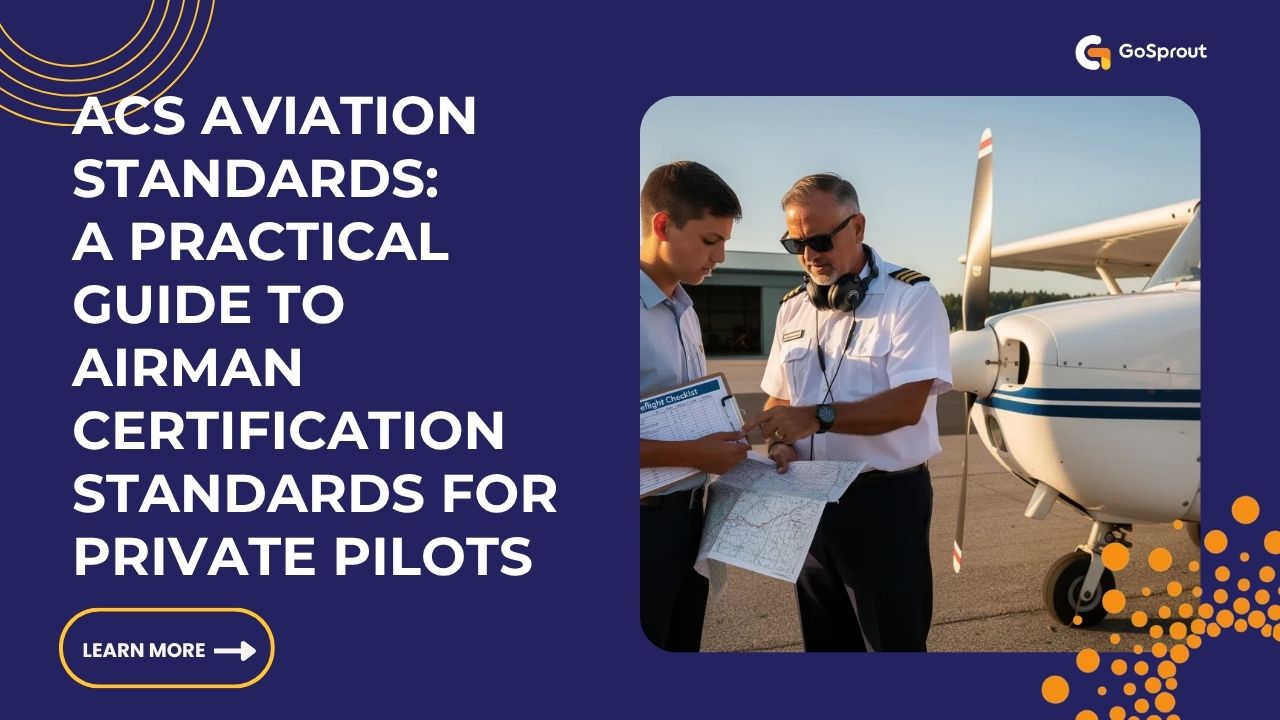
If you are training for a private pilot certificate, the Airman Certification Standards are not just another FAA document to skim before your checkride. They are the roadmap for what you must know, how you must manage risk, and how well you must fly.
The challenge is that the ACS can feel dense at first. It contains task codes, testing rules, performance tolerances, and references that can look more like a regulatory manual than a training guide.
This article breaks down how ACS works, how it replaced the older PTS system, and how private pilot applicants can use it to prepare for the FAA knowledge exam and practical test with more confidence.
Table of Contents
What Are ACS Aviation Standards?
“ACS Aviation Standards” refers to the FAA’s Airman Certification Standards, the official testing and certification framework used for many pilot certificates and ratings in the U.S. If you are pursuing a pilot certificate today, ACS tells you what the applicant must know, what risks the applicant must consider, and what flight skills the applicant must demonstrate during certification.
The Airman Certification Standards are published by the Federal Aviation Administration, part of the U.S. Department of Transportation. More specifically, the Airman Certification Standards (ACS) are the minimum performance standards set by the Federal Aviation Administration (FAA) for pilot certification.
In practical terms, the ACS connects the written exam, oral questioning, and flight portion of the practical test into one consistent process. For a deeper resource, bookmark our ACS aviation standards page and compare it with the official FAA documents as you train.
The ACS replaced the older standards PTS, or Practical Test Standards, for most pilot airplane certificates between 2016–2024. The first major ACS rollout for Private Pilot Airplane and Instrument Rating took effect in June 2016, and later updates, including the May 2024 revisions, continued the transition to a more modern certification model.
The airman certification standards (ACS) framework is important because it reflects how pilots actually fly. Instead of separating textbook knowledge from cockpit decisions, the ACS brings aeronautical knowledge risk management and flight proficiency together in the same task.
ACS vs. PTS: How Standards Evolved
The shift from Practical Test Standards (PTS) to ACS was not just a formatting change. The FAA made the change because older testing methods were often criticized for encouraging rote memorization and isolated maneuver practice rather than real-world decision-making.
Historically, the FAA knowledge tests were criticized for containing outdated questions with little relevance to modern flying. The ACS helps fix that by linking the knowledge exam to the practical test and by tying each question to a real skill or risk management outcome.
What the PTS were
Before ACS, the Practical Test Standards were the primary guide for the practical test. The PTS functioned mainly as a checklist of maneuvers, procedures, and tolerances.
For example, a private pilot applicant might be required to demonstrate steep turns within a certain altitude tolerance or complete a short-field landing within a stated distance. The PTS told examiners what to evaluate, but it did not always make the connection between knowledge risk management and the physical flight maneuver clear.

That is why many instructors and students treated the old practical test standards pts as a maneuver checklist: learn the maneuver, hit the numbers, and answer oral questions separately.
What ACS added
The ACS expands the old PTS model by organizing every task around three core pillars:
- Aeronautical Knowledge
- Risk Management
- Flight Proficiency, also called Skills
Every evaluation task within an ACS document is structured around three core pillars: Aeronautical Knowledge, Risk Management, and Flight Proficiency (Skills). This means each task includes what the pilot must know, what hazards the pilot must identify and mitigate, and what the pilot must physically do in the aircraft.
Aeronautical Knowledge addresses the fundamental theory behind a maneuver and includes aircraft systems and regulations. Knowledge Elements refer to the theoretical understanding required for flight operations, including aerodynamics, aircraft systems, and weather theory.
Risk Management emphasizes real-world Aeronautical Decision Making (ADM) and the identification of hazards and risks. Risk Management Elements involve the ability to identify, assess, and mitigate real-world flight hazards and execute aeronautical decision-making (ADM).
Skill Elements pertain to the physical ability to manipulate flight controls and perform flight maneuvers within specific defined tolerances. Flight Proficiency (Skills) involves the execution of flight maneuvers within precise operational tolerances.
In short, ACS is not just asking, “Can you fly the maneuver?” It is also asking:
- Do you understand the aerodynamics and procedures behind it?
- Can you identify the real-world risks?
- Can you perform the task safely and consistently?
Key FAA milestones
Here are the milestones most private pilot applicants should know:
| Year | Change |
|---|---|
| 2016 | Initial ACS rollout for Private Pilot Airplane and Instrument Rating in June 2016 |
| 2018 | ACS-6B became a key version for Private Pilot Airplane |
| 2024 | ACS-6C became effective May 31, 2024 |
| 2016–2024 | ACS replaced PTS for most pilot airplane certification areas |
The ACS is now the primary standard for the private pilot certificate, instrument rating, commercial pilot certificate, and many other pilot airplane certificates. Some specialized areas may still reference legacy PTS in certain contexts, but for most modern airplane training, the ACS is the standard to use.
The Airman Certification Standards represent a modern and systematic approach to pilot testing, providing a comprehensive document that unifies knowledge, risk management, and practical skills. The ACS represents a modern and systematic approach to pilot testing, providing a comprehensive document that unifies knowledge, risk management, and practical skills, moving beyond the outdated Practical Test Standards (PTS).
How ACS Shapes Your Private Pilot Practical Test
The private pilot airplane practical test, often called the checkride, is built around ACS tasks. A Designated Pilot Examiner uses the ACS to decide what to test, how to structure the oral and flight portions, and what performance standards the applicant must meet.
By detailing exactly what an applicant must know and do, the ACS acts as a unified contract between the applicant, the instructor, and the Designated Pilot Examiner (DPE). That shared framework helps everyone prepare from the same set of expectations.
How the ACS connects to the FAA knowledge test
The ACS established a system of unique codes that link every question on a knowledge test directly to a corresponding flight proficiency skill or risk management requirement.
After the FAA knowledge exam, your Airman Knowledge Test Report may show ACS codes for missed questions. Those codes are not random. They point to specific items in the ACS that need review before the practical test.
For example, if you miss questions tied to weather information, cross-country planning, or aircraft performance, your instructor can use the codes to build a focused study plan. The examiner may also address those missed areas during the oral portion of the practical test.
This is one of the biggest advantages of ACS. It makes the process more transparent. Instead of guessing what went wrong on the exam, you can trace each missed question back to a task, knowledge element, or risk area.
How a DPE uses ACS during the checkride
A DPE uses the ACS task structure to evaluate your readiness in the airplane category and class you are testing for. For many private pilot applicants, that means airplane category single engine land, often written as ASEL.
During a private pilot airplane checkride, the examiner may evaluate tasks such as:
- Preflight preparation
- Weather briefing and go/no-go decisions
- Aircraft systems and airworthiness
- Airport operations
- Normal, short-field, and soft-field takeoffs and landings
- Slow flight and stalls
- Ground reference maneuvers
- Navigation and diversion
- Emergency operations
- Basic instrument skills
Each maneuver or task has standards. The applicant must meet the knowledge, risk management, and skill requirements associated with the task.
Example: landing standards in ACS
The ACS includes detailed performance standards that an applicant must meet, which are organized into chapters corresponding to different phases of flight, outlining specific tasks defined by Knowledge, Risk Management, and Skills objectives.
A practical example is the private pilot landing standard. The Airman Certification Standards (ACS) specify that a private pilot landing must result in touchdown at a proper pitch attitude, within 400 feet beyond or on the specified point, with no side drift, and with the airplane’s longitudinal axis aligned with and over the runway center/landing path.
That single standard tells you a lot. You are not just trying to “make a decent landing.” You must manage pitch attitude, aim point, drift, alignment, runway centerline, and touchdown accuracy at the same time.
Why studying the ACS improves checkride readiness
Studying directly from the ACS aligns your flight training, knowledge test preparation, and checkride expectations.
A smart approach is to ask after each lesson:
- Which ACS task did we train today?
- Which knowledge elements support this task?
- Which risk management elements did we discuss?
- Which performance tolerances did I meet or miss?
- What needs improvement before the exam?
This keeps training from becoming a collection of disconnected maneuvers. It also improves your odds of first-time success because you know exactly how the examiner will evaluate you.
Inside the Private Pilot Airplane ACS (ACS‑6C)
The current FAA Private Pilot Airplane ACS, ACS‑6C, is the core reference for private pilot airplane applicants. It is the document that organizes the requirements, test codes, and standards used for the private pilot practical test.
The official FAA ACS documents can be found on the Federal Aviation Administration’s Airman Certification Standards page. Always use the current version that applies to your certificate, rating, category, and class.
What ACS‑6C contains
ACS‑6C is not a short checklist. The May 2024 edition is about 100+ pages and covers Private Pilot Airplane category with classes like Single Engine Land and Multi Engine Sea. It also addresses applicable airplane classes such as single engine, multi engine, land and sea operations.
Common sections include:

- Introduction and applicability
- Use of the ACS
- Applicant and examiner responsibilities
- Knowledge test codes
- Areas of Operation
- Task descriptions
- Required references
- Performance standards
- Appendices and supporting information
The ACS is organized into chapters that correspond to different phases of flight, outlining specific tasks defined by Knowledge, Risk Management, and Skills objectives.
For example, Private Pilot Airplane ACS‑6C includes task areas related to:
- Preflight Preparation
- Preflight Procedures
- Airport Operations
- Takeoffs, Landings, and Go-Arounds
- Performance and Ground Reference Maneuvers
- Navigation
- Slow Flight and Stalls
- Basic Instrument Maneuvers
- Emergency Operations
- Night Operations
- Postflight Procedures
Depending on the category and classes involved, some tasks apply differently. A single engine land applicant will not have the same sea operations requirements as an applicant training in engine land and sea aircraft.
The three-column task structure
The heart of the ACS is the task table. Each task is divided into three categories:
| ACS pillar | What it means | Example |
|---|---|---|
| Knowledge | What the pilot must know | Weather theory, aircraft systems, airspace, regulations |
| Risk Management | What the pilot must identify and mitigate | Runway contamination, distractions, fuel planning, wind shear |
| Skills | What the pilot must do | Maintain airspeed, altitude, heading, alignment, and tolerances |
The ACS includes aeronautical knowledge, risk management, and flight proficiency standards necessary for certification, and it supersedes the previous Practical Test Standards (PTS).
This structure is what makes ACS more comprehensive than the old PTS. It recognizes that safe aviation depends on knowledge risk management and physical aircraft control, not just one of those elements.
Why the document scope matters
Because ACS‑6C is detailed, it can feel intimidating at first. But that detail is helpful. The ACS provides a clear framework for pilot certification, reducing subjectivity in evaluations by outlining specific tasks and performance standards for each certificate type.
The ACS provides a clear, objective framework for pilot certification, reducing the subjectivity of individual examiners. That does not mean every checkride is identical, but it does mean the examiner’s plan must be built around FAA standards rather than personal preference.
Students and instructors should keep a current copy of ACS‑6C available throughout training. Please do not wait until the week before your checkride to open the document.
Use it before:
- First solo
- Cross-country training
- Night flight
- Knowledge exam preparation
- Stage checks
- Final checkride preparation
The FAA also publishes supporting documents such as the ACS Companion Guide for Pilots, which helps explain codes, test reports, and archived items.
Using ACS in Your Flight Training Program
ACS should be used from day one of flight training. It is not a last-minute checklist to memorize after your instructor signs you off.
Scenario-Based Training encourages flight schools to utilize realistic scenarios rather than treating training as a list of isolated tasks. The ACS facilitates a shift from rote memorization and practicing maneuvers in isolation to integrated, real-world scenario-based training.
That shift matters because real flying rarely presents one isolated problem at a time. A pilot may need to manage weather, airspace, passenger pressure, fuel planning, aircraft performance, and workload during the same flight.
How students can use ACS
As a student pilot, you do not need to memorize every page on day one. But you should become familiar with how the guide is organized.
Here is a practical way to use it:
- Download the current ACS for your certificate and rating.
- Mark the tasks that apply to your airplane category and class.
- Match each lesson to at least one ACS task.
- After each flight, note which standards you met and which need work.
- Review knowledge and risk elements before repeating the maneuver.
- Use ACS codes from the written exam to guide remedial study.
- Track progress before scheduling the practical test.
For example, if your lesson covers short-field landings, do not only practice the touchdown. Review the aircraft performance data, obstacle clearance planning, stabilized approach criteria, runway surface conditions, and go-around decision points.
That is what risk management and flight proficiency look like in real training.
How instructors can use ACS
Instructors can build syllabi around ACS standards so each lesson covers knowledge, risk management, and skills.
A strong ACS-based lesson plan might include:
- The task name and ACS code
- Ground discussion items
- Relevant FAA references
- Risk management prompts
- Flight proficiency standards
- Common applicant errors
- Completion criteria
- Debrief questions
This helps prevent training gaps. It also gives the instructor and applicant a more objective way to decide whether the applicant is ready for the next phase.
For stage checks, CFIs can evaluate performance against proficiency standards rather than using vague comments like “needs improvement” or “almost ready.” A more useful comment would be: “Short-field landing accuracy is not yet consistently within the ACS tolerance, and go-around decision-making needs earlier recognition.”
Yes, that kind of feedback is more direct. It is also more useful.
Using ACS codes after the knowledge exam
If your knowledge test report includes missed ACS codes, do not treat them as a formality. Build a remediation plan before scheduling the practical test.
A simple remediation table can help:
| Missed area | ACS task | Study action | Flight connection |
|---|---|---|---|
| Weather information | Preflight Preparation | Review Aviation Weather Handbook | Apply to go/no-go decisions |
| Aircraft performance | Performance and Limitations | Recalculate takeoff/landing distances | Practice short-field operations |
| Airspace | National Airspace System | Review chart symbols and requirements | Plan cross-country route |
| Emergency procedures | Emergency Operations | Review checklist flow | Practice simulated failures |
The standard is updated by the FAA Airman Testing Section to reflect shifts in regulatory requirements. That is why relying on old notes, outdated gouges, or a random page found online can lead to bad information.
Safety benefits of ACS-based training
ACS-based training does more than prepare you to pass. It builds habits that carry into future ratings and real-world flying.
The ACS is built directly into the FAA’s Safety Management System (SMS) framework and targets the root causes of general aviation accidents. This is one reason risk management is not treated as a side topic. It is built into every task.
The ACS provides an audited trail ensuring every licensed aviator qualifies to command an aircraft. In other words, the certification process is not just about one examiner’s opinion on one day. It is part of a broader system designed to verify that each licensed pilot meets national standards.
Role of the FAA and Department of Transportation in ACS
The Federal Aviation Administration is the agency responsible for developing and maintaining ACS under the authority of the U.S. Department of Transportation. If you see the federal aviation administration faa referenced in testing materials, it is referring to the same federal agency that governs pilot certification standards in the United States. Official FAA publications and resources typically display the FAA logo to identify authoritative guidance and certification materials.
FAA rulemaking, advisory circulars, handbooks, and ACS documents work together to support pilot certification and aviation safety. Regulations establish legal requirements, while FAA handbooks and ACS documents provide the testing and training framework that instructors, applicants, and examiners use.
Updates to ACS, such as the May 2024 revisions, reflect changes in technology, industry best practices, safety data, and regulatory requirements. Pilots should always reference the latest official FAA version before any exam or practical test.

The federal aviation administration maintains current ACS documents through its testing resources, and those documents may include updated references to modern avionics, weather resources, risk management guidance, and aircraft systems.
Compliance with ACS during certification is part of the broader U.S. aviation safety system governed by the department of transportation. This matters because pilot certification is not just an individual achievement; it is a public safety process within the national airspace system.
The FAA has also expanded the ACS to include aviation maintenance technicians (AMTs) to reflect modern aviation technologies and safety systems. That expansion shows that the ACS model is not limited to pilots; it is becoming part of a broader aviation certification framework.
When in doubt, use official FAA documents rather than unofficial summaries. You can use summaries, videos, and instructor notes as learning aids, but the current FAA ACS is the controlling resource for certification.
Why ACS Matters for Different Pilot Certificates
ACS now exists for multiple levels of pilot certificates and ratings, not just private pilot airplane. The same basic structure applies across many certificates: knowledge, risk management, and flight proficiency.
A private pilot certificate focuses on foundational flying, safe aircraft control, airspace, weather, navigation, and decision-making. A commercial pilot certificate uses the same ACS concept but raises the level of precision, professionalism, and operational judgment expected from the pilot.
An instrument rating adds another layer. Instrument ACS tasks focus heavily on weather, procedures, navigation systems, approach briefings, missed approaches, and workload management in reduced visibility or instrument meteorological conditions.
Common structure, higher expectations
The structure remains familiar as you advance:
- Knowledge: What must the pilot understand?
- Risk Management: What hazards must the pilot identify and mitigate?
- Skills: What must the pilot do within standards?
The difference is that the standards become more demanding. The pilot must demonstrate greater precision, stronger decision-making, and better command of complex operations.
For example, a private pilot may be expected to demonstrate basic instrument skills to recover from inadvertent visual reference loss. An instrument-rated pilot must manage full instrument procedures with accuracy and situational awareness.
Category and class matter
The ACS version and required tasks may vary by certificate, rating, category, and class. For airplane applicants, that may include:
- Airplane category
- Single engine land
- Single engine sea
- Multi engine land
- Multi engine sea
A private pilot airplane applicant in single engine land aircraft will use the tasks applicable to that class. An applicant pursuing privileges in sea airplanes will have additional sea-specific operations. The same idea applies when moving from private pilot airplane to more advanced ratings or certificates.
Think of ACS as a career-long standards framework, not a one-time hurdle. If you learn to use it well during private pilot training, it becomes easier to prepare for instrument, commercial, instructor, or additional category and class ratings later.

Common ACS Questions (FAQ)
What is the difference between ACS and PTS?
PTS focused mainly on practical test maneuvers and tolerances. ACS includes aeronautical knowledge, risk management, and flight proficiency standards in one document, making it more connected to real-world flying and modern pilot certification.
Do I still need to know the Practical Test Standards?
For most current private pilot airplane applicants, no. ACS has superseded the previous Practical Test Standards for the applicable certificate and rating, although some specialized areas or older references may still mention PTS. If you are unsure, ask your instructor or examiner which current document applies to your practical test.
Where can I download the latest Private Pilot Airman Certification Standards?
You can download the latest Private Pilot Airman Certification Standards from the Federal Aviation Administration’s official ACS page. Always confirm that you are using the current ACS edition for your pilot certificate, rating, airplane category, and class before training for an exam.
How do ACS codes on my knowledge test report affect my checkride?
ACS codes on your knowledge test report show the subject areas connected to missed questions. Before the practical test, review each code with your instructor, connect it to the relevant task, and be ready to discuss that area with the examiner. This is one of the most useful ways to turn the written exam into targeted checkride preparation.
Does ACS apply outside the United States?
ACS is an FAA standard and applies to FAA certificates and ratings in the U.S. However, flight schools and instructors outside the United States may reference ACS as a high-quality training benchmark, especially when preparing applicants for an FAA pilot certificate.
Is ACS only for private pilots?
No. ACS applies to multiple pilot certificates and ratings, including private pilot, instrument rating, commercial pilot, and other FAA certification areas. The FAA has also expanded the ACS model to aviation maintenance technicians, showing its broader use in aviation certification.
What should I bring to an ACS-based checkride?
Bring the required documents, aircraft records, personal identification, knowledge test report, endorsements, navigation planning materials, and any items your instructor or examiner requests. Also bring a working understanding of the ACS tasks that apply to your test, because the examiner’s plan of action will be built around those standards.
Can ACS reduce checkride subjectivity?
Yes, that is one of its major purposes. The ACS provides specific tasks, codes, tolerances, and evaluation areas so applicants, instructors, and examiners work from the same standard. Examiner judgment still matters, but ACS creates a clearer and more consistent certification process.
Want to Learn More About Your Registered Apprenticeship Opportunities?
BOOK A FREE CONSULTATION
Conclusion and Next Steps
ACS aviation standards are the roadmap to earning a safe, modern private pilot certificate. They explain what you must know, what risks you must manage, and what flight skills you must demonstrate to pass the practical test and operate confidently as pilot in command.
Before scheduling a checkride, download the current ACS document for your airplane category and rating. Review it with your flight instructor, build your study plan around ACS tasks, and track your progress against specific standards rather than vague impressions.
Here are your next steps:
- Download the current FAA ACS for your certificate.
- Match your lessons to specific ACS tasks.
- Review missed knowledge exam codes early.
- Practice risk management as part of every flight.
- Use stage checks to confirm readiness before the practical test.
A strong checkride result starts long before exam day. Treat ACS as your training guide from the beginning, and you will be better prepared not just to pass, but to fly with safer judgment, sharper skills, and more confidence.
Understanding ACS Aviation Standards is one of the best ways to prepare for successful pilot certification and safer flying. Visit our website to explore additional resources, training guidance, checkride preparation strategies, and FAA certification insights designed to help you apply ACS principles throughout your flight training journey. Whether you are preparing for a private pilot certificate or advancing to higher ratings, our resources can help you train with greater confidence and clarity.


