Table of Contents
- Why Most Apprenticeship Software Is Solving the Wrong Problem
- What Is Apprenticeship Database Software and How Does It Work?
- RAPIDS, RAPs, and Regulatory Requirements: What Your Software Must Actually Handle
- Core Features to Evaluate: Enrollment, Time Tracking, and Competency Management
- The Employer Perspective: Recruiting, Onboarding, and Building a Talent Pipeline
- The Apprentice Experience: How Platform Design Shapes Program Outcomes
- Cost-Benefit Analysis: Implementation Reality and Measuring ROI
- Beyond Compliance: Strategic Talent Development, Retention, and Career Pathing
- How to Choose the Right Platform: A Decision Framework
- Evaluate for Talent Value, Not Just Regulatory Coverage
- Frequently Asked Questions
Why Most Apprenticeship Software Is Solving the Wrong Problem
The Compliance-First Trap: How the Market Got Narrowly Defined
The apprenticeship software market was largely built around a single administrative problem: satisfying the U.S. Department of Labor’s RAPIDS reporting requirements for Registered Apprenticeship Programs. That origin story matters, because it explains why most platforms on the market today are optimized for compliance administrators rather than the hiring managers, operations leads, and workforce development teams who actually run these programs day to day.
When a market gets defined by its regulatory context, the products that emerge tend to reflect that framing. Platforms compete on how cleanly they integrate with federal reporting workflows, how well they track OJT hours against DoL standards, and how thoroughly they document apprentice progress for audit purposes. These are real requirements. They are not, however, the full job.
What Hiring Managers Actually Need vs. What Most Platforms Deliver

Hiring managers evaluating apprenticeship database software are rarely asking whether a platform will satisfy their RAPIDS submission. They are asking how the platform handles sourcing, how it moves candidates through an intake process, whether it automates the onboarding paperwork they currently manage by hand, and what visibility it gives them into cohort progress over time.
Most platforms deliver on one end of that list. The result is a common pattern: organizations purchase a compliance-capable system, then rebuild the recruitment and onboarding workflows they needed in spreadsheets, email threads, and disconnected HR tools. The administrative burden does not disappear. It relocates.
The Full-Funnel Argument: From Candidate Discovery to Career Pathing
A well-run apprenticeship program is not a compliance exercise with a hiring component attached. It is a structured talent pipeline with a defined entry point in candidate discovery and recruitment, an operational core in onboarding, training progression, and hour tracking, and a long-term output in retained, competency-verified employees with documented career trajectories.
Each stage of that funnel has distinct software requirements. Recruitment needs candidate matching and communication tools. Onboarding needs automated agreement workflows and document management. Progression needs competency tracking tied to structured milestones. Career pathing needs data that connects program completion to internal mobility outcomes. A platform that handles only one or two of these stages forces program managers to stitch together the rest manually, which introduces exactly the compounding administrative costs that software is supposed to eliminate.
What Apprenticeship Management Software Actually Does Beyond Training
Training content delivery is visible and easy to demo. The harder operational work happens around it: intake and enrollment processing, wage schedule documentation, related technical instruction coordination, multi-cohort progress reporting, and end-of-program certification management. These functions do not generate compelling product screenshots, but they represent the majority of administrative hours a program coordinator actually spends.
The best apprenticeship management systems treat training as one module within a broader program lifecycle platform, not as the product’s primary feature. That distinction is a useful diagnostic when you are evaluating vendors.
What Is Apprenticeship Database Software and How Does It Work?
A Clear Definition for Decision-Makers
Apprenticeship database software is a purpose-built platform that centralizes the records, workflows, and reporting functions required to administer structured work-based learning programs. At minimum, it tracks apprentice enrollment, OJT and related instruction hours, competency progression, and program documentation. More capable platforms extend into recruitment, onboarding automation, employer-apprentice matching, and workforce analytics.
The category sits at the intersection of an HRIS, a learning management system, and a compliance reporting tool. No single legacy category covers the full scope, which is one reason purpose-built apprenticeship management systems have emerged as a distinct product type.
The Core Functions of an Apprenticeship Management System
A functional apprenticeship management system handles four operational layers:
- Record management: Apprentice profiles, enrollment agreements, sponsor and employer data, and program documentation stored in a single system of record.
- Progress tracking: OJT hour logging, related technical instruction completion, and competency milestone verification tied to program standards.
- Compliance reporting: Automated or streamlined output for DoL RAPIDS submissions, state agency reporting, and audit documentation.
- Communication and workflow: Notifications, task assignments, and status updates that keep coordinators, employers, and apprentices aligned across the program lifecycle.
Platforms that add recruitment and onboarding functionality extend these layers upstream, capturing the full apprentice journey from initial application through program completion.
How Work-Based Learning Programs Create Unique Administrative Demands
Apprenticeships differ from standard training programs in one structurally important way: the employer is both a program sponsor and an active participant in the learning process. That dual role creates administrative complexity that generic LMS platforms are not designed to handle. Hour tracking must reflect actual on-the-job work, not just course completions. Competency verification requires input from workplace supervisors, not just instructors. Wage progression ties to documented milestone achievement, creating a payroll dependency that most learning platforms ignore entirely.
These interdependencies are why apprenticeship programs typically overwhelm teams that try to manage them with standard HR software. The workflows are structurally different, not just more complex.
Can Apprenticeship Programs Exist in the Digital and Tech Sector?
Why Modern Business Functions Are Expanding RAP Eligibility
Yes, and this is one of the more significant shifts in how employers should think about the category. The DoL has steadily expanded the list of occupations eligible for Registered Apprenticeship designation beyond the traditional construction and manufacturing trades. Roles in cybersecurity, software development, data analytics, healthcare information technology, and business operations now qualify for Registered Apprenticeship Program status in many states. The Software and Data Foundation apprenticeship framework, active in several states, is a direct example of this expansion into technical roles.
This matters because organizations in sectors that have historically considered apprenticeships irrelevant to their hiring model now have access to the same wage subsidy frameworks, community college partnerships, and employer tax incentives that trade-based programs have used for decades.
Implications for Platform Selection in Non-Trade Industries
Tech and business-sector organizations evaluating apprenticeship database software face a specific mismatch: most platforms on the market were designed around trade program workflows, with hour categories, competency frameworks, and documentation templates built for craft occupations. A cybersecurity team running a Registered Apprenticeship Program needs a platform that can accommodate custom competency frameworks, flexible related instruction formats (often online or hybrid), and employer reporting workflows that map to knowledge-based role progressions rather than task-based trade skills.
When evaluating platforms, non-trade organizations should directly ask whether the system supports custom occupation standards and configurable competency frameworks. The answer separates platforms built for the full apprenticeship market from those built for a specific trade context.
Apprenticeship Management System Platform Evaluation Rubric
Use this rubric to score platforms during a structured vendor evaluation. Rate each dimension on a 1-to-5 scale, then weight by your organization’s priorities.
| Evaluation Dimension | What to Assess | Key Questions to Ask |
|---|---|---|
| Compliance capability | RAPIDS integration, state reporting, documentation standards | Does the platform generate DoL-ready reports automatically? Does it support multi-state program management? |
| Recruitment and matching | Candidate intake, application workflows, employer-candidate discovery | Does the platform support a candidate-facing portal? Can you source applicants within the system? |
| Onboarding automation | Agreement generation, document collection, task workflows | Does onboarding require manual data entry, or does the system automate document routing and status tracking? |
| Progress and competency tracking | OJT hour logging, milestone verification, supervisor input | Can supervisors log and verify hours directly in the platform? Are competency frameworks configurable? |
| Candidate and apprentice experience | Interface usability, mobile access, communication tools | What does the apprentice-facing view look like? Can apprentices track their own progress? |
| Integration and interoperability | HRIS, ATS, and payroll connectivity | Does the platform offer documented API access? What integrations exist out of the box? |
| Scalability | Multi-program management, cohort volume, enterprise workflows | How does the platform perform across multiple programs and locations simultaneously? |
Weight the dimensions by your program context. A first-time employer launching a single-trade program should prioritize compliance capability and onboarding automation. A mid-market employer building a recurring technical talent pipeline should weight recruitment, candidate experience, and integration more heavily. Score each vendor against the same rubric to create a defensible comparison, not a vendor-influenced shortlist.
Want to Learn More About Your Registered Apprenticeship Opportunities?
BOOK A FREE CONSULTATION
RAPIDS, RAPs, and Regulatory Requirements: What Your Software Must Actually Handle
What Is RAPIDS and Why It Exists
RAPIDS, the Registered Apprenticeship Partners Information Data System, is the DoL’s national database for tracking active Registered Apprenticeship Programs and the apprentices enrolled in them. Program sponsors use it to register new occupations, submit apprentice enrollment records, report progress, and document completions or cancellations. It is the federal system of record for the Registered Apprenticeship Program ecosystem, and any organization running a DoL-registered program will interact with it regularly.
RAPIDS exists to give the federal government visibility into apprenticeship program activity, labor market outcomes, and demographic participation data. For employers, it functions as a compliance requirement attached to program registration, not an operational tool for managing the program itself.
What a Registered Apprenticeship Program Requires from an Administrative Platform
A Registered Apprenticeship Program creates several specific administrative obligations that a platform must support. The program must define a training plan with documented OJT hours and related technical instruction requirements. Each apprentice’s progression must be tracked against that plan. Wage schedules tied to milestone achievement must be documented. Regular status updates must be submitted to RAPIDS, including enrollment confirmations, progress reports, and completion or cancellation records.
A platform that supports this kind of program management needs to capture all of this in a format that maps cleanly to RAPIDS data fields, reducing the manual effort of translating internal records into federal reporting format. The more a platform automates that translation, the less administrative time coordinators spend on data entry.
Key Differences Between RAPIDS and Private Apprenticeship Platforms
RAPIDS is a government database, not program management software. It records outcomes rather than helping you manage the process that produces them. Private apprenticeship management platforms sit between the employer and RAPIDS, providing the operational workflows, tracking tools, and documentation systems that make RAPIDS submissions possible.
Some platforms position themselves primarily as RAPIDS submission tools, offering just enough functionality to satisfy federal reporting requirements. Others treat RAPIDS compliance as one feature within a broader program management platform. The distinction has significant operational implications: organizations that buy a compliance-first platform will still need to manage recruitment, onboarding, and day-to-day coordination somewhere else.
What Compliance Requirements Does Apprenticeship Program Tracking Software Need to Cover?
Hour Monitoring, Progress Reporting, and Documentation Standards
At the compliance layer, a platform must accurately log two categories of hours: on-the-job training (OJT) and related technical instruction (RTI). These hours must be tracked separately, attributed to the correct apprentice and program, and verified against the standards established in the program’s training plan. Documentation requirements include signed apprenticeship agreements, wage schedule records, and evidence of competency milestone completion.
Programs subject to federal or state audit need this documentation organized and retrievable on short notice. Platforms that store records in disconnected files or require manual aggregation create real audit risk, regardless of whether the underlying data is accurate.
Multi-State Apprenticeship Management and Jurisdictional Variance
Organizations that operate apprenticeship programs across multiple states face a layer of compliance complexity that single-state platforms are not equipped to handle. State Apprenticeship Agency requirements vary by jurisdiction, and some states have their own reporting systems that operate alongside or separately from RAPIDS. A platform managing programs in multiple states needs to accommodate different documentation standards, approval workflows, and reporting cadences without requiring a separate administrative process for each location.
This is a specific capability to pressure-test with any vendor under evaluation. Ask directly how the platform handles multi-state apprenticeship management and which state-specific requirements it currently supports.
Why Compliance Capability Is Necessary but Not Sufficient
Meeting compliance requirements is the floor, not the ceiling, of what apprenticeship database software should deliver. A platform that satisfies RAPIDS submissions but requires manual recruitment workflows, paper-based onboarding, and disconnected progress tracking is not solving the problem most hiring managers face. It is solving the narrowest version of it.
The organizations that get the most operational value from their apprenticeship software are the ones that evaluated platforms against the full program lifecycle, not just the reporting endpoint. Compliance capability confirms that a platform is eligible for consideration. It does not determine which platform is the right fit.
Core Features to Evaluate: Enrollment, Time Tracking, and Competency Management
Apprentice Enrollment Management and Onboarding Automation
Enrollment is where most manual processes break first. When a new cohort arrives, coordinators are typically managing signed agreements, background documentation, wage schedule confirmations, and system access across multiple tools simultaneously. A capable platform centralizes this intake into a single automated workflow: application receipt, document collection, agreement generation, and profile creation all happen in sequence without requiring manual data transfer between systems.
The test for any platform is how much human intervention the enrollment process actually requires. If a coordinator still needs to export data from a spreadsheet and re-enter it into the apprenticeship management system, the enrollment module is not solving the problem.
How to Keep Track of Apprenticeship Hours Across Multiple Cohorts
Hour tracking across cohorts is operationally simple in concept and consistently problematic in practice. The core requirement is that OJT and RTI hours log separately, attribute to the correct apprentice and program, and remain verifiable by a supervisor without requiring a coordinator to chase confirmation emails.
Platforms handle this differently. Some require coordinators to enter hours on behalf of apprentices. Better-designed systems let apprentices log their own hours through a mobile-accessible interface, with supervisor verification built into the workflow. The difference matters at scale: a coordinator managing three concurrent cohorts of 20 apprentices cannot sustainably serve as the data entry point for 60 people’s weekly hour logs.
When evaluating platforms, ask specifically how supervisor verification works and whether the system flags discrepancies against the training plan automatically.
Competency Management and Structured Progress Monitoring
Competency tracking is the layer that separates a time-tracking tool from an actual program management system. An apprentice can log 2,000 OJT hours without demonstrating that they have achieved the competencies those hours were supposed to build. Platforms that only track hours are measuring activity, not progress.
A functional competency management module links documented milestones to specific program standards, requires supervisor sign-off at defined intervals, and surfaces gaps before they become program completion problems. For non-trade programs in particular, configurable competency frameworks matter: a cybersecurity apprenticeship has entirely different milestone structures than a pipefitting program, and a platform that cannot accommodate that distinction will require workarounds from day one.
Document Management at Scale: Certifications, Agreements, and Audit Trails
Every apprenticeship program produces a significant volume of documentation: enrollment agreements, wage schedule amendments, RTI completion records, competency sign-offs, and program completion certificates. In a single cohort, that volume is manageable. Across multiple cohorts, programs, and state jurisdictions, it becomes an audit liability if it is not systematically organized.
The standard to apply is retrieval speed. If a state agency requests documentation for a specific apprentice’s program completion within 48 hours, how many steps does that take your team? Platforms with centralized, searchable document repositories and version history reduce that answer to minutes. Systems where documents are stored in email threads or shared drives do not.
Integration With Existing HRIS, ATS, and Business Workflows

Why Workflow Compatibility Is the Decision-Maker’s Actual Friction Point
The compliance features of an apprenticeship management system are relatively easy to evaluate on a product demo. The harder operational question is whether the platform will fit into the workflow ecosystem your team already uses. An AMS that does not connect to your HRIS creates a duplicate data entry problem for every new hire. One that does not communicate with your ATS requires manual candidate transfers at the point of enrollment. These friction points do not show up in feature checklists, but they drive the majority of post-implementation frustration.
What to Ask Vendors About API Access and System Connectivity
Do not accept a general answer about integration capability. Ask for the specific list of systems the platform has documented integrations with, whether those integrations are bidirectional, and what the process looks like for connecting systems that are not on that list. If the vendor’s answer is that they can build a custom integration for your use case, clarify the timeline, cost, and who owns ongoing maintenance. A platform with clean API access and documented developer resources is a meaningfully different proposition than one that handles integrations through one-off professional services engagements.
Program Scalability: Evaluating Platforms for Multi-Program and Enterprise Growth
A platform that works well for a single 20-person cohort may not hold up when you add a second program, a second location, or a second state jurisdiction. Scalability is not just about data volume. It is about whether the platform’s permission structures, reporting architecture, and administrative workflows can accommodate organizational complexity without requiring a separate instance or a custom build for each new program.
Ask vendors how multi-program management actually works in the interface, not just whether it is supported. The distinction between a platform that technically handles multiple programs and one that handles them cleanly is often visible only in a live demonstration with your specific program structure as the test case.
The Employer Perspective: Recruiting, Onboarding, and Building a Talent Pipeline
Why Manual Tracking and Disconnected Systems Create Compounding Costs
Disconnected systems do not create a single large problem. They create a series of small inefficiencies that compound across every cohort cycle. A coordinator who spends several hours per week reconciling spreadsheet data with a compliance platform loses a substantial portion of their productive time annually on a task that a properly integrated system eliminates entirely. Multiply that across two or three staff members, add the error rate that manual data transfer introduces, and the cost of not investing in a unified platform becomes a measurable operational drag rather than a theoretical concern.
Recruitment Bottlenecks That Apprenticeship Software Should Eliminate
Most apprenticeship programs still treat recruitment as a manual process managed outside the program platform. Job postings go to general job boards, applications arrive by email, and candidate screening happens in spreadsheets. This workflow does not scale and introduces delays at exactly the point where candidate interest is highest.
Purpose-built apprenticeship database software should handle candidate intake directly, with program-specific application flows, automated acknowledgment communication, and a coordinator-facing pipeline view that shows every candidate’s status without requiring manual updates. If your current process involves a coordinator forwarding application emails to a hiring manager, the platform is not solving the recruitment problem.
Centralizing Onboarding: Moving from Paper-Based to Automated Workflows
Paper-based onboarding for apprenticeship programs is not just slow. It creates compliance exposure. Unsigned agreements, missing documentation, and incomplete wage schedule records are exactly the audit findings that disrupt program status. Automated onboarding workflows eliminate these risks by making document completion a prerequisite for enrollment confirmation, not a follow-up task.
The operational goal is a system where a newly accepted apprentice receives a structured onboarding task list, completes required documentation through a digital portal, and enters active program status without a coordinator manually chasing each item. That workflow exists in well-designed platforms and is absent in compliance-only tools that treat onboarding as outside their scope.
Building a Repeatable Talent Pipeline Through Program Data and Cohort Visibility
The organizations that use apprenticeships as a genuine talent pipeline treat cohort data as a strategic asset. Completion rates, time-to-competency, retention at 12 and 24 months post-completion, and promotion rates for program graduates are all measurable with the right platform. These metrics tell you which recruitment channels are producing the best candidates, which parts of the program are causing attrition, and what a fully scaled cohort model would produce in hiring volume per year.
Platforms that only track compliance data cannot generate these insights because they are not capturing the upstream and downstream data points that make them possible. The decision to invest in a full-lifecycle platform is partly a decision to treat your apprenticeship program as a data-generating talent function, not just an administrative obligation.
What Features Should I Look for in Apprenticeship Management Software?
Use this checklist during vendor evaluation. Each item maps to a real operational workflow, not a feature marketing category.
- Candidate-facing application portal with program-specific intake forms
- Automated document routing and digital agreement signing at enrollment
- Separate OJT and RTI hour logging with mobile access for apprentices
- Supervisor verification workflow built into the hour logging process
- Configurable competency frameworks tied to program-specific milestones
- Centralized document repository with version history and audit trail
- RAPIDS-compatible reporting output with automated data mapping
- Multi-state program support with jurisdiction-specific documentation
- Integration with existing HRIS and ATS via documented API or native connector
- Cohort-level reporting dashboard with completion rates and progress visibility
- Apprentice-facing progress tracker accessible without coordinator mediation
Any platform that cannot demonstrate each of these capabilities in a live environment, rather than a slide deck, warrants a direct follow-up question about timeline and implementation scope.
The Apprentice Experience: How Platform Design Shapes Program Outcomes
Why the Candidate-Facing Interface Is a Structural Differentiator
Employers evaluate apprenticeship platforms from the administrator’s view. Apprentices experience them from a completely different one, and that experience has measurable consequences for program outcomes. A platform that is difficult to navigate, mobile-unfriendly, or opaque about what an apprentice is supposed to do next creates disengagement before the program’s substantive work even begins.
This is not a UX preference. It is a structural problem. Programs that require apprentices to contact a coordinator to find out their current hour totals or pending task requirements are creating unnecessary friction at every touchpoint.
Ease of Use, Accessibility, and Adoption Rates Among Apprentice Cohorts
Adoption rates are the honest measure of platform usability. A system that coordinators need to repeatedly remind apprentices to use is one that is not serving its users well. The benchmark is whether an apprentice can complete their weekly hour log, check their competency progress, and access their next RTI requirement without any coordinator intervention or instructional support.
Mobile accessibility is a baseline requirement, not a premium feature. A significant portion of apprentices in trade and technical programs do not have consistent desktop access during working hours. A platform that functions only as a desktop web application will see lower completion rates on time-sensitive logging tasks simply because of access constraints.
How Software Design Affects Engagement, Retention, and Program Completion
The causal chain here is direct: apprentices who can clearly see their progress stay more engaged, and engaged apprentices complete programs at higher rates. Platforms that present milestone progress visually, surface upcoming requirements proactively, and communicate directly with apprentices through the system create a different behavioral environment than platforms where that information is only available to administrators.
Program attrition is rarely the result of a single decision to leave. It builds from accumulated friction: unclear expectations, delayed feedback, and the sense that no one is tracking whether you are progressing. A well-designed apprentice interface reduces all three.
The Dual-Sided Platform Argument: Serving Employers and Opportunity Seekers Simultaneously
Most apprenticeship platforms are built for one primary user: the administrator. The apprentice is a data subject in the system, not a participant with their own interface and functionality. This asymmetry creates a structural gap that platforms built around the dual-sided marketplace model are specifically designed to close.
A dual-sided platform treats employers and apprentices as co-users with distinct but connected needs. Employers need administrative control and reporting visibility. Apprentices need progress transparency, task clarity, and communication access. A platform that delivers both creates a shared operational environment rather than a one-directional reporting relationship, which is more consistent with how high-functioning apprenticeship programs actually operate.
What the Highest-Performing Apprenticeship Programs Have in Common

Consistently high-performing programs share a platform characteristic that is easy to overlook during evaluation: the platform reduces dependency on individual coordinators rather than concentrating it. When program visibility, task completion, and communication are distributed across the system, programs survive coordinator transitions, scale without proportional staff increases, and generate consistent outcomes across cohort classes.
Programs that depend on a single coordinator’s knowledge, email history, and spreadsheet management are one personnel change away from a significant operational disruption. Platform architecture either distributes that dependency or concentrates it, and the difference is visible in how the system handles routine functions without human intervention.
Cost-Benefit Analysis: Implementation Reality and Measuring ROI
Common Pricing Models: Subscription, Per-Seat, and Enterprise Licensing
Apprenticeship management platforms typically price along three models. Subscription pricing charges a flat recurring fee regardless of cohort size, which favors organizations with high and variable apprentice volumes. Per-seat pricing charges per active apprentice, which is cost-effective for smaller programs but can become expensive as programs scale. Enterprise licensing involves custom pricing based on organizational size, program complexity, and required integrations, and typically includes dedicated implementation and support.
The pricing model matters because it shapes your total cost of ownership as the program grows. A per-seat model that looks affordable at 25 apprentices may create a significant budget increase at 150. Ask vendors to model your projected apprentice volume over three years before committing to a pricing structure.
Honest Implementation Timelines: What Onboarding a New Platform Actually Involves
Most vendors quote implementation timelines in weeks. Actual go-live timelines depend on factors that are rarely fully scoped in an initial sales conversation: data migration from existing systems, integration configuration with your HRIS and ATS, staff training, and the time required to configure competency frameworks and program templates for your specific occupations.
A realistic expectation for a mid-market organization with one or two existing programs and moderate integration requirements is 60 to 90 days from contract signature to full operational deployment. Organizations with complex multi-state programs, custom occupation standards, or deep HRIS integration requirements should plan for longer. The vendors worth working with will provide a detailed implementation plan before you sign, not after.
How to Measure ROI From an Apprenticeship Program
Recruiting Speed, Hiring Conversion, and Retention Rate as Primary Metrics
ROI measurement for an apprenticeship program starts with three baseline metrics that the platform itself should be able to generate. Recruiting speed measures the time from application to enrollment confirmation, which a well-functioning intake workflow should reduce measurably compared to a manual process. Hiring conversion tracks the percentage of program completers who move into full-time employment, which is the primary output metric for a talent pipeline program. Retention rate at 12 and 24 months for program graduates, compared to hires from other channels, is the long-term value indicator that justifies the program’s cost.
These metrics require a platform that captures data at the recruitment stage, not just the compliance stage. A system that only tracks enrolled apprentices cannot generate recruiting speed data because it has no record of pre-enrollment candidate activity.
Building an ROI Model With Your Own Program Variables
A basic ROI model for an apprenticeship program works from four inputs:
- Program cost per apprentice, including platform fees, coordinator time, RTI costs, and wage premiums
- Hiring conversion rate, meaning the percentage who become full-time employees
- Retention premium, meaning how much longer program graduates stay versus external hires
- Replacement cost for a comparable role, typically estimated between 50% and 150% of annual salary for skilled positions
If your program places 20 apprentices per year, converts a significant majority to full-time employment, and those employees stay considerably longer than external hires, the retention premium alone can represent substantial avoided turnover expense annually. The question is not whether the program generates value. It is whether your platform captures enough data to make that value visible to the people who control program budget decisions.
Trade-Offs to Evaluate Honestly Before Committing to a Platform
Every platform involves trade-offs that do not appear in a feature matrix. A purpose-built compliance platform may have cleaner RAPIDS integration but require manual workarounds for recruitment and onboarding. A broader workforce platform may handle recruiting and onboarding well but require custom configuration to meet Registered Apprenticeship Program documentation standards. A newer entrant with a modern interface may lack the multi-state compliance depth that a more established platform has built over years of regulatory updates.
The trade-offs to take most seriously are the ones that create ongoing operational costs rather than one-time implementation challenges. A missing integration that requires a coordinator to manually transfer data every week is a recurring cost. A compliance reporting gap that surfaces at audit time is a concentrated risk. Weigh those differently than UI preferences or feature gaps in capabilities you will not use for 12 months.
Beyond Compliance: Strategic Talent Development, Retention, and Career Pathing
Workforce Development as Long-Term Business Value, Not Administrative Overhead
Apprenticeship programs that are designed only to satisfy compliance requirements produce compliant graduates. Programs that are designed as talent development systems produce retained employees with documented competency progression, internal promotion potential, and measurable contributions to workforce planning. The difference in outcome is largely a function of how the program, and the platform supporting it, was originally scoped.
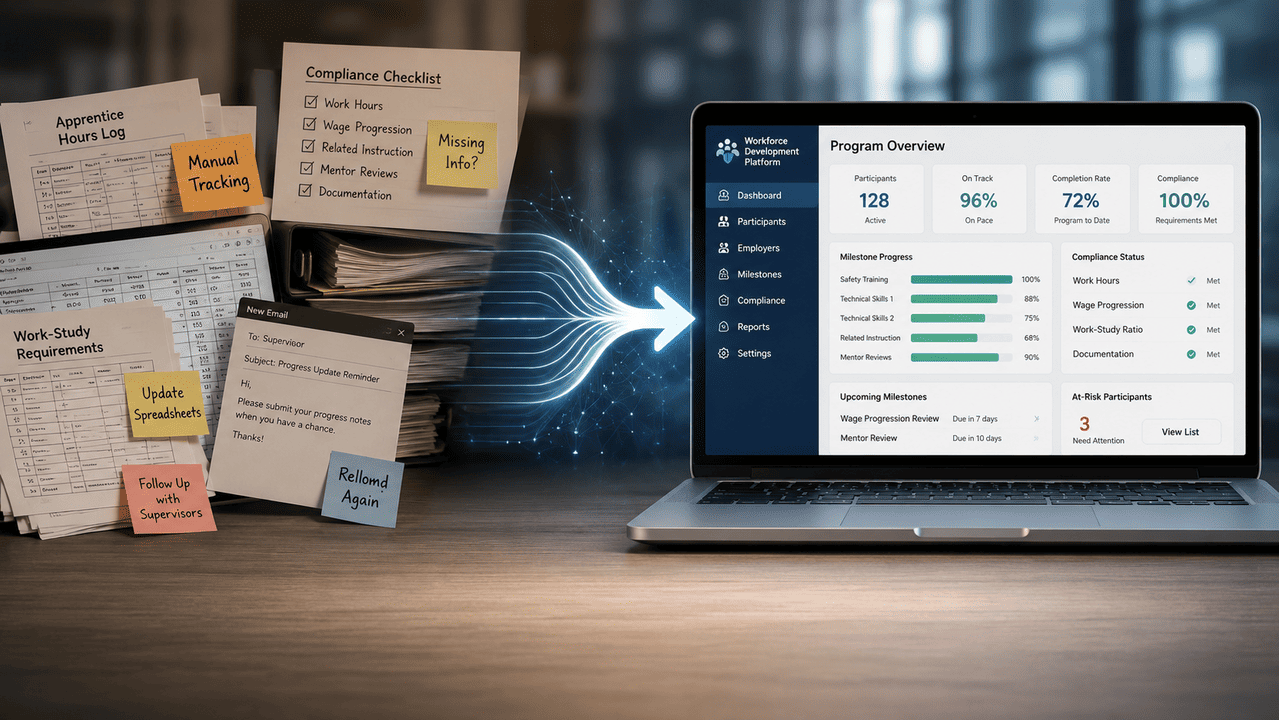
The administrative overhead of running a structured program is real. Treating the program as overhead, however, is a choice rather than a given. Organizations that treat apprenticeship as a repeatable talent function, comparable to a recruiting channel with a longer lead time, tend to measure it differently, fund it more consistently, and get more durable results from it.
How Competency Data Unlocks Retention Strategy and Internal Mobility
The competency records an apprenticeship program generates are more actionable than most organizations use them for. A documented milestone record does not just satisfy audit requirements. It tells a manager exactly what an employee can do, verified at a specific point in their development by a supervisor who worked alongside them. That is a higher-confidence skills signal than a resume or a hiring interview produces.
Organizations that connect competency data to internal mobility decisions retain apprenticeship graduates longer because those employees can see a credible path to the next role. When a platform surfaces competency gaps relative to an adjacent position, it turns a passive retention tool into an active development conversation. Platforms that treat competency records as compliance artifacts rather than talent data leave this capability unused.
Career Pathing Features That Convert Apprentices Into Long-Tenure Employees
Career pathing within an apprenticeship platform works at two levels. The first is role progression within the program itself, where milestone completion maps to wage increases and expanded responsibilities. The second is post-completion mobility, where program graduates can see what additional competencies or credentials would qualify them for advancement.
The apprentices most likely to leave after program completion are the ones who finish and have no visible next step. Platforms that present a defined pathway, with the competency requirements for the next level clearly mapped, give graduates a reason to stay and a structure to work toward. This is not a retention gimmick. It is a direct response to the most common reason early-career employees leave: not dissatisfaction with the current role, but uncertainty about what comes next.
Connecting Apprenticeship Program Performance to Broader Workforce Planning
A program that tracks completion rates, time-to-competency, and post-completion retention generates the inputs a workforce planning function needs to forecast future hiring demand. If your program consistently produces a defined number of fully qualified technicians per year at a predictable conversion rate, that output belongs in your annual headcount model alongside external recruiting projections.
Most organizations do not make this connection because the data lives in a compliance platform that HR leadership does not access for strategic planning purposes. Moving that data into a dashboard that reports alongside other talent metrics changes how leadership perceives the program’s value, which directly affects how much it gets funded and scaled.
How to Choose the Right Platform: A Decision Framework
Step One: Define Your Program Scope and Operational Complexity
Before you evaluate a single vendor, document what you are actually trying to run. A single-trade program with 15 apprentices in one state is a different administrative problem than a multi-occupation program spanning three states with 200 active apprentices across rotating cohorts. The platforms suited to each scenario overlap only partially.
Define your program scope along four dimensions: number of active programs, total apprentice volume and growth trajectory, states of operation, and existing systems that need to connect to the new platform. These four variables will determine which features are essential versus optional and will allow you to disqualify platforms that cannot meet your baseline requirements before you invest time in a full evaluation.
Step Two: Map Your Existing Workflow Gaps Before Evaluating Vendors
Vendor demos are optimized to show you what a platform does well. They are not designed to surface where your specific workflow gaps are. If you go into a demo without a mapped list of the processes you are currently managing manually or poorly, you will leave with a confident impression of the product and no clear answer to whether it solves your actual problems.
The gaps worth mapping before any vendor conversation include: where candidate data lives before it enters your tracking system, how onboarding documents are currently collected and stored, who is responsible for hour verification and how they confirm it, and how you currently generate the reports your compliance obligations require. These are the friction points a new platform needs to resolve, and they are the right test cases for a live demonstration.
Step Three: Score Platforms Against the Full-Funnel Evaluation Rubric
Use the evaluation rubric introduced earlier in this article as your scoring framework. Rate each platform across compliance capability, recruitment and matching, onboarding automation, progress and competency tracking, candidate experience, integration, and scalability. Weight the dimensions by your program context, not by which features make the best demo.
The value of a structured rubric is that it prevents vendor enthusiasm from substituting for comparative analysis. A platform that demos beautifully on the compliance module but cannot answer your integration questions concretely should not score as well as one that handles both. The rubric creates a defensible record of how you evaluated each option, which matters when you are presenting a platform recommendation to leadership.
Step Four: Pressure-Test Vendor Claims on Compliance, Integration, and Support
Three areas where vendor claims most commonly diverge from implementation reality are compliance depth, integration capability, and post-sale support.
On compliance, ask the vendor to walk through a RAPIDS submission using your specific program structure, not a generic demo account. On integration, ask for documentation of the API and a list of systems with active, maintained connectors. On support, ask what the escalation path looks like when you encounter a reporting error the week before a compliance deadline. The quality of the answers to these three questions is a better predictor of implementation success than any feature demonstration.
GoSprout’s Approach: Connecting Employers and Candidates in a Unified System
How a Dual-Sided Architecture Addresses Both Employer and Apprentice Needs
GoSprout is built around the observation that apprenticeship database software has historically served one user well, the administrator, while treating the apprentice as a passive record in the system. The platform’s dual-sided architecture gives employers the administrative control, reporting visibility, and compliance documentation they need, while giving apprentices their own interface for progress tracking, task completion, and communication.
This structure addresses a real operational gap. When apprentices can see their own progress, log hours directly, and receive proactive communication through the platform rather than waiting for a coordinator to relay information, engagement rates improve and coordinators spend less time on status updates and more time on program quality.
Where GoSprout Fits in the Platform Landscape for Mid-Market and Growing Organizations
GoSprout is designed for organizations that have outgrown manual tracking and spreadsheet-based coordination but do not require a fully custom enterprise system. The platform handles the full program lifecycle from candidate sourcing and application through onboarding, compliance documentation, competency tracking, and post-completion reporting, without requiring separate tools for each stage.
For mid-market employers building a repeatable apprenticeship pipeline, or organizations launching their first structured program and wanting to do it right from the start, GoSprout provides the operational coverage that compliance-only platforms omit.
Quick-Pick Platform Fit Guide
Launching a first Registered Apprenticeship Program with straightforward compliance needs: Prioritize RAPIDS integration, onboarding automation, and document management. Verify that the platform supports your specific occupation standard before committing.
Mid-market employer building a recurring talent pipeline: Weight recruitment capability, candidate experience, and integration with your existing HRIS or ATS equally alongside compliance features. A platform that handles only part of the lifecycle will create new coordination overhead.
Multi-state or multi-program operation: Compliance depth, multi-jurisdiction documentation support, and scalable administrative architecture are non-negotiable. Confirm how the platform handles state-specific requirements for each jurisdiction you operate in.
Non-trade or tech-sector program: Confirm configurable competency frameworks and flexible RTI formats before evaluating anything else.
Evaluate for Talent Value, Not Just Regulatory Coverage
Recapping the Full-Funnel Evaluation Standard
The argument this article has made from the start is that compliance capability is the floor of what apprenticeship database software should deliver, not the ceiling. A platform that satisfies RAPIDS submissions but requires manual workflows for recruitment, onboarding, and candidate communication has solved the narrowest version of the problem while leaving the most operationally costly friction points in place.
Full-funnel evaluation means holding platforms accountable for what happens before an apprentice is enrolled and after they complete the program, not just the compliance layer in between. That standard produces a different shortlist than a compliance-first evaluation, and a different outcome for the organizations that apply it.
The Questions Every Decision-Maker Should Answer Before Signing a Contract
Before committing to a platform, you should be able to answer these questions without relying on vendor documentation:
- How does candidate data enter the system, and what manual steps remain in the recruitment workflow?
- What does the onboarding process look like from the apprentice’s perspective on day one?
- How does a supervisor verify hours, and what happens when verification is late or disputed?
- What does a RAPIDS submission actually require from your team, step by step?
- What reports does the platform generate for internal workforce planning, not just compliance purposes?
- What is the path when you need to connect this platform to your existing HR systems?

If a vendor cannot give you clear, demonstrated answers to each of these in a live session, treat that as a signal about post-sale support quality, not just feature depth.
Next Steps: How to Begin a Structured Platform Evaluation With GoSprout
A structured evaluation starts with a demonstration built around your program, not a generic product tour. GoSprout offers working sessions that use your specific program scope, occupation standards, and workflow requirements as the test case, so you leave with a clear picture of how the platform fits your context rather than how it performs in an idealized scenario.
The right starting point is a conversation about where your current process breaks down, whether that is at recruitment, onboarding, hour tracking, compliance reporting, or all of the above. From there, a structured evaluation against the rubric in this article will give you the comparative foundation to make a defensible platform decision, one based on full-funnel talent value rather than regulatory coverage alone.
Frequently Asked Questions
Apprenticeship management software handles the full administrative lifecycle of a structured work-based learning program, not just training content delivery. Core functions include apprentice enrollment processing, OJT and RTI hour tracking, competency milestone verification, compliance documentation, and RAPIDS reporting. More capable platforms also manage candidate recruitment, onboarding automation, supervisor verification workflows, and cohort-level analytics, covering everything a program coordinator needs from initial application through program completion.
At a minimum, a compliant platform must track on-the-job training hours and related technical instruction hours separately, maintain signed apprenticeship agreements and wage schedule documentation, and generate reports formatted for DOL RAPIDS submissions. Organizations operating in multiple states must also accommodate State Apprenticeship Agency requirements, which vary by jurisdiction and may include additional documentation standards, approval workflows, and reporting cadences beyond the federal baseline.
Integration capability varies significantly by platform. The most operationally capable apprenticeship management systems offer documented API access and native connectors to common HRIS and ATS platforms, allowing candidate data, employee records, and payroll information to flow between systems without manual re-entry. When evaluating vendors, ask for a specific list of supported integrations, confirm whether they are bidirectional, and clarify the process and cost for connecting systems not already on that list.
ROI measurement begins with four inputs: program cost per apprentice, hiring conversion rate from program completion to full-time employment, retention premium compared to externally hired employees in equivalent roles, and estimated replacement cost for those positions. A platform that captures data at the recruitment stage, not just the compliance stage, is required to generate meaningful recruiting speed and conversion metrics. Retention comparisons and workforce planning projections depend on post-completion data that compliance-only platforms typically do not collect.
Yes. The DOL has expanded the list of occupations eligible for Registered Apprenticeship designation well beyond traditional trades to include roles in cybersecurity, software development, data analytics, healthcare information technology, and business operations. The Software and Data Foundation apprenticeship framework, active in several states, is a direct example of this expansion. Organizations in tech-adjacent sectors should confirm that any platform they evaluate supports custom occupation standards and configurable competency frameworks, since most legacy apprenticeship software was designed around trade program workflows.
The Software and Data Foundation is a DoL-recognized apprenticeship framework that establishes registered occupation standards for technology roles, including software development and data analysis. It allows employers in tech and digital sectors to sponsor Registered Apprenticeship Programs using structured competency frameworks designed for knowledge-based roles rather than craft trades. This framework gives tech employers access to the same federal program infrastructure, including potential wage subsidies and community college partnerships, that trade-based industries have used for decades.