
If you’re chasing IRA tax credits on clean energy projects, your apprenticeship program management can make or break the deal. Here’s how apprenticeship compliance software gets you audit-ready without the spreadsheet chaos.
Table of Contents
- What Is Apprenticeship Compliance Software? (And Why You Need It Now)
- Why Apprenticeship Compliance Software Matters for IRA & DoL in 2026
- IRA Apprenticeship & Prevailing Wage Compliance: What Contractors Must Track
- Core Features of Effective Apprenticeship Compliance Software
- Solutions Tailored to Non-Union Contractors & Open-Shop Apprenticeships
- Implementation: How to Launch Apprenticeship Compliance Software in 90 Days
- Why Choose Our Apprenticeship Compliance Platform?
- FAQs: Apprenticeship Compliance Software & IRA Projects
What Is Apprenticeship Compliance Software? (And Why You Need It Now)
Apprenticeship compliance software is a purpose-built platform designed to manage DoL-registered apprenticeships, IRA requirements, and contractor workforce data in one centralized system. Unlike generic HR or payroll tools, this software tracks apprentice ratios, tracking hours, job classifications, and documentation specifically for compliance audits.
Since IRA projects ramped up in 2024–2026, contractors can no longer afford fragmented data across emails and spreadsheets. These software solutions manage the entire apprenticeship training lifecycle, from onboarding and tracking hours to organizing training sessions and documenting outcomes for regulatory reporting.
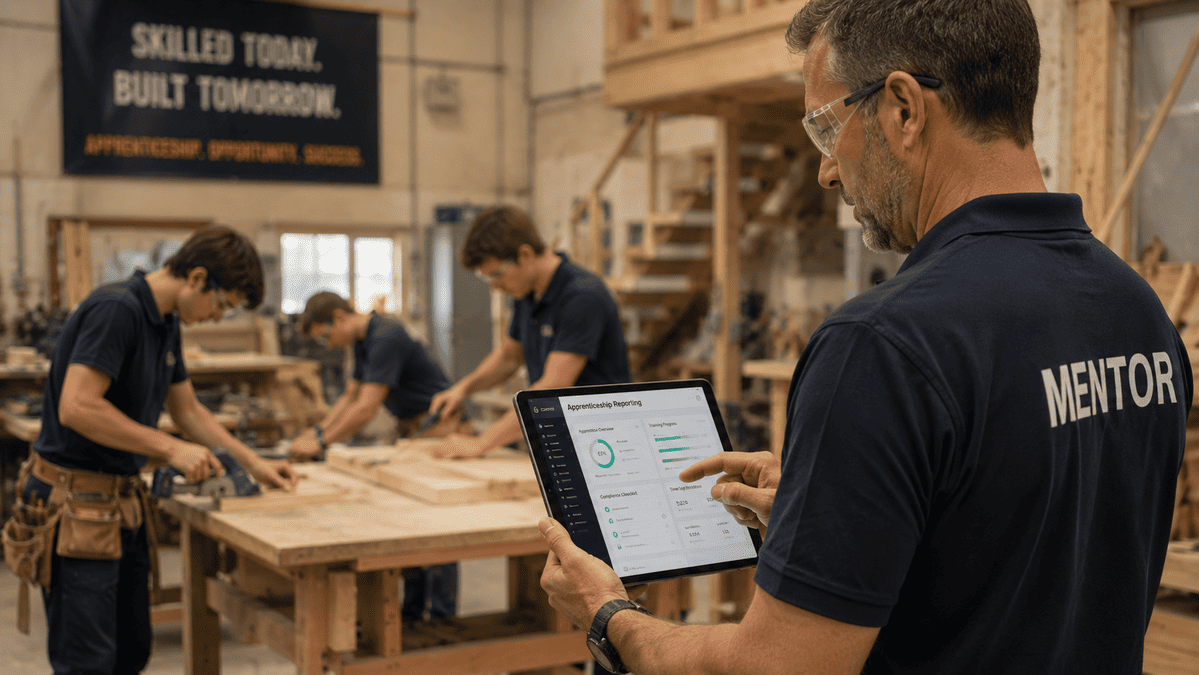
Before software:
- Spreadsheets scattered across departments
- Risk of missed apprentice ratios
- Manual data gathering for audits
With software:
- Automated tracking and alerts
- Live dashboards showing compliance status
- Audit-ready records on demand
Why Apprenticeship Compliance Software Matters for IRA & DoL in 2026
Apprenticeship compliance ties directly to Inflation Reduction Act bonus credits and Department of Labor registered apprenticeship rules. Projects that comply with the prevailing wage and apprenticeship requirements under the IRA are eligible for a 5x enhanced tax credit, significantly increasing the financial benefits for compliant projects.
Losing DoL apprenticeship compliance can jeopardize these enhanced credits on Section 45, 48, and 48C clean energy projects placed in service from 2023 onward. Under the IRA, clean energy projects meeting these requirements can increase their base credit from 6% to as much as 30%, with additional bonuses potentially bringing total benefits to 50%.
Key risks software helps avoid:
- Missed apprentice-to-journeyman ratios
- Incomplete wage and apprentice documentation
- Late reports to regulators
- Missing proof of supervision and training hours
Consider a 2025 solar EPC project in Texas with a 5-year recapture period. Poor records discovered three years post-completion could trigger IRS questions and potential credit clawback. Manual tracking simply isn’t viable on multi-state or multi-subcontractor projects.
IRA Apprenticeship & Prevailing Wage Compliance: What Contractors Must Track
PW&A (Prevailing Wage & Apprenticeship) rules under the IRA tie enhanced credits to documented wage and apprenticeship compliance. To qualify for the enhanced PW&A credit, organizations must pay skilled trade workers the federal prevailing wage and employ qualified apprentices during construction.
Core IRA apprenticeship requirements:
- Minimum apprentice labor hours per project
- Ratio of apprentices to journeymen
- Use of qualified registered programs
- Documented cure periods for non compliance
Prevailing wage elements:
- Base hourly rate plus fringe benefits
- Davis-Bacon vs. IRA PW&A differences
- Wages tied to each work classification
The “placed in service” date determines which rules apply and when the recapture period begins. Apprenticeship compliance software should automatically align apprentice hours, ratios, and wage classifications with these PW&A rules.
Department of Labor Registered Apprenticeship Requirements
DoL registration is the foundation for qualifying apprentices under most IRA and state requirements. To ensure compliance with the Inflation Reduction Act, organizations must adhere to the Department of Labor’s apprenticeship regulations, including registration, audits, and ongoing reporting.
Software must support:
- Program registration and approval workflows
- Standards of apprenticeship by trade
- On-the-job (OJT) vs. related instruction tracking
- Periodic reviews and sponsor reporting
- Direct integration with federal systems like the Registered Apprenticeship Partners Information Data System (RAPIDS) for automated regulatory reporting
The system stores approved program standards for specific trades—electrician, carpenter, solar installer—and ties actual apprentice activities to those standards. For contractors crossing state lines, the platform handles reciprocity and multi-state recognition for crews working across jurisdictions.
Prevailing Wage & Apprenticeship (PW&A) Tracking for Clean Energy Projects
PW&A represents the strongest bonus credit under the 2022 IRA, especially relevant for solar, wind, storage, and biogas energy projects entering construction from 2023 onward. Compliance requires that organizations pay skilled trade workers the federal prevailing wage and employ qualified apprentices during construction.
Key data points to track:
- Each worker’s classification and apprentice status
- Hourly wages and fringe benefits
- Job location and contractor/subcontractor relationship
- Date ranges worked on eligible projects
Automated checks flag missing apprentices on eligible projects, ratios out of compliance, or pay rates below required prevailing wage tables. For example, on a 50 MW solar project, the system alerts PMs when apprentice hours dip below required thresholds for a given quarter—supporting tax credit defense files without manual calculation.
Core Features of Effective Apprenticeship Compliance Software
A robust platform must serve contractors, project developers, and training providers with tools that balance automation with transparency. Dedicated software frameworks provide scalability to manage higher numbers of apprentices across multiple locations compared to manual systems.
Key functional pillars:
- Tracking apprentices and hours
- Scheduling and logging training
- Documentation management
- Integrations with payroll and HR
- Reporting and dashboards
- Audit support
Apprentice & Workforce Tracking (Beyond Spreadsheets)
Replace spreadsheets with a central database acting as a single source of truth for apprentices, journeymen, and foremen. Centralized record-keeping covers On-the-Job Training (OJT) hours, Related Technical Instruction (RTI) progress, and competency assessments.
Tracking capabilities:
- Total OJT hours by project and employer
- Apprentice ratios per crew
- Competency tracking systems mapping specific skills to program standards
- Connection to each subcontractor

Wage progression automation is essential for tracking mandatory wage increases based on hours or competency milestones. A single apprentice profile shows registration date, trade, level, IRA-eligible projects worked, wages, certifications, and completed classes—with quick filtering for audits.
Scheduling, Training Management & Communication
Apprenticeship compliance depends on both on-the-job hours and related classroom or online instruction. Apprenticeship management software can automate training scheduling and communication tasks, reducing manual follow-ups.
Capabilities include:
- Creating structured multi-session apprenticeship training programs
- Linking training sessions to cohorts and enforcing prerequisite rules
- Automated email/SMS reminders to apprentices and supervisors
- Predefined templates for IRA-related trainings
Centralized communication tools improve collaboration among instructors, mentors, and employers about an apprentice’s status. Automation handles reminders for time logs and schedule changes, reducing no-shows and ensuring documented completion of required training hours.
Documentation & Audit-Ready Recordkeeping
This addresses the paper trail regulators, tax equity investors, and clients ask for during compliance audits. A central, secure document management system is necessary for storing essential records.
Documents stored:
- Signed apprenticeship agreements
- Approved program standards
- Wage determinations
- Classroom attendance records
- Certificates and corrective action notes
Automated compliance and reporting can simplify audits by generating necessary reports for regulatory bodies like the Department of Labor. Exportable audit packs—organized by project, year, and contract—replace scrambling for PDFs and email threads at audit time. Secure role-based access controls let external auditors view evidence without exposing unrelated data.
Reporting, Dashboards & Compliance Alerts
Real-time dashboards offer insights into program health and help identify at-risk learners. Real-time tracking and alerts enable admins to monitor apprentice progress and identify those falling behind or due for wage increases.
Key metrics displayed:
- Apprentice-to-journeyman ratio by project
- Percent of required hours completed
- Open non compliance items and cure-period countdowns
- Wage exceptions
Automated alerts fire when a crew falls below required apprentice ratios, when an apprentice is behind on classroom hours, or when pay data is missing. Project- or investor-specific compliance summaries support quarterly reviews with easy access to status updates.
Portals for Employers, Apprentices & Training Partners
Dedicated portals for apprentices, mentors, and sponsors clarify responsibilities and progress roadmaps. Self-service functionality saves time and builds transparency for all entities involved.
Employer portal functions:
- View learner progress and download compliance documents
- Verify hours and approve schedule changes
- See project-level compliance status
Apprentice portal functions:
- View assignments and upcoming classes
- Log hours and see certifications earned
- Download proof of training completion
Training providers or community colleges can log in to mark attendance, issue grades, and upload certificates directly. Large contractors can brand portals as part of their professional ecosystem.
Financial & Commercial Tools
For apprenticeship providers and commercial programs, the software supports pricing, invoicing, and revenue tracking tied to apprenticeship cohorts.
Financial capabilities:
- Automate client invoices by milestone (enrollment, module completion)
- Track funding sources and payment schedules
- Report profitability by program
Contractors charging apprenticeship-related costs back to projects or joint ventures get clear documentation. Integrations with accounting systems and payroll minimize double data entry.
Solutions Tailored to Non-Union Contractors & Open-Shop Apprenticeships
Non-union, open-shop contractors often lack union JATC support, making software-driven compliance and sponsorship even more critical. Different engagement models work for different organizations—from fully self-managed sponsors to fractional administrator partnerships.
The platform helps smaller electrical, mechanical, carpentry, and HVAC contractors scale from a handful of apprentices to multi-state programs between 2024–2028. It simplifies getting from “no program” to “registered, IRA-compliant apprenticeship” without building an internal bureaucracy.
Hands-Off vs. Self-Managed Compliance Options
Contractors can choose between self-service operation or pairing with external compliance partners who operate as a fractional sponsor using the software.
Hands-off approach: Your team focuses on field work while experts use the software to register programs, manage reports, and ensure compliance. Benefits include speed to IRA-readiness and minimal overhead.
Self-managed approach: An internal HR or compliance lead operates the software daily with our support for setup and training sessions. Benefits include cost control and in-house workforce knowledge.
The software remains the common system of record in both cases, ensuring consistent documentation and outcomes.
Multi-State & Mobile Apprenticeship Programs
Mobile crews—commercial solar installers moving between Colorado and New Mexico, for example—need portable and remote-friendly apprenticeship management.
Platform handles:
- Differing state registration rules
- Remote learning modules for related instruction
- Jobsite-based training logs
- Mobile-first platforms that enhance apprentice engagement by allowing them to log hours and view progress on the go
The platform tracks where apprentices are working week by week, tying hours to specific jurisdictions and projects. Support for remote or hybrid programs in partnership with community colleges enables contractors to bid IRA-eligible work wherever it arises.
Implementation: How to Launch Apprenticeship Compliance Software in 90 Days
Many contractors assume implementation will be long and painful. Reality: a focused 60–90 day rollout path works for most organizations.
Concrete phases:
- Discovery & data gathering
- System configuration
- Integrations with payroll, timekeeping, HR
- Pilot project testing
- Full rollout
Involve operations, HR, payroll, and project management from day one to ensure adoption. Ongoing support includes training sessions, office hours, and periodic compliance reviews tied to key milestones like start of construction and placed-in-service dates.

Three-Step Path to IRA-Compliant Apprenticeships
Step 1: Assess & Design Inventory current workforce, identify trades needing apprentices, map to DoL standards, and define IRA-eligible projects in your pipeline.
Step 2: Configure & Connect Set up programs and projects in the software, connect to payroll and timekeeping, load wage determinations, and configure alerts for your team.
Step 3: Run & Prove Launch with a pilot project, capture live data, generate sample audit packs, and refine workflows before scaling portfolio-wide. Focus on completion rates and documented outcomes.
Why Choose Our Apprenticeship Compliance Platform?
We built our platform specifically for contractors seeking IRA and DoL apprenticeship compliance—not generic HR software adapted as an afterthought.
Distinct differentiators:
- Contractor-first workflows designed for GCs, EPCs, and specialty subs
- Nationwide non-union focus with hands-on implementation support
- Deep IRA/PW&A configuration options
- Confidence in developing scalable compliance infrastructure
We support both small regional contractors (under 50 employees) and large EPCs with thousands of workers and dozens of subs. Our comprehensive solution adapts as regulations evolve through 2026 and beyond.
Key Benefits for Contractors, Developers & Training Providers
Contractor benefits:
- Fewer compliance surprises with real-time tracking
- Confidence bidding IRA projects
- Streamlined coordination between HR, field, and finance
Project developer/investor benefits:
- Clear visibility into PW&A status
- Centralized documentation for tax equity and lender due diligence
- Minimize penalties through proactive compliance
Training provider benefits:
- Simpler program administration
- Stronger employer partnerships
- Better data for outcome reporting
Ready to see how it works for your next project? Request a live demo tailored to your upcoming work.
Want to Learn More About Your Registered Apprenticeship Opportunities?
BOOK A FREE CONSULTATION
FAQs: Apprenticeship Compliance Software & IRA Projects
Here are the questions contractors most often ask in 2024–2026 about software and apprenticeship rules.
While manual tracking may work for small, single-state projects, software provides scalability and consistency that protects you across your entire portfolio. Most contractors implement once and use for all projects.
The platform maintains all documentation through the 5-year recapture period, with exportable audit packs organized by project and date range. Records remain accessible and audit-ready.
No—the software complements existing JATC relationships by providing centralized tracking and reporting. Work with your labor partners to determine how data flows between systems.
Training providers log in to mark attendance and upload certificates directly. The software tracks completion while your company manages employment and OJT components.
Yes. The platform tracks when cure periods begin, monitors progress toward compliance, and documents whether you achieved compliance within the allowed window. Work with your tax advisor on specific cure requirements.
Generally through the recapture period (typically 5 years from placed-in-service date). The software maintains records for the required duration automatically.
Most contractors launch within 60–90 days. Contact us to discuss your timeline and upcoming projects.


