
Table of Contents
- The Operational Stakes of Getting Apprentice Compliance Wrong
- What Apprentice Compliance Tracking Actually Encompasses
- OJT vs. RTI Tracking: Why the Distinction Determines Your Compliance Architecture
- The Five Critical Components of an Effective Apprentice Compliance Tracking System
- Apprenticeship Tracking vs. Internship Tracking: Key Differences for Mixed Talent Pipelines
- How to Evaluate Integration Fit: Connecting Your Tracking System to HR, Payroll, and LMS Infrastructure
- Scaling Compliance Tracking Across Multiple Sites, Sponsors, and Regions
- Building the Internal Case for Apprentice Compliance Tracking Software
- How GoSprout Centralizes Compliance and Progress Tracking in a Single Unified Platform
- Conclusion: From Compliance Risk to Program Confidence
- Frequently Asked Questions
The Operational Stakes of Getting Apprentice Compliance Wrong
Why Compliance Tracking Is a Strategic Risk Management Function, Not an Administrative One
Apprentice compliance tracking is not a documentation exercise. It is the operational infrastructure that determines whether your registered apprenticeship program survives a DOL audit, qualifies for tax credit eligibility under the Inflation Reduction Act, and produces defensible records if a wage dispute or apprentice grievance surfaces. Programs that delegate tracking to whoever has time this week, a spreadsheet here, an email chain there, are not simply inefficient. They are exposed.
The distinction matters because administrative thinking produces administrative solutions: a shared folder, a template someone built two years ago, a supervisor who “remembers” signing off on hours. Risk management thinking produces something different: a documented, time-stamped, role-attributed record that answers every auditor question before it is asked. The gap between those two postures is where most compliance failures originate.

What an Audit Exposure Event Actually Looks Like
A DOL compliance review does not typically arrive as a formal investigation. It begins as a records request. The Office of Apprenticeship or a State Apprenticeship Agency asks for OJT hour logs, RTI completion records, apprentice agreements with current wage schedules, and RAPIDS reporting data, usually covering the prior 12 to 36 months.
If those records exist in multiple places, owned by different people, in formats that were never designed to cross-reference, the program administrator faces a reconstruction problem under time pressure. Missing supervisor sign-offs, inconsistent hour totals across logs, or wage progressions that do not align with registered program standards can trigger a corrective action, a program suspension, or, in cases involving prevailing wage violations, financial penalties and debarment from federal contracts. The audit itself is rarely the crisis. The documentation gap revealed by the audit is.
The Hidden Cost of Disconnected Tools
Most programs running on manual tools significantly underestimate their true compliance cost. The visible cost is the staff time spent maintaining logs and chasing approvals. The hidden cost is the compounding risk created every time a record lives in one place while the decision it supports lives somewhere else.
A supervisor emails hour confirmation. That email is not in the apprentice’s official file. An RTI provider sends a completion certificate. It lands in someone’s downloads folder. An apprentice advances to the next wage tier. The agreement amendment is printed, signed, and scanned, but the scan never makes it to the program file before the analyst who managed it leaves the organization. None of these gaps feel dangerous in the moment. Collectively, they create a compliance record that cannot withstand scrutiny.
How This Guide Is Structured
The argument developed throughout this guide is direct: apprentice compliance tracking is a strategic risk management function, and programs that treat it as anything less are one audit, one missing OJT log, or one prevailing wage discrepancy away from a disruption that threatens their entire workforce development investment. The sections that follow define what compliant tracking actually requires, explain why the OJT and RTI distinction is architecturally significant, and build the case for why a purpose-built platform eliminates the operational risk that disconnected tools silently accumulate.
What Apprentice Compliance Tracking Actually Encompasses
Defining the Full Scope: Beyond Hour Logging
Hour logging is the most visible element of apprentice compliance tracking, but it represents only one layer of a much broader documentation obligation. A fully compliant program maintains current apprentice agreements with dated wage progressions, RTI completion records tied to specific curriculum standards, OJT logs with supervisor attribution, RAPIDS enrollment and completion data, journeyworker ratio records by worksite, and evidence of Equal Employment Opportunity compliance. Each category has its own retention requirement, its own reporting trigger, and its own audit surface area.
Programs that treat tracking as an hour-logging problem tend to discover the other documentation gaps only when they are under review.
The Regulatory Frameworks Every Tracking System Must Reflect
DOL Standards Under 29 CFR Part 29 and Part 30
Title 29 CFR Part 29 establishes the federal standards for registering apprenticeship programs, including the required contents of the apprentice agreement and the documentation standards for OJT and RTI hours. Part 30 governs equal opportunity requirements for registered programs, including outreach, selection, and complaint procedures. Any tracking system that does not reflect both sets of requirements is missing foundational compliance infrastructure.
IRA Apprenticeship Requirements for Energy Credit Eligibility
The Inflation Reduction Act introduced apprenticeship requirements tied directly to federal clean energy tax credit eligibility. Contractors and developers claiming credits under sections 45, 45Y, 48, and related provisions must demonstrate that a defined percentage of total labor hours on qualifying projects were performed by registered apprentices. That demonstration requires hour-level documentation, by project, by trade, by apprentice, at a level of specificity that generic payroll records typically cannot support.
Prevailing Wage Obligations and Certified Payroll Implications
Programs operating on federally funded or Davis-Bacon-covered projects carry an additional documentation layer: certified payroll records showing that each apprentice was paid the correct ratio of the prevailing journeyworker wage for each pay period. Certified payroll is submitted weekly on most federal projects, and any discrepancy between the wage paid, the apprentice’s registered progression level, and the applicable wage determination creates both a payroll compliance issue and a program compliance issue simultaneously.
RAPIDS Reporting Protocols
RAPIDS, the Registered Apprenticeship Partners Information Data System, is the federal system of record for registered apprenticeship programs. Program sponsors are required to submit enrollment, cancellation, suspension, and completion data to RAPIDS. The accuracy of RAPIDS records determines whether an apprentice’s completion is federally recognized and whether the program’s aggregate metrics reflect actual performance. Discrepancies between RAPIDS data and internal records are a routine audit finding in programs that manage the two systems independently.
The Two Records Required to Document a Completed Apprenticeship
Federal standards require two primary records to document a completed apprenticeship: the apprentice’s OJT hour log, showing cumulative on-the-job training hours against the program’s required total, and the Certificate of Completion issued upon meeting all program requirements. Both records must be consistent with what was registered in RAPIDS. The OJT log establishes that the hour requirement was satisfied. The certificate establishes that the program sponsor formally recognized completion. A certificate without a supporting hour log carries no evidentiary weight in an audit.
The Four Stages of Apprenticeship and Their Distinct Tracking Obligations
Apprenticeship progression follows a defined structure, and each stage generates different documentation requirements. The tracking architecture that works at enrollment does not automatically extend to wage advancement or completion.
| Stage | Description | DOL Documentation Requirements | OJT/RTI Tracking Obligations | RAPIDS Reporting Triggers |
|---|---|---|---|---|
| 1. Enrollment | Apprentice registers with the program and begins working under a sponsor. | Executed apprentice agreement with wage schedule, EEO acknowledgment, and program standards acknowledgment. | OJT log initiated, RTI schedule established and documented. | New enrollment submitted to RAPIDS within required timeframe, typically 30 days of start date. |
| 2. Progression | Apprentice advances through wage periods based on hours or competency milestones. | Wage progression documentation tied to verified hour or competency thresholds, updated apprentice agreement amendments where applicable. | Ongoing OJT hour logs with supervisor sign-offs, RTI completion records by course or module, competency assessments if competency-based. | Periodic updates to RAPIDS where program standards require status updates, any changes to sponsor, employer, or occupation must be reported. |
| 3. Suspension or Cancellation | Apprentice exits the program before completion, either temporarily or permanently. | Written notice of suspension or cancellation, reason code documented, final hour totals recorded. | OJT log closed at suspension or cancellation date with verified total hours, any incomplete RTI modules noted. | Suspension or cancellation reported to RAPIDS with effective date and reason code within required timeframe. |
| 4. Completion | Apprentice satisfies all OJT hour and RTI requirements and receives formal recognition. | Certificate of Completion issued, final OJT hour verification, RTI completion confirmation, program sponsor sign-off. | Final OJT log reconciled against program-required total, all RTI modules confirmed complete and documented. | Completion submitted to RAPIDS to generate federally recognized Certificate of Completion, final enrollment record closed. |
Each stage creates a distinct documentation event, and gaps at enrollment cascade through every subsequent stage. A missed RAPIDS enrollment in Stage 1 means the apprentice’s completion in Stage 4 cannot be federally recognized. A wage progression in Stage 2 that lacks a supervisor-verified hour threshold has no defensible basis if audited. Tracking architecture must account for each stage’s obligations before the stage begins, not after the fact.
OJT vs. RTI Tracking: Why the Distinction Determines Your Compliance Architecture
Defining On-the-Job Training and Related Technical Instruction Under Federal Standards
OJT and RTI are not interchangeable categories of apprenticeship time. On-the-job training is the structured, supervised work experience performed on the job, directly developing the occupational competencies defined in the program standards. Related technical instruction is the technical and theoretical instruction that complements the on-the-job experience, delivered through classroom instruction, online learning, or an accredited provider. Federal standards under 29 CFR Part 29 require that registered programs deliver a minimum of 144 hours of RTI per year for time-based programs, separate from and in addition to OJT requirements.
The distinction is not semantic. Each category has its own minimum hour requirements, its own documentation standards, and its own audit surface. Treating them as a single pool of “training hours” is one of the most common structural errors in manual tracking systems.
How to Track Apprenticeship Hours Accurately for Each Category
Accurate tracking requires separate logs for OJT and RTI from day one. OJT logs should capture the date, hours worked, the specific work processes or competencies practiced, and the verifying supervisor. RTI records should capture the course or module title, the provider, the delivery method, the date, the duration in hours, and evidence of completion or attendance.
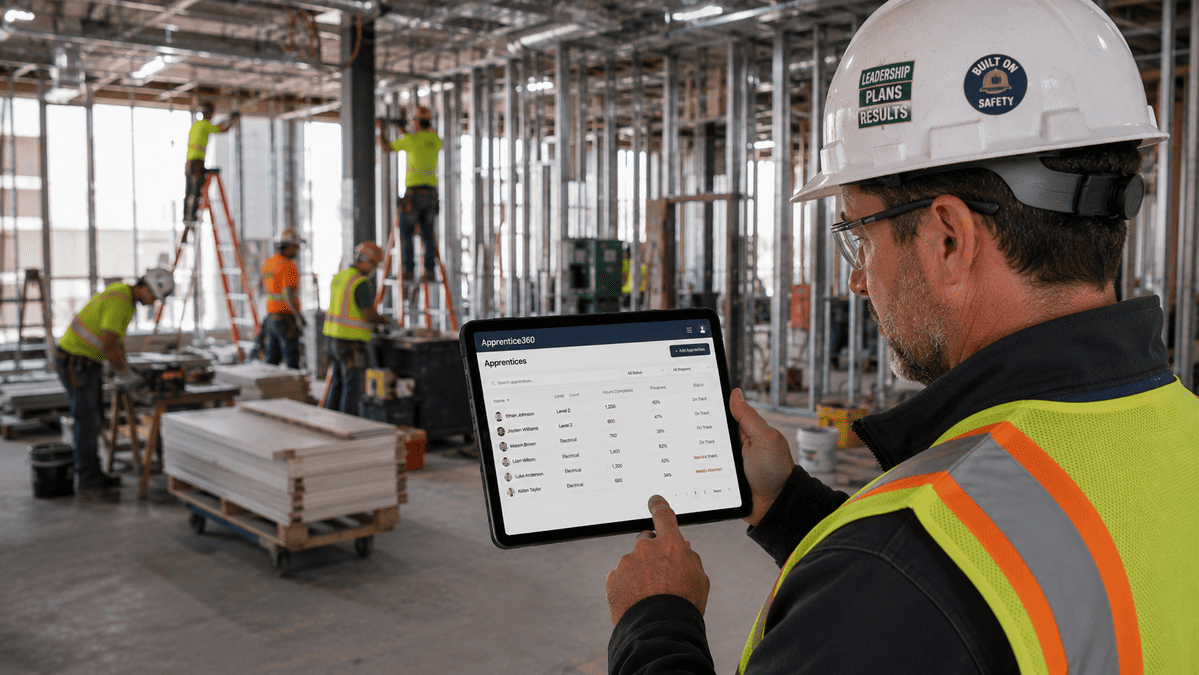
Both sets of records must be maintained in a format that allows the program administrator to produce a cumulative total for each category at any point in time. A system that can only show a combined “training hours” total does not meet the documentation standard.
Competency-Based vs. Time-Based Progression: How Your Tracking Model Changes
Time-based programs advance apprentices when they accumulate a defined number of OJT hours at each wage period. Competency-based programs advance apprentices when they demonstrate mastery of defined skills, regardless of hours. Hybrid programs use both criteria. The tracking architecture is different in each case.
In a time-based program, hour accuracy is the primary compliance variable. Every logged hour must be supervisor-verified and attributable to an approved work process. In a competency-based program, the documentation burden shifts toward evidence of skill demonstration: assessments, evaluator sign-offs, and records that connect a specific competency to the date and conditions under which it was verified. A tracking system designed only for hour accumulation cannot support a competency-based program’s audit documentation requirements.
Supervisor Sign-Off Workflows: Creating Legally Defensible Approval Records
A supervisor’s verbal confirmation that an apprentice completed a week of OJT is not a compliance record. A legally defensible OJT approval record requires a time-stamped attestation from an identified, qualified supervisor, tied to a specific date range, specific work processes, and a specific hour total. That record must be retained in the apprentice’s program file and be producible on request.
Manual workflows, whether email approvals, paper logs, or verbal confirmations, create two problems. First, they are inconsistently applied across supervisors. Second, they generate records in different formats and locations, making consolidated audit documentation nearly impossible without significant manual reconstruction.
RTI Documentation Requirements: Connecting Instructional Hours to Program Standards
RTI documentation must do more than confirm attendance. It must connect the instruction delivered to the work processes or competencies defined in the program’s registered standards. An auditor reviewing RTI records will look for evidence that the instruction is relevant to the occupation, not just that hours were logged with a provider.
This means RTI records should reference the specific program standard or work process the instruction supports. A 40-hour electrical theory course carries more weight in an audit review when the record links it to the program’s registered work process schedule than when it appears as a standalone hour entry.
Why Conflating OJT and RTI in a Single Log Creates Audit Vulnerability
A combined training log that does not distinguish OJT from RTI creates two immediate problems. First, the program cannot demonstrate that it met the minimum annual RTI requirement, because the RTI hours cannot be isolated from the total. Second, it signals to an auditor that the program does not maintain the internal controls necessary to distinguish between categories, which raises questions about the reliability of every other record in the file.
The separation of OJT and RTI is not a technicality. It is the baseline structural requirement that every other compliance documentation obligation is built on. Programs that cannot produce separate, accurate, supervisor-verified OJT logs and provider-verified RTI records are not tracking compliance. They are creating the appearance of tracking while accumulating the risk of not doing so.
The Five Critical Components of an Effective Apprentice Compliance Tracking System
Understanding what documentation is required is the first step. Building the infrastructure to produce it reliably under audit pressure is the second. These five components define what a compliant tracking system must do in practice.
Component 1: Centralized Hour Logging With Role-Based Access and Accountability Trails
Hour logs are only as defensible as the process that creates them. A centralized logging system assigns each entry to a specific apprentice, records the date and work process, and requires verification from an identified supervisor before the record is closed. Role-based access ensures that apprentices can submit hours, supervisors can approve or dispute them, and program administrators can view and export records across the entire cohort without any single person controlling all data entry.
The accountability trail is what separates a compliant record from a reconstructed one. Every action, whether submission, approval, edit, or rejection, should carry a timestamp and a user identity. If a record is challenged, the program administrator can show exactly who approved what and when.
Component 2: Automated RAPIDS Reporting Integration and Data Synchronization
Manual RAPIDS entry is one of the most common sources of compliance discrepancy in registered programs. When enrollment, status changes, and completions are entered into RAPIDS separately from internal records, the two systems drift. Automated synchronization eliminates that drift by pushing enrollment triggers, wage progression milestones, suspensions, and completions to RAPIDS in real time or on a defined schedule, pulling from the same underlying record.
Integration with RAPIDS does not mean submitting raw data automatically without review. It means the system flags required reporting events, pre-populates submission fields from verified internal records, and maintains a log of what was submitted and when. The program administrator confirms and submits rather than reconstructing data from scratch each time.
Component 3: Apprentice Agreement Management, E-Signature, and Version Control
An apprentice agreement is a living document. It must reflect current wage rates at each progression, document any program amendments, and carry signatures from both the apprentice and the sponsor. Programs running on paper or PDF workflows frequently cannot produce a current, fully executed agreement on short notice because amendments were signed but not filed, or the original agreement was updated without generating a new version.
A document management system with e-signature and version control solves this by maintaining a complete history of every executed agreement and amendment, with timestamps and signature records attached. When an auditor asks for the current apprentice agreement, the answer is a single click, not an email to whoever last touched the file.
Component 4: Competency and Skills Progression Monitoring Tied to Program Standards
For competency-based and hybrid programs, hour totals alone do not establish wage advancement eligibility. The system must capture assessments, evaluator sign-offs, and the specific competency or work process that was verified. Those records must be traceable back to the competencies listed in the registered program standards, not just stored as general training notes.
This connection between the tracking record and the registered standard is what gives the record its compliance weight. An evaluator sign-off on “welding skills” is not the same as a verified record linking the assessment to Work Process 3.2 in the program’s DOL-registered occupation schedule.
Component 5: Audit-Ready Reporting Dashboards and Exportable Documentation Packages
An effective apprentice compliance tracking system does not require staff to assemble audit documentation manually. Program-level dashboards should surface active enrollment counts, OJT hours by apprentice, RTI completion rates, upcoming wage progressions, and RAPIDS sync status in a single view. When a records request arrives, the system generates an exportable package for a specific apprentice or the full cohort, organized by documentation category, without requiring any manual compilation.
The difference between a program that navigates a records request in two hours and one that takes two weeks is almost entirely a function of whether the documentation was managed in a system or reconstructed from files.
What Compliance Documentation Is Required for a Registered Apprenticeship Program Audit
An audit package for a registered apprenticeship program typically requires:
- Executed apprentice agreements with all wage progression amendments
- OJT hour logs with supervisor verification, organized by apprentice and date range
- RTI completion records tied to program standards, by course and provider
- RAPIDS enrollment, status, and completion records consistent with internal logs
- Journeyworker ratio records by worksite and time period
- EEO compliance documentation including outreach records and complaint procedures
- Certificates of Completion for any graduates, consistent with RAPIDS data
Programs that cannot produce all of these categories, with consistent data across them, in a reasonable timeframe are not audit-ready regardless of how diligent their staff believe they have been.

Apprenticeship Tracking vs. Internship Tracking: Key Differences for Mixed Talent Pipelines
Why Mixed Intern-Apprentice Programs Cannot Use a Single Generic Tracking Framework
Organizations managing both internship programs and registered apprenticeships under the same administrative umbrella often default to a single tracking approach. That approach is almost always built around the internship, because internships carry fewer documentation requirements. The result is a registered apprenticeship program being managed with infrastructure that was never designed to meet federal standards.
The risk is not theoretical. An internship tracking system does not capture OJT work processes, does not enforce supervisor sign-off workflows tied to wage periods, and does not generate RAPIDS-compatible records. Applying it to apprentices produces records that look organized but fail every substantive compliance test.
Regulatory Divergence: What Registered Apprenticeship Programs Require That Internship Programs Do Not
Internship programs operate primarily under FLSA guidance and employer-defined policies. Registered apprenticeship programs operate under 29 CFR Part 29, program-specific DOL-registered standards, and, where applicable, prevailing wage and IRA requirements. The documentation obligations are categorically different.
Registered programs require executed apprentice agreements with legally defined contents, minimum annual RTI hours, supervisor-verified OJT logs, RAPIDS reporting at enrollment and completion, and wage progressions tied to verified milestones. Internship programs require none of these. A tracking framework that satisfies one does not satisfy the other.
Documentation Obligations Compared: Apprentices vs. Interns
The specific documentation gap becomes clear when the two program types are placed side by side:
- Apprentice agreements are legally required for registered programs and must include wage schedules, work processes, and program standards references. Internship offer letters carry no equivalent regulatory requirement.
- Journeyworker ratios must be maintained and documented for registered apprenticeship programs on most projects. Internship programs have no ratio requirement.
- Wage progressions for apprentices must be tied to verified OJT hours or competency milestones and documented accordingly. Intern pay is employer-determined with no progression documentation obligation.
These are not minor variations in paperwork. They represent structurally different compliance obligations that require separate tracking architectures.
How a Unified Platform Handles Both Pipelines Without Compliance Crossover Risk
A unified platform designed for both program types maintains separate compliance frameworks for each. Apprentices follow the registered program’s documentation workflow: OJT logging with work process attribution, RTI tracking against the 144-hour annual minimum, RAPIDS sync, and agreement management with version control. Interns follow a parallel but distinct workflow suited to their program’s requirements.
The two pipelines share administrative infrastructure, a single login environment, shared reporting access, and unified onboarding, but their compliance records do not cross-contaminate. The program administrator sees both cohorts in one place without applying the wrong standard to either.
What Is a Compliance Apprentice and How Does the Role Differ From an Intern?
A compliance apprentice is a registered apprentice placed in an occupation within the compliance, legal, or regulatory field. Like any registered apprentice, this individual is enrolled in a DOL-registered program, working under a structured OJT plan, completing required RTI hours, and advancing through defined wage periods tied to verified milestones. The registration, documentation, and RAPIDS reporting requirements are identical to those in any other registered occupation.
An intern in a compliance role, by contrast, is not enrolled in a registered program. Their experience is structured by the employer’s internal program design, not by federal standards. They may or may not receive a wage, have no legally required progression structure, and generate no RAPIDS records. The shared label of “compliance” describes the function, not the regulatory framework governing the placement.
How to Evaluate Integration Fit: Connecting Your Tracking System to HR, Payroll, and LMS Infrastructure
Why Standalone Apprenticeship Tracking Tools Create New Data Silos
A tracking tool that does not connect to your existing HR, payroll, and learning infrastructure solves one problem and creates three others. Apprentice demographic data lives in the HRIS. Wage data lives in payroll. RTI course completions may live in an LMS. If the compliance tracking system cannot read from or write to those sources, staff reenter the same data in multiple places and the records never fully agree.
The silo risk is particularly acute for certified payroll compliance. If the apprenticeship tracking system and the payroll system do not share apprentice progression status, a payroll run can issue wages at the wrong rate without any system-level flag. The error surfaces in the next audit, not in the next pay cycle.
Critical Integration Points: HRIS, Payroll, and Learning Management Systems
Effective integration requires bidirectional data flow at three points.
- HRIS: Apprentice enrollment, demographic data, and employer assignment should sync so that records do not require manual duplication across systems. Terminations and transfers in the HRIS should trigger status updates in the compliance system.
- Payroll: Wage progression milestones verified in the compliance system should feed directly into the payroll record to support certified payroll accuracy. Discrepancies between progression status and wages paid should surface before submission, not after.
- LMS: RTI course completions recorded in the LMS should automatically populate the apprentice’s RTI log in the compliance system, with course metadata that connects to program standards.
What Integration Does Your Apprenticeship Tracking System Need With RAPIDS?
RAPIDS integration does not require a real-time API connection in every deployment, but it does require a reliable, documented data pathway. At minimum, the tracking system should pre-populate RAPIDS submission fields from verified internal records, track submission history by event type, and flag records where internal data and last-submitted RAPIDS data have diverged.
Programs that submit RAPIDS data manually, without a system that tracks what was submitted and when, cannot easily identify discrepancies or demonstrate a consistent reporting history under review.
How to Audit Your Current Tech Stack Before Selecting a Compliance Platform
Before evaluating any compliance platform, map where apprenticeship-relevant data currently lives and who owns it. Identify the systems of record for employee demographics, wage rates, training completions, and documentation files. Note where those systems overlap, where they conflict, and where data exists only in a spreadsheet or email inbox with no system record at all.
This audit answers two questions a vendor needs to answer honestly: what integrations are required for the platform to replace manual processes, and what data will need to be migrated or reconciled at the point of transition.
Avoiding Data Loss During Integration: Validation Checkpoints and Parallel-Run Protocols
Data loss during system transitions almost never looks like a dramatic failure. It looks like an OJT log that existed in the old spreadsheet but did not map cleanly to a required field in the new system and was quietly dropped during import. Preventing this requires validation checkpoints at each stage of migration: a record count comparison before and after import, a spot-check of individual apprentice files against the source records, and a sign-off process before the old system is decommissioned.
Running both systems in parallel for a defined period, typically 30 to 60 days, allows the program team to verify that new entries in the compliance platform match expected records and that no historical data was lost before the old system is retired.
Scaling Compliance Tracking Across Multiple Sites, Sponsors, and Regions
How Multi-Location Programs Multiply Compliance Complexity
A single-site apprenticeship program has one set of OJT logs, one wage schedule, and one journeyworker ratio to maintain. A program operating across five sites in three states has wage determinations that vary by location, supervisor sign-off workflows distributed across dozens of managers who may never interact with the program administrator, and the potential for site-specific compliance failures that do not surface until a review covers the full program.
Scale does not dilute compliance risk. It amplifies it, because the conditions that produce documentation gaps, inconsistent supervisor behavior, delayed hour submissions, and missed RAPIDS updates, occur more frequently with more people involved, and the gaps are harder to detect without centralized visibility.
Want to Learn More About Your Registered Apprenticeship Opportunities?
BOOK A FREE CONSULTATION
Managing Journeyworker Ratios, Site-Specific OJT Logs, and Regional Wage Schedules at Scale
Multi-location programs need site-level compliance tracking, not just program-level aggregates. Each worksite must maintain its own journeyworker-to-apprentice ratio records, because ratio requirements apply at the worksite level, not the program level. OJT logs must be attributable to a specific worksite, because prevailing wage obligations and Davis-Bacon applicability can vary by project location. Wage schedules may reflect different area wage determinations depending on where the apprentice works.
A compliance system managing these programs must allow administrators to filter, report, and audit by site, region, or sponsor. A single consolidated view with no geographic segmentation cannot support multi-site compliance management.
How to Migrate an Existing Program From Spreadsheets Without Creating Compliance Gaps
Migration from manual systems to a compliance platform is one of the highest-risk moments in a program’s administrative lifecycle. The gaps that were tolerable in a spreadsheet become visible, and sometimes unresolvable, when data is imported into a system with defined field requirements.
Audit Your Current Documentation State Before Migration
Before any data moves, the program administrator should generate a complete inventory of existing records: apprentice agreements, OJT logs, RTI records, RAPIDS submission history, and wage progression documentation. Identify records that are missing, incomplete, or inconsistent with RAPIDS data. Resolve those gaps, or document why they cannot be resolved, before migration begins. Importing incomplete records into a new system does not clean them up. It just makes them harder to find.
Map Existing Records to Required Data Fields in the New System
Spreadsheet data rarely maps cleanly to a compliance platform’s required fields. OJT hours recorded as weekly totals may need to be reformatted as individual log entries with work process attribution. Supervisor names recorded as free text may need to be matched to user accounts. Wage progression dates recorded in one column may need to be linked to the specific milestone that triggered them. Completing this field mapping before import, rather than discovering gaps mid-migration, prevents the most common source of data loss.
Establish a Parallel-Run Period With Clear Cutover Criteria
Define in advance what conditions must be met before the old system is retired. A parallel-run period works only if the team actively reconciles records between systems and documents discrepancies. Set a specific cutover date, tied to a milestone like the start of a new program year or a completed cohort transition, and treat that date as a firm deadline rather than a rolling target.
Role-Based Access Design for Distributed Supervisor and Admin Teams
Distributed programs require access models that reflect the actual org chart, not a flat permission structure. Site supervisors should have access to their own apprentices’ OJT logs and sign-off queues, without visibility into records at other sites. Regional administrators may need cross-site reporting access without the ability to modify individual records. Program-level administrators need full read and export access for audit purposes.
Getting this right before rollout prevents both compliance risk from supervisors approving records outside their authority and adoption friction from supervisors facing records that are not their responsibility.
What Are the Penalties for Non-Compliant Apprenticeship Tracking?
The DOL can deregister a non-compliant program, which terminates federal recognition for all enrolled apprentices and voids any pending Certificates of Completion. For programs claiming IRA energy tax credits, documentation failures can result in credit disallowance and IRS penalties on prior-year filings. Prevailing wage violations on federally funded projects carry back-pay liability, potential debarment from federal contracts, and civil monetary penalties in cases involving willful violations.
These consequences apply to any program, regardless of size. But scale increases exposure in a specific way: more sites, more supervisors, and more apprentices mean more opportunities for a documentation gap to occur and more difficulty detecting it before an external review does. A program managing ten apprentices across one site can catch most problems through direct oversight. A program managing 150 apprentices across eight sites cannot.
Building the Internal Case for Apprentice Compliance Tracking Software
Framing the Cost-Benefit Decision for HR and Operations Leadership
The internal conversation about compliance software rarely starts with regulatory risk. It starts with budget. HR and operations leaders evaluating a platform investment need a frame that connects the cost of the tool to the cost of not having it, and that frame requires specificity, not general claims about efficiency.
The productive framing is not “compliance software vs. spreadsheets.” It is “what does the current system cost us, fully loaded, including the risk we are carrying?” Once leadership sees manual tracking as an active cost center rather than a free solution, the platform conversation shifts from a discretionary purchase to a risk mitigation decision.
Quantifying the Administrative Burden of Manual Tracking
Consider a program with 30 active apprentices across three sites. Each apprentice generates one OJT log entry per week, requiring supervisor review and sign-off. That is 30 approval touchpoints per week, most of which require the supervisor to find, open, fill out, and return a form through email or paper. At a conservative estimate of 12 minutes per approval cycle, including follow-up on missing entries, the program generates roughly six hours of supervisor time per week on hour logging alone.
Add monthly RTI reconciliation, quarterly wage progression reviews, and RAPIDS updates at enrollment and completion, and a mid-sized program with manual tracking can consume hundreds of staff hours annually on compliance administration that produces records of inconsistent quality. That time has a real dollar cost. It also has an opportunity cost: those are hours not spent on apprentice development, sponsor relations, or program growth.
Compliance Failure Costs vs. Platform Investment: A Decision-Maker Framework
The asymmetry between the cost of a compliance platform and the cost of a compliance failure is significant. A DOL corrective action requiring program remediation, back-pay resolution, or program deregistration creates costs that dwarf any software subscription. IRA tax credit disallowance on a qualifying project can represent substantial lost credits. Debarment from federal contracts removes entire project categories from the business pipeline.
A practical decision-maker framework for this conversation involves three columns: the annual cost of the platform, the annual cost of manual administration, and the probability-weighted cost of a compliance event. In most programs with more than 15 apprentices or multiple sites, the platform pays for itself through administrative savings alone before compliance risk is factored in.
How to Ensure Supervisor Sign-Offs Are Legally Defensible Without Adding Workflow Friction
Supervisor adoption is the variable that determines whether a compliance system actually works or simply creates digital versions of the same gaps it was meant to close. The sign-off workflow must be fast enough that supervisors complete it consistently, and structured enough that what they produce is legally defensible.
A defensible sign-off requires three elements: the supervisor’s confirmed identity, a specific time period and hour total, and attestation that the hours reflect actual supervised work. A system that delivers this through a mobile-accessible notification, requiring two or three taps to confirm a pre-populated log entry, removes the friction that causes supervisors to delay or skip approvals without removing any of the compliance substance.
Getting Supervisors and Apprentices to Actually Use the System
Technology does not solve compliance problems. Adoption does. A platform sitting unused by supervisors produces the same compliance gaps as a spreadsheet.
Designing Onboarding That Fits Supervisor Workflows
Supervisor onboarding should be built around the one or two actions a supervisor takes most frequently: reviewing a submitted log and confirming or flagging hours. Train on those actions first, in the context supervisors already use, whether mobile, during site walkthroughs, or between tasks. Position the system as replacing the email thread they already find cumbersome, not as a new compliance obligation layered on top of existing ones.
Apprentice onboarding follows a similar logic. Apprentices who understand that their hour submissions directly affect their wage progression milestones have an intrinsic reason to submit accurately and on time. That connection should be made explicit during setup, not assumed.
Using Accountability Trails to Reinforce Adoption
Automated reminders for overdue log submissions, weekly summary dashboards for program administrators showing completion rates by supervisor, and escalation paths for entries that have not been reviewed within a defined window are all adoption tools that operate without requiring a manager to chase individuals personally. The system surfaces the gap. The supervisor resolves it. That distinction matters for team culture, particularly with site supervisors managing compliance obligations alongside a full operational workload.
Three Indicators Your Program Has Outgrown Manual Tracking
Your program likely needs a purpose-built platform if any of these are true:
- You cannot produce a complete, current OJT log for any apprentice in under 10 minutes without contacting a supervisor or searching email.
- Your RAPIDS records and internal hour logs require manual reconciliation before each submission because they do not stay synchronized.
- You manage apprentices across more than one site or with more than five supervisors involved in sign-off workflows.
If two of the three apply, the administrative cost and compliance risk of your current approach has already exceeded the investment required to replace it.
How GoSprout Centralizes Compliance and Progress Tracking in a Single Unified Platform
Why Purpose-Built Differs From Configured
A configured platform is a general-purpose tool shaped to approximate compliance requirements through custom fields and workarounds. A purpose-built platform starts with the compliance architecture already embedded: the OJT and RTI distinction is native, the RAPIDS reporting triggers are built in, and the supervisor sign-off workflow reflects the legal standard rather than a generic approval process.
GoSprout was built specifically for registered apprenticeship and internship program management. The compliance framework is not a module added later. It is the foundation the system was built on, which means program administrators are not translating regulatory requirements into system logic. The system already reflects them.
OJT and RTI Tracking, RAPIDS Sync, and Supervisor Workflows in a Single Environment
GoSprout maintains separate OJT and RTI logs within a unified apprentice record, with each log capturing the data fields that make the record defensible: work process attribution for OJT entries, course and provider metadata for RTI completions, and supervisor-identified sign-offs with timestamps on both. RAPIDS sync operates from the same underlying records, flagging reporting events and pre-populating submission data without requiring parallel manual entry.
Supervisors interact with the system through a streamlined approval workflow that fits into existing job site routines. Program administrators have a single source of truth for every apprentice, without toggling between systems to confirm that internal records and RAPIDS data agree.

Supporting Mixed Pipelines: Registered Apprenticeship and Internship Programs Together
Organizations running both registered apprenticeship and internship programs manage them in GoSprout under separate compliance frameworks that share a single administrative interface. Apprentices follow DOL-compliant documentation workflows. Interns follow program-defined workflows suited to their requirements. The records do not mix, and neither do the compliance standards.
This separation is operationally significant for HR teams that previously applied one tracking approach to both populations and discovered the gap only when compliance documentation was needed for an apprenticeship audit.
Multi-Location Program Management Without Compliance Fragmentation
GoSprout’s access model is designed for distributed programs. Site supervisors see their own apprentices’ logs and sign-off queues. Regional administrators can view cross-site compliance metrics without modifying individual records. Program-level administrators have full export and reporting access across all locations, with the ability to filter by site, sponsor, or apprentice cohort.
This structure prevents both the compliance risk of inappropriate record access and the adoption problem of supervisors facing records that are not their responsibility.
The Path From Manual Tracking to Full Compliance Readiness With GoSprout
Migration begins with a documentation audit, proceeds through structured data import with field mapping validation, and includes a parallel-run period before the prior system is retired. GoSprout’s onboarding process is designed to surface the documentation gaps that manual systems obscure, not import them invisibly. Programs that arrive with incomplete records receive guidance on remediation before going live, so the system launches on a clean compliance baseline.
Conclusion: From Compliance Risk to Program Confidence
Why Tracking Infrastructure Is a Workforce Development Investment
Every capability built throughout a registered apprenticeship program, the employer relationships, the RTI curriculum, the supervisor development, the wage progression structure, depends on documentation infrastructure to be recognized, defensible, and scalable. A program that cannot produce clean records under review is not just at audit risk. It is at risk of losing the federal recognition that makes the program worth building in the first place.
Apprentice compliance tracking is not overhead. It is the mechanism that converts workforce development activity into verifiable outcomes, and programs that invest in it accordingly are the ones positioned to grow, scale, and withstand scrutiny at every stage.
The Operational Checklist Before Your Next Audit or Program Launch
Before the next program review or new cohort launch, confirm the following are in place:
- Executed apprentice agreements on file for every active participant, with current wage schedules
- Separate OJT and RTI logs, with supervisor-verified entries for OJT and provider-verified records for RTI
- RAPIDS enrollment records consistent with internal program files
- Journeyworker ratio documentation current for each active worksite
- Wage progression records tied to verified OJT hours or competency milestones
- A documented process for generating a complete apprentice file on short notice
If any item requires a manual search across multiple systems or people, that gap is where the next compliance exposure will originate.
How to Start the Platform Evaluation Process With the Right Compliance Criteria
Evaluate any compliance platform against the documentation requirements your program is actually accountable for, not against a generic feature list. Ask whether the system natively separates OJT and RTI records, whether RAPIDS sync operates from verified internal data rather than a parallel entry process, whether supervisor sign-off workflows produce legally attributable records, and whether the system generates exportable audit packages without manual assembly.
A platform that can answer yes to each of those questions was built for registered apprenticeship compliance. Start the evaluation there, and the operational fit questions will follow more quickly than you expect.
Frequently Asked Questions
Compliant apprenticeship hour tracking requires a dedicated log for each apprentice that records the date, hours worked, work processes covered, and a verified supervisor sign-off for every entry. Logs must be maintained separately for OJT and RTI, as each category carries distinct minimum hour requirements under federal standards. Purpose-built apprenticeship management software automates this process by enabling apprentices to submit hours digitally, routing entries to the appropriate supervisor for time-stamped approval, and maintaining a complete, exportable record throughout the program.
A registered apprenticeship program audit typically requires executed apprentice agreements with all wage progression amendments, OJT hour logs with verified supervisor sign-offs, RTI completion records tied to program standards, RAPIDS enrollment and completion data consistent with internal records, journeyworker ratio documentation by worksite, EEO compliance records, and Certificates of Completion for any program graduates. These records must be consistent with one another and producible in a reasonable timeframe. Programs that cannot cross-reference these categories quickly are not audit-ready regardless of how carefully staff believe they have maintained records.
Federal standards require two primary records to document a completed apprenticeship: the apprentice’s OJT hour log, confirming that the cumulative on-the-job training requirement was satisfied, and the Certificate of Completion issued by the program sponsor. Both records must be consistent with the data registered in RAPIDS. A Certificate of Completion issued without a supporting, verified OJT hour log carries no evidentiary weight in an audit or federal review.
The Department of Labor can deregister a program that fails to meet documentation standards, which voids federal recognition for all enrolled apprentices and any pending Certificates of Completion. Programs claiming clean energy tax credits under the Inflation Reduction Act risk credit disallowance and associated IRS penalties if hour-level documentation cannot support the claimed apprentice labor percentages. On federally funded or Davis-Bacon-covered projects, prevailing wage documentation failures carry back-pay liability, potential debarment from federal contracting, and civil monetary penalties for willful violations.
A legally defensible supervisor sign-off requires three elements: the confirmed identity of the approving supervisor, a specific date range and hour total, and attestation that the hours reflect actual supervised work on approved work processes. Systems that deliver this through a structured, mobile-accessible approval workflow, where the supervisor confirms a pre-populated entry rather than completing a blank form, produce consistent records without adding significant burden to the supervisor’s workflow. Verbal confirmations, informal emails, and paper logs do not meet this standard because they cannot be reliably attributed, timestamped, and tied to the specific apprentice record.
A successful migration begins with a full documentation audit before any data is moved. Inventory all existing apprentice agreements, OJT logs, RTI records, wage progression documentation, and RAPIDS submission history, and resolve or formally document any gaps before import begins. Map spreadsheet fields to the required fields in the new system before migration starts, as mismatches are the primary cause of data loss during transitions. Run both systems in parallel for 30 to 60 days, actively reconciling records between them, and establish clear cutover criteria before decommissioning the old system.


