Table of Contents
- Introduction: Why Registered Apprenticeship Management Software Matters in 2026
- What Is Registered Apprenticeship Management Software?
- Who Uses Registered Apprenticeship Management Software?
- Core Capabilities of Registered Apprenticeship Management Software
- Key Benefits: Why Organizations Invest in RA Management Software
- How to Choose the Right Registered Apprenticeship Management Software
- Implementing Registered Apprenticeship Management Software: Best Practices
- Why Choose Our Registered Apprenticeship Management Platform?
- FAQs About Registered Apprenticeship Management Software
- Conclusion: Building Durable Talent Pipelines With the Right Infrastructure
Introduction: Why Registered Apprenticeship Management Software Matters in 2026
Federal and state investment in Registered Apprenticeship has surged past $300 million in DOL grants from 2021-2025, pushing active apprentices beyond 600,000—an 84% increase since 2013. With approximately 10 million skilled labor vacancies in the U.S., the need for sustainable infrastructure that aligns training providers, employers, and regulatory agencies has never been greater.
Registered Apprenticeship means DOL- or State Apprenticeship Agency-approved programs combining paid on-the-job training with related technical instruction. Managing registered apprenticeship programs involves navigating complex compliance, funding, and tracking systems, which creates significant burdens for administrators. Apprenticeship programs often face challenges in tracking due to the complexity of managing multiple entities and compliance requirements.
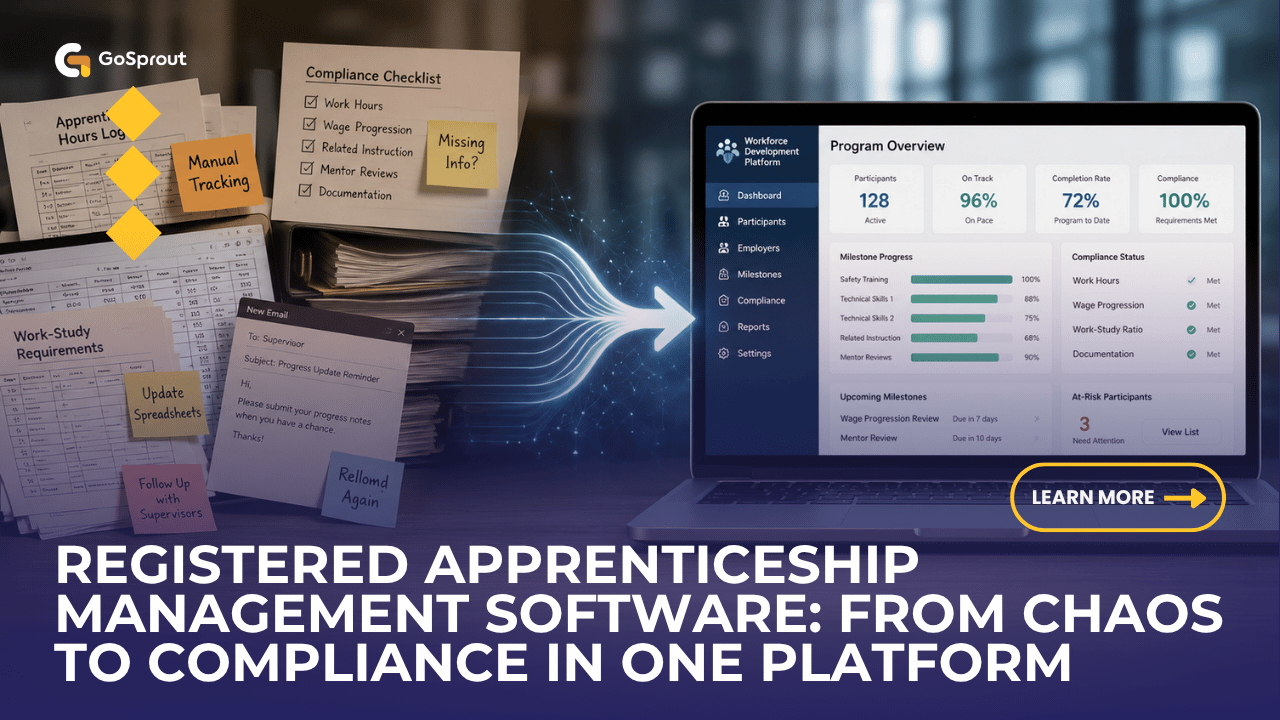
Registered apprenticeship management software serves as the primary platform to run programs end-to-end: design, registration, onboarding, OJT and RTI tracking, wage progressions, reporting, and completion. The contrast is stark—from spreadsheets, email chains, and paper sign-off sheets to a single system keeping you audit-ready and aligned with employers, sponsors, RTI providers, and apprentices.

What Is Registered Apprenticeship Management Software?
Registered apprenticeship management software is a purpose-built platform for managing US DOL or state-registered programs—distinct from generic LMS tools focused on course delivery, HRIS systems handling payroll without OJT validation, or CRM software lacking RAPIDS integration. If you want a refresher on the basic apprenticeship meaning before getting into registration rules, GoSprout covers it in plain terms.
Comprehensive apprenticeship platforms streamline the management of complex apprenticeship programs by integrating various functions such as compliance, tracking, and reporting into a single system. Apprenticeship management software is designed to simplify the administration of apprenticeship programs by centralizing On-the-Job Training hours, Related Technical Instruction, standards, wage steps, and compliance documentation. The integration of education, training, and employment data into one system is a key feature of modern apprenticeship management software, facilitating easier tracking of learner progress and compliance with regulatory standards.
Typical workflows replaced:
- Paper OJT logs and clipboard tracking
- Manual RTI attendance in separate spreadsheets
- Email chains for mentor evaluations
- Error-prone manual RAPIDS data entry
- Ad-hoc completion documentation
Who Uses Registered Apprenticeship Management Software?
Modern apprenticeship management software must serve multiple user types with different goals and permissions across your organization and partners.
| Stakeholder | Primary Use Cases |
|---|---|
| Employers/HR Teams | Forecast talent pipelines, track apprentice progress against standards, integrate with payroll |
| Sponsors/Intermediaries | Maintain standards with DOL/SAAs, manage MOUs, centralize agreements and status tracking |
| RTI Providers | Track enrollment, attendance, grades, certifications; exchange data without spreadsheet handoffs |
| Journeyworkers/Mentors | Sign off skills, leave feedback, review OJT logs via mobile |
| Apprentices | View required competencies, remaining hours, wage schedules, completion milestones |
For sponsors managing high quality apprenticeships, the software centralizes documentation and ensures all parties stay aligned. Training providers like community colleges benefit from exchanging relevant program information seamlessly. Educators and instructors can focus on developing skills rather than administrative processes.
Core Capabilities of Registered Apprenticeship Management Software
Not all apprenticeship software supports the depth required for RA-specific workflows. Here’s what to evaluate across six critical capability areas.
Program Design & Registration Support
Organizations launching their first registered apprenticeship need guided workflows defining occupations, competencies, OJT hour requirements, RTI curricula, and wage progression schedules. The system should generate DOL or state registration forms automatically, reducing design and submission time from months to weeks.
On-the-Job Training (OJT) Tracking
RA structures typically span 2,000–8,000 hours with specific work processes—500 hours in safety protocols, 1,000 in equipment operation. Apprenticeship programs benefit from tools that allow apprentices to log On-the-Job Training and Related Technical Instruction hours from any device. Competency management in apprenticeship programs maps specific skills to OJT tasks and RTI courses. Real-time visibility into apprentice progress enables program managers to identify and support struggling apprentices before they fall behind on wage gates.
Related Technical Instruction (RTI/RSI) & Classroom Tracking
Most programs require 144+ annual RTI hours. Effective tracking of apprentice progress requires integrating education, training, and employment data into a single system to simplify reporting and compliance. Whether partnering with community colleges, union training centers, or online bootcamps, the platform should map courses to competencies and provide sponsors easy access to combined OJT and RTI views.
Wage Progression & Milestone Automation
RA standards define wage steps tied to completed hours and competencies. Automating wage progression alerts ensures apprentices receive pay increases based on milestones or logged hours. The platform maintains historical trails of wage changes with dates, reasons, and approvals—critical for audits or disputes.
Compliance, Funding, and Audit-Ready Reporting
Many apprenticeship platforms automatically aggregate data to generate reports for regulatory bodies like the U.S. Department of Labor. Dashboards in apprenticeship platforms offer insights into key metrics like completion rates and post-apprenticeship retention. Centralized, automated tracking in apprenticeship programs lowers the risk of human error and incomplete documentation, producing audit-ready exports in hours rather than weeks.
Portals, Collaboration, and Communication
Centralized communication tools in apprenticeship platforms facilitate messaging, alerts, and reminders among sponsors, mentors, and apprentices. Self-service portals allow users to access schedules, track progress, and view performance feedback independently. A well-designed comprehensive apprenticeship platform can significantly enhance collaboration among training providers, employers, and regulatory agencies, which is crucial for closing the skills gap in the workforce.

Key Benefits: Why Organizations Invest in RA Management Software
Good RA software is a prerequisite for scaling programs responsibly, whether managing 10 learners or thousands.
- Compliance & Risk Reduction: Instant audit prep versus weeks of manual data gathering; safeguards funding amid DOL scrutiny
- Time Savings: These platforms help reduce administrative burdens by automating essential tasks, which allows organizations to focus more on learner outcomes and program effectiveness. Automating routine tasks in apprenticeship programs reduces administrative burden on HR teams and mentors.
- Better Outcomes: A well-structured tracking system can significantly reduce the administrative burden associated with managing apprentices, allowing for more focus on learner outcomes. Apprentices love transparent milestone tracking, with completion rates climbing from 50-60% nationally to 80%+ in software-supported programs.
- Scalability: Standardized digital workflows in apprenticeship programs facilitate scalability without increasing administrative complexity.
- Talent Pipeline Data: Consolidated analytics help demonstrate ROI to executives, showing apprentices filling jobs at 40-60% lower cost than external hires.
Providing a tech-enabled experience with mobile access attracts top talent to apprenticeship programs, giving job seekers clear visibility into careers and future growth.
How to Choose the Right Registered Apprenticeship Management Software
The market includes generic training tools and true RA-focused platforms. Evaluate vendors on RA-specific functionality, ease of use, implementation support, integrations, data security, and total cost.
Evaluating RA-Specific Feature Fit
Verify OJT tracking by work process, RTI mapping, wage steps, RAPIDS/state reporting, and multi-stakeholder access. Check support for multiple occupations, sponsors, and multi-state operations without workarounds. Ask how vendors handle updates when DOL or state requirements change. The difference between “can be customized for RA” and “built for RA” matters significantly.
Usability, Implementation, and Ongoing Support
Teams need software that non-technical staff—often wearing many hats—can adopt quickly. Look for intuitive navigation, training resources, and support channels including email, chat, and dedicated customer success. Implementation typically spans 2-8 weeks with data migration assistance. The complexity of registered apprenticeship programs can suppress demand from employers and sponsors without proper tools, leading to unnecessary administrative expenses for all parties.
Integrations, Data Security, and Privacy
RA software often exchanges data with HRIS, payroll, LMS, and case management systems. Expect standardized APIs, SSO options, encryption, role-based access controls, and audit logs. Organizations should retain control of their data with clear terms around usage. Request security documentation rather than accepting vague assurances.
Implementing Registered Apprenticeship Management Software: Best Practices
Many RA teams are adopting centralized software for the first time. Follow these steps:
- Map current processes with a cross-functional team (sponsor rep, employer HR, RTI contact, IT lead)
- Clean legacy data from spreadsheets before migration
- Pilot with a small cohort before full rollout
- Train stakeholders using vendor resources and phased approaches
- Set success metrics (reporting time reduction, wage step accuracy, data errors)
- Iterate based on feedback targeting 90%+ adoption
Why Choose Our Registered Apprenticeship Management Platform?
We focus exclusively on Registered Apprenticeship and work based learning programs rather than generic training management. Our platform is built around real RA workflows: standards design, OJT/RTI tracking, wage progression automation, and DOL/state reporting in one system. For example, a registered welding apprenticeship has to document OJT hours and related instruction against its approved standards for years at a time.
We enable multi-stakeholder collaboration, giving employers, sponsors, training providers, mentors, and apprentices each a tailored view with appropriate permissions. Our tools help you organize, track, and scale programs while maintaining state requirements and regulations.
What sets us apart:
- Compliance-first reporting that keeps you audit-ready
- Intuitive setup for first-time RA sponsors
- Support for scaling to statewide or multi-employer initiatives
- Data privacy commitment—we do not sell customer data
Ready to see how we serve organizations building talent pipelines? Schedule a demo to explore how our platform helps you enroll, manage, and support apprentices at scale.
Want to Learn More About Your Registered Apprenticeship Opportunities?
BOOK A FREE CONSULTATION
FAQs About Registered Apprenticeship Management Software
No, it’s not mandated, but increasingly essential for programs scaling beyond 50 apprentices. Manual methods falter under audit rigor and growing documentation requirements.
LMS platforms focus on course delivery without RAPIDS/OJT tracking. HRIS systems handle payroll without RTI mapping. RA software embeds the full apprenticeship lifecycle with compliance built in.
Yes. Free and low-cost tiers reduce admin by 30-50%, though ROI accelerates at scale. Even smaller programs gain from centralized tracking and audit readiness.
Most implementations span 2-12 weeks depending on data volume, with dedicated support for migration from spreadsheets and legacy systems.
Many platforms extend to pre-apprenticeships via configurable paths, enhancing talent pipelines amid work based learning expansion. Effective apprenticeship management software can significantly reduce the administrative burden associated with managing compliance and documentation across program types.
Conclusion: Building Durable Talent Pipelines With the Right Infrastructure
Registered apprenticeship management software transforms fragmented, manual processes into a coherent system supporting compliance, learner success, and workforce strategy. RA isn’t just a funding mechanism—it’s a long-term talent strategy deserving purpose-built infrastructure.
Audit your current processes. Where do spreadsheets create risk? Where does manual reporting drain your team? Identify the gap between your current state and audit readiness.
Ready to modernize your registered apprenticeship programs? Explore our platform and discover how the right tools help you create, manage, and scale apprentice achievements that matter to your company, industry, and future workforce.


