Table of Contents
- When Spreadsheets Stop Working: The Real Cost of Managing Intern Programs Manually
- Core Features Every Internship Tracking System Needs
- Internship Tracker vs. Applicant Tracking System: Why the Wrong Tool Creates New Problems
- Compliance, Documentation, and Legal Considerations That a Platform Must Handle
- Supporting Every Stakeholder: Why Multi-Sided Architecture Matters
- How an Internship Tracking System Improves Employer ROI and Hiring Outcomes
- How to Evaluate and Choose the Right Internship Tracking System
- Conclusion: Building Intern Programs That Perform
- Frequently Asked Questions
When Spreadsheets Stop Working: The Real Cost of Managing Intern Programs Manually
The Organizational Debt Hidden Inside Every Manual Intern Program
Every spreadsheet-managed intern program carries a hidden liability: organizational debt. This is the accumulated cost of workarounds, manual re-entry, version conflicts, and institutional knowledge that lives inside one coordinator’s inbox rather than a shared system. It compounds quietly until a missed deadline, a compliance audit, or a hiring season surge exposes it all at once.
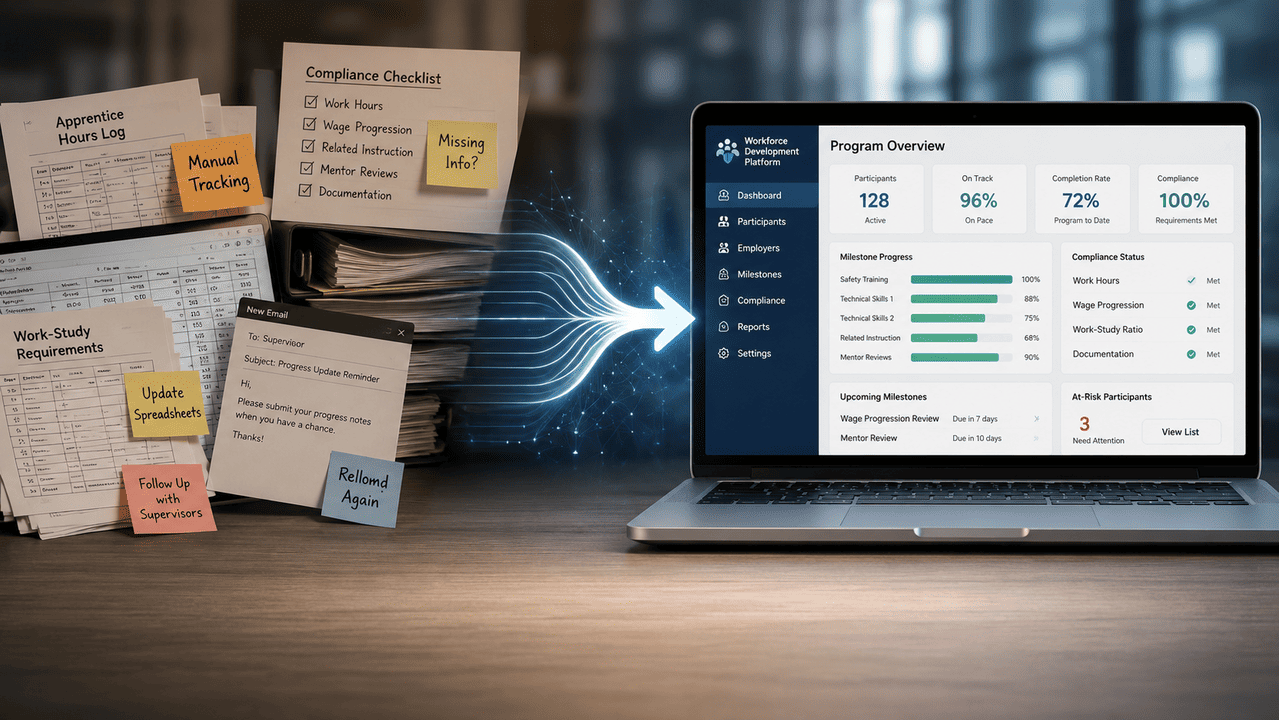
The debt isn’t just operational. It’s structural. When program data lives across multiple files, email threads, and calendar reminders, no single person can see the full picture. Tasks fall through the cracks because ownership is unclear. Supervisors don’t submit feedback because there’s no prompt to do so. Interns don’t return because the experience felt disorganized, and no one tracked that signal to act on it.
Most HR managers who are still running programs manually know something isn’t working. What they underestimate is how much the dysfunction is already costing them.
Why the Stakes Are Higher Than Most HR Managers Realize
Intern programs look lightweight from the outside: a few hires, a few months, a few projects. In practice, they carry the same operational and legal exposure as any structured employment relationship, with added complexity from multiple supervisors, institutions, and program types all running in parallel.
Compliance Exposure from Incomplete Documentation
Incomplete documentation is not a minor inconvenience. For organizations running registered apprenticeships or programs subject to Department of Labor oversight, missing logsheets, unsigned agreements, or undocumented evaluations can trigger findings during audits. Even standard corporate internship programs carry wage and hour obligations that require documentation to defend. A spreadsheet cannot enforce that documentation is complete. A purpose-built internship tracking system can.
Talent Pipeline Losses from Poor Candidate Experience
Candidate experience in intern recruiting directly predicts whether top candidates accept offers and whether current interns refer peers the following cycle. When applications go unacknowledged, offer letters arrive late because the coordinator had to locate the right template, or onboarding amounts to a stack of PDFs sent the night before day one, the signal to the intern is clear: the program is not well-run. That impression sticks, and it spreads.
The Measurement Gap: Not Knowing What Your Program Actually Produces
Most organizations cannot answer basic questions about their intern programs. What percentage of interns received a full-time offer? What skills did interns demonstrate by end of term? Which supervisor cohorts produced the strongest outcomes? Without structured data collection built into the workflow, these questions require manual analysis that rarely happens. The result is a program that cannot learn from itself.
What a Modern Internship Tracking System Is Actually Built to Do
A modern internship tracking system is not a database for storing intern contact information. It is an operational layer that manages workflows across the full program lifecycle, from application intake through onboarding, performance evaluation, compliance documentation, and final conversion decisions.
The distinction between an internship tracking system and an internship management platform is worth clarifying. In its narrowest form, an internship tracking system monitors application status and program milestones. An internship management platform encompasses the full operational lifecycle, including onboarding automation, supervisor workflows, performance reviews, compliance documentation, and reporting. In practice, any platform worth evaluating functions as both. The tracking layer is table stakes. The management layer is where programs differentiate.
This distinction also shapes how you evaluate vendors. If you assess platforms only on tracking capabilities such as pipeline views and status flags, you will select a system that solves the easiest part of your problem. The harder operational challenges, ensuring supervisors submit evaluations on time, generating audit-ready documentation automatically, and measuring program outcomes consistently, require management-layer functionality. Frame your evaluation around the full lifecycle, not just the intake stage.
Core Features Every Internship Tracking System Needs
Application Tracking and Pipeline Organization as the Foundation
Effective application tracking requires more than a list of applicants and their stages. It requires automated follow-up triggers when candidates go cold, deadline visibility so no offer window expires unnoticed, and status management that updates across the team in real time. The coordinator should know immediately when a supervisor hasn’t reviewed their assigned candidate pool.
Every category-credible platform offers application tracking. Evaluating vendors on this feature alone is like choosing an accounting system based on whether it can add numbers. Use it as a baseline qualification, then focus your evaluation on the capabilities that separate strong platforms from weak ones.
Centralized Program Data: The Single Source of Truth Requirement
Fragmented data is the root cause of most intern program failures. When offer letters, onboarding documents, evaluation forms, and logsheets live in separate systems or shared drives, every stakeholder operates with an incomplete view. A centralized internship tracking system creates one authoritative record per intern, per cohort, and per program that any authorized user can access in real time. This single source of truth eliminates duplication, reduces the risk of acting on stale information, and makes reporting dramatically faster.
Onboarding Automation and Intern Lifecycle Management
Onboarding automation works by triggering a defined sequence of tasks, documents, and communications the moment an intern is marked as accepted in the system. The intern receives a welcome message with their start date and first-week agenda. HR receives an equipment request checklist. The supervisor receives an orientation guide. Offer letters, tax forms, and program agreements are routed for e-signature without coordinator intervention.
The lifecycle extends well beyond day one. A strong internship management platform tracks the intern through their full term: assignment milestones, mid-term check-ins, final evaluations, and, where applicable, conversion decision workflows. Each stage has its own set of triggers, so nothing depends on someone remembering to send an email.
Supervisor Feedback, Performance Evaluation, and Skill Development Tracking
Performance tracking requires two things most manual programs lack: structured evaluation criteria and scheduled prompts that ensure supervisors complete reviews on time. Without both, feedback is inconsistent across the cohort and difficult to use for program-level analysis.
A capable platform standardizes evaluation rubrics across the organization, schedules review reminders automatically, and aggregates results into dashboards that show skill development trends, supervisor engagement rates, and cohort performance comparisons. Program success becomes measurable rather than anecdotal, and intern performance evaluation shifts from a reactive exercise to a structured process.
Compliance Documentation, Logsheets, and Audit-Ready Record-Keeping
Compliance documentation is not optional for programs operating under formal apprenticeship standards or government workforce development grants. These programs require timestamped logsheets, signed competency verifications, and documented supervisor hours, all organized in a format that survives an external audit.
A purpose-built system generates these records automatically as part of normal program activity. The coordinator does not assemble an audit binder at year-end. The system maintains it continuously.
Workflow Customization for Apprenticeships, Co-ops, and Rotational Programs
Not all structured work-based learning programs follow the same shape. A registered apprenticeship runs over one to five years with defined competency milestones. A rotational program moves interns across departments on a six-to-eight-week cycle. A co-op program management structure alternates academic and work terms on a semester schedule. Each requires different workflows, evaluation timing, and documentation logic.

A platform that only supports a single program template forces administrators to bend their programs to fit the software. The right system supports workflow customization so the platform adapts to the program, not the other way around.
Integration with Existing HR, Recruitment, and Workforce Development Tools
Intern program data does not exist in isolation. It connects to your HRIS for employee record creation, your ATS for candidate sourcing, your payroll system for compensation setup, and in some cases your learning management system for training completion tracking. A platform that cannot pass data cleanly to these systems adds manual work at every handoff point.
Prioritize integrations that eliminate re-entry at the three highest-friction touchpoints in your current workflow. For most programs, those are candidate import from the ATS, offer letter generation linked to HRIS records, and evaluation data export for HR reporting.
Platform Feature Evaluation Matrix
Use this rubric to score internship tracking systems during vendor evaluation. Rate each capability from 1 (absent or minimal) to 4 (fully built and scalable). A platform scoring below 24 out of 32 warrants close scrutiny before selection.
1. Application Tracking. Does the platform manage pipeline stages, automate follow-ups, and provide deadline visibility across the recruiting team? A score of 4 requires role-based views and real-time status sync.
2. Onboarding Automation. Does the platform trigger document routing, task assignments, and communications automatically upon offer acceptance? A score of 4 requires e-signature integration and configurable onboarding sequences.
3. Compliance Documentation. Does the platform generate and maintain logsheets, signed agreements, and competency verifications in an audit-ready format? A score of 4 requires timestamped records and export-ready reporting.
4. Performance Evaluation. Does the platform support structured evaluation rubrics, scheduled review reminders, and program-level performance dashboards? A score of 4 requires configurable criteria and cohort comparison views.
5. Multi-Stakeholder Access. Does the platform support distinct access and workflows for HR administrators, hiring supervisors, and interns? A score of 4 requires role-specific dashboards and permission controls.
6. Workflow Customization. Can the platform support apprenticeships, co-ops, and rotational programs with different timelines, milestones, and documentation logic? A score of 4 requires template flexibility without requiring custom development.
7. Integration Depth. Does the platform connect cleanly to your HRIS, ATS, and payroll systems? A score of 4 requires native integrations or a documented API, not CSV exports as the only option.
8. Marketplace Connectivity. Does the platform connect your program to a network of student talent, or does it only manage candidates you already sourced? A score of 4 requires a two-sided marketplace with active candidate supply.
Total possible score: 32. Use this matrix to compare platforms side by side and identify capability gaps before a vendor conversation turns into a contract negotiation.
Internship Tracker vs. Applicant Tracking System: Why the Wrong Tool Creates New Problems
What an ATS Is Designed to Do, and Where Its Scope Ends
An applicant tracking system is purpose-built for one workflow: moving candidates from application to offer. It handles job posting distribution, resume parsing, interview scheduling, and offer generation. For high-volume recruiting teams, it is an essential tool. But its scope ends at the offer letter, and that boundary is by design.
An ATS has no concept of an intern’s first week, their mid-term evaluation, or the compliance documentation their program requires by month three. It cannot prompt a supervisor to submit feedback, track logsheet hours for a registered apprenticeship, or tell you what percentage of last year’s cohort converted to full-time roles. These are not edge cases. They are the operational core of a functioning intern program.
The Post-Hire Gap: What Happens After the Offer Letter
The gap between offer acceptance and program completion is where most intern programs lose control. Once the ATS marks a candidate as hired, the coordinator is back to email threads and spreadsheets: tracking start dates manually, assembling onboarding documents one by one, reminding supervisors to schedule check-ins, and hoping nothing slips before the final evaluation cycle.
This gap compounds at scale. A program running twenty interns across four departments requires dozens of simultaneous workflows: equipment requests, systems access, signed agreements, orientation sessions, and evaluation deadlines all happening in parallel. An ATS cannot manage any of it. The coordinator becomes the system, and the program’s quality depends entirely on how much that person can hold in their head at once.
Why Generic Project Management Tools Also Fall Short at Scale
Project management tools seem like a reasonable bridge. They offer task assignment, deadline tracking, and customizable workflows. For a coordinator managing a handful of interns in a single department, one of these tools can hold things together temporarily.
The structural problem with spreadsheets and general-purpose tools is that they require constant manual maintenance. There is no logic that enforces a workflow, no automatic trigger when a deadline passes without action, and no access control that shows supervisors only their assigned interns without exposing the entire cohort record.
At ten interns, a spreadsheet is inconvenient. At thirty, it is a liability. Version conflicts create data integrity issues. There is no audit trail when a field is edited. Compliance documentation cannot be generated from a row of cells. And when the coordinator who built the spreadsheet leaves, institutional knowledge walks out with them. Free tools trade short-term cost savings for long-term operational fragility.
Purpose-Built Internship Management Platforms vs. Assembled Patchworks
The alternative most organizations land on before adopting a dedicated platform is a patchwork: an ATS for recruiting, a project tool for task tracking, shared drives for documents, and email for everything else. Each individual tool does its job adequately. The failure point is the handoffs between them.
Every transition between systems is a place where data does not transfer automatically, where a step gets missed, and where reporting becomes impossible because the information you need lives across four platforms with no common identifier. A purpose-built internship tracking system eliminates those seams. The same record that holds an intern’s application also holds their onboarding checklist, their evaluation scores, and their compliance documentation. There is no re-entry, no reconciliation, and no question about which version is current.
Compliance, Documentation, and Legal Considerations That a Platform Must Handle
The Regulatory Landscape for Internship and Apprenticeship Programs
The compliance obligations vary significantly by program type, but they share a common thread: documentation that can be produced on demand and verified as complete.
For standard corporate internships, the primary exposure is wage and hour classification. Unpaid internships in the private sector must meet the Department of Labor’s primary beneficiary test, and the factors supporting that determination need to be documented and defensible. For programs receiving workforce development funding, grant compliance typically requires attendance records, participant eligibility verification, and outcome reporting.
Registered apprenticeships operate under the most rigorous framework. Programs registered with the DOL or a State Apprenticeship Agency must maintain records of on-the-job training hours, related technical instruction completion, competency assessments, and wage progression. These records are subject to periodic review and must be organized in a format an external reviewer can navigate without assistance from program staff. An apprenticeship tracking system built for this complexity is a meaningfully different tool than one designed for standard summer internships.

Documentation Requirements That Expose Organizations Without a Dedicated System
The documentation failures that create the most legal exposure are rarely dramatic. They are cumulative and quiet: an evaluation discussed verbally but never recorded, a logsheet submitted late and never verified, a signed agreement emailed but never confirmed received.
Without a system that enforces completion, these gaps accumulate across an entire cohort. When an audit occurs or a dispute arises, the organization cannot demonstrate what happened. The absence of documentation is treated as evidence that the obligation was not met, regardless of what actually occurred.
How a Purpose-Built Platform Reduces Legal and Audit Risk Structurally
A purpose-built platform reduces risk not by adding a compliance checklist but by making non-compliance structurally difficult. When logsheets are embedded in the intern’s workflow and require supervisor sign-off before the next milestone unlocks, they get completed. When evaluation forms are automatically routed at scheduled intervals with escalation reminders, they get submitted. The system enforces the process rather than relying on individual memory.
Audit readiness becomes a byproduct of normal operation. Records are timestamped automatically, organized by program and participant, and exportable in a format that mirrors regulatory reporting requirements. The compliance record exists continuously, not as a last-minute assembly project.
Apprenticeship-Specific Compliance: Where Standard Intern Tools Break Down
Standard intern platforms, even capable ones, are designed around semester-length programs with straightforward evaluation cycles. Registered apprenticeships run one to five years, require hour-by-hour OJT tracking against a defined work process schedule, and mandate documented wage increases tied to competency milestones. A tool built for twelve-week internships cannot model this structure without significant workarounds.
The gap matters most when a program scales. A small apprenticeship cohort might be manageable with a mismatched tool. A cohort of fifty apprentices across multiple occupation codes, each at a different point in their journey, requires a platform designed specifically for that complexity.
Supporting Every Stakeholder: Why Multi-Sided Architecture Matters
The Three-Party Problem: Students, Employers, and Institutions Have Different Needs
Most intern programs involve at least three distinct parties, each with a different relationship to the program. Students need visibility into their application status, their program requirements, and their own performance feedback. Employers need to manage workflows, approve documents, and track program outcomes across a cohort. Academic institutions need to verify participation, confirm learning objectives, and in some programs award credit.
A platform designed for only one of these parties will always create friction for the others. When the employer workflow is well-designed but students have no portal access, the coordinator becomes the communication layer between the system and the intern. That is the manual overhead the system was supposed to eliminate.
What Employer-Only Platforms Miss About the Intern Experience
Employer-facing platforms excel at administrative management but treat the intern as a record rather than a participant. When interns cannot track their own milestones, access their feedback, or confirm the status of their submitted documents, they contact their coordinator by email. For a cohort of any size, this creates a support burden that consumes the time the platform was supposed to free up.
Beyond operational efficiency, the intern experience is a talent signal. Interns who navigate a well-designed platform form a different impression of the organization than those who receive disorganized instructions through generic email. That impression influences whether they accept a full-time offer and whether they refer peers to future cycles.
What Student-Only Tracking Tools Miss About Operational Management
Tools designed from the student’s perspective often handle the experience side well but lack the administrative infrastructure employers need. They may provide a clean interface for interns to track their hours or submit reflections while offering no supervisor workflow, no compliance documentation layer, and no program-level reporting for HR.
An HR manager using one of these tools still needs a separate system for offer management, onboarding, and evaluation. The student-facing tool becomes one more layer in the patchwork rather than a solution to it.
How a Two-Sided Marketplace Model Resolves the Structural Conflict
A two-sided platform handles both the student experience and the employer workflow within the same system, on the same record. The intern applies through the platform, tracks their status, completes onboarding tasks, submits logsheets, and views their evaluations without leaving the system. The employer manages the pipeline, triggers onboarding sequences, assigns supervisors, and generates compliance documentation through the same platform, referencing the same underlying data.
This architecture eliminates the translation problem between tools. There is no moment where information needs to be manually transferred from a student portal to an employer management system. The record is shared, current, and visible to the right parties based on role-based access controls.
A two-sided marketplace also creates a compounding advantage that pure management tools cannot replicate. As more students use the platform to find opportunities, employers gain access to a qualified candidate pool without running separate sourcing campaigns. As more employers post programs, students have more relevant opportunities to pursue. Each side of the marketplace makes the other more valuable over time.
For HR managers, this means the platform is not only managing current program operations but actively feeding future cohorts. Candidate sourcing and program management share a single system, which reduces the friction between finding talent and developing it.
How an Internship Tracking System Improves Employer ROI and Hiring Outcomes
Reframing the Investment: From Administrative Cost to Talent Infrastructure
Intern programs are routinely budgeted as overhead: coordinator time, onboarding materials, supervisor hours. That framing guarantees underinvestment and obscures the actual business case. An intern program run well is a pre-screened, partially trained talent pipeline that produces full-time hires at a fraction of the cost of external recruiting. The platform that manages it is not an administrative expense. It is the infrastructure that determines whether that pipeline produces anything.
The return on an internship management platform comes from three sources: reduced coordinator labor, improved conversion rates, and lower early-tenure attrition.
Coordinator labor is the most visible. Organizations running manual programs commonly spend several hours per intern per month on administrative tasks: tracking document completion, chasing supervisor feedback, assembling reports. For a cohort of twenty-five interns, that translates to substantial time each month spent on process management rather than program quality. A platform that automates those workflows returns most of that time immediately.
Conversion rate improvement is the more significant return. Interns who experience an organized, well-supported program convert to full-time offers at meaningfully higher rates than those who do not. The structured evaluation process a platform enforces also produces better hiring decisions, because supervisors have documented performance data rather than a general impression when it comes time to extend offers.
The third source is retention. Early-career hires sourced through internship programs consistently outperform external hires on retention metrics. A platform that strengthens the intern experience and improves the quality of the conversion decision compounds that advantage.

Measurable Outcomes: Conversion Rates, Time-to-Productivity, and Retention Signals
The metrics that matter most for intern program ROI are trackable only if the program generates structured data. A well-configured internship tracking system produces three categories of output that directly inform business decisions.
Conversion rate by cohort, department, and supervisor reveals which parts of the program actually develop hire-ready talent. If one business unit converts a strong percentage of interns and another converts very few, that gap is a management signal, but only if the data exists to surface it.
Time-to-productivity for former interns versus external hires quantifies the ramp-up advantage. Interns who complete a well-documented program and return as full-time employees typically reach independent productivity faster because they understand the organization’s systems, culture, and expectations. Without tracked onboarding milestones and performance benchmarks, that advantage remains anecdotal.
Retention signals emerge from evaluation data collected during the internship. Interns who report high supervisor engagement, clear feedback, and meaningful project work are more likely to accept offers and remain beyond their first year. These signals are measurable when the platform collects structured data at each program stage.
Transforming Intern Cohorts Into a Competitive Early-Talent Pipeline
The strategic shift happens when an organization stops treating each cohort as a one-time operational event and starts treating the intern program as a continuous talent channel. That shift requires data continuity across cohorts: knowing which sourcing channels produce the highest-converting candidates, which supervisor behaviors correlate with strong intern outcomes, and which program structures produce the fastest time-to-productivity.
A platform accumulates that intelligence automatically. Each cohort’s data becomes a benchmark for the next. Over two or three cycles, the program generates enough evidence to make intentional improvements rather than intuitive ones. The result is a talent pipeline that strengthens each year rather than one that resets to zero every recruiting season.
Understanding Internship Management Platform Costs
Pricing in this category varies widely based on program scale, feature depth, and whether the platform includes marketplace access. Most platforms structure pricing along one of three models: per-intern seat pricing, flat subscription tiers by organization size, or program-based licensing for organizations managing multiple distinct program types.
Entry-level platforms targeting small programs typically run in the range of a few hundred dollars per month. Mid-market platforms with full lifecycle management, compliance documentation, and multi-stakeholder access generally fall in the range of one thousand to several thousand dollars per month, depending on cohort size and configuration. Enterprise platforms with deep HRIS integration and custom workflow support are priced on contract.
The factors that drive cost variance include cohort volume, number of program types managed, compliance documentation requirements, integration complexity, and whether the platform includes a candidate marketplace. Platforms that provide both program management and talent sourcing through a unified system carry a higher base cost but eliminate separate sourcing spend.
The cleaner calculation, however, is the cost of the status quo. If a coordinator spends significant hours per month on administrative tasks and the program misses conversion opportunities that would otherwise reduce future external recruiting costs, the total cost of maintaining a manual system often exceeds platform investment within the first year. The cost of non-conversion is not zero. It is the full cost of finding and onboarding the replacement hire through a more expensive channel.
How to Evaluate and Choose the Right Internship Tracking System
Applying the Evaluation Framework: Eight Criteria That Separate Strong Platforms from Weak Ones
The evaluation matrix introduced earlier in this article provides a scoring structure. In practice, applying it requires knowing which gaps are disqualifying and which are manageable. A platform that scores lower on integration depth may be acceptable for an organization whose HR stack is simple. A platform that scores low on compliance documentation is a liability for any program operating under DOL oversight or workforce development grant requirements.
Prioritize the criteria that map directly to your current failure points. If compliance is your primary exposure, treat that dimension as a minimum threshold, not a weighted factor. If candidate sourcing is a bottleneck, marketplace connectivity should carry disproportionate weight.
Questions to Ask Every Vendor Before Committing
These questions cut through demo-layer polish and reveal operational reality.
- How does the platform handle a supervisor who does not submit an evaluation by the deadline? What is the escalation path?
- Can we configure different workflow templates for different program types, such as an apprenticeship and a summer internship, without custom development?
- What does audit-ready documentation look like in practice? Walk me through what we would export if we received a DOL inquiry tomorrow.
- How does the platform connect us to candidate supply? Is there an active network of students, or does sourcing stay entirely outside the system?
- What does implementation actually require? How long does configuration take, and what does your team provide versus what do we build ourselves?
Illustrative Scenario: What Evaluation Looks Like for a Mid-Sized HR Team
Consider a company running forty interns per year across three departments, with two of those departments participating in a registered apprenticeship program. That organization needs a platform that handles two distinct compliance frameworks simultaneously, which is a meaningfully different evaluation than a company running twenty summer interns in a single business unit.
Their non-negotiable criteria include apprenticeship-specific logsheet tracking, supervisor workflows that distinguish between internship and apprenticeship evaluation requirements, and documentation export that matches DOL reporting formats. Secondary criteria include integration with their existing HRIS for employee record creation and a candidate marketplace to reduce sourcing effort in a tight labor market.
Running the evaluation matrix, they weight compliance documentation and workflow customization as threshold requirements. Any platform scoring below three on either dimension is removed from consideration before the demo stage. The remaining platforms are evaluated on integration depth and marketplace reach. That sequence focuses evaluation time where the stakes are highest.
Matching Platform Architecture to Program Type and Scale
Program type determines the operational complexity a platform must handle. A single-cohort summer program with standard evaluation cycles has different requirements than a multi-year apprenticeship with defined competency milestones. Scale determines how much that complexity matters: a mismatched platform is tolerable at low volume and becomes a serious operational problem at high volume.
The clearest alignment principle is to match the platform’s core architecture to your most complex program. A platform designed for apprenticeship management can handle a summer internship program without friction. A platform designed for summer internships will not handle a registered apprenticeship without significant workarounds.
Quick-Pick Platform Recommendation Guide
Use this guide to identify the right platform tier before entering vendor conversations.
Manage only, no sourcing needed. Your program already has candidate supply and needs lifecycle management, evaluation tracking, and documentation. Look for a purpose-built internship management platform with strong compliance features and HRIS integration. A marketplace is not required.
Manage and source. Your program needs both operational management and access to a candidate network. A two-sided marketplace platform that handles both in one system eliminates sourcing friction and keeps your program data unified.
Apprenticeship or grant-funded programs. Compliance documentation is a hard requirement. Prioritize platforms with apprenticeship-specific workflow support and audit-ready record generation.
Want to Learn More About Your Registered Apprenticeship Opportunities?
BOOK A FREE CONSULTATION
Ten or fewer interns, no compliance complexity. A structured platform still outperforms spreadsheets, but an entry-level tier will likely cover your needs without enterprise-level investment.
Conclusion: Building Intern Programs That Perform
From Cost Center to Talent Pipeline
The organizations that convert intern programs into genuine competitive advantages are not doing something fundamentally different from their peers. They are running the same program structures with better operational visibility, more consistent evaluation data, and a clearer line between intern experience and full-time hiring outcomes. The platform enables that consistency. Without it, program quality depends on individual coordinators maintaining manual systems that break under pressure.
The Strategic Case for a Purpose-Built, Two-Sided Platform
A general-purpose tool solves part of the problem. An employer-only platform solves another part. Neither resolves the structural challenge: intern programs involve multiple parties, generate compliance obligations, require lifecycle management that begins before day one and continues through conversion, and need candidate supply to remain viable over time.
A purpose-built, two-sided internship tracking system handles all of it in one place. The intern and the employer operate on the same record. The compliance documentation is a byproduct of normal workflow. The candidate pool grows with the platform’s network. The program data accumulates into a benchmark that makes each cohort stronger than the last.
That is not a feature list. It is a structural advantage that a spreadsheet, a project tool, or a single-sided platform cannot replicate.
Next Steps for HR Managers Ready to Move Beyond Spreadsheets
Start with an honest audit of your current program’s failure points. Where does data go stale? Where do workflows depend on one person’s memory? Where is your compliance documentation incomplete? Those are the gaps a platform must close.
Then apply the evaluation matrix to at least three vendors. Weight the criteria that match your highest-risk failure points, ask the operational questions that demos rarely surface on their own, and evaluate platforms against your most complex program type, not your simplest one.
The investment threshold is lower than most HR managers assume. The cost of the status quo, measured in coordinator hours, missed conversions, and compliance exposure, typically exceeds platform cost within the first year. The question is not whether a purpose-built internship tracking system is worth the investment. The question is how much the current approach is already costing before the switch.
Frequently Asked Questions
An internship tracking system, in its narrowest definition, monitors application status and program milestones. An internship management system encompasses the full operational lifecycle, including onboarding automation, supervisor workflows, performance evaluations, compliance documentation, and program-level reporting. In practice, any platform worth evaluating today functions as both. The tracking layer is a baseline expectation; the management layer is where operational value is created.
A capable internship tracking system should include application pipeline management, automated onboarding workflows, structured performance evaluation tools, compliance documentation with audit-ready record-keeping, multi-stakeholder access for HR administrators, supervisors, and interns, and integration with existing HRIS and ATS systems. For organizations managing apprenticeships or grant-funded programs, dedicated logsheet tracking and competency verification are also required.
Intern performance tracking requires two components: standardized evaluation rubrics applied consistently across the cohort, and scheduled prompts that ensure supervisors complete reviews on time. A well-configured platform aggregates this data into dashboards showing skill development trends, supervisor engagement rates, and cohort comparisons. Program success is then measurable through concrete metrics such as conversion rate by department, time-to-productivity for returning interns, and retention rates relative to external hires.
Requirements vary by program type. Standard corporate internship programs must document the basis for any unpaid classification against the Department of Labor’s primary beneficiary test. Programs funded through workforce development grants typically require attendance records, participant eligibility verification, and outcome reporting. Registered apprenticeships carry the most rigorous requirements, including timestamped OJT logs, related technical instruction records, competency assessments, and documented wage progression, all subject to periodic external review.
Onboarding automation is triggered the moment an intern is marked as accepted in the system. The platform automatically routes offer letters, tax forms, and program agreements for e-signature, sends the intern a welcome message with first-week instructions, and notifies HR and the assigned supervisor of their respective action items. Subsequent milestones, including mid-term check-ins, evaluation reminders, and final review cycles, follow the same trigger-based logic, so the process advances without manual intervention at each stage.
The return comes from three primary sources: reduced administrative labor, improved intern-to-hire conversion rates, and stronger retention among early-career hires sourced through the program. Organizations running manual programs allocate meaningful coordinator time each month to process management tasks that a platform can automate. Beyond labor savings, structured evaluation processes support better conversion decisions, and interns who experience organized, well-supported programs are more likely to accept full-time offers and remain with the organization beyond their first year. The combined effect typically offsets platform costs within the first program cycle.