
Table of Contents
- When Spreadsheets Become a Liability: The Real Cost of Manual Intern Management
- What Internship Management Software Is — and What It Is Not
- Key Features of High-Quality Internship Management Software
- Compliance, Onboarding Automation, and Why They Demand Dedicated Infrastructure
- Evaluating Platforms: A Structured Framework for Making the Right Decision
- How GoSprout Centralizes the Entire Internship and Apprenticeship Lifecycle
- Conclusion: Building Smarter Internship Programs Starts with the Right Infrastructure
- Frequently Asked Questions
When Spreadsheets Become a Liability: The Real Cost of Manual Intern Management
The Administrative Overhead That Scales Against You
Managing five interns with a shared spreadsheet is inconvenient. Managing fifteen interns across two cohorts with that same spreadsheet is a liability. The administrative overhead of manual intern management does not grow linearly with program size. It compounds.
Tracking Candidates Across Disconnected Tools
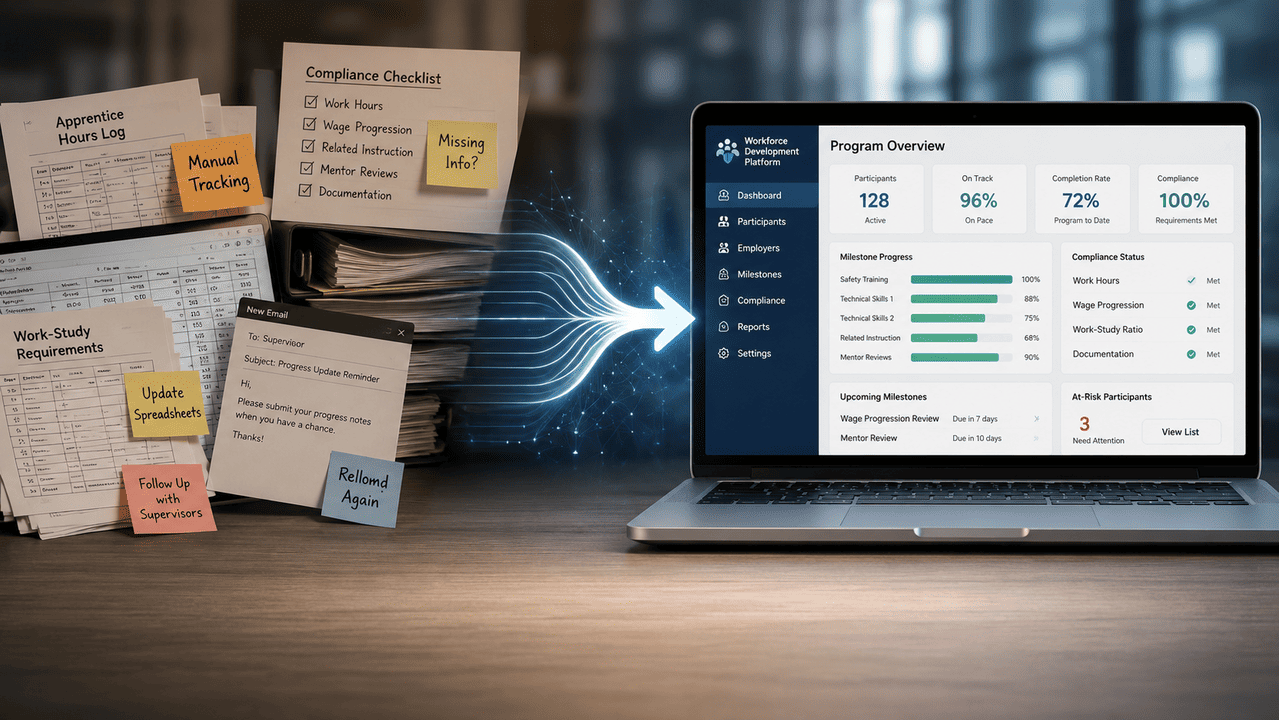
A typical manually managed program fragments candidate data across at least three systems: an email inbox for applications, a spreadsheet for status tracking, and a shared drive for documents. Every time a candidate advances, someone manually updates each location. Entries fall out of sync. Candidates receive duplicate outreach or, worse, no outreach at all because their status was recorded incorrectly. At five interns, a coordinator catches these errors by memory. At fifteen, they do not.
Managing Onboarding Checklists Without Automation
Onboarding a new intern manually requires a coordinator to identify which tasks apply to that person, assign each one individually, follow up when deadlines pass, and confirm completion without a reliable audit trail. When a second cohort starts six weeks later, the process repeats from scratch. There is no template enforcement, no automatic reminder logic, and no visibility into who is blocked or behind. The coordinator becomes the system, which means the system fails whenever the coordinator is unavailable.
Coordinating Compliance Documentation by Hand
Compliance documentation, including signed agreements, I-9 verification, confidentiality disclosures, and training acknowledgments, requires consistent collection and structured record keeping. When this process runs through email and spreadsheets, gaps are predictable. A document gets sent but not signed. A signed document gets filed in the wrong folder. An audit surfaces missing records that no one can reconstruct. These are not hypothetical failure modes. They are the natural result of using tools that were never designed to enforce process compliance.
What Disorganized Programs Signal to Emerging Talent
The Employer Brand Cost of a Fragmented Intern Experience
A candidate’s first extended interaction with your organization is the internship itself, and the program experience communicates organizational competence as clearly as any job posting or interview process. When an intern receives a welcome email days late, cannot locate their onboarding materials, or spends their first week waiting for access and assignments, they draw conclusions about how the organization operates. Those conclusions follow them into conversations with peers, onto review platforms, and into their own hiring decisions later in their careers.
How Program Structure Influences Intern Quality and the Retention Pipeline
Organizations that run structured, well-administered programs attract stronger candidates and convert a higher percentage of them to full-time hires. The correlation is direct: an intern who experiences a coherent, professional program is more likely to accept a return offer and more likely to recommend the organization to their network. Disorganized programs erode both outcomes. The downstream cost is not just one lost hire. It is a narrowing talent pipeline that compounds over multiple program cycles.
Putting the Problem in Perspective: An Illustrative Scenario
A 10-Intern Cohort: Manual Management vs. a Dedicated System
Consider a 10-intern summer cohort at a mid-sized company with one HR coordinator managing the program alongside other responsibilities. Without dedicated software, that coordinator spends roughly 30 to 45 minutes per intern on initial onboarding coordination, collecting documents, sending instructions, and confirming completions. That amounts to as many as 7.5 hours on onboarding administration alone, before any program management begins.
With a dedicated internship management software platform, onboarding workflows deploy automatically on each intern’s start date. The coordinator reviews a dashboard rather than managing individual threads. Time spent on onboarding administration for the entire cohort drops to under two hours.
Where Time Loss and Compliance Gaps Typically Surface First
The two areas where manual management fails earliest are onboarding and documentation. Onboarding fails because it requires coordination across multiple parties, including IT, managers, and HR, without a system to track each step. Compliance documentation fails because it relies on human follow-up to enforce deadlines, and human follow-up does not scale. Both problems are invisible until they produce a visible failure: an unprepared intern on day one, or a missing record during an audit.
How Much Time and Labor Is Actually at Stake?
The honest answer is that most organizations running manual programs have not measured it. The time cost is distributed across email threads, file searches, follow-up reminders, and duplicate data entry, none of which registers as a discrete line item. When organizations do measure it, many find that a program coordinator spends 20 to 30 percent of their program management time on administrative tasks that purpose-built software eliminates entirely.
For a small business where the HR function is one person handling multiple responsibilities, that reclaimed time is not marginal. It is the difference between running a reactive program and a strategic one.
What Internship Management Software Is — and What It Is Not
Defining the Category: Purpose-Built vs. General-Purpose Tools
Internship management software is a purpose-built platform designed to manage the full lifecycle of an intern or apprentice, from application and selection through onboarding, progress tracking, and offboarding. That scope matters because it distinguishes this category from the general-purpose tools organizations often try to adapt for program management.
Why Project Management Platforms Fall Short of Program Management
Project management platforms are built to track tasks and deliverables. They are not built to manage compliance documentation, enforce structured onboarding sequences, track candidate pipelines, or maintain records suitable for an HR audit. Adapting one to serve as an internship management system requires significant configuration, sustained manual discipline, and workarounds for every function the platform was not designed to perform. The result is a system that demands more maintenance than it saves.
The Distinction Between Intern Tracking Software and Broader HR Software
General HR platforms handle payroll, benefits, and workforce management for permanent employees. Most do not include the workflow structures an internship program requires: cohort-based onboarding, milestone evaluation frameworks, or program-level reporting. A company may already use an HR system and still have no functional infrastructure for managing interns. These are adjacent categories, not interchangeable ones.
Who Uses Internship Management Software and Why
HR Managers Scaling Programs Beyond a Single Cohort
The inflection point for most HR managers is the second cohort. Managing one cohort of interns manually is difficult but survivable. Running two cohorts simultaneously, with different start dates, managers, and compliance requirements, without a centralized system produces errors at a rate that becomes difficult to defend.
Small Business Owners Without a Dedicated HR Operations Team
Small businesses face a different constraint: they rarely have a dedicated HR operations team at all. The owner or office manager runs the internship program alongside many other responsibilities. For these organizations, the value of internship management software is not efficiency at scale. It is the capacity to run a program at all without it consuming disproportionate administrative resources.
Operations Leads Managing Apprenticeship and Rotational Worker Programs
Apprenticeship and rotational worker programs carry additional compliance obligations that make manual management especially risky. These programs often involve documented training hours, skills milestones, and regulatory reporting requirements. An operations lead managing these programs without dedicated infrastructure is building compliance risk into every program cycle.

Is There Software Specifically for Managing Interns?
Yes, and it is a distinct product category, not a feature set bolted onto a general HR platform. Purpose-built internship management software addresses the specific operational requirements of running cohort-based, time-limited talent programs: structured onboarding, candidate pipeline visibility, evaluation workflows, and compliance documentation. The platforms built for this category share a common design assumption — that program administrators need a single system of record for every intern, from first contact to final day.
What Does Internship Management Software Actually Do?
At its core, internship management software centralizes every function that a manual program distributes across disconnected tools. It replaces the inbox-spreadsheet-shared-drive model with a unified environment where candidate tracking, onboarding automation, task management, and documentation all operate from the same data source. Program administrators gain real-time visibility into program status. Interns receive a consistent, structured experience. Compliance records are captured automatically rather than assembled after the fact.
The Full Internship Lifecycle: Application Through Completion
Application and Candidate Management
Candidate management begins before an intern’s first day. A dedicated platform tracks applications, organizes candidate profiles, and records selection decisions in a structured pipeline, eliminating the version-control problems that plague spreadsheet-based tracking. Managers can review candidate status, add notes, and move individuals through stages without reconciling multiple data sources.
Structured Onboarding and Task Automation
Onboarding automation is among the highest-value capabilities a platform can deliver. When a new intern is added to the system, predefined onboarding workflows deploy automatically: document requests, manager introductions, system access tasks, and policy acknowledgments all trigger without coordinator intervention. Completion is tracked in real time, and outstanding items surface as exceptions rather than requiring manual follow-up.
Progress Tracking, Feedback, and Evaluation
Structured milestone tracking replaces informal check-ins with documented progress reviews. Managers complete evaluations within the platform, interns receive and acknowledge feedback, and the program generates a complete record of performance over time. This structure benefits both parties: managers gain a consistent framework, and interns receive feedback that is organized and retrievable.
Offboarding, Documentation, and Alumni Pipeline
Program completion requires its own administrative process, covering exit documentation, final evaluations, equipment returns, and access revocation. A platform that manages offboarding systematically ensures these steps are completed consistently and recorded accurately. It also creates the data foundation for an alumni pipeline: a structured record of every intern who has completed the program, their performance, and their status as a potential full-time hire.
Key Features of High-Quality Internship Management Software
Not every platform that claims to manage internships actually manages them well. The difference between a capable system and a basic tool shows up in the specifics: whether automation is genuinely configurable, whether compliance records are structured for audit retrieval, and whether reporting gives administrators actionable visibility or simply a count of completed tasks.
Core Capabilities Every Platform Must Demonstrate
Candidate Tracking and Pipeline Visibility
A platform must maintain a structured candidate pipeline from first application through final selection. That means individual candidate profiles, stage-based status tracking, and a cohort-level view that does not require opening individual records to understand overall program progress. Administrators should be able to filter by stage, flag candidates for follow-up, and export selection records without manual compilation.
Workflow Automation for Onboarding and Recurring Tasks
Automation means trigger-based deployment, not template storage. When an intern is added to the system with a start date, the platform should initiate the appropriate onboarding sequence automatically: document requests, manager assignments, access task notifications, and policy acknowledgments. Recurring tasks, such as mid-program check-ins and evaluation reminders, should follow the same logic. A platform that requires a coordinator to manually launch each workflow has not automated the process. It has merely digitized it.
Compliance Documentation and Audit-Ready Record Keeping
Compliance infrastructure means more than document storage. It means timestamped completion records, version-controlled agreements, and a retrieval structure that produces a complete audit trail by intern, by cohort, or by document type. If reconstructing a record requires searching across folders and email threads, the system has not solved the compliance problem.
Dashboard Reporting for Program Administrators
Program-level dashboards should surface what requires attention without the administrator needing to query for it. Overdue tasks, incomplete documentation, upcoming evaluation deadlines, and cohort completion rates should all be visible at a glance. Reporting that requires exporting data to a spreadsheet for analysis is a gap, not a feature.
Essential vs. Nice-to-Have Features: An Evaluation Framework
During vendor evaluation, the risk is over-weighting features that sound impressive but do not address core operational problems. The matrix below provides a structured framework for prioritizing your evaluation.
Feature Evaluation Matrix
| Feature Category | Essential | High Value | Context-Dependent |
|---|---|---|---|
| Onboarding Automation | Trigger-based workflow deployment on intern start date | Configurable onboarding sequences by program type or role | Branded onboarding portals with custom welcome content |
| Compliance Tracking | Timestamped document collection with audit-ready retrieval | Automated deadline reminders for expiring agreements | Jurisdiction-specific compliance rule sets |
| Candidate Pipeline Management | Stage-based tracking with individual profiles and cohort view | Bulk status updates and communication logging | Integration with external job board postings |
| Reporting and Dashboards | Real-time visibility into overdue tasks and completion rates | Exportable program-level reports for stakeholders | Custom report builders with advanced filtering |
| Integrations | Data sync with at least one existing HR or ATS system | Bidirectional sync with HRIS for payroll and employee records | Native integrations with LMS or project management tools |
| Mobile Access | Mobile-accessible interface for interns completing assigned tasks | Mobile notifications for managers on evaluation deadlines | Full administrative functionality on mobile |
| Evaluation and Feedback | Structured evaluation forms tied to milestone dates | 360-degree feedback options including self-assessment | Competency-mapped evaluation frameworks |
Start with the Essential column. If a platform cannot demonstrate these capabilities without significant configuration or workarounds, it does not qualify regardless of how strong its other features are. Move to High Value features once the Essential tier is satisfied. Context-Dependent features should only enter the evaluation for programs with specific requirements. A small business running a single annual cohort does not need a custom report builder. An operations team managing multi-site apprenticeship programs likely does.
Customization and Flexibility for Different Program Types
Internships, Co-Ops, Apprenticeships, and Rotational Roles
These program types share a common structure but differ in duration, compliance requirements, and evaluation cadence. Co-ops run longer and often involve academic credit coordination. Apprenticeships carry documented training hour obligations and regulatory reporting. Rotational programs require tracking across multiple departments within a single engagement. A platform built only for short-cycle internships will require workarounds for every other program type.

The relevant question during evaluation: can the platform accommodate your specific program structure without requiring IT support or custom development?
Configurable Workflows for Varying Cohort Sizes and Durations
A summer cohort of 12 interns and a rolling apprenticeship program with staggered start dates are operationally different. Platforms that force all programs into a single workflow template create friction for programs that do not match that template. Configurable workflows, where administrators can define milestone timing, evaluation frequency, and task sequences without developer involvement, are what make a platform genuinely flexible rather than just generically capable.
Integration with Existing HR Systems
Connecting Internship Management Software to Your ATS or HRIS
Most organizations running internship programs already use an applicant tracking system and some form of HR software for employee records. A standalone internship management platform that does not connect to either creates a new data silo rather than eliminating existing ones. At minimum, look for a platform that can sync candidate data from your ATS and push completed intern records to your HRIS.
What to Verify Before Assuming Compatibility
Integration claims in vendor marketing materials require verification. Before assuming compatibility, confirm whether the integration is native or API-based, whether it requires technical setup by your IT team, whether data flows bidirectionally or only in one direction, and whether there are additional costs for integration access. A platform that lists dozens of integrations but requires a developer to configure each one is not a practical option for a small business HR team.
Remote and Hybrid Program Support
Do Internship Management Platforms Support Distributed Teams?
Remote and hybrid programs introduce coordination challenges that a platform designed for in-person cohorts may not handle well. When interns and managers operate across different time zones and cannot rely on informal in-person contact, the platform itself must carry more of the coordination load: task visibility, asynchronous feedback mechanisms, and communication logging within the system rather than through external channels.
Feature Requirements for Asynchronous and Hybrid Coordination
For distributed programs, the platform needs to support task completion and progress updates that do not depend on synchronous interaction. Interns should be able to view assignments, submit documentation, and receive feedback without a manager being online at the same time. Managers should receive notifications when items require review rather than depending on email threads to signal action. These are not advanced features. They are baseline requirements for any program where participants are not co-located.
Compliance, Onboarding Automation, and Why They Demand Dedicated Infrastructure
The Compliance Risk Hidden in Manual Processes
Compliance gaps in manually managed programs are rarely the result of negligence. They are the result of using tools that have no mechanism for enforcement. A checklist in a spreadsheet cannot follow up on itself. An email requesting a signed agreement cannot escalate when it goes unanswered.
Documentation Gaps That Create Legal and Regulatory Exposure
The specific documents required vary by program type and jurisdiction, but the failure pattern is consistent: a step gets missed, no system flags it, and the gap persists until an audit or dispute surfaces it. Signed confidentiality agreements, I-9 records, and training acknowledgments all carry legal weight. A missing record does not mean the step did not happen, but it does mean you cannot prove it did.
Apprenticeship Compliance Requirements and Tracking Obligations
Registered apprenticeship programs operate under specific regulatory frameworks that require documented training hours, competency milestones, and progress reporting to oversight bodies. These obligations cannot be tracked reliably through informal processes. A dedicated apprenticeship management platform structures this tracking natively rather than requiring administrators to build and maintain their own compliance monitoring system.
How Onboarding Automation Reduces Error and Accelerates Time-to-Productivity
The first two weeks of an internship determine whether a new intern reaches productive contribution quickly or spends that period in administrative limbo. The variable is not intern capability. It is onboarding execution.
Automated Checklist Deployment vs. Manually Assigned Tasks
When onboarding runs on automation, every intern receives the same set of tasks in the same sequence, with deadlines enforced by the system rather than by a coordinator’s follow-up calendar. Nothing is forgotten because one coordinator was out sick. Nothing is skipped because the system does not know to ask. The coordinator’s role shifts from task dispatcher to exception reviewer.
Consistent Intern Onboarding Experience at Scale
Consistency matters beyond efficiency. An intern who receives a structured, well-sequenced onboarding experience develops a different perception of the organization than one who receives sporadic instructions across email threads. At five interns, a skilled coordinator can deliver consistency manually. At fifteen or twenty, automation is the only reliable mechanism.
How Do Companies Track Intern Progress Effectively?

Structured Milestone Tracking vs. Informal Check-Ins
Informal check-ins produce inconsistent data. One manager holds weekly one-on-ones and takes notes in a personal document. Another sends a monthly email. A third conducts no formal check-ins at all. When program administrators attempt to assess intern progress or identify who needs additional support, they have no comparable data across the cohort.
Structured milestone tracking sets defined evaluation points in the program timeline, typically at 30, 60, and 90 days for a standard program, and requires managers to complete a standardized review at each point. The platform records these reviews, flags overdue evaluations, and gives administrators a cohort-wide view of intern progress tracking.
Feedback Loops and Evaluation Frameworks Built Into the Platform
Evaluation frameworks should be built into the platform, not imported from a separate document. When managers complete evaluations within the system, the data is associated with the intern’s record automatically. Interns can receive, review, and acknowledge feedback within the same environment. This creates a feedback loop that is documented, retrievable, and consistent across all program participants.
Workforce Development as a Strategic Objective
Connecting Structured Internship Programs to Longer-Term Talent Acquisition Goals
An internship program that produces no actionable data about participant performance is a missed opportunity in two directions: it fails to identify strong candidates for full-time conversion, and it fails to generate the program intelligence that improves future cohort quality. A platform that tracks performance data over time creates the foundation for measuring program effectiveness as a talent acquisition channel.
Building an Intern Pipeline That Feeds Full-Time Hiring
The conversion rate from intern to full-time hire is a measurable outcome, and organizations that track it systematically make better decisions about program investment. Which roles produce the strongest candidates? Which managers produce the highest conversion rates? Which cohort structures correlate with stronger performance? These questions cannot be answered with data stored across disconnected tools. A dedicated platform makes them answerable.
Evaluating Platforms: A Structured Framework for Making the Right Decision
The Criteria That Matter Most for HR Managers and Small Business Owners
Platform selection involves trade-offs, and the right trade-offs depend on your program’s current size, growth trajectory, and operational constraints. The following criteria provide a consistent basis for comparison across vendors.
Scalability as Cohort Size and Program Complexity Grow
A platform that works for one cohort of eight interns should not require a different architecture to support three cohorts of twenty. Evaluate whether the pricing model, workflow structure, and administrative interface scale proportionally as program volume grows. A platform that becomes significantly more complex or expensive at 30 interns is a platform you will need to replace.
Implementation Complexity and IT Dependency
For HR teams without dedicated technical support, implementation complexity is a real constraint. Platforms that require IT involvement for initial setup, integration configuration, or workflow customization present practical barriers. Evaluate the vendor’s implementation process explicitly: what requires IT support, what does not, and what the vendor provides to bridge the gap.
User Experience for Both Administrators and Interns
The platform serves two distinct user types with different needs. Administrators need efficient access to program-level data and bulk action capabilities. Interns need a clear view of their assigned tasks, evaluation status, and submitted documents. Evaluate the platform from both perspectives. A system that is efficient for administrators but confusing for interns will generate support requests that absorb the time the platform was supposed to free.
How Long Does Implementation Actually Take?
For a non-technical HR team, a realistic implementation timeline is two to six weeks, depending on the platform, the complexity of your existing processes, and the quality of vendor support. That range assumes no custom development and relies on the vendor providing structured implementation guidance.
Realistic Timelines for Non-Technical HR Teams
- Weeks 1 to 2: Account configuration, workflow setup, and user permissions
- Weeks 2 to 3: Integration verification with existing ATS or HRIS
- Weeks 3 to 4: Pilot testing with a small cohort or simulated program run
- Weeks 4 to 6: First live cohort with vendor support available
Organizations that attempt to self-implement without vendor guidance typically extend this timeline significantly.
What Onboarding Support and Training Should Look Like From a Vendor
A vendor that hands you a knowledge base and a support email is not providing onboarding support. It is providing documentation. Adequate vendor onboarding includes a structured setup call, workflow configuration guidance, and a named point of contact during the initial launch period. Ask vendors directly what their implementation process includes and what is charged separately.
Choosing Between Platforms: What to Evaluate
Vendor Support, Documentation, and Long-Term Reliability
Platform quality degrades quickly when vendor support is unresponsive. During evaluation, test the support channel directly: submit a pre-sales question and measure response time and quality. Review the documentation for completeness. Ask the vendor for references from organizations with similar program structures and sizes.
Long-term reliability means the platform is actively maintained and developed. A product that has not released meaningful updates in 18 months may not be a viable option in three years.
Want to Learn More About Your Registered Apprenticeship Opportunities?
BOOK A FREE CONSULTATION
Questions to Ask During a Platform Demo or Trial Period
- How does the system handle a compliance document that is overdue?
- Can you show me what the onboarding experience looks like from the intern’s perspective?
- How does the platform handle multiple cohorts with different start dates?
- What does the audit trail look like for a completed program?
- What happens to historical data if we cancel the subscription?
These questions separate platforms that are technically functional from platforms that are operationally ready.
Total Cost of Ownership: Visible Pricing and Hidden Manual Costs
SaaS pricing for internship management software typically ranges from per-seat monthly fees to cohort-based annual pricing. The visible cost is straightforward to compare across vendors. The harder calculation is the cost of not adopting a platform.
Transparent SaaS Pricing vs. the Accumulated Cost of Manual Administration
Manual administration costs are distributed and therefore rarely appear in budget reviews. A coordinator spending several hours per week on administrative tasks that software would eliminate is a real and recurring labor cost. When organizations calculate the fully loaded labor rate against the hours spent on manual coordination, documentation follow-up, and error correction over a full program cycle, many find that the cost of the software is offset before accounting for compliance risk or missed hire conversions.
How to Build a Cost-Justification Model for Stakeholders
A cost-justification model needs three inputs: current time spent on administrative tasks per program cycle, the fully loaded labor cost of that time, and the estimated reduction in administrative hours the platform delivers. Conservative estimates are defensible estimates. Assume a 60 percent reduction in administrative overhead rather than a higher figure. If the platform cost is lower than the reclaimed labor cost at that conservative reduction, the investment is justified on efficiency alone — and that calculation does not yet include the value of avoided compliance errors or improved hire conversion rates.
How GoSprout Centralizes the Entire Internship and Apprenticeship Lifecycle
From Fragmented Tools to a Single System of Record
Every operational problem described in this article, from scattered candidate data to manual onboarding coordination and inconsistent compliance records, shares a common cause: program information distributed across tools that do not communicate with each other. GoSprout resolves this by functioning as a single system of record for the entire internship and apprenticeship lifecycle, from first application to final offboarding.
How GoSprout Addresses Each Phase of the Internship Lifecycle
GoSprout structures program management around the lifecycle phases that matter operationally: candidate pipeline, onboarding, progress tracking, evaluation, and offboarding. Each phase feeds into the next within the same environment. A candidate who advances through selection moves directly into an automated onboarding sequence. An intern who completes onboarding moves into a milestone tracking framework. Evaluations attach to the intern’s record rather than living in a manager’s inbox. The program administrator sees all of it from one dashboard rather than assembling a picture from five different sources.
Apprenticeship Management Platform Capabilities Within a Unified Environment
GoSprout supports apprenticeship programs alongside standard internships without requiring a separate system or workflow workaround. Training hour documentation, competency milestone tracking, and compliance reporting for registered apprenticeship programs operate within the same platform that manages summer interns. For organizations running multiple program types simultaneously, this eliminates the fragmentation that typically forces administrators to maintain parallel processes.
Compliance and Onboarding Infrastructure Built for Program Administrators
Employee Onboarding Automation as a Core Platform Function
Onboarding automation in GoSprout is trigger-based: when an intern or apprentice is added to the system with a start date, the platform initiates their onboarding sequence automatically. Document requests deploy on schedule. Manager assignments generate notifications. Policy acknowledgments are tracked to completion without coordinator follow-up. The administrator’s role shifts from manually dispatching each step to reviewing exceptions, items that are overdue or blocked, rather than monitoring every task in progress.
This matters most for programs running multiple cohorts with staggered start dates. Each cohort receives the same structured onboarding regardless of when the coordinator is available, because the platform enforces the sequence rather than depending on human timing.
Audit-Ready Documentation and Apprenticeship Compliance Tracking
GoSprout captures compliance documentation with timestamped completion records and retrieval structures organized by intern, cohort, or document type. If an audit requires producing a signed confidentiality agreement from a cohort that ran 18 months ago, that record is retrievable in seconds rather than reconstructed from email archives. For apprenticeship programs, training hour logs and competency milestone records are tracked natively, producing the documentation that regulatory reporting requires without administrators maintaining a separate tracking system alongside the platform.
Scalability for Growing Programs Without Growing Overhead
Supporting Small Business HR Teams as Cohort Volume Increases
A small business running its first cohort of six interns has different needs than the same business two years later running three overlapping cohorts of fifteen. GoSprout’s architecture scales with program volume without requiring the administrator to rebuild their process at each new threshold. Adding a cohort means configuring a new program instance, not redesigning the workflow infrastructure. The dashboard, reporting structure, and compliance tracking all accommodate additional volume without proportional increases in administrative work.
For a small business HR team where one person manages the internship program alongside other responsibilities, this scalability is the practical difference between absorbing growth and being overwhelmed by it.
Configurable Workflows That Adapt to Program Type Without IT Involvement
Workflow configuration in GoSprout does not require developer support or IT involvement. Program administrators define milestone timing, task sequences, evaluation cadence, and document requirements through the platform’s administrative interface. A co-op program with a 16-week duration and academic credit coordination requirements uses a different workflow configuration than a 10-week summer internship, and both can be set up and adjusted by the HR administrator who runs the program. The platform adapts to program structure rather than forcing programs into a single template.
The Candidate Experience Advantage
How Platform Quality Shapes Intern Perception of Organizational Competence
The intern’s experience of the platform is also their experience of the organization. A structured onboarding portal, clear task assignments, and organized feedback delivery communicate something specific: that the organization prepared for their arrival and invested in their development. The inverse is equally communicative. An intern who spends their first week chasing down instructions across email threads and waiting for access that was not provisioned on time reaches conclusions about organizational competence that no amount of team culture will fully reverse.
Structured Programs as a Differentiator in Emerging Talent Recruitment
Among early-career candidates, program quality is a material differentiator. Candidates with options choose organizations that demonstrate structure and investment. GoSprout’s intern-facing interface gives participants a clear view of their assignments, milestones, and feedback — the kind of professional development experience that interns reference when recommending the organization to peers and when deciding whether to accept a return offer. This is not a soft benefit. It has a direct connection to hire conversion rates and the quality of future applicant pools.
Is a dedicated platform the right call for your program?
If your program manages more than five interns per cycle, relies on manual onboarding checklists, or has experienced compliance documentation gaps in the past 12 months, a dedicated platform is no longer optional. It is a baseline operational requirement. GoSprout is built specifically for this transition: from fragmented manual processes to a single, structured system that handles every phase of the internship and apprenticeship lifecycle. Start with a GoSprout demo to see how the platform maps to your current program structure.

Conclusion: Building Smarter Internship Programs Starts with the Right Infrastructure
What This Analysis Confirms for HR Leaders and Business Owners
The case for dedicated internship management software is not primarily about efficiency gains, though those gains are measurable and significant. It is about operational reliability. Manual processes do not fail occasionally. They fail predictably, at the same points in every program cycle, and the failures carry real consequences: compliance gaps that create legal exposure, onboarding delays that reduce intern productivity, and program disorganization that signals to emerging talent that the organization is not prepared to develop them.
The Operational and Strategic Case in Summary
The operational argument is straightforward. Purpose-built internship management software eliminates the administrative overhead that scales against HR teams as program volume grows, automates the compliance and onboarding functions that manual processes cannot enforce consistently, and provides the reporting visibility that program administrators need to manage by exception rather than by constant intervention.
The strategic argument is longer-term. Organizations that run structured, well-documented internship programs convert more interns to full-time hires, build stronger talent pipelines, and generate the program data needed to improve future cohorts. None of that is achievable with program information distributed across disconnected tools.
Your Next Step Toward a Structured, Scalable Internship Program
The transition from manual management to a dedicated platform does not require a large implementation project. For most non-technical HR teams, a platform like GoSprout can be configured and ready for a live cohort within four to six weeks. The starting point is a direct assessment of your current program: how many interns you manage per cycle, where your administrative bottlenecks consistently appear, and whether your compliance documentation would withstand an audit today.
If the honest answer to any of those questions reveals a gap, that gap is the reason to act now rather than at the start of the next program cycle.
Frequently Asked Questions
Pricing for internship management software generally follows a per-seat monthly model or cohort-based annual pricing, with options available at a range of scales. For small businesses, the return on investment is most clearly demonstrated by calculating the fully loaded labor cost of manual program administration per cycle and comparing it against the platform cost. When organizations account for the hours spent on onboarding coordination, compliance follow-up, and documentation management, many find the software pays for itself within the first program cycle, before factoring in the value of avoided compliance errors or improved full-time hire conversions.
Prioritize platforms that demonstrate trigger-based onboarding automation, audit-ready compliance documentation, structured candidate pipeline tracking, and real-time dashboard reporting — without requiring IT involvement to configure or maintain. Evaluate the platform from both the administrator’s and the intern’s perspective, since a system that is efficient on the back end but confusing for participants will generate friction that offsets its administrative benefits. Vendor support quality and implementation guidance are equally important, particularly for small HR teams without dedicated technical resources.
Most purpose-built platforms offer integration with common applicant tracking systems and HR information systems, though the nature of those integrations varies. Before selecting a platform, confirm whether the integration is native or API-based, whether it requires IT setup, and whether data syncs bidirectionally. A platform that cannot connect to your existing systems creates a new data silo rather than eliminating the ones you already have.
Many organizations that measure the time cost of manual program administration find that coordinators spend a meaningful portion of their program management hours on tasks that purpose-built software automates entirely, including document collection, onboarding task assignment, reminder follow-up, and status tracking. The practical impact is most visible during onboarding: what can take hours of individual coordination per intern in a manual process is reduced to exception review when automation handles deployment. For small teams managing programs alongside other responsibilities, this reclaimed time is the difference between a reactive and a strategic program.
A well-designed platform supports distributed programs by carrying the coordination load that in-person contact cannot. This means interns can complete tasks, submit documentation, and receive feedback asynchronously, while managers receive notifications when items require their attention rather than relying on email to surface action items. When evaluating a platform for remote or hybrid use, confirm that the intern-facing interface is functional without in-person guidance and that task visibility does not depend on synchronous interaction.
For a non-technical HR team working with a vendor that provides structured implementation support, most organizations are ready for a live cohort within four to six weeks. That timeline covers account configuration, workflow setup, integration verification, and a pilot run before the first live cohort. The timeline extends when organizations attempt self-implementation without vendor guidance. Ask prospective vendors specifically what their implementation process includes, what requires IT involvement, and whether a dedicated support contact is provided during the launch period.