

Table of Contents
- The Hidden Cost of Managing Internships Without a Dedicated System
- What an Internship Tracking Platform Actually Does
- Key Features to Look for in an Internship Tracking Platform
- How Centralized Tracking Strengthens Compliance and Program Quality
- The Business Case for Investing in Dedicated Intern Tracking Software
- How GoSprout Brings It All Together for Employers and Interns
- Conclusion: From Operational Strain to Structured Program Excellence
- Frequently Asked Questions
The Hidden Cost of Managing Internships Without a Dedicated System
When Spreadsheets Become a Liability, Not a Solution
A spreadsheet is a tool built for data storage, not program management. The distinction matters more than most hiring managers realize until something goes wrong. When your internship program consists of five or fewer participants, a shared spreadsheet can hold the seams together. When it grows to fifteen, twenty-five, or a rotating cohort across multiple departments, that same spreadsheet becomes the single most fragile point in your entire operation.
The problem is not the spreadsheet itself. The problem is what the spreadsheet cannot do: it cannot enforce a process, flag an incomplete onboarding step, alert a supervisor to a missing timesheet, or generate an audit-ready compliance record. Every one of those functions requires a person to remember to do it. And when program coordination falls to someone managing ten other responsibilities, things get missed.
Version control compounds the risk. When two coordinators update the same file on different days, or when a formula breaks silently after a row is deleted, the data you are relying on to manage your program is no longer trustworthy. Decisions made from that data carry the error forward.

The Compliance Exposure That Manual Tracking Creates
Audit Trails, Data Integrity, and Regulatory Requirements
Internship and apprenticeship programs operate under a specific set of regulatory requirements, and those requirements carry documentation obligations. Whether your program falls under Department of Labor standards for registered apprenticeships, state wage and hour rules for unpaid internships, or sector-specific training mandates, the underlying requirement is the same: you need a verifiable, time-stamped record of what happened, when it happened, and who was responsible.
Manual systems do not produce audit trails by default. A spreadsheet edited on a shared drive does not record who changed a field, when it was changed, or what the previous value was. When a compliance review or a dispute arises, those gaps are your liability.
Data integrity is a related but distinct problem. Manual entry introduces inconsistency across records. Dates formatted differently across rows, names entered without standardization, and hours logged in incompatible units all degrade the reliability of your data over time. An auditor or a legal review does not forgive sloppy recordkeeping because the program was small.
What a Missed Compliance Deadline Actually Costs
The cost of a missed compliance deadline is rarely just the immediate penalty. A missed certification deadline for a registered apprenticeship can suspend the program, require re-enrollment of participants, or trigger a formal corrective action review. For an employer relying on that program to develop skilled workers, the operational disruption can cost far more than any fine.
Beyond regulatory consequences, there is the cost of reconstruction. When a compliance gap is identified, someone has to rebuild the documentation trail from emails, calendar entries, and memory. That process is time-consuming, often incomplete, and requires pulling senior staff away from higher-priority work.
The Scalability Ceiling: When Program Growth Outpaces Manual Capacity
There is a specific inflection point in every manually managed internship program where administrative time stops scaling linearly and starts scaling exponentially. Adding five more interns does not just mean five more rows in a spreadsheet. It means five more onboarding checklists to track, five more sets of paperwork to collect, five more supervisors to follow up with, and five more exit interviews to schedule.
Most program coordinators absorb this growth by working longer hours or by letting lower-priority tasks slip. The tasks that slip are usually the ones that matter most for program quality: mid-program check-ins, structured feedback collection, and progress documentation. The program grows in headcount but degrades in quality, which is the worst possible outcome for a talent development investment.
How Disorganized Tracking Degrades the Intern Experience
Interns notice organizational dysfunction faster than most employers expect. When an intern’s first day involves confusion about system access, an incomplete orientation packet, or a supervisor who was not notified of the start date, the professional signal that sends is not subtle. That intern forms a judgment about your organization’s operational maturity in the first 48 hours, and that judgment affects their engagement, their performance, and whether they accept a full-time offer.
Disorganized programs also produce inequitable experiences. When tracking is manual, the quality of an intern’s onboarding depends heavily on which coordinator handles it and how much bandwidth that person has that week. A purpose-built system standardizes the experience across every participant, regardless of cohort size or coordinator workload.
The Default Outcome of Manual Management: An Illustrative Scenario
Consider a company running a summer cohort of 18 interns across three departments. The program is coordinated by an HR generalist who also manages recruiting and benefits administration. Onboarding documentation lives in a shared Google Drive folder. Hours are submitted weekly via email. Supervisor feedback is collected through a survey form sent manually at the midpoint and end of each rotation.
By week three, four interns have not submitted timesheets. Two onboarding checklists are incomplete. One supervisor has not responded to the midpoint survey. The coordinator is spending roughly six hours per week chasing missing information and reconciling records, none of which produces any output beyond getting the program back to where it should have started.
This is not an exceptional scenario. It is the default outcome of manual management at moderate scale.
Decision Matrix: Manual Management vs. a Dedicated Internship Tracking Platform
| Dimension | Manual Management | Dedicated Platform |
|---|---|---|
| Compliance tracking | Relies on coordinator memory and calendar reminders, with no automated alerts for deadlines or missing documentation. | Automated deadline tracking, document collection prompts, and audit-ready recordkeeping built into the workflow. |
| Onboarding consistency | Varies by cohort and coordinator bandwidth. Steps are missed when workloads are high. | Standardized onboarding workflows deployed consistently to every participant, with progress tracked in real time. |
| Admin time per intern | Increases with program size, as coordination tasks multiply without structural support. | Automation handles routine follow-ups, timesheet reminders, and data collection, so admin time scales modestly rather than exponentially. |
| Data integrity | Manual entry introduces inconsistency, with no version control or change history. | Structured data fields and automated inputs reduce entry errors, and change logs support verification and review. |
| Scalability | Functional at small scale, but breaks down as cohort size or program complexity increases. | Designed to manage large cohorts and multiple program types without additional administrative overhead. |
| Intern experience visibility | Feedback and progress data collected inconsistently, with gaps common at mid-program and exit stages. | Structured check-ins, progress milestones, and feedback workflows give coordinators a real-time view of each participant’s experience. |
The gap between columns widens as your program grows. At five interns, manual management is inconvenient. At twenty-five, it is a structural liability.
What an Internship Tracking Platform Actually Does
Beyond a Spreadsheet Replacement: Understanding the Full Scope
A dedicated internship tracking platform is not a better spreadsheet. The distinction is architectural. Spreadsheets store data passively. A purpose-built platform actively manages processes: it routes tasks, enforces completion, tracks status, and surfaces information to the right person at the right time without requiring a coordinator to manually check each item.
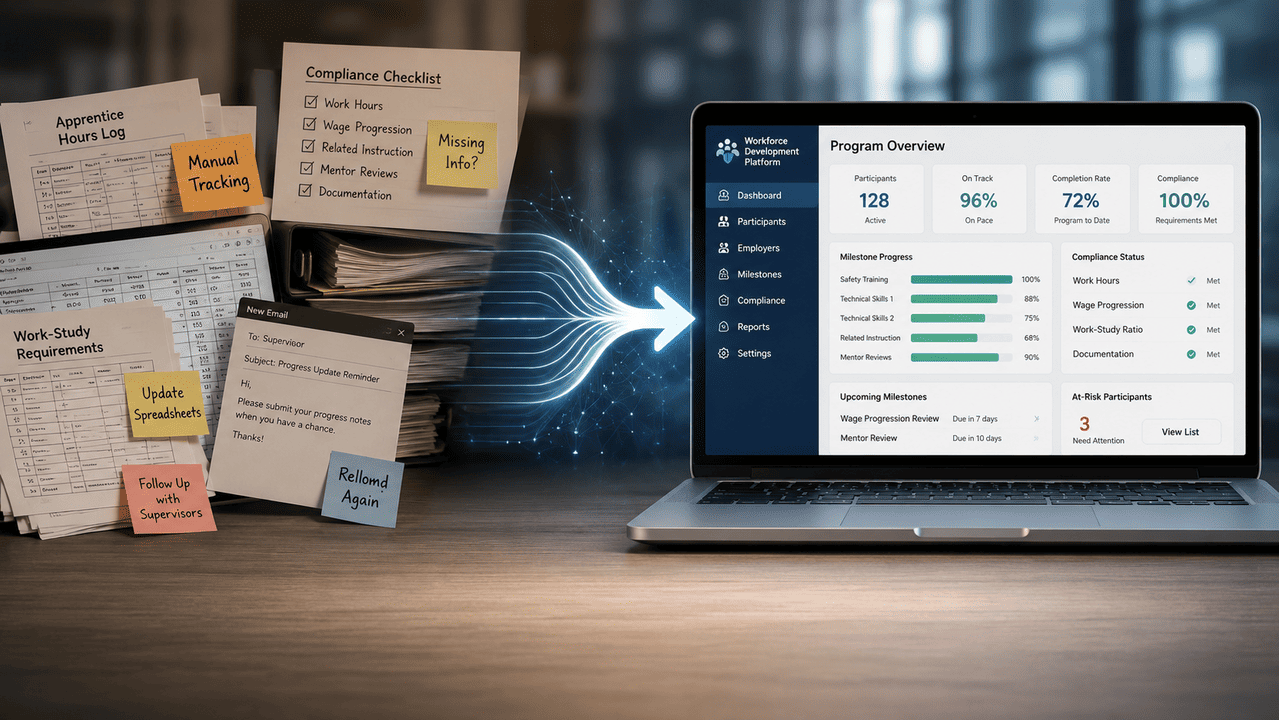
The operational scope covers the full lifecycle of an intern’s time with your organization, from application and placement through onboarding, active program management, and program completion. Each stage has distinct administrative and compliance requirements, and a well-designed platform treats them as connected rather than separate.
Core Functions That Define Purpose-Built Intern Program Management Software
Centralized Intern Data and Application Pipeline Management
Every intern in your program represents a record that needs to be created, maintained, and eventually closed. A centralized platform holds that record from the moment an application enters the pipeline: contact information, placement details, assigned supervisor, start and end dates, required documentation, and program milestones.
The value of centralization is immediate when you need to answer a specific question. Who is currently active in the program? Which interns have completed their compliance documentation? Which placements are ending next month? Manual systems require someone to dig through folders and cross-reference spreadsheets to answer those questions. A platform surfaces the answer in seconds.
Onboarding Workflow Automation and Progress Tracking
Onboarding is the highest-risk stage of the intern lifecycle from an administrative standpoint. It involves the most documentation, the most coordination across departments, and the highest probability that something falls through the cracks. A platform converts onboarding into a defined workflow: each step is assigned, tracked, and marked complete by the responsible party. Coordinators see progress at the individual and cohort level without having to ask for status updates.
Automated reminders eliminate the manual follow-up loop that consumes coordinator time. The system prompts the intern, the supervisor, or the HR contact directly, removing the program manager from the middle of every exchange.
Time Tracking, Timesheets, and Automated Data Collection
For paid internships and registered apprenticeships, accurate time tracking is both an operational requirement and a compliance obligation. A platform that includes integrated time tracking removes the email-based submission model entirely. Interns log hours directly in the system. Supervisors review and approve within the same interface. The coordinator has a consolidated, verified record without touching a single spreadsheet.
Automated data collection extends beyond hours. Attendance, task completion, and program milestone records all feed into the same system, creating a complete activity log for each participant.
Compliance Documentation and Audit-Ready Recordkeeping
Purpose-built platforms maintain a structured record of every compliance-relevant action taken during a program. Document submissions are time-stamped. Approvals are logged. Deadlines generate automated alerts before they are missed. The result is a documentation trail that can be produced in response to an audit or a legal inquiry without a reconstruction effort.
This capability matters most when you least expect it. The time to build a compliant record is during the program, not after a problem has already surfaced.
How This Differs From Generic HR or Project Management Tools
Generic HR systems are designed to manage full-time employees. Project management tools are designed to manage deliverables and timelines. Neither is built around the specific lifecycle of an intern or apprentice, which involves temporary placement, structured development milestones, rotating supervisors, and time-bound compliance requirements.
Adapting a generic tool to manage an internship program requires significant configuration, workarounds, and ongoing manual effort to compensate for what the tool was never designed to do. The administrative burden does not disappear. It shifts to whoever is maintaining the workaround.
A dedicated internship tracking platform is built around the actual structure of an internship program. The workflows, the data fields, the reporting outputs, and the compliance features reflect how intern programs actually operate, not how full-time employee management works.
The Dual-Sided Platform Model: Managing the Employer and Intern Experience Together
The most operationally complete platforms manage both sides of the program relationship simultaneously. The employer side receives administrative control through dashboards, compliance tracking, supervisor management, and program reporting. The intern side receives a structured experience with clear onboarding steps, progress visibility, feedback mechanisms, and a professional interface that reinforces the organization’s credibility.
When both sides operate within the same system, the data is consistent. An intern who completes an onboarding step updates the coordinator’s dashboard in real time. A supervisor who submits a mid-program review creates a record that the coordinator can act on immediately. The program runs as a connected system rather than a series of disconnected handoffs.
Key Features to Look for in an Internship Tracking Platform
Building a Feature Evaluation Framework That Reflects Real Operational Needs
Not every feature a vendor lists in a product demo will matter to your operation. The useful evaluation question is not whether a platform has many features, but whether it solves the specific failure points in how you currently manage programs. Start by mapping your actual breakdowns: where does compliance documentation slip? Where do supervisors fail to respond? Where does intern progress go untracked? The features worth prioritizing are the ones that directly replace the manual steps consuming the most coordinator time or creating the most compliance risk.

With that frame in mind, the following capabilities are where purpose-built platforms separate themselves from adapted workarounds.
Assessment, Feedback, and Supervisor Reporting Capabilities
Structured feedback is the mechanism that converts an internship from a temporary placement into a meaningful development experience. It is also the most commonly skipped step in manually managed programs. When feedback collection depends on a coordinator remembering to send a survey at the right moment, it happens inconsistently. When it lives in a platform, it runs on a schedule.
Look for platforms that support configurable assessment templates, mid-program check-ins, and supervisor evaluation workflows that trigger automatically at defined milestones. The supervisor interface matters as much as the form itself. A reporting tool that requires supervisors to navigate a complicated system will generate low response rates. The simpler the submission process, the better the data.
Communication Tools Built for the Internship Lifecycle
Generic email and messaging tools work for ongoing team communication. They do not work well for structured program communication, where specific messages need to reach specific people at specific stages. An intern onboarding reminder sent to the wrong cohort, or a supervisor notification buried in a crowded inbox, produces the same outcome as no communication at all.
Platforms with built-in communication tools route messages contextually: reminders go to interns with incomplete onboarding steps, alerts go to coordinators when deadlines approach, and check-in prompts go to supervisors at the right program stage. This is not about replacing email. It is about removing the coordinator from the middle of every communication loop.
Program Analytics, Reporting Dashboards, and Performance Visibility
A coordinator managing twenty interns across three departments cannot hold the status of every record in their head. A reporting dashboard solves this by surfacing the information that requires action: who is behind on timesheets, which onboarding workflows are incomplete, which supervisors have not submitted their mid-program assessments.
Beyond daily management, aggregate reporting enables program improvement over time. Completion rates, feedback scores, and milestone adherence data across cohorts give program managers the evidence they need to identify what is working and what requires adjustment. That kind of structured analysis is not possible when program data lives in disconnected spreadsheets.
Mobile and Web Accessibility: Managing Programs From Anywhere
Interns are not always at a desk. Supervisors are often managing from a phone between meetings. A platform that requires desktop access during business hours will generate the same friction as a paper-based process. Mobile access is not a convenience feature. It is a direct driver of completion rates for timesheets, check-ins, and feedback submissions.
Evaluate mobile functionality specifically, not just whether a mobile version exists. Can an intern submit hours from a phone in a few taps? Can a supervisor approve a timesheet without logging into a desktop interface? The answers to those questions predict how much time your coordinators will spend chasing submissions.
Customizable Workflows for Different Program Types and Industries
A summer undergraduate cohort, a registered apprenticeship program, and a co-op placement all carry different compliance requirements, different milestone structures, and different supervisor relationships. A platform that enforces a single workflow for every program type will create as much friction as it removes.
Customizable workflows allow your team to build the onboarding sequence, milestone schedule, and documentation requirements that match each program’s actual structure. This is especially relevant for organizations running multiple program types simultaneously, where a one-size approach consistently fails one cohort or another.
Integration With Existing HR, Onboarding, and Payroll Systems
An internship tracking platform that operates as a fully isolated system adds a data-entry burden rather than removing one. Intern records created in the platform need to connect to payroll for hours processing, to your HRIS for personnel recordkeeping, and to your onboarding system for IT access and equipment requests.
Evaluate integration depth, not just integration availability. A platform that offers a native integration with your payroll system is meaningfully different from one that requires a custom API build or a manual export-import cycle. The former saves time. The latter creates a new maintenance obligation.
Want to Learn More About Your Registered Apprenticeship Opportunities?
BOOK A FREE CONSULTATION
Questions to Ask Before Committing to Any Platform
Before a platform demo moves to a procurement decision, get specific answers to the following:
- What does the data migration process look like, and who owns it?
- How does the platform handle programs that span multiple departments or locations?
- What compliance frameworks does the platform support, and how are regulatory updates handled?
- What does the supervisor experience look like, and how much training is required?
- What are the integration options with your current HR and payroll systems?
The quality of those answers reveals whether the vendor understands how internship programs actually operate or whether they are describing a general workflow tool with a different label.
How Centralized Tracking Strengthens Compliance and Program Quality
What Compliance Tracking for Internships and Apprenticeships Requires
Compliance in internship and apprenticeship programs is not a single requirement. It is a set of overlapping obligations that vary by program type, industry, and jurisdiction. Registered apprenticeships under Department of Labor standards require documented on-the-job training hours, related technical instruction records, and wage progression evidence. Unpaid internships carry the six-factor primary beneficiary test under the Fair Labor Standards Act, and documentation supporting each factor is the only protection against misclassification exposure. State-level requirements add another layer.
The common thread across all of these is documentation that must exist before a compliance question is raised, not after. A platform that captures this documentation as a natural output of normal program operations eliminates the reconstruction problem entirely.
How a Structured Apprenticeship Tracking System Reduces Regulatory Risk
For registered apprenticeship programs specifically, a structured tracking system is not optional infrastructure. It is the mechanism that makes the program defensible. Hour logs, competency progression records, and training milestone documentation need to be accurate, time-stamped, and producible on demand. When that data lives in a purpose-built system, pulling it takes minutes. When it lives in a mix of spreadsheets and email threads, producing it can take days, with no guarantee of completeness.
The risk reduction extends beyond audits. Sponsors who cannot demonstrate program compliance can lose registered status, which eliminates the incentive structures that make apprenticeships operationally valuable in the first place.
Consistent Onboarding as a Quality Control Mechanism
Onboarding consistency is both a compliance issue and a quality issue. From a compliance standpoint, certain onboarding steps, including policy acknowledgments, safety training, and I-9 verification, must occur before work begins. A platform enforces this sequence and creates a record of completion. From a quality standpoint, an intern who receives a complete onboarding experience is better positioned to contribute early and engage fully with the program.
The practical mechanism is straightforward: define the required onboarding workflow once, deploy it to every participant, and let the platform track completion. Program quality stops depending on which coordinator is having a high-bandwidth week.
Using Progress Monitoring Data to Improve Program Outcomes Over Time
Each cohort your program runs generates data that your next program design should reflect. Which milestones do interns consistently complete on time? Where does progress stall? Which supervisors produce the highest feedback engagement? Which departments see the best mid-program assessment scores?
Manual systems do not surface this data because it is never collected systematically in the first place. A platform that tracks intern progress at the individual and cohort level creates a foundation for evidence-based program improvement. After two or three cohort cycles, the patterns become clear enough to inform structural changes: adjusting milestone timing, adding a specific onboarding step, or revisiting the supervisor assignment model for a particular department.
How to Transition Your Internship Program From Spreadsheets to a Platform
The transition itself is the most common reason program managers delay adopting a dedicated system. The concern is legitimate: moving active programs mid-cycle is disruptive, and historical data that exists only in spreadsheets cannot simply be abandoned. The practical answer is a phased approach.
Begin the transition between cohort cycles, not during one. Use the gap between program end and the next application cycle to configure the platform, import historical records, and run your team through the new workflows before any intern data is live. Most platforms include a structured onboarding or implementation process. Use it fully rather than self-configuring under time pressure.
Migrating Historical Data Without Disrupting Active Programs
Historical data migration requires two decisions: what data to migrate, and what format it needs to be in. Not everything in your existing spreadsheets warrants import. Focus on records with ongoing compliance relevance, specifically completed program documentation, signed agreements, and hour logs for apprenticeship participants. Data that is purely administrative and no longer actionable can be archived rather than migrated.
For active programs running during the transition, a clean handoff point is the most practical path. Complete the current program cycle on your existing system, archive those records formally, and launch the next cohort entirely within the platform. Attempting a mid-program migration introduces reconciliation problems that offset the efficiency you are trying to gain.
The Business Case for Investing in Dedicated Intern Tracking Software
How Automation in Internship Management Reduces Administrative Burden
The administrative burden of manual internship management does not come from any single task. It comes from the cumulative volume of small, recurring coordination actions: following up on missing timesheets, tracking down incomplete onboarding documentation, sending midpoint survey reminders, reconciling hours before payroll runs, and confirming that every supervisor has submitted their feedback. Each action takes five to fifteen minutes. Across a cohort of twenty interns, they add up to hours every week.
Automation does not eliminate these tasks. It handles them without coordinator involvement. A timesheet reminder goes out automatically on Friday morning. An onboarding checklist prompt goes to the intern when a step has been open for 48 hours. The coordinator’s role shifts from task executor to exception handler, which is a fundamentally different and more productive use of their time.

Estimating Admin Hours Recovered at Different Program Sizes
The following estimates are based on common coordination patterns in manually managed programs and illustrate how automation changes the time equation at different scales.
| Program Size | Estimated Weekly Admin Hours (Manual) | Estimated Weekly Admin Hours (Platform) | Hours Recovered per Week |
|---|---|---|---|
| 5 interns | 3 hours | 1 hour | 2 hours |
| 15 interns | 8 hours | 2 hours | 6 hours |
| 30 interns | 16 hours | 3.5 hours | 12.5 hours |
| 50 interns | 25+ hours | 5 hours | 20+ hours |
Manual administration scales with headcount because every new intern adds proportional coordination tasks. Platform administration scales modestly because automation handles the volume, not the coordinator. The difference in those figures represents real staff capacity that can be redirected to higher-value work.
For a team managing 15 to 30 interns, recovering 6 to 12 hours of coordinator time per week across a 10-week summer program represents 60 to 120 hours of recaptured capacity per cycle. The calculation should also include the time cost of compliance reconstruction, which manual systems impose irregularly but significantly when it occurs.
The Strategic Value of a Well-Administered Talent Development Program
An internship program that runs smoothly creates a recruiting advantage that extends well beyond the program itself. Interns who experience a structured, professionally managed program are more likely to accept full-time offers, refer peers to the organization, and speak positively about the employer in the networks where your next hires are paying attention.
Disorganized programs produce the opposite effect. An intern who encountered a chaotic onboarding process or received no structured feedback is not a reliable conversion candidate, regardless of their performance. The quality of program administration shapes the perception of the organization as an employer, and that perception has downstream costs that do not appear in any spreadsheet.
Evaluating the True Operational Cost: Manual Management vs. a Purpose-Built System
The cost comparison between manual management and a dedicated platform is typically framed as platform subscription cost versus zero. That framing is incomplete. Manual management carries real costs: staff time for coordination tasks, compliance exposure from documentation gaps, and the quality degradation that drives lower intern conversion rates.
A more accurate comparison includes the following:
- Staff hours consumed by manual coordination, valued at fully-loaded labor cost
- The probability-weighted cost of a compliance event, given the documentation gaps manual systems routinely produce
- The recruiting cost of replacing interns who do not convert to full-time roles, in part because the program experience was poorly managed
- The opportunity cost of coordinator time spent on administrative follow-up rather than program development
Viewed in full, the operational cost of manual management at any meaningful program scale generally exceeds the cost of a purpose-built platform within a single cohort cycle. The investment case is not about convenience. It is about whether the system you are running can support the program outcomes you are trying to achieve.
How GoSprout Brings It All Together for Employers and Interns
Purpose-Built for the Full Internship and Apprenticeship Lifecycle
Most software that gets adapted for intern program management was designed for something else. GoSprout was not. The platform is built specifically around the intern and apprenticeship lifecycle, from initial application through placement, onboarding, active program management, and program completion. That specificity matters operationally because every stage of that lifecycle carries distinct requirements, and a tool designed for one stage poorly serves the others.
The result is a system where the workflows, data fields, compliance features, and reporting outputs reflect how internship programs actually function, not how a generic HR or project management tool has been configured to approximate that function.
How GoSprout Addresses Each Layer of the Operational Problem
The operational problems that surface in manually managed programs are not isolated. Compliance gaps connect to documentation failures. Documentation failures connect to onboarding inconsistency. Onboarding inconsistency connects to a degraded intern experience. Each layer compounds the next.
GoSprout addresses these as a connected system rather than a collection of separate features. Application and placement data flows into onboarding workflows. Onboarding completion feeds compliance recordkeeping. Time tracking outputs feed payroll-ready reports. Supervisor feedback connects to the coordinator’s program dashboard. Nothing requires a manual handoff between stages, which is precisely where manual systems consistently break down.
Employer-Side Administration: Centralized, Compliant, and Scalable
From the coordinator’s perspective, GoSprout consolidates what manual programs scatter across multiple tools. Intern records, placement details, onboarding progress, timesheet submissions, compliance documentation, and supervisor feedback all live in one place. The coordinator’s dashboard surfaces the information that requires action without requiring them to check each record individually.
Compliance-relevant documentation is collected and time-stamped as a natural output of normal program operations. Deadlines generate automated alerts. Document submission prompts go directly to the intern or supervisor responsible. When a compliance review or internal audit requires documentation, the records are already organized and retrievable, not reconstructed after the fact.
Scalability is built into the architecture. Adding a new cohort does not require rebuilding the system from scratch. Workflows configured for one program cycle carry forward. A coordinator managing 40 interns on GoSprout is not performing eight times the administrative work of someone managing five. The automation absorbs the volume.
Intern-Side Experience: Structured, Visible, and Professionally Managed
The intern experience on GoSprout is not an afterthought to the administrative system. It is the other side of the same platform. Interns log in to a structured interface that shows them exactly where they are in the onboarding process, what is complete, and what requires their attention. That clarity removes the confusion that characterizes poorly managed programs and signals organizational competence from day one.
Progress is visible throughout the program, not just at the beginning and end. Interns can track milestones, submit timesheets directly in the platform, and engage with feedback workflows without relying on a coordinator to route everything manually. For interns who are early in their professional development, that structure is also educational: it models what organized, accountable professional environments look like.
Supervisors interact with the same system, which means their feedback and approvals reach the coordinator’s dashboard in real time rather than sitting in an email thread waiting to be reconciled.
Is Your Program Ready to Move to a Dedicated Platform?
If two or more of the following describe your current situation, the transition to a dedicated internship tracking platform is overdue:
- Your coordinator spends more than three hours per week chasing missing timesheets, incomplete onboarding steps, or supervisor feedback.
- You have experienced a compliance documentation gap or could not produce a complete record on short notice.
- Your program has grown past ten active interns and onboarding quality varies by cohort.
- Intern feedback is collected inconsistently or only at program end.
- You are managing multiple program types, such as apprenticeships, co-ops, or summer cohorts, with no unified system.
If any of these describe your program today, GoSprout warrants a direct evaluation. The operational cost of continuing with manual management compounds with every cohort you run.
Conclusion: From Operational Strain to Structured Program Excellence
The Core Argument, Restated With Operational Clarity
Managing an internship program through spreadsheets and manual coordination is not a neutral choice. It is a structural decision that creates compounding risk: compliance documentation that degrades as programs grow, onboarding quality that varies with coordinator bandwidth, and intern experiences that depend on which week it happens to be rather than on a defined standard. These are not edge cases. They are the predictable outputs of a system not designed for the job.
The argument for a dedicated internship tracking platform is not that spreadsheets are bad tools. It is that intern program management is a specific operational problem that requires a system built for it.
What a Purpose-Built Platform Makes Possible
A dedicated platform changes the coordinator’s role from task executor to program manager. Instead of spending the majority of their time chasing submissions and reconciling records, they spend it on the work that actually improves program outcomes: reviewing aggregate feedback data, refining milestone structures based on completion patterns, and building stronger supervisor relationships.
It also makes program quality consistent and measurable. Every intern goes through the same onboarding sequence. Every supervisor receives the same feedback prompt at the same program milestone. Every cohort generates comparable data that informs the next one. That consistency is not achievable in a manually managed program, where quality is a function of individual effort rather than system design.
Compliance becomes a byproduct of normal operations rather than a separate workstream. Documentation exists because the platform collected it continuously, not because someone assembled it in response to a request.

Your Next Step: Exploring GoSprout as Your Centralized Internship Management Solution
The practical next step is a direct evaluation against your program’s specific requirements. Bring your current failure points, the places where documentation slips, where supervisors go unresponsive, where intern experiences vary, and map them against what GoSprout’s workflows are designed to handle. That comparison is more instructive than a general feature review.
If your program is growing, running multiple cohort types, or carrying compliance obligations that your current system cannot reliably support, GoSprout is worth serious consideration. The operational infrastructure your intern program runs on directly determines what that program can produce, and the case for upgrading it becomes clearer with every cohort you run under the current one.
Frequently Asked Questions
A well-designed internship tracking platform should include centralized intern recordkeeping, automated onboarding workflows, integrated time tracking and timesheet approvals, compliance documentation with time-stamped audit trails, supervisor feedback and assessment tools, and a reporting dashboard that surfaces program status in real time. Customizable workflows for different program types and integration with existing HR and payroll systems are also essential for organizations managing more than one cohort structure simultaneously.
Begin by identifying the specific failure points in your current process: where does documentation slip, where do supervisors fail to respond, and where does compliance risk accumulate. Evaluate platforms against those failure points rather than a generic feature checklist. Ask vendors detailed questions about data migration, multi-department support, compliance framework coverage, and integration depth with your existing HRIS and payroll systems. The platform that best maps to your actual operational structure will deliver more value than one with a longer feature list.
The time recovered depends on current program size and how much coordination is still manual. Programs managing 15 to 30 interns typically see coordinators reclaim 6 to 12 hours per week by automating routine follow-ups, timesheet reminders, and documentation collection. Across a 10-week program cycle, that represents 60 to 120 hours of recaptured staff capacity, before accounting for the time cost of compliance reconstruction, which manual systems impose unpredictably but significantly when documentation gaps surface.
Most purpose-built platforms offer integration options with common HRIS, payroll, and onboarding systems, but integration depth varies considerably. A native integration that syncs data automatically is meaningfully different from one that requires a manual export-import process or a custom API build. Before committing to any platform, confirm specifically which systems it connects to, how data flows between them, and what ongoing maintenance that integration requires. Shallow integrations can create new administrative obligations rather than eliminating existing ones.
Compliance requirements vary by program type, industry, and jurisdiction. Registered apprenticeships under Department of Labor standards require documented on-the-job training hours, related technical instruction records, and wage progression evidence. Unpaid internships require documentation supporting the six-factor primary beneficiary test under the Fair Labor Standards Act. State-level wage and hour rules and sector-specific training mandates add further obligations. A capable platform captures this documentation as a standard output of normal program operations, producing a time-stamped, auditable record without requiring a separate documentation effort.
Manual management is often treated as a zero-cost baseline, but that framing is inaccurate. The true cost includes staff hours spent on coordination tasks valued at fully-loaded labor rates, the probability-weighted cost of a compliance event resulting from documentation gaps, the recruiting cost of interns who do not convert to full-time roles due to a poorly managed program experience, and the opportunity cost of coordinator time that could be directed toward program development. At any meaningful program scale, these costs typically exceed the subscription cost of a purpose-built platform within a single cohort cycle.