
Table of Contents
- When Managing Interns Breaks Down: The Operational Reality Without Dedicated Software
- What Student Intern Management Software Actually Does
- Core Features to Evaluate in an Intern Management Platform
- How Centralized Software Solves Compliance and Onboarding Bottlenecks
- The Business Case: Structured Intern Management as Talent Pipeline Infrastructure
- How GoSprout Delivers End-to-End Student Intern Management in One Unified System
- Conclusion: From Operational Fragmentation to a Scalable Intern Program
- Frequently Asked Questions
When Managing Interns Breaks Down: The Operational Reality Without Dedicated Software
Intern programs fail operationally long before they fail visibly. The breakdown rarely announces itself with a single crisis. It accumulates quietly, across a dozen small process failures that only become obvious when a supervisor asks a question no one can answer.
The Scenario Every Hiring Manager Recognizes
The Multi-Intern Tracking Problem in Practice
Picture a hiring manager running six interns across three departments, with staggered start dates and different program durations. Two are fully onboarded. One is still waiting on IT access. One hasn’t returned their signed confidentiality agreement. Two are three weeks from program completion with no evaluation scheduled. This information lives across a shared spreadsheet, an email thread, a paper folder in HR, and someone’s calendar.
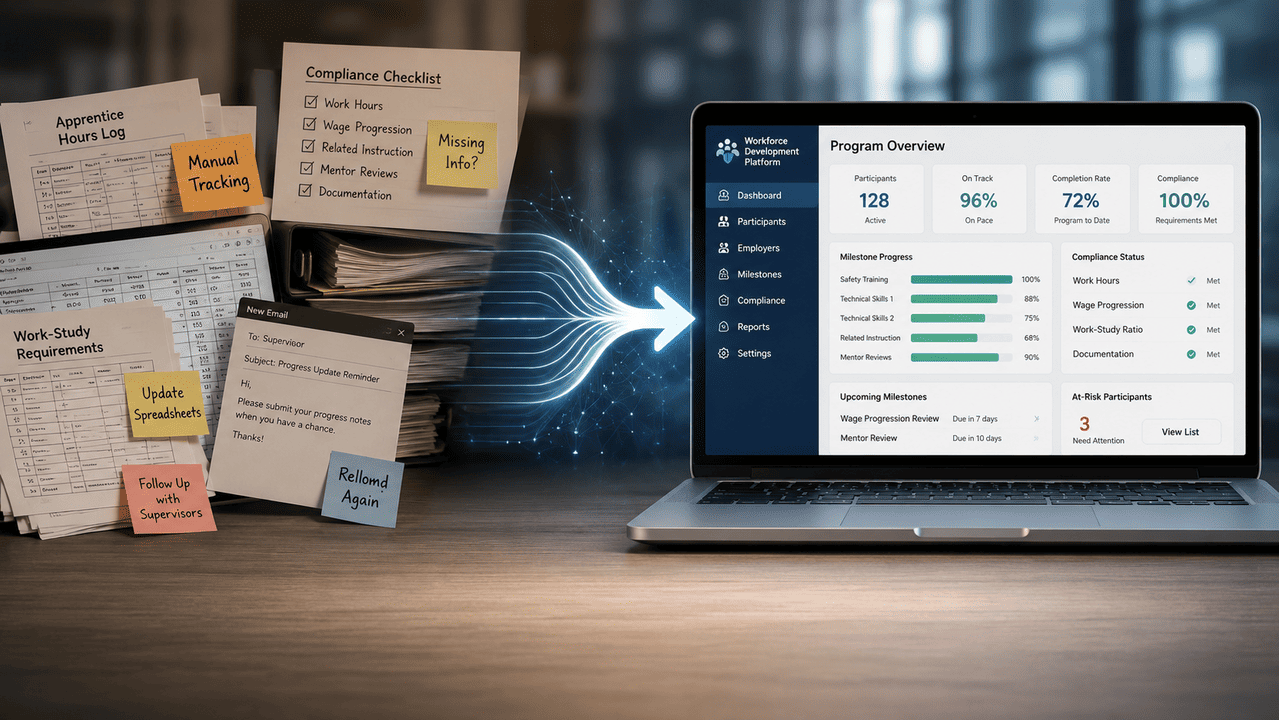
The moment that manager needs to answer a simple question — “Where is each intern in their program right now?” — the answer requires assembling fragments from four separate sources. Multiply that by two cohorts a year, and the administrative overhead is not incidental. It is structural.
How Disorganized Onboarding Delays a Student’s First Productive Week
When onboarding steps are not automated or sequenced, each task depends on a human remembering to trigger the next one. A hiring coordinator sends the offer letter, then has to remember to forward credentials to IT, then has to follow up with the intern’s assigned mentor, then has to confirm that compliance training is scheduled. If any step gets missed in week one, the intern starts their program without the tools or context to do anything useful.
First-week experiences consistently shape how interns perceive an organization’s competence and professionalism. An intern sitting idle because their system access was never provisioned is not just a minor inconvenience. It signals to that student, and through them to their university program, that the organization was not prepared to host them.
Why Generic Tools Create a Structural Mismatch
What Spreadsheets and Email Chains Cannot Systematically Prevent
Spreadsheets track data states. They do not enforce workflow sequences, trigger alerts when deadlines pass, or flag when a required document has not been submitted. A cell marked “pending” in a shared sheet looks identical to a cell that was never updated because the task was forgotten. Nothing in the tool itself distinguishes between “in progress” and “silently dropped.”
Email chains carry the same problem. An onboarding instruction buried in a reply chain from six weeks ago is technically accessible but practically invisible. There is no escalation logic, no task ownership, and no audit trail that holds up under scrutiny.
Why General HR Software and ATS Platforms Fall Short for Intern Lifecycles
General HR platforms are built for permanent employees. Their workflows assume hire-to-retire continuity: a single onboarding event, a stable role, and performance management tied to annual cycles. Interns operate on compressed, multi-stage timelines with distinct phases — application, screening, placement, onboarding, active program, evaluation, and offboarding — often measured in weeks rather than years.
An applicant tracking system handles recruitment effectively, but its function ends at the hire decision. It does not manage what happens after an intern accepts an offer: mentor assignment, progressive task completion, mid-program check-ins, compliance documentation, or program completion records. Forcing these workflows into an ATS or a general HRIS creates workarounds, not solutions.
What Is the Difference Between an ATS and Dedicated Intern Management Software?
An ATS manages candidates up to the point of hire. Student intern management software manages the entire relationship, from sourcing through program completion, with workflow logic designed specifically for the intern lifecycle.
The operational difference is not just feature depth. It is structural. An ATS is optimized for selection decisions. An intern management platform is optimized for program execution, compliance continuity, and cohort visibility. These are different problems that require different system architectures.
The Compliance Gap: Where Manual Processes Fail Quietly
Missed Documentation Deadlines and the Risks Generic Tools Miss
Intern compliance requirements vary by jurisdiction, industry, and program type, but the categories are consistent: worker classification documentation, tax withholding setup, safety protocol acknowledgment, academic credit coordination where applicable, and background verification where required. Each of these has a deadline. Most carry legal exposure if missed.
Generic tools do not enforce these deadlines. A spreadsheet with a column labeled “background check complete” relies entirely on someone checking the box correctly and on time. There is no built-in logic to block an intern’s active program access until documentation is confirmed, no automated reminder to the relevant supervisor, and no audit trail documenting when each item was completed and by whom.
How Compliance Failures Compound Across Intern Cohorts
A single missed I-9 is a correctable problem. The same error across twelve interns in two cohorts is a systemic exposure. Manual processes do not just create individual compliance failures — they create the conditions where the same failure repeats, because nothing in the workflow prevents it from repeating.
This compounding risk is why compliance in intern programs requires specific infrastructure, not just more careful attention. Attention is finite. Workflow enforcement is not.
What Student Intern Management Software Actually Does
Dedicated student intern management software does not simply consolidate existing tools. It replaces a set of disconnected workarounds with a unified system that owns the full intern lifecycle, from first application to final evaluation.
Defining the Intern Lifecycle Platform: Beyond Applicant Tracking
The Distinct Stages Software Must Own
A purpose-built intern program management platform needs to operate across every phase of the intern relationship:
- Sourcing and application intake
- Screening, review, and offer management
- Pre-start onboarding and document collection
- Active program management, including task tracking and mentor coordination
- Mid-program and final performance evaluation
- Offboarding, records retention, and alumni tracking
Most organizations manage the first two stages adequately with existing recruitment tools. The breakdown begins at onboarding and compounds through every subsequent stage. A platform that covers only recruitment has not solved the problem.
How Intern Management Software Differs From Employee Onboarding Software
Employee onboarding software assumes a single, relatively uniform transition from candidate to permanent employee. Intern management requires phase-specific workflows that differ meaningfully from one another. An onboarding checklist for a summer cohort looks different from the mid-program evaluation process, which looks different from final documentation and offboarding.
Intern management platforms also handle relationships with external stakeholders that employee onboarding tools do not: university career offices, faculty advisors, academic credit coordinators, and in apprenticeship contexts, workforce development agencies. The software must manage communication and documentation flows with parties outside the organization.

Core Workflow Capabilities That Define a Purpose-Built Platform
Candidate Application Management and Structured Onboarding Automation
An intern onboarding workflow built into a purpose-built platform centralizes application intake with configurable forms, structured review workflows, and automated candidate communication at each stage. Once a candidate is selected, the platform triggers a sequenced onboarding workflow — document requests, system access provisioning tasks, compliance training assignments — without requiring a coordinator to manually initiate each step.
The operational value is task elimination, not just task organization. When the system sends an I-9 request automatically upon offer acceptance, a coordinator does not have to remember to do it.
Mentor Assignment, Supervisor Feedback, and Progress Monitoring
Effective intern programs require structured touchpoints between interns and their supervisors. Purpose-built platforms build this structure into the workflow: they assign mentors at program start, schedule check-in prompts, and collect supervisor feedback through standardized evaluation forms tied to specific program milestones.
This matters for both quality and documentation. Supervisor feedback captured in a structured system creates a program record. Feedback exchanged over email creates nothing.
Compliance Documentation, Audit Trails, and Regulatory Workflow Enforcement
The compliance capability in dedicated software operates differently from a document repository. The platform enforces sequence, meaning certain program phases cannot advance until required documentation is confirmed complete. It timestamps each action, records who completed it, and generates an audit trail that holds up to regulatory review.
For organizations running apprenticeship programs with specific Department of Labor reporting requirements, this enforcement logic is not a convenience. It is the difference between a program that passes an audit and one that does not.
Real-Time Dashboards and Intern Cohort Reporting
Student tracking dashboards give hiring managers and program leads a live view of every intern’s position in the program lifecycle, not a snapshot from last week’s spreadsheet update. At the cohort level, reporting surfaces aggregate data including completion rates, compliance gaps, evaluation scores, and time-to-productivity metrics. This data supports program iteration and gives leadership the visibility to make informed resourcing decisions about future cohorts.
Managing Multiple Interns at Different Lifecycle Stages Simultaneously
When one intern is still completing onboarding while another is approaching a mid-program evaluation and a third is in the final week of their placement, each requires different actions from different people on different timelines. Coordinating this manually means the hiring manager functions as the system itself, holding the full state of every concurrent workflow across disconnected notes and memory.
Centralized intern cohort management removes that dependency. The platform tracks stage by intern, surfaces what is overdue, and routes the right task to the right person without requiring a coordinator to orchestrate it manually. For a program running more than three concurrent interns, this is the difference between a manageable process and a full-time coordination job.
Generic Tools vs. Purpose-Built Intern Management Software: A Decision Rubric
Use this rubric to evaluate whether your current toolset is structurally adequate for your intern program’s operational requirements.
| Operational Dimension | Spreadsheets and Email | General HR / ATS | Purpose-Built IMS |
|---|---|---|---|
| Onboarding automation | Manual, coordinator-dependent | Partial (hire event only) | Sequenced, trigger-based, end-to-end |
| Compliance tracking | Passive (data entry only) | Limited, not lifecycle-aware | Active enforcement with audit trail |
| Progress monitoring | Static snapshots | Not designed for it | Real-time dashboards by intern and cohort |
| Multi-cohort management | High manual overhead | Not supported | Native, with stage-level visibility |
| Supervisor feedback | Unstructured, email-based | Basic review tools | Structured evaluations tied to milestones |
| Reporting | Manual aggregation | Limited to hiring metrics | Cohort analytics, completion rates, compliance gaps |
If your current toolset falls primarily in the first two columns, you are not dealing with an organization problem. You are dealing with a structural capability gap that better process discipline will not close.
Core Features to Evaluate in an Intern Management Platform
The gap between a capable platform and a glorified task list comes down to whether the software owns the workflow or simply records it. Four capabilities separate purpose-built platforms from everything else.
Customizable Onboarding Workflows and Configurable Program Design
No two intern programs run identically. A ten-week summer cohort at a financial services firm has different onboarding requirements than a semester-long placement at a healthcare organization. The platform needs to support both without requiring a full rebuild each time. Look for configurable onboarding templates — the ability to define step sequences, assign task ownership, set conditional logic, and reuse program structures across cohorts with targeted adjustments rather than complete reconstruction.
Configurable design is not a luxury feature. It is what keeps the system aligned with your actual program as it evolves.
Intern Progress Tracking and Structured Performance Assessment Tools
Intern progress monitoring should be continuous, not event-based. A platform that shows you where each intern stands at any point in their program — which onboarding steps are complete, which milestones are upcoming, which evaluations are overdue — gives you operational visibility that a status column in a spreadsheet cannot replicate. Pair that with structured performance assessments tied to specific program milestones, and you have a record of development, not just completion.

The assessment tools matter for two reasons: they create consistency across supervisors who would otherwise evaluate interns very differently, and they produce documentation that supports conversion decisions at program end.
Compliance and Documentation Management with Audit-Ready Records
The compliance layer should enforce requirements, not merely send reminders. A platform that prevents program advancement until required documentation is confirmed complete is structurally sound. Look for timestamped audit trails, document status tracking with clear ownership, and the ability to generate a compliance summary by intern or by cohort on demand. If your program is ever reviewed, you need records that show what was collected, when, and by whom.
Supervisor and Mentor Evaluation Tools Built Into the Workflow
Supervisor feedback collected outside the platform is feedback you cannot act on at scale. Evaluation tools built into the workflow mean that check-in prompts, mid-program reviews, and final assessments happen inside the system, captured in a standardized format. This makes feedback comparable across supervisors and retrievable without chasing down email threads. It also keeps supervisors accountable to the evaluation schedule without requiring a coordinator to follow up manually.
Integration Capabilities: Connecting to Your Existing HR Stack
Can Intern Management Software Integrate with My Existing HR Tools?
Most hiring teams already use an ATS, an HRIS, or both. The question is not whether an intern program management platform can stand alone — it can — but whether it reduces friction with the tools you use daily. Native integrations with common HR platforms, payroll systems, and identity management tools prevent double data entry and keep intern records consistent across systems.
Before evaluating a platform, map the handoffs in your current process: where does intern data need to flow, and when? That map identifies which integrations are critical versus secondary.
What Real Integration Looks Like vs. Surface-Level Data Export
A CSV export is not an integration. Real integration means bidirectional data flow, triggered automatically at defined workflow events. When an intern accepts an offer in your intern management system, that event pushes relevant data to your HRIS without manual intervention. When an onboarding task is completed, it updates across connected systems in real time.
Surface-level integrations create the illusion of connectivity while leaving the actual coordination work to a human. Ask vendors specifically: which integrations are native, which require middleware, and what triggers data movement. The answers will tell you how much manual coordination you are still responsible for.
Accessibility for Distributed and Remote Programs
How Does Intern Management Software Handle Multi-Location or Remote Internships?
Remote and multi-site programs surface a specific failure mode in manual systems: when there is no physical proximity to prompt action, workflow steps get dropped silently. A supervisor in a different city does not receive the same informal reminders that an in-office coordinator might provide.
Purpose-built platforms handle distributed programs through location-agnostic workflow logic. Tasks are assigned by role and program stage, not by physical presence. Interns complete onboarding steps through a self-service portal accessible from anywhere. Supervisors submit evaluations through the platform regardless of their site. Compliance documentation is collected and verified without anyone needing to be in the same building.
For organizations running hybrid or fully remote cohorts, this architecture is a baseline requirement, not an edge case.
Evaluating Platform Fit for Small and Mid-Sized Businesses
What Is the Best Student Intern Management Software for Small Businesses?
Small and mid-sized businesses do not need less capability — they need less complexity. The right platform for a smaller operation delivers core workflow automation, compliance tracking, and cohort visibility without requiring a dedicated administrator to configure and maintain it.
The practical criteria to evaluate: Can a hiring manager set up a new cohort without IT support? Does the platform offer pre-built templates that require configuration rather than construction? Is pricing structured for programs running fewer than 20 concurrent interns, or is it scaled for enterprise volume only?
Avoid platforms that treat small programs as a stripped-down version of enterprise software. The workflow requirements are structurally similar across program sizes — the difference is volume, not complexity.
Implementation Reality: Time to Value Without IT Support
A platform that takes three months to implement does not solve the problem you have now. For most small and mid-sized hiring teams, the realistic threshold is a system you can configure and run with your first cohort within two to three weeks of setup. That means pre-built onboarding templates, intuitive configuration without developer involvement, and responsive support during initial setup. The time to your first automated onboarding workflow is a more meaningful indicator of fit than the length of a feature list.
How Centralized Software Solves Compliance and Onboarding Bottlenecks
Compliance and onboarding are the two areas where manual processes fail most predictably, and where software investment pays back fastest.
The Compliance Obligation Most Intern Programs Underestimate
How Intern Management Software Improves Compliance and Reduces Legal Risk
Most organizations underestimate intern compliance obligations until they encounter one they missed. The exposure is not limited to paperwork. Worker misclassification — treating a paid intern as a contractor, or maintaining an unpaid internship without meeting the legal criteria — carries wage claim liability. Missing I-9 deadlines creates immigration compliance exposure. Failing to document safety protocol acknowledgment in regulated industries can affect both audit outcomes and insurance coverage.
Dedicated intern management software reduces this risk by building compliance requirements into the program workflow itself. Requirements are not tracked alongside the program — they are built into the conditions that allow the program to advance.
Labor Law Classification, Tax Documentation, and Safety Protocol Tracking in One System
A centralized platform handles the compliance categories that manual processes treat as separate administrative tasks:

- Worker classification confirmation and supporting documentation
- W-4 and tax withholding setup, with completion tracked before the first day of work
- Safety and policy acknowledgment, with timestamped confirmation records
- I-9 verification with deadline tracking and completion status visible at the cohort level
- Academic credit coordination documentation where applicable
Managing these in one system means one audit trail, one status dashboard, and one place to generate compliance reports. Managing them across email, paper, and a shared drive means relying on the hope that every box was checked.
Onboarding Automation as an Operational Multiplier
How Automated Onboarding Checklists Eliminate Manual Back-and-Forth
Manual onboarding coordination is expensive in ways that do not appear on a budget line. When a coordinator sends individual emails to collect each document, follows up on missing items, confirms that IT has provisioned access, and verifies that compliance training was completed — that is not a checklist. That is a second job.
Automated onboarding checklists replace the coordinator as the trigger mechanism. The platform sends document requests, follows up on incomplete items, routes tasks to the right people, and escalates overdue steps without human prompting. The coordinator’s role shifts from initiating each step to reviewing completion status.
Consistent Onboarding Across Cohorts: Why Standardization Is a Compliance Tool
Inconsistent onboarding is not just an experience problem — it is a compliance liability. If one cohort completes safety acknowledgments and another does not because a coordinator was on leave during intake, you have a documentation gap that no amount of retroactive effort fully closes. Standardized, automated onboarding ensures the same steps run the same way every time, regardless of who is managing the cohort. That consistency is what makes compliance defensible across a full year of program activity.
Apprenticeship Tracking and Workforce Development Program Administration
Where Apprenticeship Compliance Requirements Exceed Standard Intern Workflows
Registered apprenticeship programs carry compliance obligations that exceed what standard internship workflows handle. Department of Labor reporting, related technical instruction hour tracking, competency progression documentation, and wage schedule advancement tied to skill milestones require a level of structured record-keeping that general intern management workflows do not fully address.
Organizations running DOL-registered apprenticeships need apprenticeship tracking software that records on-the-job training hours alongside related technical instruction completion, documents competency sign-off at each progression point, and generates the program records required for compliance reviews. The platform you select needs to account for that structure if apprenticeship administration is part of your scope.
The Business Case: Structured Intern Management as Talent Pipeline Infrastructure
An intern program that runs well is not just an operational achievement. It is a talent acquisition asset that compounds over time.
Reframing Software Investment as Workforce Strategy
How Intern Program Tracking Creates a Measurable Candidate Conversion Funnel
Most organizations track whether they convert interns to full-time hires. Few track the data that explains why conversion rates look the way they do: which supervisors produce the highest-performing interns, which program structures correlate with strong final evaluations, which cohorts had the highest completion rates, and what distinguished the interns who accepted offers from those who did not.
Centralized tracking makes this analysis possible. When application data, onboarding completion, supervisor evaluations, and program outcomes live in one system, you can build a conversion funnel with actual metrics, not anecdotal impressions. That data informs every future cohort design decision.
How Much Time Can Intern Management Software Save a Hiring Team?
The time savings compound across the program lifecycle. A coordinator managing onboarding manually for a cohort of eight interns can spend several hours per intern on document collection, follow-up, and status verification before the program even starts. Automated onboarding reduces that to oversight and exception handling. Multiply that across two cohorts annually and the administrative time recovered is substantial, without counting compliance review time, supervisor coordination, or report generation.
The more accurate framing is not “hours saved” but “hours redirected.” That time does not disappear from the job. It moves from reactive coordination to program quality improvement, relationship development with university partners, and preparation for the next cohort.
Building a Repeatable, Scalable Intern Program From the Ground Up
Why Cohort Management Infrastructure Is the Foundation of Talent Pipeline Development
A program you can run once is not a pipeline. A talent pipeline requires infrastructure that supports replication: the same workflows, the same compliance standards, the same evaluation process, applied consistently across every cohort. Without a centralized system, each cohort requires rebuilding the operational scaffolding from scratch. With one, each cohort benefits from the process refinements of every previous one.
Organizations that grow their intern programs from two annual cohorts to five, or from one location to three, do not succeed because they hired more coordinators. They succeed because the infrastructure scaled with the program.
What a Structured Intern Lifecycle Signals to Students and Institutional Partners
University career offices and faculty advisors are not passive stakeholders. They direct their strongest students toward organizations with reputations for running structured, professional programs. An intern who experiences a disorganized onboarding, an absent supervisor, or a final week with no evaluation does not just leave with a poor impression — they report that impression back to their institution.
A structured intern lifecycle signals organizational competence to students and credibility to institutional partners. That reputation affects the quality of candidates you attract in future cycles, your access to partnership programs with universities, and your ability to compete for top students against larger organizations.
Putting the Model Into Practice: An Illustrative Scenario for a Growing Hiring Team
Before: The Manual Workflow Failure Map
A 40-person professional services firm runs six interns per semester across two practice areas. The hiring coordinator manages intake through email and a shared spreadsheet. Onboarding steps are triggered manually. Supervisor check-ins are informal. Compliance documents are collected on an ad-hoc basis and stored in a shared drive with inconsistent naming conventions.
Mid-semester, a supervisor asks for a status update on her two interns’ progress. The coordinator spends 45 minutes assembling information from three sources. One intern’s confidentiality agreement is missing. The other’s mid-program evaluation has not been scheduled. Neither issue was flagged before the supervisor asked. At program end, the firm can confirm that interns completed their placements. It cannot produce structured performance records, a compliance documentation log, or any data to inform the next cohort.
After: How Centralized Infrastructure Changes the Operational Picture

The same firm implements an internship management system before the following semester. Onboarding workflows are configured once and run automatically for each new intern: document requests trigger on offer acceptance, IT provisioning tasks route to the relevant team, and compliance acknowledgments are tracked with completion deadlines. The coordinator’s role during onboarding shifts from initiator to exception handler.
Mid-semester, the supervisor logs into the platform and sees both interns’ program status in real time: completed milestones, upcoming evaluation due dates, and outstanding items. The evaluation is scheduled automatically based on the program calendar. The compliance documentation log is complete and timestamped. At program end, the firm generates a cohort report showing evaluation scores, completion rates, and conversion outcomes. That report becomes the baseline for designing the next semester’s program. The infrastructure that once felt like overhead has become the foundation for a program that actually scales.
How GoSprout Delivers End-to-End Student Intern Management in One Unified System
What “Purpose-Built” Means in Practice for Intern Lifecycle Management
Why GoSprout Is Designed Around the Intern Workflow, Not Adapted to It
Most software that touches intern management was built for a different problem. ATS platforms were built for recruitment. HRIS platforms were built for permanent employees. Even general onboarding tools assume a hire-to-retain arc that does not match how intern programs actually operate.
GoSprout starts from the intern lifecycle itself: a time-bounded relationship with distinct phases, external stakeholders, compliance requirements that do not map to standard employment, and the need to run multiple concurrent programs without losing visibility into any of them. That starting point determines how the platform handles workflows, data structures, and reporting. The system does not require workarounds because it was designed around the problem, not retrofitted to approximate a solution.
The Unified System Advantage: Eliminating Tool Switching Across the Intern Lifecycle
The hidden cost of assembling intern management from generic tools is not any single capability gap. It is the coordination overhead of moving between systems at every phase transition. A coordinator who manages applications in one tool, onboarding tasks in a shared document, compliance documents in a folder, and supervisor feedback over email is not using four tools efficiently. They are doing integration work manually, across every handoff, for every intern.
GoSprout eliminates those handoffs by keeping the full intern lifecycle in one place. Application data flows directly into onboarding workflows. Onboarding completion status feeds into compliance tracking. Supervisor evaluations are tied to the same intern record that holds their program history. Nothing has to be re-entered, re-routed, or reconciled across platforms. The coordinator sees the complete picture in one view, and so does every supervisor or program lead who needs access.
GoSprout’s Core Platform Capabilities Mapped to Hiring Manager Pain Points
Application and Onboarding Automation in GoSprout
GoSprout centralizes application intake with configurable forms and structured review workflows, so candidate management does not require a separate recruiting tool for smaller programs. Once a candidate accepts an offer, the platform triggers a sequenced onboarding workflow automatically: document requests, compliance acknowledgments, task assignments, and access provisioning prompts route to the right people without coordinator intervention at each step.
For a hiring team managing multiple interns with staggered start dates, this automation matters most during intake. Each new intern enters the same structured workflow regardless of when they start, which means onboarding quality does not depend on how busy the coordinator is that week.
Compliance Documentation and Audit-Ready Record Keeping
GoSprout builds compliance requirements into the program workflow rather than tracking them alongside it. Required documents carry completion deadlines, and the platform surfaces outstanding items before they become problems. Each action in the compliance record is timestamped and attributed, creating an audit trail that shows what was collected, when, and by whom.
For hiring managers who have experienced the pressure of retroactively assembling compliance documentation, this structure is the operational difference that matters. When a compliance question arises, the answer is in the platform, retrievable in minutes, organized by intern and by cohort.
Progress Tracking, Mentor Feedback, and Cohort Dashboards in One View
GoSprout’s student tracking dashboards give program leads a live view of every intern’s position in the lifecycle without requiring anyone to compile a status update. Milestone completions, upcoming evaluation dates, and outstanding items are visible at both the individual and cohort level.
Mentor and supervisor evaluations are built into the workflow at defined program points, not handled through separate communication. Supervisors receive structured prompts, complete evaluations through the platform, and their feedback becomes part of the intern’s permanent program record. At the cohort level, that data aggregates into completion rate and evaluation metrics that support decisions about the next program cycle.
Implementation and Getting Started: The Realistic Path to Operational Control
What Setup Looks Like for a Busy HR Team Without Dedicated IT Resources
GoSprout is configured, not constructed. Pre-built program templates give hiring managers a working structure immediately, with the ability to adjust step sequences, task assignments, and compliance requirements to match their specific program design. A coordinator who understands their onboarding process can set up a new cohort without developer support.
For most hiring teams, the practical path to running a first automated onboarding workflow is measured in days, not weeks. The initial configuration involves defining program stages, mapping compliance requirements, and assigning task ownership. After that, the platform runs the workflow. The team’s role shifts from building and maintaining the process to reviewing its output.
Is GoSprout the Right Fit Right Now? A Quick Decision Guide
GoSprout delivers the fastest return for three specific business profiles:
- Hiring managers running three or more concurrent interns who are currently tracking program status across disconnected tools and spending meaningful time assembling status updates on demand.
- Teams with active compliance documentation gaps, including missing or inconsistently collected documents, no structured audit trail, or uncertainty about whether required items were completed across past cohorts.
- Operations leads who need cohort-level visibility — including completion rates, evaluation data, and compliance status — but do not have the resources or appetite to build custom reporting infrastructure from scratch.
If your program does not yet fit all three profiles, it likely fits at least one. That is where the gap between your current process and a purpose-built system is already costing you.
Conclusion: From Operational Fragmentation to a Scalable Intern Program
The Core Argument
Managing student interns with generic tools does not just create inconvenience. It creates a structural mismatch between what your program requires and what your tools can enforce. Spreadsheets track data but do not enforce sequence. Email chains carry instructions but do not create accountability. General HR platforms handle employment but do not support the multi-stage, time-bounded, externally coordinated reality of an intern lifecycle. The result is a program that functions through individual effort rather than systematic design — one that scales poorly, documents inconsistently, and fails compliance requirements quietly.
Why Better Organization Is Not the Answer
The instinct to solve this with more discipline, better templates, or tighter process documentation is understandable. It is also insufficient. The problem is not that coordinators are disorganized. It is that the tools they are using do not enforce the process on their behalf. No amount of process rigor closes the gap when the system itself does not escalate overdue documents, does not trigger the next onboarding step automatically, and does not surface compliance gaps before they compound across a cohort.
Purpose-built infrastructure replaces the coordinator as the trigger mechanism. The system enforces sequence, routes tasks, tracks completion, and surfaces exceptions. The team’s attention goes to program quality, not process maintenance.
How GoSprout Closes the Gap
If you are managing interns today with tools that were not built for intern programs, you are absorbing costs that do not appear on a budget line: coordinator time spent on manual follow-up, compliance exposure from inconsistent documentation, and the reputational cost of an intern experience that does not reflect your organization’s actual capabilities.
GoSprout gives hiring teams a direct path from that operational reality to a program that runs on its own logic. The workflow is configured once and repeats consistently. Compliance is enforced by the system, not by memory. Supervisors evaluate through the platform. Cohort data is available without manual assembly.
Want to Learn More About Your Registered Apprenticeship Opportunities?
BOOK A FREE CONSULTATION
The next cohort is an opportunity to run a program that works the way it should. The infrastructure to do that is available now.
Frequently Asked Questions
The best student intern management software for small businesses is one that delivers core workflow automation, compliance tracking, and cohort visibility without requiring a dedicated administrator or IT resources to maintain it. Look for platforms with pre-built onboarding templates, straightforward configuration, and pricing structures appropriate for programs running fewer than 20 concurrent interns. GoSprout is designed to meet these criteria, giving smaller hiring teams enterprise-grade program logic without enterprise-level complexity.
Purpose-built intern management software reduces compliance risk by building documentation requirements directly into the program workflow, rather than tracking them as a separate administrative task. The platform prevents program advancement until required items — such as I-9 verification, tax withholding setup, and safety acknowledgments — are confirmed complete. Every action is timestamped and attributed, creating an audit trail that holds up to regulatory review and protects the organization in the event of an inquiry.
The most critical features in an internship management system are customizable onboarding workflows, continuous intern progress tracking, compliance documentation with audit-ready records, and structured supervisor evaluation tools built into the workflow. Beyond core capabilities, assess integration compatibility with your existing HR stack, support for multi-location or remote programs, and the ease with which a non-technical user can configure and launch a new cohort. A platform that owns the workflow end-to-end — rather than simply recording it — is the meaningful distinction.
An applicant tracking system manages candidates through the recruitment and selection process, ending at the hire decision. Dedicated intern management software begins where an ATS leaves off, covering the full program lifecycle: onboarding, compliance documentation, active program management, supervisor evaluations, and offboarding. The structural difference is that an ATS is optimized for selection decisions, while an intern management platform is optimized for program execution, compliance continuity, and cohort visibility — which are fundamentally different operational problems.
Time savings vary by program size, but the gains compound across the full lifecycle. Manual onboarding for a cohort of eight interns typically requires several hours per intern in document collection, follow-up, and status verification before the program even begins. Automated onboarding reduces that to exception handling and oversight. Across two cohorts annually, the time recovered is substantial, and that does not account for the ongoing coordination time eliminated during active program management and compliance review. The more accurate measure is not hours saved but hours redirected toward program quality, university partnerships, and cohort planning.
Yes. Purpose-built intern management platforms are designed to connect with common HR tools including ATS platforms, HRIS systems, and payroll software. Meaningful integration means bidirectional, event-triggered data flow, not manual CSV exports. When evaluating a platform, ask specifically which integrations are native, which require middleware, and what workflow events trigger data movement. Before any evaluation, map the data handoffs in your current process to identify which integrations are essential to eliminating manual coordination versus those that are supplementary.