
The electrical trade adds about 77,400 openings per year across the United States, yet many people still aren’t sure how to actually enter the field. This guide walks you through the concrete steps to becoming an electrician—from meeting basic education requirements, through earning your journeyman electrician licensure, and building a long-term career path in one of the most rewarding careers in the skilled trades.
Table of Contents
- What Does It Mean to Become an Electrician Today?
- Step One: Meet Basic Education Requirements in High School
- Step Two: Decide How You’ll Get Formal Training
- Step Three: Find and Apply to an Electrical Apprenticeship Program
- Step Four: Start Working as an Apprentice Electrician
- Step Five: Earn Your Journeyman Electrician License
- Step Six: Build a Long-Term Career Path as an Electrician
- Why Choose Our Platform to Support Your Electrician Career Path
- Start Your Journey to Become an Electrician Today
- Frequently Asked Questions About How to Become an Electrician
What Does It Mean to Become an Electrician Today?
A career as an electrician in 2026 stretches far beyond pulling wire through residential wiring. Most electricians work across commercial construction sites, industrial facilities, and increasingly in clean-energy sectors—installing solar panels, electric vehicles charging infrastructure, energy storage systems, data center power distribution, and smart-building control systems. Electricians read blueprints, install, maintain, and repair electrical systems, troubleshoot electrical problems with testing devices, and ensure everything meets the National Electrical Code.
The typical timeline to become an electrician follows this sequence:
- Earn a high school diploma or GED
- Enter a registered electrical apprenticeship (4–5 years combining classroom instruction with on the job training)
- Complete required hours and pass a written exam
- Receive journeyman electrician licensure
- Optionally pursue master electrician status or open your own contracting business
Most states use a three-tiered licensing structure: apprentice electricians work under direct supervision logging hours, a journeyman electrician can work independently and often pull permits, and a licensed electrician at the master level can design electrical systems and supervise others. Electricians earn an average salary of $60,240 in the U.S., with experienced electricians and those in high-demand states earning considerably more—electricians can earn approximately $29.98 per hour in 2025. Employment of electricians is projected to grow 6% from 2022–2032, faster than average, driven by renewable energy expansion and infrastructure investment.
While licensing regulations for electricians vary significantly by state and locality, the core steps are similar everywhere. This guide covers that universal sequence.
Step One: Meet Basic Education Requirements in High School
Nearly every apprenticeship program expects a high school diploma or GED as the baseline credential. Preparation can start as early as 9th or 10th grade by choosing the right coursework.

Courses to prioritize in high school:
- Algebra I and II – solving equations, working with fractions, decimals, and ratios used daily in load calculations
- Geometry – angles and spatial reasoning for conduit bending and layout
- Physics – basic electricity, Ohm’s law, AC/DC circuits, and magnetism form the foundation of electrical theory
- Shop, electronics, or robotics electives – build hands on skills with hand tools, power tools, and simple circuits
Concrete actions: talk to a school counselor by junior year about entering the electrical trade. Join STEM or robotics clubs to develop comfort with tools and technical diagrams. Maintain strong attendance and punctuality—apprenticeship interviews screen for reliability.
For adults and career changers: if you don’t have a diploma, earn a GED. Brush up on algebra and basic physics through community college or free online courses. Many apprenticeship sponsors and local contractors also require a valid driver’s license, a clean driving record, and reliable transportation to reach construction sites.
Step Two: Decide How You’ll Get Formal Training
Becoming a licensed electrician requires a combination of technical education and field experience. You cannot skip either component. Structured training through an electrical apprenticeship is the most proven route, combining classroom learning with thousands of hours of supervised hands on experience.
Your main training routes:
- Registered apprenticeship program (union JATC or merit-shop) – the gold standard combining classroom instruction with on the job training under experienced electricians
- Community or technical school combined with an apprenticeship – some programs partner directly with contractor associations
- Direct-to-employer trainee roles under licensed electrical contractors who sponsor your training programs
A common misconception: attending a trade school or technical school alone is rarely sufficient. Most states require documented OJT hours for journeyman electrician licensure. Completing a vocational or trade school can sometimes shorten required apprenticeship hours, but it cannot replace them entirely. A registered apprenticeship program already integrates both, making it the cleanest path.
State requirements vary. Texas journeyman licensure requires 8,000 documented hours of experience under a master electrician. Oklahoma requires 8,000 hours for an unlimited journeyman license (4,000 for residential). Apprenticeships typically require 4,000 to 8,000 hours of work depending on your state and license type. Always verify your state licensing board’s specific rules.
Registered programs track OJT and related technical instruction hours in systems recognized by licensing boards, simplifying compliance reporting later.
Step Three: Find and Apply to an Electrical Apprenticeship Program
This is the core step. Securing a spot in a registered electrical apprenticeship is how electricians start their careers—and apprentices earn while they learn during their training.
Where to look for an apprenticeship program:
- Local union JATCs (IBEW/NECA chapters)
- Merit-shop and contractor associations
- Community colleges with electrical programs
- State apprenticeship offices and workforce development boards
- Individual electrical contractor job postings
Common apprenticeship options include union and non-union programs sponsored by contractor organizations.
A typical application process looks like this:
- Submit application with proof of high school diploma or GED
- Take a math or mechanical aptitude test
- Complete an interview demonstrating reliability and motivation
- Pass a drug screen or background check if required
- Obtain an apprentice license or trainee card (required in some states)
Electricians typically complete a four-year apprenticeship program. Most programs expect around 8,000 hours of on-the-job training and roughly 576 or more hours of related technical instruction spread across 4–5 years. Apprenticeships typically last about four years.
Preparation tips: refresh basic algebra and fractions, practice reading simple wiring diagrams, prepare examples of reliability from school or work history, and ask questions about safety training, overtime policies, and rotation through residential, commercial, and industrial work.
Step Four: Start Working as an Apprentice Electrician
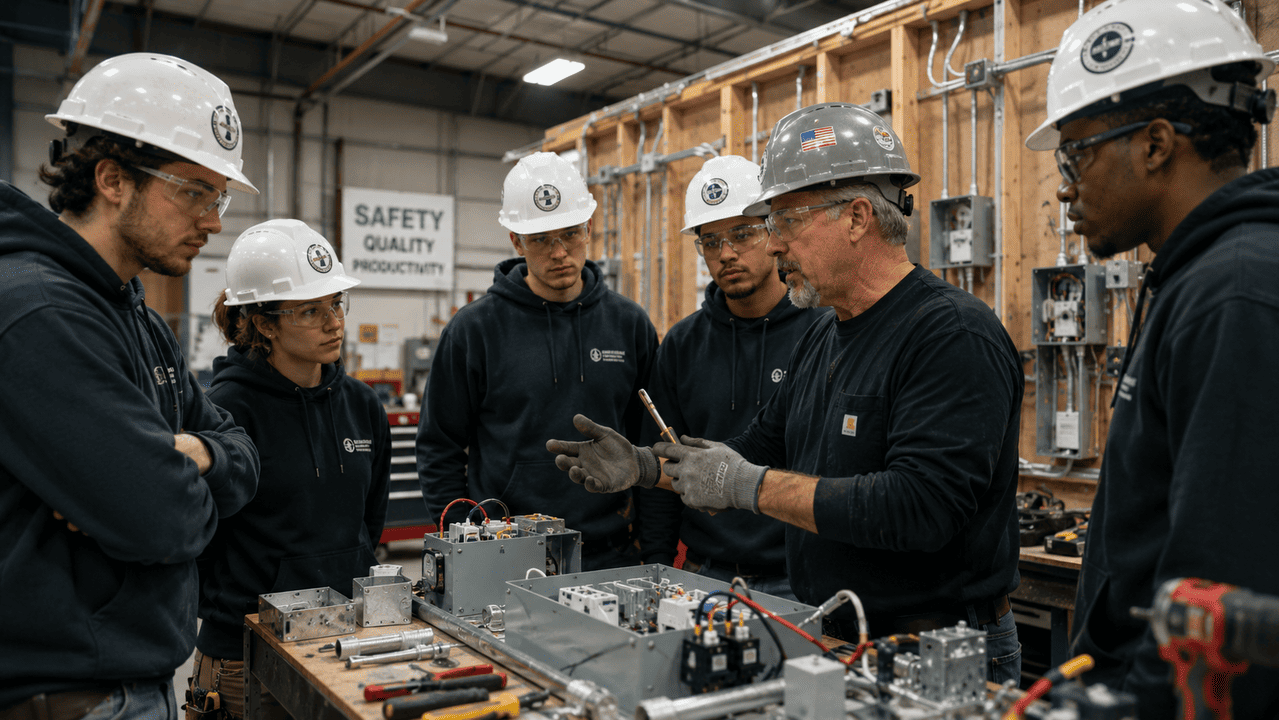
Day-to-day life as an apprentice electrician means early start times—often 5 to 7 AM—travel to job sites, and working directly under a journeyman electrician. You’ll handle residential wiring, bend conduit, install circuit breakers, pull cable, mount fixtures, and learn to troubleshoot electrical power distribution. Most apprenticeship programs include classroom instruction and hands-on training running in parallel.
A registered electrical apprenticeship blends paid on the job training with related technical instruction. RTI covers electrical theory, the National Electrical Code, blueprint reading, motor controls, safety procedures (OSHA 10, lockout/tagout, NFPA 70E), and proper use of hand tools and power tools. Combining classroom instruction with field work is how electricians learn to perform electrical work safely and competently.
Progression through an apprenticeship typically looks like this:
- Year 1 – basic tools, safety, simple installations, learning to maintain and repair electrical components
- Years 2–3 – commercial and industrial work, more complex circuits, maintaining equipment, working with control systems
- Years 4–5 – leading small tasks, preparing load calculations, studying for the journeyman exam
Accurately tracking work hours and competencies is critical. State licensing boards base journeyman electrician licensure on documented experience and specific task exposure. On-the-job experience is typically required to progress from apprentice to journeyman and master electrician licenses.
Soft skills matter as much as hands on training: taking instruction well, documenting work accurately, communicating with foremen, and staying current with code updates determine who earns trust and career advancement.
Step Five: Earn Your Journeyman Electrician License
Licensure is the milestone where you officially become a qualified electrician who can work independently, earn higher pay, and in many states pull permits. Most states require passing a licensing exam after apprenticeship.
Typical licensing requirements:
- Minimum age of 18 or older
- Completion of 4–5 years or approximately 8,000 documented OJT hours (electricians need 4,000 to 8,000 hours of apprenticeship work depending on license type)
- Completion of required classroom training hours in technical instruction
- Passing a journeyman electrician written exam
The licensing process often requires passing a comprehensive exam based on the National Electrical Code. Exam content typically includes NEC code questions, load calculations, safety rules, grounding and bonding, wiring methods, and local building codes. Electricians must pass a location-specific examination for licensing. Oklahoma requires passing a written exam for electrician licensing, and Texas manages its process through the TDLR.
After earning your licensed journeyman credential, the work isn’t over. Electricians must often complete continuing education to maintain their credentials—Oklahoma, for example, requires 12 hours of continuing education every three years. Code cycles update every three years, so staying current is non-negotiable.
Step Six: Build a Long-Term Career Path as an Electrician
After reaching journeyman level, skilled electrical workers unlock higher wages, more independence, and the ability to specialize. The right training and experience open doors most people don’t expect.

Common career path options:
- Residential service electrician or commercial/industrial specialist
- Data centers and mission-critical facilities
- Solar panels and renewable energy installations
- Electric vehicles charging infrastructure
- Controls, automation, and smart-building systems
- Estimator, safety professional, or project manager roles
Electricians can specialize in different areas such as residential, commercial, or industrial work. Texas electricians average $67,269 annually due to high demand, and electricians in Oklahoma can build stable, well-paying careers. A master electrician license—requiring around 12,000 total hours in Texas, plus two years as a licensed journeyman—unlocks the ability to design electrical systems, supervise crews, and operate as an electrical contractor.
Entrepreneurship is a real option: after meeting state requirements, some skilled electrical workers open their own businesses, hire apprentice electricians, and bid on larger projects. Health insurance, retirement plans, and profit margins improve significantly at the contractor level.
Ongoing learning keeps a successful career resilient. Staying current with NEC updates, energy-efficient technologies, and local code changes matters as the electrical industry evolves rapidly.
Guidance for different starting points:
- High school students – maximize math and physics coursework, seek pre-apprenticeship programs, build a track record of reliability
- Military veterans – many states grant credit for military electrical experience, potentially reducing OJT requirements
- Mid-career changers – assess time and financial commitments, take math refreshers, connect with local contractors and training providers to find the best fit
Why Choose Our Platform to Support Your Electrician Career Path
Launching and managing an electrical apprenticeship involves tracking thousands of OJT hours, coordinating related technical instruction, and reporting to state and federal systems. A modern apprenticeship management platform eliminates the chaos.
- Centralized OJT and RTI tracking – apprentices and sponsors see real-time progress toward the hours needed for journeyman electrician licensure, replacing scattered paper logs
- Automated compliance reporting – built-in support for RAPIDS, WIPS, and PIRL reduces administrative burden for sponsors and electrical contractors running training programs
- Mobile access for apprentices – log hours, view competency checklists, and access course materials for electrical theory and code updates from any job site
- Progress dashboards – clear visibility into how close each apprentice is to required milestones, keeping engagement high
- Scalability – organizations can expand electrical apprenticeship cohorts, partner with local high schools and community colleges, and build a reliable pipeline of future journeyman electricians
Start Your Journey to Become an Electrician Today
The steps to becoming an electrician are straightforward: earn a high school diploma or GED, research your state’s licensing requirements, apply to an apprenticeship program, complete your apprentice electrician training, and sit for journeyman electrician licensure. Every step builds on the last, and the electrical trade rewards those who commit to the process with a successful career and long-term stability.
If you’re serious about a career as an electrician, take your next step today—contact a local training provider, speak with an electrical contractor, or connect with organizations managing registered apprenticeship programs. Sponsors, schools, and employers looking to launch or scale electrical apprenticeship pathways should explore modern tools that streamline tracking, compliance, and apprentice engagement. The future belongs to smart buildings, data centers, and renewable energy, and the skilled electrical workers who power them.
Want to Learn More About Your Registered Apprenticeship Opportunities?
BOOK A FREE CONSULTATION
Frequently Asked Questions About How to Become an Electrician
These FAQs address the most common questions people ask before starting an electrical apprenticeship or pursuing formal training in the electrical trade.
How long does it take to become an electrician?
Most people spend about 4–5 years in an electrical apprenticeship before qualifying for journeyman electrician licensure, following completion of high school. The typical timeline to become an electrician includes completing high school, entering an apprenticeship, and passing licensing exams. Some intensive pre-apprenticeship or technical school programs can help you get hired faster, but they do not replace the OJT hours required by licensing boards.
Can I become an electrician without a high school diploma?
A high school diploma or GED is required by nearly all registered apprenticeship programs. Applicants usually need a high school diploma or GED. If you don’t have one, earning a GED and brushing up on algebra and physics are practical first steps before applying to an electrical apprenticeship.
Do I need to go to trade school, or is an apprenticeship program enough?
A registered apprenticeship program already combines classroom instruction and on the job training and is sufficient for licensure in most states. Some candidates complete a trade school or pre-apprenticeship first to build hands on skills and become more competitive when applying to apprenticeship programs and electrical contractors.
What’s the difference between an apprentice electrician and a journeyman electrician?
An apprentice electrician works under direct supervision, logging hours and building skills, while a journeyman electrician has completed required hours and exams and can work much more independently. Journeyman status brings higher pay, greater responsibility, and is often the stepping stone toward master electrician or supervisory roles and further career advancement.
Is a career as an electrician physically demanding or unsafe?
Electricians work in active environments—climbing ladders, lifting panels, working in tight spaces on construction sites—and around energized equipment. However, specialized training and adherence to OSHA and NEC standards manage these risks. PPE use, lockout/tagout procedures, and structured safety education from day one of an apprenticeship make the profession far safer than prior experience might suggest.
Can I switch careers and become an electrician later in life?
Many apprenticeship programs welcome career changers in their 20s, 30s, and beyond, provided they meet physical demands and scheduling requirements. Talk with local contractors, visit training providers, and assess your finances and time before enrolling. Prior experience in related fields can sometimes accelerate your path.