Table of Contents
- Why Most Organizations Are Using the Wrong Tool for Apprenticeship and Internship Management
- Understanding What Workforce Development Tracking Software Actually Does
- The Platform Evaluation Matrix: Purpose-Built vs. General HR Tools
- Core Features to Evaluate in Workforce Development Tracking Software
- How Apprenticeship-Specific Platforms Eliminate Employer and Participant Friction
- ROI and Cost-Benefit Framework for Workforce Development Software Investment
- How to Measure Success Once a Platform Is Deployed
- Choosing the Right Platform for Your Organization’s Needs
- Building a Workforce Development Program That Can Be Managed, Measured, and Scaled
- Frequently Asked Questions
Why Most Organizations Are Using the Wrong Tool for Apprenticeship and Internship Management
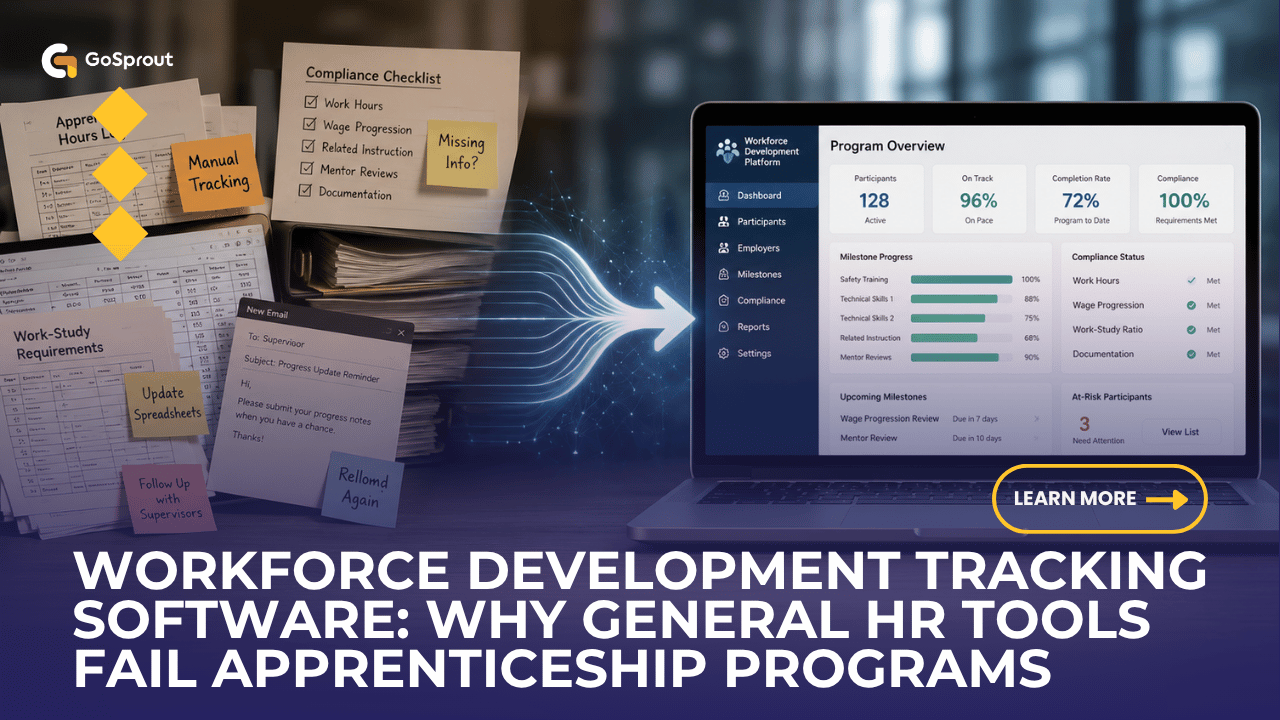
The Default Problem: General HR Tools Were Built for a Different Job
Most HR platforms were designed to manage employees, not develop them. The workflows that power payroll processing, benefits enrollment, and performance reviews are built around the stable, recurring nature of full-time employment. Apprenticeships and internships do not fit that model. They are structured developmental programs with defined timelines, incremental skill milestones, regulatory compliance requirements, and multi-party oversight, none of which general HR tools are architected to handle.
The result is a familiar workaround: HR teams adapt what they have. They add custom fields to their HRIS. They build spreadsheet trackers alongside the platform. They manually log hours against work-study requirements and remind supervisors to submit progress notes through email. The system technically functions, but the administrative effort required to make it function is disproportionate to the size of the program it supports.
This is not a configuration problem. It is a product-fit problem. General HR tools were built for a different job, and forcing them to manage apprenticeship workflows creates operational debt that compounds as programs scale.

How Repurposed Scheduling and Payroll Platforms Create Hidden Administrative Costs
Scheduling and payroll platforms solve a real problem. They make time and compensation management accurate and efficient for a standing workforce. When organizations use them as the backbone of an apprenticeship program, those platforms introduce a specific category of hidden cost: administrative translation work.
Every time a program coordinator needs to cross-reference a participant’s hours log against required on-the-job training hours, pull a completion status that lives in a separate spreadsheet, or manually compile data from three systems to generate a program report, they are performing translation work the software should be doing automatically. Across a cohort of twenty or thirty apprentices, these tasks consume meaningful staff time each week. Across a cohort of one hundred, they consume enough time to justify a dedicated administrative headcount that exists entirely because the platform does not fit the workflow.
The hidden cost is not just time. It is also data quality. Manual reconciliation introduces errors, and errors in apprenticeship records create compliance exposure that can outlast the program cycle that generated them.
The Compliance Gap No One Talks About
Apprenticeship programs operate under a distinct set of regulatory requirements that general HR tools do not surface, track, or enforce. WIOA-funded programs carry specific documentation obligations. Registered apprenticeships require verified wage progressions tied to competency milestones. Work-study ratios must be maintained and documented across the program term. When these requirements are managed through workarounds, including manual logs, calendar reminders, and periodic audits by program staff, the failure modes are predictable.
Compliance gaps do not announce themselves until they are already costly. A missed wage progression trigger. An incomplete participant record at the point of a program audit. An hours log that does not align with the approved training plan. Each of these is a preventable failure, and each typically traces back to a tool that was never designed to monitor the specific conditions that trigger compliance obligations.
Purpose-built workforce development tracking software embeds these requirements into the workflow itself, so compliance is not a separate task that happens after program administration. It is a condition of the workflow moving forward.
Workforce Development Tracking vs. Workforce Management Software
These two categories are frequently conflated in vendor marketing and in buyer research, and the conflation causes organizations to evaluate the wrong tools. Workforce management software handles operational efficiency for an existing workforce: scheduling, time and attendance, payroll integration, and labor cost optimization. It answers the question of whether people are in the right place at the right time and whether they are being compensated correctly.
Workforce development tracking software answers a different set of questions. Is each participant progressing through their training plan on schedule? Are skill competencies being assessed and recorded? Are compliance obligations being met at each stage of the program? Are employers engaged, and are participants on track to complete and place?
The operational scope is different. The data model is different. The compliance framework is different. Buyers who enter a software evaluation without this distinction in place will consistently evaluate workforce management tools against workforce development criteria and find that no available solution quite fits, because they are looking at the wrong product category entirely.
Understanding What Workforce Development Tracking Software Actually Does
A Critical Distinction Buyers Routinely Miss
Workforce management is a continuous operational function. Workforce development is a structured program function with a defined start, a set of sequential milestones, and a measurable end state. That distinction determines everything about how software in each category is designed.
A workforce management platform optimizes recurring processes across a stable employee population. A workforce development platform manages a cohort of participants through a lifecycle that includes intake, onboarding, skills training, competency assessment, compliance documentation, and eventual placement or completion. The data these platforms produce, and the workflows they support, are fundamentally different.
Buyers who recognize this distinction early avoid the most common evaluation mistake: scoring a workforce management platform highly on development criteria because it handles time tracking and has a reporting module.
The Apprenticeship Lifecycle: Why It Demands Its Own Operational Framework
An apprenticeship program is not a single event or a static state. It moves through distinct phases, and each phase generates different data, triggers different compliance requirements, and requires different actions from different stakeholders.
The lifecycle typically includes:
- Candidate sourcing and employer matching
- Program enrollment and onboarding
- Structured on-the-job training with defined hour requirements
- Related technical instruction tracked against a competency framework
- Incremental wage adjustments tied to skill progression
- Supervisor assessments and documented reviews
- Program completion and credential issuance or placement
A general HR platform manages a subset of these phases, typically the middle ones, and only at the surface level. Purpose-built workforce development tracking software manages the full arc, maintaining continuity of participant data from intake through completion and creating the longitudinal record that program audits and outcome reporting require.
What Participant Outcome Tracking Looks Like in Practice
Outcome tracking is the operational layer that separates workforce development software from workforce management software most visibly. In practice, it means the platform records not just whether a participant showed up and worked their hours, but whether they are developing toward the program’s stated objectives.
That includes skill assessment records tied to specific competency frameworks, milestone completion rates across the cohort, early indicators of disengagement or at-risk status, and placement or completion data at the program’s close. These outputs are what workforce development funders, employer partners, and program administrators actually need to evaluate program health and justify continued investment.
Who Uses This Software and What They Need It to Do
HR Managers and Operations Leads Managing Multi-Participant Programs
HR managers overseeing apprenticeship or internship cohorts need centralized visibility across all participants without building that visibility manually. Their core needs are progress monitoring at the individual and cohort level, automated compliance alerts, and reporting that can be exported for internal stakeholders or external auditors without additional data preparation work. They also need employer-side engagement data: whether host supervisors are completing assessments on schedule and whether participants are receiving the structured experience the program commits to delivering.

Small Business Owners Running Structured Internship or Pre-Apprenticeship Pipelines
Small business owners managing structured internship or pre-apprenticeship programs face a different constraint set. They typically lack a dedicated HR function, which means the platform has to carry more of the administrative load with minimal configuration overhead. Their priorities are simplicity of participant tracking, automated reminders for key milestones, and documentation they can produce quickly if a compliance question arises. They are not looking for enterprise functionality. They need a system that keeps a small program organized and audit-ready without requiring a specialist to operate it.
The Platform Evaluation Matrix: Purpose-Built vs. General HR Tools
How to Structure a Fair Comparison Between Platform Categories
A fair comparison between purpose-built apprenticeship platforms and general HR tools starts by defining evaluation criteria that reflect the actual job to be done, not the feature sets vendors choose to highlight. That means anchoring the evaluation in the specific workflows your program requires: participant lifecycle management, compliance documentation, multi-stakeholder visibility, and outcome reporting.
Evaluating both categories against the same criteria surfaces the capability gaps that vendor demos tend to obscure. A general HR tool may demonstrate time tracking and reporting, but the relevant question is whether that reporting can produce a WIOA-compliant participant record or a wage progression audit trail, not whether a reporting module exists.
What a Feature Checklist Misses When Evaluating Apprenticeship Software
Feature checklists favor breadth over fitness. A platform can have a compliance module, a progress tracking feature, and a reporting dashboard, and still be unable to manage an apprenticeship program without significant manual intervention to fill the gaps between those features. What a checklist cannot capture is workflow continuity: whether the platform connects intake to onboarding to milestone tracking to compliance documentation to outcome reporting in a single data environment, or whether each capability exists in isolation and requires manual bridging.
The more useful evaluation question is not whether a platform has a particular feature, but how it handles the specific workflow that requires that feature, and what happens when that workflow intersects with three other workflows simultaneously. That question exposes the operational gaps that feature comparisons hide.
Comparison Rubric: Purpose-Built Apprenticeship Platform vs. General HR Tool
Use this rubric to score candidate platforms during evaluation. Rate each dimension on a 1-3 scale: 1 = requires manual workarounds, 2 = partial native support, 3 = full native support.
| Evaluation Dimension | What to Assess | Purpose-Built Platform | General HR Tool |
|---|---|---|---|
| Participant Lifecycle Management | Can the platform manage a participant from intake through placement in a single record? | 3 | 1 |
| Compliance Automation | Does the platform track WIOA documentation, wage progressions, and work-study ratios automatically? | 3 | 1-2 |
| Milestone and Progress Tracking | Can supervisors and coordinators record competency-based milestones, not just task completion? | 3 | 1 |
| Multi-Stakeholder Visibility | Do employers, participants, and program administrators each have role-appropriate access to real-time data? | 3 | 2 |
| Outcome and Completion Reporting | Can the platform generate program-level outcome reports without manual data assembly? | 3 | 2 |
| Employer Engagement Monitoring | Does the platform track whether employer-side obligations are being fulfilled? | 3 | 1 |
| Onboarding and Candidate Sourcing | Does the platform support program intake and candidate matching, or only post-hire management? | 3 | 1 |
| Integration with Payroll and HRIS | Does the platform pass compliant, milestone-linked data to payroll and HR systems without manual export? | 2-3 | 3 |
The final row is intentional. General HR tools genuinely lead on payroll and HRIS integration because that is what they were built to do. The tradeoff a program manager accepts when choosing a general tool is strong integration at the expense of every dimension that makes apprenticeship management operationally distinct. A purpose-built platform closes that integration gap through standard API connections while delivering native capability across the seven dimensions where general tools consistently fall short.
Core Features to Evaluate in Workforce Development Tracking Software
The evaluation rubric in the previous section established which dimensions matter. This section goes one level deeper, examining what good implementation of each capability actually looks like and which specific shortfalls should disqualify a platform from consideration.
Participant Milestone and Progress Monitoring
What Milestone Tracking Should Look Like Across the Apprenticeship Lifecycle
Milestone tracking in a purpose-built platform follows the participant through each defined phase of their program, not just their daily task list. That means the platform maintains a longitudinal record that connects enrollment to on-the-job training hours, competency assessments, supervisor reviews, and credential issuance, in sequence, with timestamps and accountability tied to each step.
The record should reflect where a participant is in their developmental arc at any moment, not just whether they completed yesterday’s assigned work. Competency frameworks should be attached to milestones so that progress is measured against the program’s stated skill objectives. When a participant finishes a training rotation, the platform should record what was learned and verified, not just that the rotation occurred.
Red Flags When a Platform Cannot Distinguish Progress Stages from Task Completion

A platform that treats milestone completion as task closure is managing a checklist, not a development program. The operational consequence is that program coordinators lose visibility into whether participants are actually developing toward program objectives or simply moving through scheduled activities.
Watch for these indicators during evaluation:
- Milestones cannot be tagged to competency levels or skill frameworks
- Progress status is binary, with no intermediate stages
- Supervisor assessment records exist separately from the participant’s progress record
- The platform cannot surface which participants are behind pace on development milestones versus those who are simply behind on scheduled tasks
These gaps force coordinators back into manual tracking to answer questions the software should answer automatically.
Compliance Automation and Regulatory Requirement Tracking
WIOA Compliance: What It Requires and How Software Should Handle It
The Workforce Innovation and Opportunity Act establishes documentation standards for participant eligibility, service delivery, and outcome reporting that most general HR tools do not recognize as workflow conditions. WIOA-funded programs must maintain records that verify participant eligibility at enrollment, track the services delivered against approved plans, and report outcomes at defined intervals.
Software that handles WIOA compliance embeds these documentation requirements into the workflow. Eligibility documentation is collected at intake. Service delivery is logged against the approved training plan automatically. Outcome data is structured to match reporting templates rather than requiring manual reformatting before submission. When an audit occurs, the record exists in the system. It does not need to be assembled from multiple sources.
Wage, Hours, and Work-Study Requirement Tracking Built into the Workflow
Registered apprenticeship programs require wage progressions tied to competency milestones and work-study ratios that must be maintained across the program term. These are not passive data points. They are active compliance conditions that should trigger alerts and workflow actions when thresholds approach.
A platform that handles this correctly will track cumulative on-the-job training hours against the program’s required total, flag when a wage progression trigger is approaching based on milestone completion, and document the work-study ratio across each pay period. These checks should run continuously in the background, not surface only when a coordinator runs a manual report.
What Compliance Requirements Does Apprenticeship Software Track?
The compliance scope varies by program type, but purpose-built workforce development tracking software should natively handle:
- WIOA eligibility documentation and service delivery records
- Registered apprenticeship wage progression schedules
- On-the-job training hour requirements against program targets
- Work-study ratio compliance across the program term
- Participant agreement and training plan documentation
- Credential and completion verification records
Time, Attendance, and Scheduling Integration
Why Time-Tracking Alone Does Not Satisfy Apprenticeship Program Requirements
Time tracking records presence. Apprenticeship program management requires more. It needs to record what type of training occurred during those hours, whether those hours count toward on-the-job training requirements, and how the accumulated total compares to the program’s required threshold.
A platform that logs hours without categorizing them against the program’s training structure produces attendance data that cannot serve compliance documentation or outcome reporting without additional manual work to contextualize it.
How Scheduling and Labor Forecasting Connect to Participant Outcome Data
Scheduling in an apprenticeship context is a development planning tool, not just a staffing tool. When scheduling data connects to outcome data, program coordinators can identify whether participants are getting consistent exposure to each required training area or whether scheduling gaps are creating uneven development across the cohort. That connection allows proactive intervention, adjusting rotations or placements before a participant falls behind on milestone pace.
Centralized Data Management and Multi-Stakeholder Visibility
Fragmented data is the single most consistent operational failure in programs that run on general HR tools. The participant record exists in the HRIS. The training log lives in a spreadsheet. The supervisor assessment is in email. When a program coordinator needs a complete picture of one participant’s status, they are manually assembling it from three sources every time.
Employer-Side Visibility: Engagement Metrics and Participant Status in Real Time
Employer partners and host supervisors need role-appropriate access to participant data without requiring program staff to generate and send status reports manually. A purpose-built platform gives supervisors a view of their participants’ progress, outstanding assessment obligations, and upcoming milestones, in real time, from their own interface.
This matters for program integrity, not just convenience. When supervisors can see that an assessment is overdue or a milestone is approaching, they are more likely to act on it. Passive compliance, where program staff chase supervisors for documentation, is replaced by active notification and employer-side accountability.
Participant-Side Access: Progress Dashboards and Skills Assessment Records
Participants who can see their own progress data are more engaged with their development trajectory. A participant-facing dashboard that shows completed milestones, remaining requirements, and skills assessment records gives participants a concrete picture of what they have earned and what they still need to accomplish. That visibility also reduces inbound questions to program staff about status and completion timelines.
How Do You Track Apprenticeship Progress and Compliance?
Effective tracking requires a single participant record that accumulates data from all stakeholders, including coordinator inputs, supervisor assessments, participant self-reporting, and automated compliance checks, into one longitudinal view. The record should be accessible to appropriate parties in real time and should produce audit-ready documentation without manual compilation. That is the operational standard a platform should meet before it is considered fit for apprenticeship program management.
Real-Time Reporting, Analytics, and Program-Level Dashboards
What a Reporting Framework Should Reveal About Program Health
Program-level reporting should answer four questions without manual data assembly: Are participants progressing at the expected pace? Are compliance obligations being met? Are employer partners fulfilling their program commitments? And what is the projected completion and placement rate for the current cohort?
A dashboard that surfaces only aggregate activity metrics, such as logins, hours logged, and tasks completed, tells a coordinator what is happening, not whether the program is working. Reporting that connects activity data to outcome trajectories provides the analytical basis for program adjustments before problems compound.

Workforce Development Case Management as an Analytical Layer
Workforce development case management is the practice of tracking individual participant circumstances, interventions, and outcomes alongside program-level metrics. When a participant shows early signs of disengagement, such as declining assessment completion rates, irregular attendance, or stalled milestone progress, case management workflows surface that risk and prompt a coordinator response.
This is distinct from basic progress tracking. It is an analytical layer that treats each participant as a case with a trajectory, not just a record with a completion status.
Candidate Sourcing, Onboarding, and the Two-Sided Marketplace Architecture
Why Onboarding Friction Reduction Starts Before Day One
Programs that manage intake and enrollment outside their primary platform introduce data gaps that persist for the participant’s entire program lifecycle. If candidate information is collected in one system and transferred to another at enrollment, the longitudinal record is incomplete from the start. Purpose-built platforms manage candidate sourcing, screening, matching, and enrollment in the same data environment that tracks progress and compliance, so the record is continuous from first contact through program completion.
What a Two-Sided Marketplace Platform Delivers That One-Way Case Management Cannot
One-way case management tracks participants. A two-sided marketplace platform connects participants to employers, manages obligations on both sides, and creates accountability for both parties in a shared data environment. Employer engagement is not assumed. It is measured. Participant progress is not reported to employers through manual updates. It is visible to authorized employer contacts in real time.
That architecture changes the operational dynamic of a program. Instead of a coordinator managing information flow between employers and participants, the platform handles that function automatically, and the coordinator manages exceptions.
HR System Integration and Cloud-Based Infrastructure
Expected Integration Touchpoints: HRIS, Payroll, and Scheduling Systems
A purpose-built platform does not need to replace an organization’s existing HRIS or payroll system. It needs to connect to them reliably. The expected integration points are participant enrollment data flowing into the HRIS, milestone-triggered wage changes passing to payroll, and scheduling data syncing to track training type against hour requirements. Standard API connections should handle these integrations without requiring custom development from the buyer.
Mobile Accessibility and Remote Program Management Capabilities
Supervisors complete assessments in the field. Participants log training hours on-site. Program coordinators manage multiple locations. A platform that requires desktop access to perform core functions creates friction at every point where those users actually work. Mobile access is not a feature enhancement. It is a functional requirement for any program operating outside a single office environment.
How Apprenticeship-Specific Platforms Eliminate Employer and Participant Friction
The Operational Cost of Manual and Spreadsheet-Based Program Tracking
The administrative cost of manual program tracking scales with participant volume in a way that software costs do not. Each additional participant adds recurring coordination tasks: tracking their hours, updating their progress record, chasing supervisor assessments, and verifying compliance thresholds. At ten participants, these tasks are manageable. At fifty, they consume a meaningful portion of a coordinator’s available time. At one hundred, they either justify dedicated administrative headcount or they do not get done consistently, which creates the compliance exposure discussed earlier.
The compounding cost that spreadsheet-based tracking produces is not just time. It is the organizational risk that accumulates when records are inconsistent, out of date, or difficult to audit. That risk does not appear on a budget line until it materializes as a compliance finding or a program audit that requires weeks of retroactive documentation work.
Managing Fifty Apprentices Across Departments Without a Purpose-Built Platform
Consider a mid-sized manufacturer running a registered apprenticeship program with fifty participants across four departments. Each participant has a training plan with defined hour requirements, competency milestones, and a wage progression schedule. Supervisors in each department submit progress notes via email. Hours are logged in the payroll system but not categorized by training type. Compliance documentation is maintained in a shared drive by one program coordinator.
Each month, that coordinator spends roughly two days pulling together a program status report: cross-referencing hours logs against training plan requirements, following up with supervisors on outstanding assessments, verifying that wage progressions have been processed correctly, and updating individual participant records. When a WIOA report is due, the same coordinator spends an additional day reformatting the data to match the reporting template.
That is approximately thirty days of coordinator time per year spent on data assembly work that a purpose-built internship tracking software or apprenticeship management platform would handle automatically. The coordinator’s actual job, supporting participants, engaging employers, and improving program quality, is subordinated to administrative maintenance.
How Automated Workflows Reduce Administrative Overhead at Scale
Automation in a purpose-built platform does not eliminate the coordinator’s role. It redirects it. Instead of managing information flow, coordinators manage program quality. Automated workflows handle:
- Sending assessment reminders to supervisors when milestone reviews are due
- Flagging participants whose hours are not on pace to meet program requirements
- Triggering wage progression notifications when competency milestones are completed
- Generating compliance reports formatted for WIOA or registered apprenticeship submissions
- Notifying program administrators when documentation gaps create audit risk
The coordinator receives exceptions and alerts, not raw data to be reconciled.
Can General HR Software Handle Apprenticeship Program Management?
General HR software can manage some components of an apprenticeship program, including time and attendance, basic record-keeping, and payroll processing, but it cannot manage the program as a coherent whole. The gaps are structural. The data model of a general HR tool is built around employment records, not participant development trajectories. Competency-based milestone tracking, compliance automation for registered apprenticeship requirements, and two-sided employer-participant visibility are not features that can be configured into a system not designed to hold them.
Organizations that run apprenticeship programs on general HR tools rarely discover this limitation during evaluation. They discover it six months into the program, when the administrative load required to compensate for the platform’s gaps becomes unsustainable.
What Features Should Apprenticeship Management Software Have?
The feature set that matters is not a long list of capabilities. It is a specific set of integrated workflows. Apprenticeship management software should handle participant lifecycle management from intake through completion, compliance tracking across WIOA and registered apprenticeship requirements, competency-based milestone monitoring, multi-stakeholder visibility with role-appropriate access, automated reporting for program audits and funder submissions, and integration with existing payroll and HRIS systems. Each of these capabilities should operate within a single participant record, not as separate modules that require manual coordination.
ROI and Cost-Benefit Framework for Workforce Development Software Investment
Building the Business Case: What Costs Are Actually Measurable
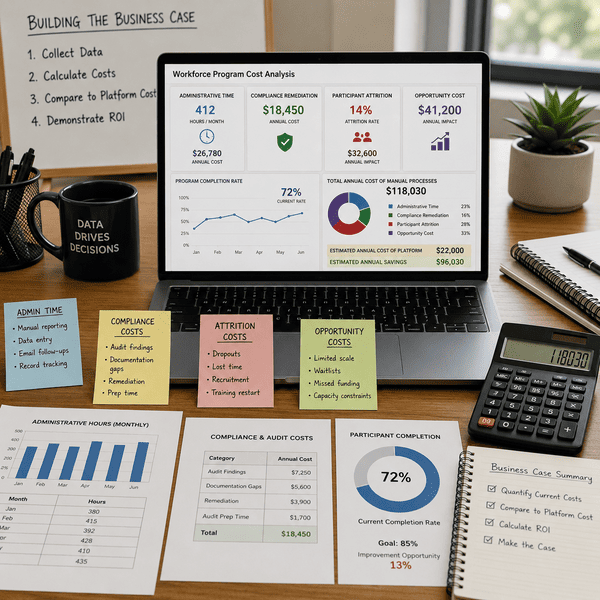
The business case for dedicated workforce development tracking software rests on four cost categories that organizations currently absorb without attributing them to a tool-fit problem: staff time spent on administrative translation work, compliance remediation costs when gaps surface, participant attrition costs when program disorganization reduces completion rates, and opportunity costs when program scale is limited by the administrative capacity of the existing system.
Each of these categories is measurable with data most organizations already hold. Hours spent on manual reporting and compliance documentation can be logged and costed against coordinator salaries. Compliance findings and audit preparation costs appear in operational budgets. Participant completion rates are tracked, even if inconsistently. The analysis required to build the business case is not complex. It requires collecting these figures and comparing them against the platform’s annual cost.
An Illustrative ROI Model for Apprenticeship and Internship Programs
Time Recaptured from Manual Compliance and Reporting Tasks
Using the fifty-participant scenario described earlier: if a coordinator spends thirty days per year on administrative work a platform would automate, and that coordinator’s fully-loaded annual cost is $65,000, the time recaptured represents approximately $7,500 in labor cost. At one hundred participants, that figure approximately doubles. Most purpose-built platforms in this category are priced well below the labor cost of the administrative work they replace.
Compliance Risk Reduction and the Cost of a Preventable Audit Failure
A WIOA audit finding that requires retroactive documentation and program remediation can cost organizations significant amounts in staff time, external support, and potential funding recapture, depending on the severity of the finding. That exposure represents a risk that a platform’s compliance automation directly reduces. Even at a relatively low probability of occurrence, the expected value of that risk reduction can exceed the platform’s annual cost.
Participant Retention and Program Completion Rate as Output Metrics
Programs that track participants proactively, identify at-risk participants early, and maintain consistent employer engagement consistently show higher completion rates than programs managed through manual or fragmented systems. A meaningful improvement in completion rate across a fifty-participant cohort represents additional program completions per cycle, each of which carries credential value, employer goodwill, and potential program funding implications.
What Is the ROI of Investing in Dedicated Apprenticeship Tracking Software?
The ROI calculation for most programs becomes straightforward when administrative time, compliance risk, and completion rate are quantified together. Organizations running more than twenty-five participants on manual or general HR systems will typically recover the platform cost within the first program cycle through time savings alone, before accounting for risk reduction or outcome improvements. Programs that have experienced compliance findings or high participant attrition will see faster payback periods because the baseline cost of the current approach is higher.
What Is the Cost of Workforce Development Tracking Software?
Pricing varies by platform architecture and participant volume, but purpose-built apprenticeship and workforce development platforms generally operate on per-participant or per-program subscription models. Entry-level tiers for small programs typically range from a few hundred to a few thousand dollars annually. Mid-market programs managing fifty to several hundred participants should expect pricing in the range of $5,000 to $25,000 per year, depending on feature depth and integration requirements. Enterprise configurations for large-scale or multi-site programs are typically custom-quoted. The more relevant comparison is not the platform cost against zero. It is the platform cost against the measurable cost of the current approach.
How to Measure Success Once a Platform Is Deployed
Defining Program-Level KPIs Before Implementation Begins
Platform implementation without defined success metrics produces data without interpretation. Before go-live, program administrators should establish baseline figures for the metrics they intend to improve: current coordinator hours spent on administrative tasks per month, current participant completion rate, current compliance documentation turnaround time, and current employer assessment completion rate. These baselines make the platform’s impact measurable rather than assumed.
Tracking Participant Outcomes Against Baseline
The outcome metrics that matter most to program funders and employer partners are completion rates, placement rates, and skills acquisition rates against the program’s competency framework. A platform should surface these metrics at the cohort level on an ongoing basis, not only at program close. Mid-program outcome data allows coordinators to identify cohorts that are underperforming against baseline and adjust program delivery before the completion cycle ends.
How Apprenticeship Software Improves Participant Outcomes
Structured visibility into participant progress, combined with automated alerts for at-risk status indicators, allows coordinators to intervene earlier and more precisely than manual tracking permits. When a platform surfaces that a participant has stalled on milestone completion or shows declining engagement indicators, a coordinator can act within days rather than discovering the issue at a quarterly check-in. Earlier intervention produces measurably better outcomes, including higher completion rates, stronger skill development, and more successful placements, because the window for effective support is wider.
Employer Engagement Metrics as a Leading Indicator of Program Health
Employer engagement predicts participant outcomes more reliably than most lagging metrics. Whether supervisors are completing assessments on schedule, whether host organizations are providing the structured training experience the program requires, and whether employer contacts are accessing participant status data are all signals that a well-configured platform can track in real time. Programs with high employer engagement consistently produce stronger completion and placement rates. A platform that monitors employer engagement continuously gives program administrators early warning when employer-side obligations are not being met, before that gap affects participant outcomes.
How Long Does It Take to Implement Apprenticeship Management Software?
Implementation timelines for purpose-built workforce development platforms typically range from two to eight weeks for programs under one hundred participants, depending on integration complexity and the volume of historical data being migrated. Programs with straightforward integration requirements, connecting to a single HRIS and payroll system, typically reach full operational deployment within four weeks. The critical path is usually not the platform configuration but the internal process alignment: defining the milestone framework, establishing role-based access for employers and participants, and documenting the compliance workflow before configuring it in the system.
Change Management and Adoption: Moving from Manual Tracking to a Software-Driven Workflow
The most common implementation risk is not technical. It is behavioral. Coordinators accustomed to managing programs through spreadsheets and email will default to those methods under pressure unless the platform provides a clear operational improvement from day one. Adoption accelerates when the platform reduces visible friction immediately: automated reminders replace manual follow-up, reporting replaces manual compilation, and participant status is available at a glance rather than through active inquiry.
Employer and participant adoption follows a similar pattern. When the platform delivers a better experience than the process it replaces, including clearer status visibility, simpler assessment submission, and faster communication, adoption becomes the path of least resistance rather than a change management challenge.
Choosing the Right Platform for Your Organization’s Needs
Decision Criteria for Organizations Managing Under Fifty Participants
At this program scale, the primary risk is not complexity. It is administrative fragility. A single coordinator managing thirty participants through spreadsheets and email can keep the program running, but one staffing change or one compliance inquiry can expose how thin the operational foundation actually is. The platform decision at this scale should prioritize three things: minimal configuration overhead, automated compliance documentation, and a participant record that is audit-ready by default.
Want to Learn More About Your Registered Apprenticeship Opportunities?
BOOK A FREE CONSULTATION
Criteria to weight heavily include:
- Onboarding time under four weeks with no dedicated IT support required
- Automated milestone reminders and compliance alerts that work out of the box
- Participant records that produce exportable documentation without manual formatting
- Employer-side access that does not require the coordinator to generate and send status updates manually
Price sensitivity is real at this scale, but the cost comparison that matters is platform cost against the coordinator hours currently spent on administrative maintenance, not platform cost against zero. Most small programs find the math resolves quickly once that comparison is made explicit.
Decision Criteria for Mid-Market Programs Managing Fifty to Five Hundred Participants
Programs at this scale have crossed the threshold where manual tracking is not just inefficient. It is operationally unsustainable without dedicated administrative headcount. The platform decision here shifts from whether the investment is affordable to what it costs not to have the platform in place. The criteria change accordingly.
At this scale, integration capability matters in ways it does not for smaller programs. Participant enrollment data needs to flow into the HRIS without manual re-entry. Wage progression triggers need to pass to payroll reliably. Reporting needs to aggregate data across cohorts and program sites, not just individual participants. Evaluate platforms against these integration requirements explicitly, not just their feature list.
Additional criteria specific to this scale include:
- Multi-cohort and multi-site visibility from a single dashboard
- Role-based access for employer contacts, participants, and program staff without requiring administrator intervention for each configuration
- Reporting that produces funder-ready output for WIOA submissions or registered apprenticeship audits
- Scalable pricing that does not impose disproportionate cost increases as participant volume grows within the contract term
Mid-market programs should also assess vendor support depth. A platform that handles fifty participants adequately may degrade operationally at three hundred if the underlying data architecture was not built for volume. During evaluation, ask vendors to demonstrate the platform with a cohort size at the upper end of your projected growth range, not your current enrollment.
When a General HR Tool Is Sufficient and When It Is Not
A general HR tool is sufficient when your program management need is primarily administrative record-keeping for a small number of participants with no regulatory compliance requirements, no competency-based milestone framework, and no employer-side accountability obligations. If you are managing a handful of informal internships where the primary need is tracking hours and generating offer letters, a general HR platform covers that ground adequately.
The threshold shifts the moment any of the following conditions apply:
- The program is WIOA-funded or involves registered apprenticeship requirements
- Participants must demonstrate competency milestones, not just complete scheduled hours
- Employer partners have documented obligations they must fulfill as part of the program structure
- The program will scale beyond twenty-five participants within the next two program cycles
- Outcome reporting is required by a funder, workforce board, or employer consortium
Once any of these conditions are present, a general HR tool will require manual workarounds to compensate for its structural gaps. Those workarounds scale with participant volume, and the administrative cost of maintaining them will eventually exceed the cost of the platform that would eliminate them.
What to Demand from a Vendor During the Evaluation Process
The evaluation process is where platform gaps are most effectively surfaced, but only if the evaluation is structured to expose them. Most vendor demos are designed to show what a platform does well. Your job is to create conditions where the gaps appear.
Go into every vendor conversation with these specific demands:
- Show me how the platform handles a WIOA eligibility documentation workflow from intake through audit. Walk through the specific steps, not a general compliance module.
- Demonstrate how a wage progression trigger works when a participant completes a competency milestone. Show what happens in payroll integration at that moment.
- Show me the employer-facing interface. What can a supervisor see and do without coordinator intervention?
- Run a cohort-level outcome report for a program that has been active for six months. What does it show, and how long did it take to generate?
- What does implementation actually require from our team? Who does the configuration work, and what is the realistic go-live timeline for our program size?
Vendors who struggle to answer these questions in the product, rather than in a follow-up call or a roadmap discussion, are confirming the gaps that will become your administrative burden after contract signature.
Matching Platform Type to Program Scale and Compliance Complexity
Use this matrix to narrow platform type before beginning vendor conversations. It does not replace a full evaluation, but it eliminates the mismatches that waste evaluation time.
| Program Scale | Compliance Complexity | Employer Accountability Required | Recommended Platform Type |
|---|---|---|---|
| Under 25 participants | None or informal | No | General HR tool or basic internship tracking software |
| Under 25 participants | WIOA or registered apprenticeship | Yes | Purpose-built workforce development platform |
| 25-50 participants | Any | Yes | Purpose-built workforce development platform |
| 50-500 participants | Any | Yes | Purpose-built platform with HRIS and payroll integration |
| 500+ participants | WIOA, registered apprenticeship, or multi-funder | Yes | Enterprise-tier purpose-built platform, custom-quoted |
The compliance complexity column is the deciding variable at small program scales. A twenty-participant program with no regulatory requirements can run adequately on lighter tools. A twenty-participant registered apprenticeship program cannot. The compliance structure demands a platform that was built to hold it.
Building a Workforce Development Program That Can Be Managed, Measured, and Scaled
The Case for Purpose-Built Over Repurposed
The argument this guide has developed is not that general HR tools are poor products. They are well-designed for the job they were built to do. The problem is that managing an apprenticeship or internship program is a different job, and the structural gaps between what general tools provide and what apprenticeship management requires do not close through configuration or workarounds. They require a different product architecture entirely.
Programs that run on repurposed tools absorb the cost of that mismatch as administrative overhead, compliance exposure, and constrained growth. Programs that run on purpose-built platforms redirect that cost toward the work that actually develops participants and delivers program outcomes.
Why the Two-Sided Marketplace Model Represents the Operational Standard
The administrative standard that purpose-built platforms establish is not simply better record-keeping. It is a fundamentally different operational model, one where both employers and participants are active participants in a managed workflow, not passive recipients of coordinator-generated updates.
The two-sided marketplace architecture matters because it changes accountability. Employers are not bystanders who receive progress reports. They are active parties with visible obligations, real-time access to participant data, and automated prompts to fulfill their program commitments. Participants are not subjects of a tracking system. They are users of a platform that shows them their own progress and keeps them oriented toward completion. That shared visibility, built into the platform architecture, is what produces the engagement and completion outcomes that one-way case management systems cannot consistently replicate.
How GoSprout Embodies This Evaluation Framework
GoSprout was designed around the exact operational requirements this framework identifies. The platform manages the full apprenticeship and internship lifecycle in a single participant record, from candidate sourcing and employer matching through milestone tracking, compliance documentation, and outcome reporting. Compliance automation is embedded in the workflow, not added as a reporting module. Employer and participant visibility is built into the architecture, not delivered through coordinator-generated status updates.
The evaluation dimensions in the comparison rubric, covering participant lifecycle management, compliance automation, milestone tracking, multi-stakeholder visibility, outcome reporting, employer engagement monitoring, candidate sourcing, and system integration, reflect the capabilities GoSprout was built to deliver natively. Organizations that apply this framework to their platform evaluation will consistently find that GoSprout meets the criteria that purpose-built programs require, without the administrative overhead that general tools impose.
Your Next Step: Evaluate Your Current Tool Against the Criteria That Actually Matter
The most productive next step is not to start a new vendor search. It is to apply the evaluation framework in this guide to the tool you are currently using. Pull the comparison rubric and score your current platform honestly across each dimension. Estimate the coordinator hours per month that go to administrative work the platform does not automate. Review your last program cycle for compliance documentation gaps or participant records that required manual assembly.
If that assessment confirms that your current tool is creating operational debt rather than reducing it, the business case for purpose-built workforce development tracking software is already in front of you. You simply need to quantify it. GoSprout offers a structured evaluation process designed to help you do exactly that, starting with your current program’s specific requirements and working forward to the platform configuration that fits them.
Frequently Asked Questions
Apprenticeship management software should deliver a specific set of integrated workflows rather than a broad list of standalone capabilities. At minimum, it should handle participant lifecycle management from intake through program completion, competency-based milestone tracking, WIOA and registered apprenticeship compliance automation, multi-stakeholder visibility with role-appropriate access for employers and participants, automated reporting for audits and funder submissions, and reliable integration with existing payroll and HRIS systems. Each of these capabilities should operate within a single participant record to eliminate the manual bridging that fragmented systems require.
Effective tracking requires a single longitudinal participant record that accumulates inputs from all stakeholders, including coordinator entries, supervisor assessments, participant self-reporting, and automated compliance checks, into one continuously updated view. Compliance tracking should be embedded in the workflow itself, automatically monitoring wage progression triggers, on-the-job training hour thresholds, and work-study ratios rather than surfacing gaps only when a coordinator runs a manual report. Audit-ready documentation should be a byproduct of normal program operations, not a separate preparation task.
Purpose-built workforce development platforms typically operate on per-participant or per-program subscription models. Entry-level tiers for small programs generally range from a few hundred to a few thousand dollars annually. Mid-market programs managing fifty to several hundred participants should expect pricing in the range of $5,000 to $25,000 per year, depending on feature depth and integration requirements. Enterprise configurations for large-scale or multi-site programs are typically custom-quoted. The most relevant cost comparison is not the platform fee measured against zero, but the platform fee measured against the staff time, compliance risk, and participant attrition costs the current approach generates.
Purpose-built platforms improve outcomes by enabling earlier and more precise intervention. When a platform continuously monitors milestone completion pace, attendance patterns, and supervisor engagement, program coordinators receive alerts about at-risk participants within days rather than discovering issues at a quarterly review. That shorter response window translates directly into higher completion rates and stronger skill development. Participant-facing progress dashboards also improve outcomes by keeping participants oriented toward their own development trajectory, which increases engagement and reduces early program exits.
General HR software can manage isolated components of an apprenticeship program, such as time and attendance, basic record-keeping, and payroll processing, but it cannot manage the program as a coherent whole. The limitations are structural. General HR tools are built around employment records, not participant development trajectories, which means competency-based milestone tracking, WIOA compliance automation, and two-sided employer-participant visibility cannot be adequately configured into them. Organizations typically discover this not during evaluation but several months into program delivery, when the administrative workload required to compensate for the platform’s gaps becomes unsustainable.
The ROI case becomes straightforward when three cost categories are quantified together: staff time currently spent on administrative tasks the platform would automate, compliance risk exposure from documentation gaps, and participant attrition from program disorganization. For programs running more than twenty-five participants on manual or general HR systems, time savings alone typically recover the platform cost within the first program cycle. Programs that have experienced compliance findings or elevated participant attrition will see faster payback periods because the measurable cost of the current approach is higher. The business case is usually already present in an organization’s existing operational data. It simply needs to be made explicit.


