Table of contents
- Introduction: Why Immersive Training Matters for Employee Performance in 2026
- What Is Immersive Training? From Passive Learning to Hands-On Simulations
- Immersive Learning vs. Traditional Employee Training Methods
- Why Immersive Training Works (The Learning Science and Data)
- Immersive VR Training in High-Stakes and Emergency Response Scenarios
- Beyond Safety: Corporate Training Use Cases Across the Employee Lifecycle
- Planning and Implementing an Immersive Training Program
- Measuring the Impact and ROI of Immersive Training
- FAQs About Immersive Training for Employees
- Why Choose a Purpose-Built Platform to Support Immersive Training in Work-Based Learning
- Taking the Next Step: How to Get Started with Immersive Training for Your Workforce
Introduction: Why Immersive Training Matters for Employee Performance in 2026
Since 2020, employee training has collided with three forces at once: distributed workforces, widening skills gaps in technical trades, and rising safety expectations from regulators and insurers. Traditional training methods like slide decks and shadowing have not kept pace. Between 2024 and 2026, adoption of immersive VR training in manufacturing, healthcare, logistics, and public safety grew roughly 5.4 times over five years.
Immersive training for employees places workers inside realistic, interactive scenarios using immersive technology like virtual reality, augmented reality, and 3D simulations. Employees actively practice skills and make decisions rather than passively watching videos. This article covers how immersive learning works, why it outperforms traditional formats, where it fits across the employee lifecycle, how to plan a rollout, and how platforms built for apprenticeship and work-based learning programs tie it all together.
What Is Immersive Training? From Passive Learning to Hands-On Simulations
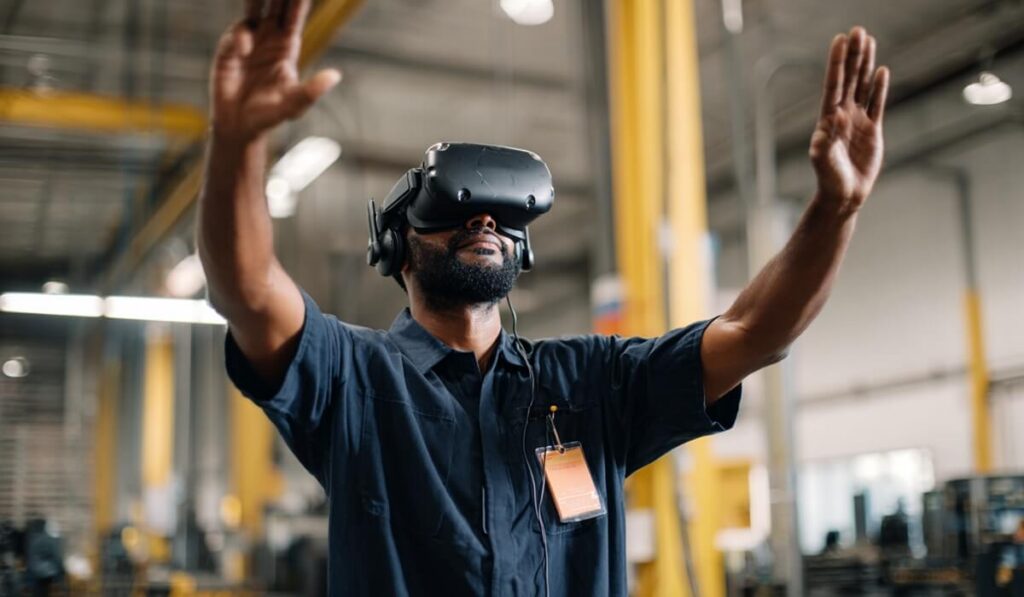
Immersive training is a training method that uses interactive simulations or virtual environments for experiential learning. Unlike static e-learning modules or instructor led training in a conference room, immersive learning demands that learners act, react, and see the consequences of their choices in real time. Virtual reality fully replaces the physical environment with a simulated world, while augmented reality overlays digital information onto the physical world. Mixed reality blends real and virtual elements for interactive experiences.
Three components define the approach:
- Presence: the learner feels inside the scenario. A technician practices operating equipment in a digital twin of the actual plant layout. Digital twins create virtual replicas of workplaces for practice before real applications.
- Interactivity: the learner makes decisions. They respond to a machine fault, manage a chemical spill, or de-escalate an upset customer. AI-powered characters provide dynamic interaction during training scenarios.
- Feedback and consequence: actions produce visible results. Errors trigger simulated consequences, so employees learn without real world consequences.
Custom VR training reflects actual facilities and workflows, which makes simulations directly transferable to on-the-job training tasks. For apprenticeship programs, this means learners can practice competencies in a virtual space that map to OJT and RTI requirements. 360-degree video modules also allow immersive experiences on conventional screens for lower-stakes procedural work.
Immersive Learning vs. Traditional Employee Training Methods
Most organizations still rely on classroom sessions, LMS videos, and ride-along shadowing for employee training. These traditional formats produce low retention and limited confidence, especially for high-risk roles where real practice opportunities are rare or dangerous.
Here is how the main approaches compare:
- Classroom and e-learning: scalable and inexpensive per seat, but passive. Knowledge retention from traditional learning drops to roughly 20% within weeks. Employees recall scenarios better than traditional bullet points, yet most compliance courses are still built around slides.
- Shadowing and ride-alongs: builds contextual understanding but depends on availability of senior staff, limits throughput, and exposes new hires to live risk before they are ready.
- Hands on training with physical equipment: the gold standard for skill development, but takes equipment offline, creates downtime, and cannot replicate rare scenarios safely.
- Immersive simulations: combine the realism of hands on learning with unlimited repeatability and zero operational disruption. Nationwide Insurance cut training time from 3 hours to 25 minutes using VR for one of its programs. Immersive training can increase retention from 20% to 80%.
- Blended immersive learning: combines VR with traditional training methods for the best of both approaches. Immersive modules handle the high-stakes, high-repetition portions; classroom and coaching handle context, reflection, and assessment. This is a training strategy, not a total replacement.
Why Immersive Training Works (The Learning Science and Data)
Cognitive research shows experiential learning enhances memory formation. When learners physically navigate a scenario, interact with objects, and feel time pressure, they encode information through spatial, motor, and emotional channels simultaneously. That multi-channel encoding is why VR training improves knowledge retention rates up to 80%, compared to roughly 20-30% for passive video or lecture.
Here is how each mechanism translates into measurable employee performance:
- Presence: the sense of “being there” activates the same neural pathways as real world situations. A fire evacuation rehearsed in VR produces context-dependent recall when the alarm sounds for real.
- Repetition: VR training allows repeated practice, enhancing long-term retention. Retention rates for VR training can reach 80% after one year. Learners build muscle memory for lockout/tagout procedures, equipment startup sequences, and patient assessment steps.
- Feedback loops: immediate scoring and branching paths show learners what went wrong and why. Training programs can track performance metrics to identify skill gaps in each individual.
- Emotional engagement: realistic simulations generate the stress and stakes of real work scenarios without real world risk. Active participation in training enhances engagement and knowledge retention. VR training can improve employee performance by up to 70%.
- Safe failure: learners can make errors, see the outcome, and retry. This is especially valuable for rare scenarios that would take months to encounter on the job.
- Gamification: incorporating game mechanics like scoring, badges, and leaderboards into immersive environments further boosts intrinsic motivation and keeps the learning process from feeling like a chore.
Immersive VR Training in High-Stakes and Emergency Response Scenarios
Emergency response, utilities, healthcare procedures, confined-space entry, and chemical handling share a common problem: mistakes are too costly or dangerous to practice live, yet employees must respond correctly the first time. Immersive VR training solves this by placing workers in lifelike scenarios with realistic sound, smoke, alarms, and time pressure.
Concrete applications in high stakes environments include:
- HAZMAT response: the BNSF Railway program has trained over 4.6 million first responders in a virtual environment that replicates railroad emergencies. Learners read consist documents, size up incidents, and make decontamination decisions under pressure.
- Industrial safety: Shell built VR simulations of storage tanker overspill scenarios, achieving consistent scenario recreation, high throughput, and auditable compliance data. VR training reduces workplace accidents by 45%.
- Medical emergencies: CPR and AED simulations aligned to national standards let responders practice emergency procedures without risk to patients or equipment.
- Fault diagnosis: a utilities apprentice can complete five different fault scenarios in a single 45-minute VR session. In the field, encountering all five could take months. Immersive training enables repeated practice of hazardous scenarios safely, and VR training eliminates real-world consequences during practice sessions.
- Compliance documentation: in regulatory-heavy contexts like OSHA safety exercises and healthcare codes, simulations record which scenarios each worker has completed, how they performed, and where they need more practice. This digital traceability supports audit readiness.
Immersive training allows practice of dangerous scenarios safely and lets workers rehearse rare scenarios in less time than any other training method.
Beyond Safety: Corporate Training Use Cases Across the Employee Lifecycle
Immersive training is not limited to hazardous work. It supports core corporate training needs from the first day on the job through leadership development.
- Onboarding new hires: simulating a distribution center layout or a “day in the life” of an apprentice technician reduces first-week anxiety. VR training reduces onboarding time from 12 weeks to 3-4 weeks in some technical roles, and immersive training can reduce onboarding time by 40-75%. Walmart reduced new technology training time by 96% using VR for its associates.
- Cross-training and upskilling: employees moving to new roles practice in interactive environments without disrupting live operations. Immersive training can compress months of learning into days.
- Soft skills and leadership: frontline supervisors practice difficult conversations, sales reps rehearse discovery calls, and managers work through conflict de-escalation in a controlled setting. The emotional realism of immersive experiences makes the practice transfer to real world challenges.
- Apprentices and interns: simulations help early-career employees practice foundational skills in a safe environment, accelerate progression through OJT tasks, and reduce the burden on mentors. Immersive learning allows for consistent and scalable training across locations, which matters for sponsors managing apprentices at multiple sites.
- Compliance and regulatory refreshers: annual retraining for safety, data science protocols, or equipment recertification runs faster and sticks longer when workers walk through scenarios instead of re-reading PDFs.
Effective training for staff training at scale requires content that is both repeatable and engaging. Immersive simulations deliver both.
Planning and Implementing an Immersive Training Program
Start with clear business goals, not with buying virtual reality headsets. Define what success looks like: reduce time-to-competency by 30%, cut safety incidents by 20%, or standardize apprenticeship training across five sites.
Here is a step-by-step approach for training managers and apprenticeship coordinators:
- Identify high-impact use cases: prioritize tasks that are high-risk, high-cost, or high-volume. Emergency response, equipment lockout/tagout, and frontline customer interactions are common starting points.
- Define measurable KPIs: time-to-competency, error rates in real operations, incident rates, test scores, and new hire retention at 6 and 12 months. VR training can save costs by up to 40% when deployed against the right use cases. VR training can reduce training time by 40-75%.
- Choose modality mix: not every scenario needs a VR headset. Use immersive VR for spatial, high-stakes tasks and browser-based 3D for procedural or refresher content. VR headsets like the Meta Quest 3S cost roughly $350 per device; high-fidelity devices like Varjo XR-4 run about $3,990.
- Plan content governance: subject matter experts validate scenarios against SOPs. VR training can reduce operational downtime during training by taking the learning off the production floor entirely.
- Manage devices and accessibility: shared fleets vs. personal assignments, hygiene protocols, charging stations, and alternatives for employees who experience motion sensitivity. A controlled environment for VR use requires designated space and safety rules.
- Integrate with existing systems: sync completion data with your LMS, apprenticeship tracking tools, and compliance reporting. Instructional designers and training managers need visibility into which learners completed which modules and where gaps remain.
Measuring the Impact and ROI of Immersive Training
Immersive VR and realistic simulations feel impressive in demos, but organizations need hard data to justify investment and scale beyond a pilot. VR training can reduce training time by up to 50%, and can save up to 50% of traditional training time, but those numbers only matter if you measure them against your baseline.
Key metrics to track:
- Training time saved per learner: compare hours in VR-based training vs. the equivalent in person training or classroom session. Organizations can reduce training time by up to 50% with VR.
- Error rate changes: one manufacturing plant with 250 employees reported 62% fewer errors after implementing VR training, recovering about $1.5 million per year.
- Incident and near-miss reductions: track safety incidents before and after rollout.
- Assessment and test scores: pre/post knowledge checks and practical evaluations.
- New hire retention: measure attrition at 6 and 12 months for cohorts trained with immersive vs. traditional methods.
- Granular analytics: immersive technology captures data that traditional training cannot: steps performed in order, reaction times, number of practice repetitions, and which decision paths learners choose.
A simple ROI comparison: sending 100 employees to a 2-day in-person course costs travel, instructor time, facility rental, and lost productivity. The same content in an immersive module can be reused across cohorts and locations for multiple years at a fraction of the per-learner cost. Effective learning at scale comes from reusable, data-rich content.
FAQs About Immersive Training for Employees
What is immersive training in the context of employee and corporate training?
Immersive training places employees inside realistic, interactive workplace scenarios using VR simulations, AR overlays, or screen-based 3D environments. Unlike standard e-learning or video modules, immersive training requires active participation: learners make decisions, respond to events, and receive immediate feedback. The goal is to prepare employees for real world situations through experiential learning rather than theoretical knowledge alone.
Is immersive or VR training actually more effective than traditional employee training?
Yes, with an important caveat. VR training improves knowledge retention rates to 80%, compared to roughly 20-30% for lecture or video formats. Skill acquisition happens 40-75% faster in well-designed immersive programs. But results depend on scenario quality and integration with broader training and coaching. A poorly designed simulation with weak feedback can teach incorrect habits. The learning outcomes scale with the fidelity and relevance of the content.
How much does immersive VR training cost to implement for a typical organization?
Entry-level standalone VR headsets run $350-$700 per device as of 2026. Off-the-shelf content modules cost $20-$50 per seat. Semi-custom modules range from $30,000-$80,000 per module with an 8-16 week build time. Fully custom enterprise builds can run $150,000-$500,000 or more. Over three years, a shared fleet of 50 headsets serving 200 employees costs roughly $557 per employee per year, compared to $180-$250 for traditional classroom training. The trade-off is higher retention and fewer safety incidents. Content development is the largest variable cost.
Do we need VR headsets, or can immersive simulations run on a screen or browser?
Immersive training runs cross-platform. Fully immersive VR using virtual reality headsets works best for spatial, high-stakes tasks like emergency response or equipment operation. Browser-based 3D simulations (WebXR) handle onboarding walkthroughs, procedure practice, and refresher training on laptops or tablets. Organizations can start with screen-based simulations and add VR headsets for high-value scenarios as the program matures.
Who builds immersive training content, and do we need developers or game studios?
The tooling landscape has shifted. No-code and low-code authoring platforms let instructional designers assemble scenarios using templates, 3D asset libraries, and existing SOPs without writing code. For complex, highly customized environments (e.g., a digital twin of a specific refinery), specialized studios or developers are still needed. Modular design helps: one EMR training provider built a CPR/AED module first, then reused assets to reduce cost by 15% on each subsequent module.
Is immersive training appropriate for apprentices, interns, and early-career employees?
Yes, when well-designed. Immersive simulations help early-career employees practice foundational skills safely, reduce first-week anxiety, and build confidence before working on live systems. Apprentices can demonstrate competencies in a controlled environment that mirrors OJT tasks, which lets mentors spend less time on intervention and more on coaching. The highly engaging nature of immersive environments also sustains intrinsic motivation for younger learners entering workforce training for the first time.
Why Choose a Purpose-Built Platform to Support Immersive Training in Work-Based Learning
Immersive training delivers the best results when paired with systems that manage the broader lifecycle of work-based learning: onboarding, OJT tracking, RTI, competency verification, and compliance reporting. A standalone VR app without integration into your training ecosystem creates data silos.
Here is what a purpose-built apprenticeship and internship management platform adds:
- Competency mapping: connect immersive modules to specific OJT tasks and RTI requirements so simulation completions count toward certification milestones.
- Unified tracking: hours spent in VR simulations appear alongside on-the-job hours in real-time dashboards, giving employers and training providers a single view of learner progress.
- Compliance reporting: automated feeds into RAPIDS, WIPS, PIRL, and state-level systems reduce administrative overhead for sponsors managing programs at scale.
- Mobile access for apprentices: learners check progress, review assignments, and access content from anywhere.
- Cost savings at scale: standardized immersive content delivered through a centralized platform eliminates the need to rebuild training for each new site or cohort.
Taking the Next Step: How to Get Started with Immersive Training for Your Workforce
Many organizations between 2024 and 2026 started with a focused pilot and expanded based on results. You do not need a full VR studio on day one.
A practical checklist:
- Choose one high-value use case: emergency response, equipment startup, or frontline onboarding.
- Define success metrics: time-to-competency, error rates, retention at 90 days.
- Identify stakeholders: training managers, operations, safety, HR, IT.
- Select content and delivery approach: off-the-shelf for a fast pilot (days), semi-custom for branded scenarios (8-16 weeks).
- Connect to your training and apprenticeship infrastructure: make sure completion data, competency checklists, and hours flow into your existing systems.
A realistic timeline: scoping in 2-4 weeks, content selection or build in 4-8 weeks, pilot run over 60-90 days.
Audit your current workforce training, especially for high-stakes and hard-to-scale topics. Identify where employees are undertrained or where traditional formats fail to build real confidence. That is where immersive training, paired with structured work-based learning tools, delivers the fastest return in safety, performance, and retention across your entire workforce. Immersive methods are reshaping workforce development more broadly, moving teams from passive training to measurable performance.