
Managing apprentices across multiple employers, tracking thousands of OJT hours, and preparing for compliance audits shouldn’t require a PhD in spreadsheet management. Yet many programs still operate this way. Purpose-built apprenticeship tracking software changes the equation entirely, reducing the complexity of managing apprenticeship programs for companies of all sizes and giving administrators, mentors, and learners real-time visibility into progress while automating the documentation that federal and state agencies require. Leading companies rely on this software to streamline their apprenticeship program administration.
Table of Contents
- What is Apprenticeship Tracking Software?
- Why Apprenticeship Tracking Matters in 2026
- Core Features of Modern Apprenticeship Tracking Software
- Role-Based Benefits for Each Stakeholder
- From Spreadsheets to Systems: Common Problems Tracking Solves
- Key Capabilities to Look for in Apprenticeship Tracking Software
- How Apprenticeship Tracking Software Supports Registered Programs
- Data Insights and Outcomes Reporting
- Choosing the Right Apprenticeship Tracking Platform
- Why Choose Our Apprenticeship Tracking Software
- FAQs About Apprenticeship Tracking Software
- Getting Started: Next Steps for Your Program
What is Apprenticeship Tracking Software?
Apprenticeship tracking software is a centralized platform that consolidates on-the-job training hours, related technical instruction completion, competency development, wage progression, and compliance data into one system. Effective tracking of apprentices requires a comprehensive approach that integrates education, training, and employment data into one platform, reducing administrative burdens and improving learner outcomes. By enhancing the apprenticeship experience for both learners and educators, this software ensures high-quality education and skill development.
Unlike spreadsheets, paper sign-off sheets, or scattered email threads, apprenticeship management software is designed to simplify the administration of apprenticeship programs, streamlining program management and enabling organizations to create and oversee apprenticeship programs efficiently, making it easier to manage compliance, funding, and tracking systems. Educators benefit from improved visibility and support in managing apprenticeship programs. This matters for employers, sponsors, training providers, unions, workforce boards, and state or USDOL apprenticeship agencies who need accurate records without the manual headaches.
This article focuses on registered apprenticeship programs in the U.S. but applies equally to internships, pre-apprenticeships, and work based learning programs.

Why Apprenticeship Tracking Matters in 2026
Since 2016, registered apprenticeships have surged—with over half a million active apprentices nationwide by 2024. Post-COVID federal funding has accelerated growth further. Effective apprenticeship program management directly impacts career development for participants, helping them build meaningful careers across industries. Registered apprenticeship programs (RAPs) are often regarded as a “gold standard” for workforce development, but that status comes with accountability requirements.
Three drivers make comprehensive tracking essential:
- Federal and state grants increasingly tie funding to verifiable performance data
- Industries demand demonstrable competencies and credentials from their workforce
- Apprentices expect transparency about their progress, schedule, and payments
Tracking what matters most—skills, progress, and outcomes—ensures apprenticeship programs deliver real career advancement.
Poor tracking creates audit risk, lost reimbursements, and frustrated participants across construction, healthcare, IT, and advanced manufacturing industries.
Core Features of Modern Apprenticeship Tracking Software
Modern platforms offer coordinated capabilities specifically designed for apprenticeship workflows:
OJT Hour Logging: Shift-level tracking with supervisor sign-offs creates an audit trail. Most 12-month programs require approximately 2,000 OJT hours across defined work processes.
RTI Tracking: Integration with LMS systems enables attendance tracking, simplifying monitoring of participation in courses and modules for students. Tracks attendance, grades, and course completions across terms. The typical requirement is 144 RTI hours per year.
Competency Checklists: Skills mapped to occupation standards support both time-based and competency-based progression.
Wage Progression Tracking: Wage progression tracking alerts administrators when an apprentice is due for a pay increase based on milestones or completed hours.
Digital Documentation: E-signatures for evaluations, agreements, and completion certificates eliminate paper workflows.
Automated Alerts: Notifications flag milestones, overdue items, and attendance concerns before they become problems.
Central Apprentice Profiles: Tracking systems for apprenticeships should capture all essential data points from initial registration to final evaluation and certification, ensuring that every step of the learner’s journey is accounted for. Students and administrators benefit from a unified view of all course and attendance data. We cover what to look for in modern apprenticeship tracking solutions in a separate guide.
These features support both single-employer and group joint apprenticeship structures.
Role-Based Benefits for Each Stakeholder
Role-based dashboards provide personalized views for different stakeholders, facilitating monitoring and intervention in apprentice progress.
Employers gain easier scheduling, reduced HR administration, and the ability to prove ROI through retention and promotion metrics. The use of apprenticeship management software can significantly reduce the administrative burden associated with managing apprenticeship programs, allowing organizations to focus more on learner outcomes and program effectiveness.
Sponsors benefit from simplified coordination across multiple employers and RTI providers, with one source of truth for registration standards and completion records.
RTI Providers receive automated data sharing about enrollment and grades, streamlining reporting to workforce boards and accrediting agencies.
Journeyworkers and Mentors access mobile interfaces to sign off on tasks at shift’s end and see what each apprentice must complete next.
Apprentices see transparent dashboards showing their progress, pay steps, and remaining requirements. Custom dashboards in tracking systems provide learners and administrators with a clear view of progress, tasks, and milestones, which helps minimize oversight and keeps everyone informed. The platform also supports job seekers by helping them gain the experience and credentials needed to match employer demands, bridging the skills gap and improving employment outcomes.
Regulators and Funders experience faster audits with defensible data for evaluating equity and wage outcomes.
From Spreadsheets to Systems: Common Problems Tracking Solves
Many programs in 2026 still operate with OJT logs in shared Excel files, RTI data siloed in separate student information systems, and RAPIDS entries transcribed weeks after the fact.
Common pain points include:
- Lost or inconsistent OJT hour logs with no supervisor verification
- RTI completion data requiring manual cross-referencing
- Manual state data entry introducing errors and delays
- No real-time visibility into at-risk apprentices
- Hours spent compiling reports for funders
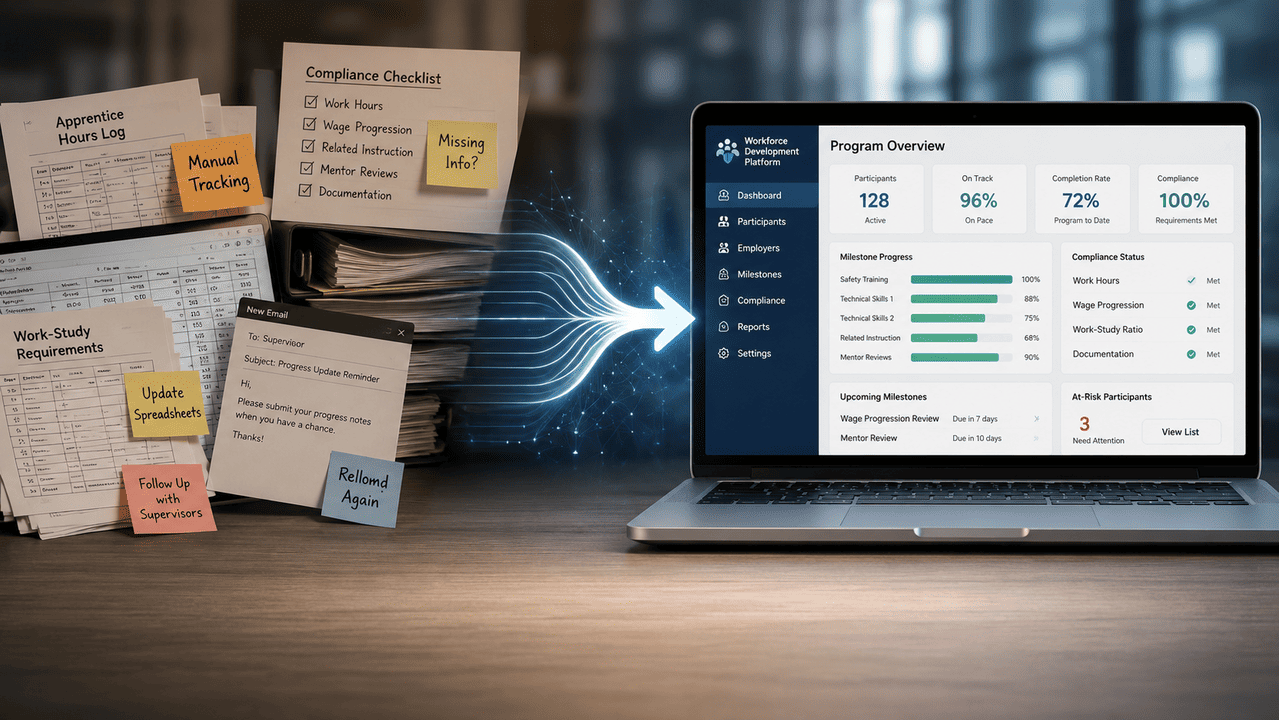
Real-time visibility into apprentices’ progress allows for immediate interventions to improve completion rates and job readiness. Automating routine tasks in apprenticeship programs can lead to significant time savings in administrative processes—purpose-built software addresses these pain points through validation rules, automated imports, and dashboards that surface problems before they escalate.
Key Capabilities to Look for in Apprenticeship Tracking Software
When evaluating platforms, consider these criteria:
| Category | Must-Have Capabilities |
|---|---|
| Data Model | Multiple occupations, pathways, cohorts; hybrid and competency-based standards |
| Compliance | RAPIDS-aligned fields, WIOA reporting, EEO data templates |
| Integrations | APIs for LMS, SIS, HRIS, payroll; SSO via SAML/OAuth |
| User Experience | Mobile-friendly logging, role-based dashboards |
| Program Management | Robust program management features for streamlined administration, tracking, and delivery of apprenticeship and workforce training programs |
| Security | Encryption, role-based access, audit logs, FERPA alignment |
| Scalability | Growth from pilot cohorts to statewide programs |
Some apprenticeship tracking software platforms offer flexible licensing models or require no user-based licenses, making them more accessible and cost-effective for organizations.
Many apprenticeship tracking systems offer robust security features, utilizing state-of-the-art encryption and compliance protocols to protect sensitive learner and program data. Scalability in managing apprenticeship programs is enhanced through specialized software to avoid chaos when handling multiple apprentices.
Effective tracking systems are designed to integrate seamlessly with existing learning management systems (LMS), providing a unified education management ecosystem that simplifies administration and enhances program efficiency.
How Apprenticeship Tracking Software Supports Registered Programs
Registered apprenticeship mechanics include standards, work process schedules, RTI requirements, and wage progressions. Specialized apprenticeship systems maintain an audit-ready trail of documentation, ensuring compliance with federal, state, and local regulations. The platform also facilitates partnerships between training providers, employers, and educational institutions, making it easier to establish and manage collaborative relationships that enhance program effectiveness.
Software stores official standards linked to each apprentice, automatically calculating hours per work process—for example, 500 hours in “Foundations” and 1,500 hours in “Advanced tasks.” Dashboards support regular sponsor reviews with scheduled compliance reports.
Consider a multi-employer construction program preparing for a USDOL review: administrators export OJT logs by work process, RTI attendance records, wage progression documentation, and demographic reports directly from the platform.
Data Insights and Outcomes Reporting
Tracking serves quality improvement, not just compliance. Effective apprenticeship management software integrates various functions, allowing organizations to manage multiple programs and track learner progress from registration to completion.
Key metrics platforms should surface:
- Enrollment, retention, and completion rates by cohort and demographics
- Time-to-completion compared to standards
- Wage progression and post-completion outcomes
- RTI pass rates and remediation needs
- Employer and apprentice satisfaction scores
Automated compliance reporting generates pre-formatted reports for regulatory bodies like the U.S. Department of Labor (USDOL). These insights help refine curricula, justify funding requests, and demonstrate impact to boards and community partners.
Choosing the Right Apprenticeship Tracking Platform
Start by engaging all roles: HR, apprenticeship coordinators, mentors, IT, and finance. Key evaluation questions include:
- Does the software support current occupations and future plans?
- Can non-technical staff configure programs independently?
- How quickly can you move from contract to first cohort enrollment?
Run a pilot with 15–25 apprentices before full rollout. Look beyond license cost to total cost of ownership: administrative time saved, improved audit outcomes, and retained funding.
To learn more about how apprenticeship tracking software can benefit your organization, explore our resources or contact us for additional information.
Why Choose Our Apprenticeship Tracking Software
Our platform was designed from day one around registered apprenticeship workflows—not retrofitted from a generic LMS. Key differentiators:
- Pre-built templates for IT, advanced manufacturing, healthcare, and construction trades
- Rapid implementation: typical programs live within 30–60 days
- Strong state agency reporting aligned with workforce boards and major funders
- Partnership approach: support through program design, data migration, and ongoing best practices
One multi-employer manufacturing program reduced manual reporting time by over 40% within six months of adoption. Custom dashboards provide learners and administrators with a clear view of progress, tasks, and milestones, enhancing engagement and accountability.
Ready to see it in action? Schedule a demo with your team.
Want to Learn More About Your Registered Apprenticeship Opportunities?
BOOK A FREE CONSULTATION
FAQs About Apprenticeship Tracking Software
Not legally mandated, but increasingly essential for programs at scale or receiving federal/state funding tied to state requirements and performance metrics.
Management software uniquely combines OJT hours, RTI progress, competencies, and wage progression tied to occupation standards—functions split across multiple tools otherwise.
Yes. Most vendors support CSV uploads with validation and spot-checking during data migration.
Programs typically see 30–50% reduction in manual reporting time once fully implemented.
Platforms include encryption in transit and at rest, role-based access controls, and FERPA-aligned compliance features.
Yes. Multi-tenant and multi-program capability is standard for group joint and non-joint structures.
Typical phases: discovery, configuration, data migration, training, and launch—usually 30–60 days for standard programs.
Some apprenticeship tracking software platforms do not require per-user licenses or additional licensing fees, making them more accessible and cost-effective for organizations. Always review the licensing model to ensure it fits your program’s needs.
Getting Started: Next Steps for Your Program
Moving from manual tracking to dedicated software delivers compliance confidence, administrative efficiency, and transparency that apprentices love.
Your path forward:
- Map your current process and pain points
- Identify must-have versus nice-to-have features
- Book a 30-minute walkthrough with your core team
The future of high quality apprenticeships depends on systems that scale with demand. Build the foundation now for sustainable work-based learning programs over the next decade.


