Every organization has gaps between the skills its workforce holds today and the skills it will need tomorrow. In a time where AI adoption is only growing, trade shortages are deepening and entire job roles are being rewritten. Understanding exactly where those gaps sit is a must. This guide walks you through a skills gap analysis process, from defining what it is to building an action plan that gets implemented.
Table of Contents
- What Is a Skills Gap Analysis?
- Why Skills Gap Analysis Matters In 2027
- How to Conduct a Skills Gap Analysis (Step-by-Step)
- Hard and Soft Skills
- Free Skills Gap Analysis Template and Tools
- Individual vs. Organizational Analysis
- Apprenticeships and Work-Based Learning
- Common Mistakes to Avoid
- FAQs
- Why Choose Our Platform
- Next Steps and Call to Action
What Is a Skills Gap Analysis?
A skills gap is the distance between current and needed skills within a role, team, or organization. When your employees current skills don’t match the skills required to hit business goals, deliver projects, or meet compliance standards, that gap becomes a risk.
A skills gap analysis is the process used to identify skills gaps, quantify them, and build a plan to close them. The process involves assessing current workforce capabilities and identifying required skills at the level of individual employees, whole teams, and the entire workforce. It covers both hard and soft skills, from technical tools and data literacy to communication, problem solving, and adaptability.
Here’s an example: a mid-sized automotive components manufacturer discovers that frontline maintenance technicians need robotics programming and data analytics skills to operate new automated lines. Those technicians are strong in mechanical maintenance but lack programming knowledge for industrial robots and basic data visualization. That discovery triggers a targeted training plan for Q1 2027, combining technical instruction with hands-on coaching.
A thorough skills gap analysis doesn’t stop at technical skills. It maps core skills like critical thinking, stakeholder management, and coaching alongside specific skills like Python, CAD, or EMR system operation. Later in this article, you will learn how to conduct a skills gap analysis step by step and how to use a practical skills gap analysis template to organize the entire process.
Why Skills Gap Analysis Matters in 2027

The workforce landscape in 2026 and 2027 looks nothing like it did five years ago. AI tooling has rolled out at extraordinary speed since 2023, 87% of companies face or will face a skills gap within the next few years, and demographic shifts in developed countries are shrinking the pool of skilled workers in trades, healthcare, and infrastructure. Skills gap analysis aligns workforce capabilities with business priorities so organizations can respond before gaps become crises.
The numbers tell the story. 80% of manufacturers report moderate to severe shortages of qualified applicants. By 2028, 3 million trade positions may remain vacant due to skills gaps. And 67% of senior technology leaders cite skill gaps as a major issue limiting their ability to deploy AI and automation initiatives. These are not distant projections-they are shaping hiring priorities and training budgets right now.
Identifying critical skills gaps early improves employee performance, reduces the cost of external hiring, and keeps teams aligned with fast-changing business goals. In healthcare, the shift to telehealth and AI diagnostics demands new digital health competencies. In advanced manufacturing, predictive maintenance and IoT require analytical skill sets that most frontline workers don’t yet have. In IT, cybersecurity and cloud engineering roles need both specialized skills and collaborative soft skills for hybrid teams. In education, training providers must align curricula to employer needs and credentialing standards.
A skills gap analysis prepares organizations for future workforce needs. The core benefits include:
- Stronger workforce planning – anticipate gaps before they stall delivery or compliance
- Better training ROI – allocate training resources more efficiently by focusing on prioritized gaps
- More resilient teams – redeploy talent when regulation, markets, or technology shift
- Improved retention – regular skills gap analysis can improve employee retention rates because employees see investment in their growth
Conducting skills gap analysis also boosts organizational competitiveness and increases productivity as skill shortages are addressed directly. It enhances employee development and job satisfaction by creating clear professional development pathways. To stay competitive, review skills at least annually-and again after any major change such as a new system rollout, product launch, merger, or regulatory shift. Regular assessments of skills help organizations adapt to evolving business needs and meet evolving business goals.
How to Conduct a Skills Gap Analysis (Step‑by‑Step)
A systematic approach ensures your gap analysis is tied to strategic goals and produces results you can act on-not just another report that collects dust. Here is how to conduct a skills gap analysis in eight steps.
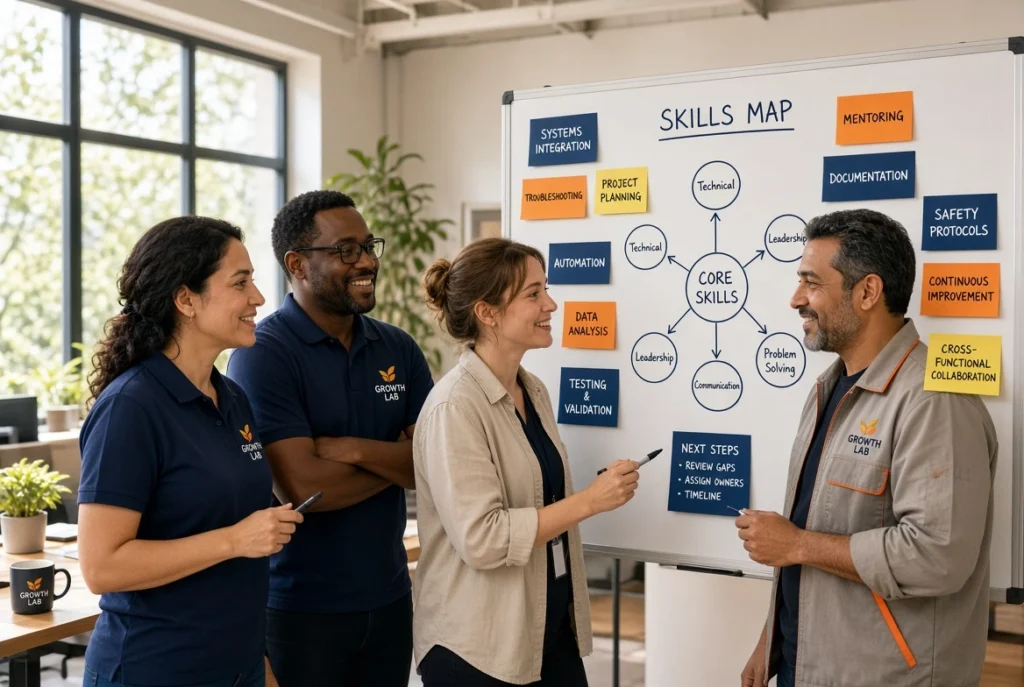
- Define business goals. Start with your 12- to 24-month business objectives before touching skills. Are you launching a new service line in Q2 2027? Meeting new compliance standards? Entering a new market? Identifying competencies required for future goals helps strategic workforce planning and keeps the analysis anchored to outcomes that matter.
- Define the scope. Choose whether to analyze a single team (like a sales team or customer support group), a department, or the full organization. Set a realistic timeline-four to six weeks is typical for a mid-size company. Get buy-in from department heads, the HR team, and operations leads on scope, roles involved, and resources.
- Identify required skills. For each role and business goal, list the hard and soft skills needed. Include new skills created by technology or regulation: AI prompt engineering, data privacy frameworks, OSHA updates, software development standards. Think about what a marketing specialist, financial analyst, or project management lead will need that they did not need two years ago.
- Measure current skills. Capture employees current skills using multiple assessment methods for comprehensive results. Combine self assessments, manager ratings, skill assessments, performance data, interviews, and observation. Use a consistent proficiency level scale (e.g., 1 = novice, 5 = expert) so data is comparable across teams.
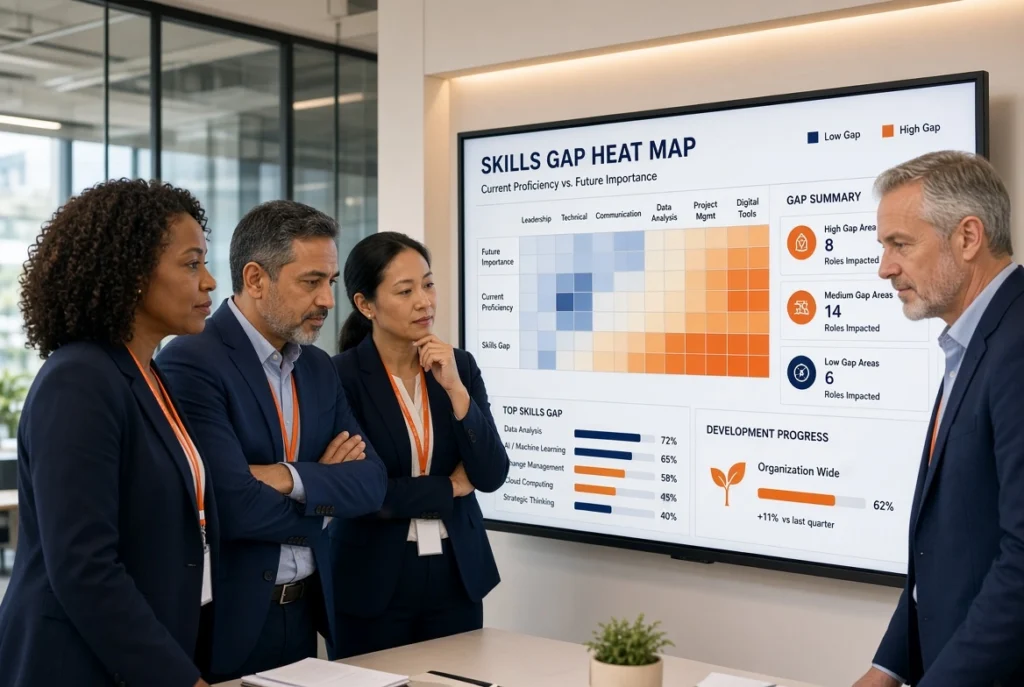
- Identify gaps. Compare current skill levels to required skills for each job role. Calculate a gap score (required minus current) and map results by role and team. A basic spreadsheet or gap analysis template works well for this. Visual heat maps help surface where critical skills gaps cluster.
- Prioritize gaps. Not every gap carries equal weight. Rank by business impact, risk, and urgency. Safety-critical or compliance skills come first, then revenue-impact skills, then long-term strategic goals. This ensures your action plan addresses what matters most to the business strategy.
- Decide how to close the gaps. Use the “Build, Buy, Borrow, Bridge” framework. Build means employee training and targeted training for existing staff. Buy means hiring new employees with the right skills. Borrow means using contractors or partners for a one off project or short-term need. Bridge means redesigning roles and workflows. Targeted Training & Development focuses learning resources on key skill deficits, and assessing gaps allows organizations to develop targeted action plans for employee development.
- Implement and review. End with a concrete training plan, apprenticeship intake, or hiring plan-plus a schedule to reevaluate skills every 6 to 12 months. Conduct skills gap analyses every 3 to 6 months for maximum effectiveness. Regular skills assessments can be conducted every 3 to 6 months to keep data current.
Focusing on Hard and Soft Skills

Balancing hard and soft skills is crucial to accurately identify skills gaps. An analysis that only measures technical skills misses half the picture. Soft skills determine how well employees learn, collaborate, adapt, and lead-all of which directly affect whether technical competency translates into actual results.
Hard skills (technical skills) relevant in 2027 include cloud architecture, CNC machine programming, electronic medical records, data visualization, Python, CAD, AI tooling, and cybersecurity frameworks. Soft skills include cross-functional communication in hybrid teams, adaptability to new systems, critical thinking, coaching, conflict resolution, and stakeholder management.
When you conduct a personal skills gap analysis or a team-level assessment, map both hard and soft skills to each job role, not just technical requirements. Update job descriptions to reflect both categories. Consider this scenario: a high-performing engineer with strong technical skills but a soft skills gap in stakeholder communication. That gap blocks promotion to team lead, stalls projects, and risks burnout-even though the engineer’s skill assessments on coding and architecture score at the top. Rate both skill types on the same proficiency scale in your gap analysis template. Ignoring soft skills leads to turnover, stalled projects, and misaligned expectations across the whole team.
Using a Skills Gap Analysis Template and Tools
A structured skills gap analysis template saves time and improves consistency, especially when running skills gap analyses across multiple teams or departments. Without a template, every manager defines skills differently, making it impossible to roll data up to the organizational level.
A practical gap analysis template should include:
| Column | Description |
|---|---|
| Role / Job Title | The particular role being assessed |
| Business Goals | Strategic goals this role supports |
| Required Skills | Essential skills (hard and soft) with definitions |
| Proficiency Scale | Clear proficiency level definitions (1–5) |
| Current Rating | Employees current skills rating (self + manager) |
| Gap Score | Required minus current |
| Priority | High / Medium / Low based on business impact |
| Action | Train, hire, reassign, or redesign + timeline + owner |
Establishing clear proficiency levels aids in measuring skill performance expectations consistently. Adapt a generic free template to different departments by customizing the skills list and proficiency descriptors-an IT team needs cybersecurity and cloud skills, while a nursing team needs EMR and patient communication competencies.
Start with a simple spreadsheet for smaller organizations, then move to dedicated skills or learning platforms as programs scale. Digital tools can automate data collection, generate dashboards, track OJT and coursework, and report progress over time. Maintain version control and document dates (e.g., “Q1 2027 Skills Gap Analysis – Customer Support Team”) so you can measure improvement across multiple cycles.
Individual vs. Organizational Skills Gap Analysis
Leaders should conduct a skills gap at multiple levels to get a complete picture of current skills and future needs.
At the individual level, managers and employees review current skill areas against role expectations and career goals. For example, an apprentice wanting to move from technician to supervisor completes a personal skills gap analysis to identify which certain skills-like leadership and scheduling-need development. Results at this level should be framed as development opportunities, not performance critiques, so employees grow professionally with confidence.
At the team level, aggregate individual data to see whether a whole team collectively covers all required skills and shifts. A 10-person maintenance crew might have robotics skills concentrated in only two members-a risk if either leaves.
At the organizational level, leadership uses summarized data from all teams for workforce planning decisions: where to expand apprenticeships, where to recruit, and which new skills are emerging company-wide. Skills gap analysis can clarify recruitment needs by showing what competencies are missing. It also informs proactive workforce planning to address future skills needs across the current workforce. The same core gap analysis template rolls up from individuals to departments to the entire workforce, as long as skill sets and proficiency levels stay consistent.
Integrating Apprenticeships and Work-Based Learning to Close Skills Gaps
Many employers in 2026 and 2027 are turning to registered apprenticeships, internships, and work-based learning to fill skills gaps rather than relying solely on external hiring. Traditional recruiting cannot close every gap fast enough-especially in trades, healthcare, and cybersecurity where the pipeline of skilled workers is thin and 80% of manufacturers report severe shortages of skilled applicants.
A skills gap analysis can pinpoint exactly where structured apprenticeship or pre-apprenticeship pathways are most valuable. Roles like machinists, electricians, medical assistants, and cybersecurity analysts frequently surface as areas where building new skills internally makes more strategic sense than competing on the open market. Engagement with apprentices improves through targeted skills assessments that connect daily work to clear competency milestones.
Work-based learning programs develop new skills through a mix of on-the-job training (OJT) and related technical instruction (RTI), and these map directly to the skills list in your gap analysis. For example, an employer identifies a shortage of mid-level maintenance technicians in 2027 and launches a 24-month apprenticeship linked to clear competencies in robotics diagnostics and predictive maintenance, with RTI coursework in data analytics. Tracking competencies, hours, and employee performance during these programs creates a live skills inventory that feeds into the next gap analysis cycle. Expansion of training frameworks can be supported through skills gap assessments. Coordinate with educational institutions, workforce boards, and training providers to align curricula with the critical skills gaps identified in your analysis.
Common Mistakes When Conducting a Skills Gap Analysis
Avoiding common pitfalls makes the difference between an analysis that drives results and one that wastes everyone’s time.
- Focusing only on current skills, not future skills. If you only measure what employees can do today, you miss upcoming technology, regulation, and market shifts. Tip: Include horizon scanning-talk to department heads about upcoming initiatives and identify candidates for roles that don’t exist yet.
- Ignoring soft skills. Only measuring technical competencies misses what actually blocks performance and leadership pipelines. Tip: Define soft skills clearly, include them in every role definition, and rate them with the same scale.
- Conducting the analysis once, then shelving it. A one-time analysis becomes stale fast. Tip: Set a revision schedule-annually at minimum, with interim refreshes after major changes. Regular skills gap analyses should occur every 3 to 6 months for best results.
- Failing to involve frontline staff and managers. If the process feels top-down, data will be inaccurate and buy-in will be low. Tip: Include self assessments, manager interviews, and focus groups at every stage.
- Collecting data without linking it to business goals. Gaps without context are impossible to prioritize. Tip: Tie every prioritized gap to a specific 2027 initiative or strategic goal.
- Overcomplicating the process. Too many skills or rating levels create confusion. Tip: Limit each role to 8–15 clearly defined skills; use a simple 1–5 proficiency scale.
- Treating results as a performance ranking. Employees who feel labeled will disengage. Tip: Frame results as a development roadmap-not a scorecard. Use coaching language and keep individual results confidential.
A “good enough and used” analysis beats a perfect model that never gets implemented.
FAQs About Skills Gap Analysis
Below are answers to the most common questions from HR leaders, operations managers, training providers, and school partners.
How often should we conduct a skills gap analysis?
A full organizational skills gap analysis is recommended every 12 months. Focused updates should happen after major changes like new technology rollouts, regulatory shifts, or large contracts. For maximum effectiveness, conduct skills gap analyses every 3 to 6 months on critical teams. Regular assessments help organizations meet evolving business goals.
What is the best way to identify skills gaps in individual employees?
Clarify role expectations using updated job descriptions. Combine self assessments and manager ratings against required proficiency levels for each skill. Review recent employee performance data and compare results to required skill levels. The analysis process should involve multiple assessment methods for comprehensive results.
How can small organizations conduct a skills gap analysis without a big budget?
Use a basic spreadsheet gap analysis template with role definitions and required skills. Run short surveys and structured manager interviews. Focus first on the most critical roles and existing skills that directly affect delivery. A free template and low-cost assessment tools can get you started.
What is the difference between reskilling and upskilling in this context?
Upskilling deepens skills employees need for their current role-like a data analyst learning advanced machine learning. Reskilling builds entirely new skills to move into a different job role-like a customer service rep becoming a QA specialist. Your gap analysis results tell you which is needed: upskill when role requirements are growing, reskill when roles are shifting.
How do we make sure employees see the analysis as supportive, not punitive?
Frame the process around growth and learning. Share how results inform training opportunities and internal mobility. Involve employees in setting development goals. Avoid language that feels like ranking or labeling. When employees learn that the process opens doors to professional development and career paths, engagement rises.
Can a skills gap analysis help with succession planning?
Yes. Mapping current skills and future skills for critical roles reveals which current employees could be developed as successors. Identifying high-potential employees enables better succession planning. The analysis shows exactly which necessary skills they must acquire in the next 1 to 3 years to remain competitive for leadership positions.
Why Choose Our Platform to Support Skills Gap Analysis
GoSprout is purpose-built for organizations running apprenticeships, internships, and work-based learning programs who need to identify and close skills gaps efficiently. Unlike generic HR tools, the platform is designed around the realities of OJT, RTI, competency tracking, and compliance reporting.
GoSprout centralizes skill competency tracking, OJT and RTI hours, assessments, and progress data in one system-giving leaders a real-time view of current skills across teams without juggling spreadsheets. Automated reporting capabilities (including exports for RAPIDS, WIPS, and PIRL compliance) reduce manual admin so staff can focus on coaching, program design, and closing skill gaps.
Configurable dashboards and gap analysis views help HR teams, training providers, and sponsors quickly see where skills gaps are emerging and which programs are effectively closing them. Mobile access lets individual employees and apprentices document new skills as they are mastered, improving the accuracy of the skills data feeding your next analysis. Employers, schools, and workforce partners collaborate on the same platform, aligning training content and on-the-job experiences with the specific skills your analysis identifies as priorities.
Next Steps: Turn Your Skills Gap Analysis Into Action
A skills gap analysis only creates value when it leads to action. Don’t stop at identifying gaps-convert your findings into a concrete development and hiring plan that moves the needle on your strategic goals.
Summarize your core steps: define business objectives, map required skills and skill areas, measure current skills, identify and prioritize gaps, then assign actions-whether that is targeted training, apprenticeships, hiring new employees, or role redesign-to close each gap. Start small if needed. One department or one apprenticeship cohort in early 2027 is enough to prove the process before scaling.
Select or adapt a free template today. Schedule stakeholder conversations this week. Set a target date to complete your first or next skills gap analysis cycle. Then explore how a work-based learning and skills management platform like GoSprout can support your gap analysis, training, and reporting from one place-so you can stay competitive and help your entire workforce grow professionally.