Table of Contents
- What Is Work-Based Learning? (Core Definition Answered Early)
- Key Elements of High-Quality Work-Based Learning
- Work-Based Learning Continuum: From Career Awareness to Career Preparation
- Types of Work-Based Learning Experiences
- Work-Based Learning vs. A Regular Job: What’s the Difference?
- Benefits of Work-Based Learning for Students
- Benefits of Work-Based Learning for Employers and Communities
- Quality Standards: Alignment, Application, and Support
- Policy and Funding Context for Work-Based Learning
- Roles and Responsibilities in Work-Based Learning Partnerships
- Designing and Implementing Work-Based Learning Programs
- Tracking, Evaluation, and Continuous Improvement
- Work-Based Learning for High School Students
- Connecting Work-Based Learning to Postsecondary Education and Career Success
- Common Challenges and Mistakes to Avoid in Work-Based Learning
- Frequently Asked Questions About Work-Based Learning
- Why Choose a Structured Work-Based Learning Management Approach
- Next Steps and More Resources on Work-Based Learning
What Is Work-Based Learning? (Core Definition Answered Early)
Work-based learning is a form of experiential education that connects classroom instruction with structured, supervised experiences in real workplaces. Unlike a typical part-time job, WBL is intentionally designed so that students learn by performing authentic job tasks under the guidance of both educators and industry professionals. It bridges education and employment by making the connection between what happens in a classroom and what happens on a job site deliberate, documented, and assessed.
At its core, work based learning must integrate classroom learning with real-world experiences. This means every placement includes defined learning objectives, ongoing mentoring, structured reflection, and formal assessment. It is not improvised or accidental. WBL is often embedded within career and technical education pathways, but it also applies to adult learners, career changers, and anyone preparing for postsecondary education or direct entry into the labor market.
Typical participants include high school students exploring different careers, community college students completing cooperative education requirements, and young adults entering pre-apprenticeship or registered apprenticeship programs. WBL sits on a continuum that stretches from short-term career exploration activities like informational interviews to intensive career preparation experiences like registered apprenticeships. States and countries may refine the exact work based learning definition in policy, but the core idea remains consistent: learning that happens through real work, guided by educators and employers working together.
Key Elements of High-Quality Work-Based Learning
Definitions only matter when backed by the elements that make WBL effective. Without these building blocks, a program risks becoming busy work rather than meaningful skill development. Here are the elements that distinguish high-quality work based learning programs from generic placements.
- Alignment to academic standards and industry needs. Tasks should reflect what professionals in the career field actually do, and they should connect to the student’s classroom curriculum and career goals.
- Clear learning objectives and planning. Every experience should have documented goals, defined duration, and competencies to be assessed before day one.
- Real workplace tasks. WBL provides students with practical skills and industry-specific knowledge by immersing them in authentic work, not filing papers in the back room. When real worksite access is not feasible, simulated environments should mirror actual job demands.
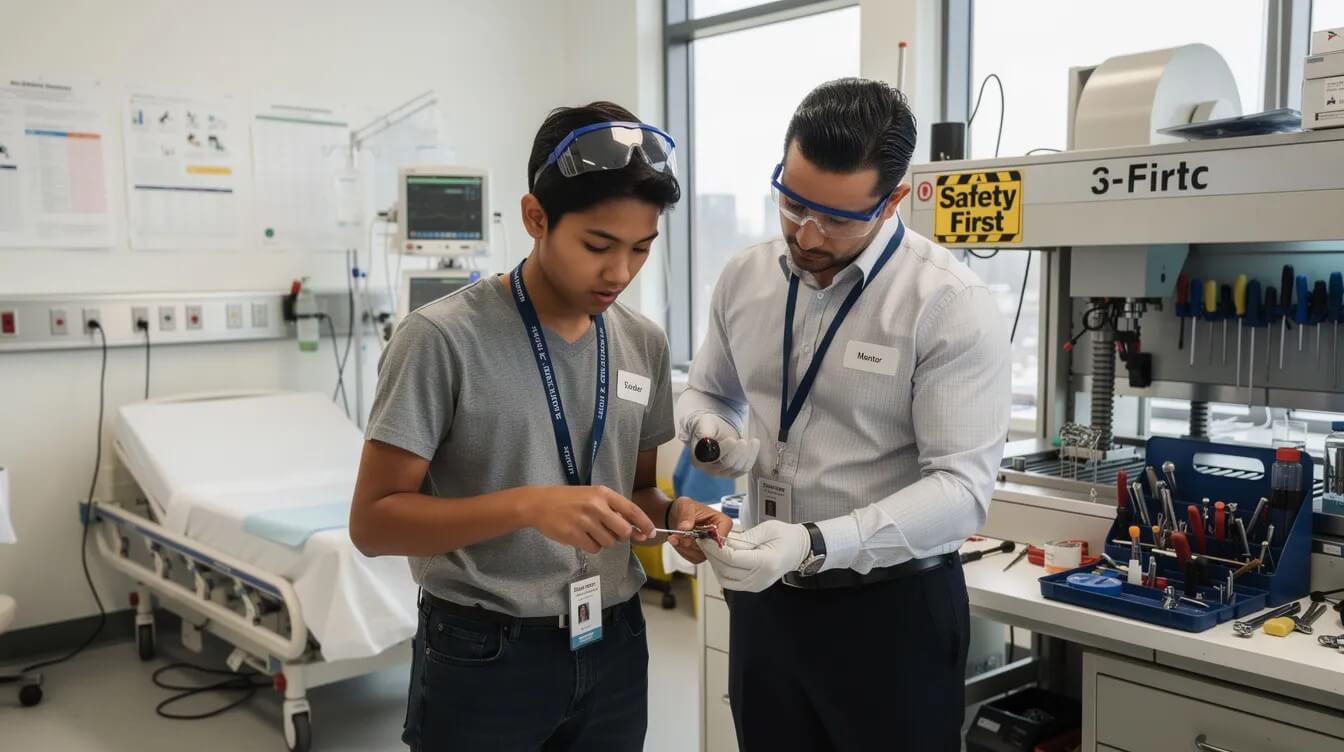
- Supervision and mentoring. Mentorship involves industry professionals providing guidance and support to learners, working alongside educators who monitor academic alignment and progress.
- Reflection and assessment. Regular reflection assignments help learners connect practical tasks to professional goals. Assessment in work-based learning often results in evaluations by employers and academic credits, creating a feedback loop that reinforces the learning process.
- Safety, compliance, and support. This includes orientation on workplace safety, adherence to youth labor laws, non-discrimination policies, and accommodations for students who need them.
- Equity and access. Ensuring all students, including low-income, rural, and special education learners, can participate, often through paid opportunities and removal of barriers like transportation.
WBL activities are structured opportunities for student-employer interaction, not casual drop-ins. Strong programs are co-designed by educators and employers. These elements apply whether the experience is in-person, hybrid, or virtual.
Work-Based Learning Continuum: From Career Awareness to Career Preparation
Work-based learning is not a single event. It is a progression. Most state frameworks organize WBL into three broad stages that students move through as their confidence and competence grow.
- Career awareness is the starting point. Activities like career fairs, guest speakers, interest inventories, and career clusters exploration introduce students to the world of work. The goal is simply to help students learn about industries, roles, and career paths that exist.
- Career exploration moves students from passive awareness to active investigation. Job shadowing, worksite tours, informational interviews, and short-term projects allow students to observe work and test their interests. Students begin to narrow their focus and develop relationships with community professionals.
- Career preparation is where sustained, hands-on experiences take center stage. Internships, pre-apprenticeships, clinical rotations, and youth apprenticeships give students real responsibilities and measurable productivity expectations. Career preparation activities build workplace skills, professional networks, and technical competence.
Key components of work-based learning include career exploration, training, and alignment with curriculum, and the continuum ensures these components build on each other over time. Career and technical education programs intentionally map WBL experiences across this continuum so that a ninth grader attending a career fair is on the same pathway as a twelfth grader completing a youth apprenticeship. Not every learner needs every activity, but a balanced mix is ideal for most high school students. Several state departments of education, including Colorado, Virginia, and Iowa, use similar three-level models to structure WBL policies and funding.
Types of Work-Based Learning Experiences
WBL is not a single model. It includes many structured experiences with varying intensity, duration, and goals. Here are the major types, organized from lighter exposure to deeper immersion.
- Career fairs and industry panels provide career awareness through brief interactions with specific employers and industry partners across multiple fields.
- Guest speakers bring community professionals into the classroom to share insights about their career field and daily responsibilities.
- Informational interviews let students ask targeted questions of professionals, helping them explore different careers without a formal placement.
- Job shadowing places students alongside a worker for a few hours or a full day to observe work in a professional setting.
- School based enterprises are student-run businesses within the school that simulate real commercial operations, from marketing to inventory management.
- Service learning with a work focus connects community service projects to academic content, building both civic engagement and career related skills.
- Project-based learning with employers challenges students to solve authentic problems for local employers, producing real deliverables.
- Internships, whether during the school year or summer, place students in sustained roles where they apply knowledge and develop technical skills. These are typically at the career preparation stage.
- Youth apprenticeships and pre-apprenticeships are formalized programs that combine on the job training with related technical instruction, bridging into registered apprenticeship pathways.
- Registered apprenticeships are employer-led, high-intensity programs with incremental wages, structured mentoring, and industry-recognized credentials.
Common examples of work-based learning include paid internships and job shadowing, which represent two different points on this continuum. Virginia has seven types of work-based learning strategies that span from awareness through training, providing a useful reference for states building their own frameworks. Virtual and hybrid formats, such as remote job shadowing and online mentoring, expanded significantly after 2020 and remain common in 2026. On the equity front, unpaid experiences can exclude students from lower-income backgrounds, making paid options and transportation supports essential for equitable access.
Work-Based Learning vs. A Regular Job: What’s the Difference?
Not all student work counts as work-based learning under state and federal definitions. The distinction matters more than many realize. Work-based learning differs from traditional education by emphasizing hands-on work, but it also differs from a typical job by emphasizing intentional learning.
Here is how the two compare:
- A WBL placement has documented learning objectives aligned to a classroom curriculum. A regular job typically has none.
- WBL includes structured mentoring from workplace mentors and oversight from educators. A regular job offers basic supervision focused on task completion.
- WBL requires reflection and formal assessment of both technical and employability skills. A regular job tracks hours and output, not learning growth.
- WBL connects to a student’s program of study and may yield academic credit. A regular job is usually unrelated to coursework.
Consider a high school student working as a cashier at a grocery store. They earn wages and learn some responsibility, but unless those tasks tie to a business or marketing pathway, include mentoring, and connect to classroom learning, it does not qualify as WBL under most career and technical education definitions. This distinction directly affects funding eligibility, liability coverage, graduation credit, and compliance reporting.
Benefits of Work-Based Learning for Students
WBL enhances students’ career readiness and employability skills in ways that classroom instruction alone cannot replicate. When students step into a real workplace, abstract concepts become tangible, and motivation increases because they can see the relevance of what they are studying.
Here are the most significant benefits:
- Career exploration with less risk. Structured WBL activities improve students’ awareness of career options, letting them test interests before committing to expensive degree programs or training programs.
- Stronger employability skills. Communication, reliability, teamwork, and problem solving are practiced daily in WBL settings. Students develop critical thinking and decision-making skills through WBL that are difficult to simulate in a classroom.
- Industry-specific technical skills. Providing students with hands on experiences in their chosen career field builds competencies that employers value immediately.
- Professional networks. WBL helps students build professional networks and industry connections that can open doors to future careers and references.
- Clearer postsecondary choices. Students who participate in WBL make more informed decisions about college majors, certifications, and direct-to-work pathways, reducing costly major-switching later.
- Sense of purpose. WBL fosters a sense of belonging and strengthens occupational identity, which research links to higher persistence in both education and early careers.
A 2026 longitudinal study of bachelor’s degree graduates found that paid internships are associated with earnings roughly $5,500 higher one year after graduation and around $9,100 higher four years later compared to graduates without such experience. This is not a marginal difference. It represents a meaningful head start on career success and financial stability for young adults entering the job market.
Benefits of Work-Based Learning for Employers and Communities
Employers are co-educators in work-based learning, and they gain tangible returns from participating.
- Early access to emerging talent. WBL lets employers evaluate potential hires over weeks or months rather than a single interview. This reduces recruiting costs and improves retention when students involved transition into full-time roles.
- Customized training pipelines. Industry partners who host apprentices and interns can shape skill development to match their specific needs, closing gaps that generic degree programs cannot address.
- Fresher perspectives. Students bring current academic knowledge and digital fluency, often contributing ideas that improve processes.
- Community reputation. Employers who invest in WBL earn visibility with local school systems, families, and workforce development boards, strengthening their brand in the community.
On a regional level, WBL helps local and state economies build resilient talent pipelines aligned with priority industries such as healthcare, advanced manufacturing, IT, and construction. In FY 2024, approximately 940,000 participants were enrolled in Registered Apprenticeship Programs across the United States. Apprentice completers earned about $80,000 in their first year post-completion, illustrating the return on investment for both individuals and employers. Workforce innovation depends on connecting education pipelines to labor market needs, and WBL is a key strategy for making that connection.
Employers new to this space should start small with career talks or job shadowing days and grow into internships or youth apprenticeships as capacity increases.
Quality Standards: Alignment, Application, and Support
The U.S. Department of Education and multiple states describe three recurring qualities of effective WBL: alignment, application, and support. These qualities serve as a practical checklist for anyone designing or reviewing work based learning programs.
Alignment means matching WBL tasks with industry standards, academic content, and student career goals. WBL programs require alignment of classroom and workplace learning so that the experience reinforces what is taught in school, rather than operating in isolation. A WBL program should integrate classroom learning with workplace experiences through deliberate planning. WBL programs also require input from local employers for quality assurance to ensure tasks are relevant and current.
Application means giving students meaningful opportunities to apply academic, technical, and employability skills to authentic work problems. Application of skills in a work setting is essential for WBL. Students should not just observe. They should perform tasks with real consequences and responsibilities, building competence through doing.
Support means ensuring structured mentoring, feedback, and coordination among teachers, WBL coordinators, and workplace supervisors. Support from mentors is a key component of WBL programs. This includes regular check-ins, formative evaluations, and help navigating challenges like scheduling or workplace culture adjustments.
Schools and employers should use these three qualities as a checklist when designing or reviewing programs each year, ensuring that no element is neglected as the program scales.
Policy and Funding Context for Work-Based Learning
WBL is embedded in U.S. federal education and workforce laws, which shape how states define, fund, and track it.
The Carl D. Perkins Career and Technical Education Act (Perkins V), reauthorized in 2018, provides the central federal definition and funding stream for career and technical education, including work-based learning. It defines WBL as sustained interactions with industry or community professionals in real workplace settings that are aligned to curriculum and instruction. WBL is supported by federal funding through Perkins and WIOA (the Workforce Innovation and Opportunity Act), which together cover CTE pathways, secondary and postsecondary education, and youth workforce programs. ESSA (the Every Student Succeeds Act) also supports career awareness through school planning and accountability.
Many states have adopted detailed WBL frameworks aligned to these laws. Tennessee provides resources for educators on work-based learning, including implementation guides that define credit-bearing experiences. Virginia has seven types of work-based learning strategies codified in state policy. Other states, including Iowa, New York, and Colorado, have built similar frameworks between 2016 and 2025.
Agencies treat WBL participation as an indicator of program quality, which is why accurate tracking, reporting, and compliance matter. Schools and workforce agencies should check their own state department of education or workforce agency for current definitions, program lists, and reporting rules in 2026.
Roles and Responsibilities in Work-Based Learning Partnerships
High-quality WBL relies on clear roles for every participant. Ambiguity leads to missed learning opportunities and compliance risks.
Schools are responsible for identifying appropriate students, aligning experiences with programs of study, preparing students on safety and professionalism, and monitoring progress throughout the placement. Professional development for educators is required in WBL programs so that teachers and coordinators understand evolving compliance requirements and can effectively bridge classroom and workplace learning. States must offer professional development for work-based learning participants, including coordinators, teachers, and employer mentors.
Employers are responsible for providing safe, structured experiences, assigning workplace mentors, giving regular feedback, and participating in evaluation or advisory meetings. The best employer partners treat WBL as a professional development opportunity for their own staff, not just as a community service obligation.
Students carry responsibilities too: active engagement, honest reflection, documenting hours and competencies, and communicating challenges early rather than letting issues fester.
Dedicated WBL coordinators or CTE directors often serve as the bridge, managing training agreements, handling risk management, and keeping communication flowing between all parties. Without this coordination role, even well-intentioned programs tend to fragment.
Designing and Implementing Work-Based Learning Programs
Intentional program design separates effective WBL from ad hoc placements. Here is a logical design process that educational institutions and their partners can follow.
- Conduct a needs assessment. Analyze the local labor market to identify priority industries and in-demand career clusters. Survey students to gauge interest and readiness.
- Recruit partners. Build relationships with local employers, non profit organizations, and industry associations willing to host learners or contribute to classroom curriculum through guest presentations and projects.
- Select WBL types along the continuum. Match activities to student readiness, available resources, and program goals. Not every school district needs to launch an apprenticeship program immediately. Start with job shadowing and grow.
- Develop learning plans. Document objectives, tasks, competencies, timelines, and assessment methods for each placement. Regular reflection assignments help learners connect practical tasks to professional goals and should be built into every plan.
- Align with courses. A WBL program should integrate classroom learning with workplace experiences so that what students learn on the job reinforces and extends what they study in school.
- Address logistics. Scheduling, transportation, and equity considerations are critical, especially for high school students balancing academics, extracurriculars, and family responsibilities.
A strong approach creates multi-year pathways: job shadowing in grade nine, a school based enterprise project in grade ten, an internship in grade eleven, and a youth apprenticeship in grade twelve.

Tracking, Evaluation, and Continuous Improvement
Systematic evaluation of WBL has historically been limited, but expectations have increased significantly between 2020 and 2026 due to tighter accountability standards and the availability of better analytics tools.
Programs should track:
- Hours completed by type of experience
- Skills practiced and competencies achieved
- Credentials earned
- Student demographics (to identify equity gaps)
- Post-program outcomes such as employment or postsecondary enrollment
This data helps school systems identify which groups access paid internships and which are underrepresented, enabling targeted outreach and resource allocation. Without tracking, equity gaps remain invisible.
Many districts and intermediaries now use dedicated work-based learning management platforms instead of spreadsheets to manage on the job training and related technical instruction logs, evaluations, and compliance reporting. These platforms reduce administrative burden and give WBL coordinators real-time visibility into program health.
Annual review cycles that include educators, employers, and other students who participated provide the qualitative context that data alone cannot capture. Use these reviews to refine placements, adjust supports, and strengthen curriculum integration for the following year.
Work-Based Learning for High School Students
High school is a pivotal time to define work-based learning clearly and expand access. It is when most students first encounter the question of what they want to do after graduation, and WBL experiences directly inform that answer.
Common high school WBL options include career fairs, guest speakers, short-term job shadowing, project-based learning with local employers, internships during the school year or summer, and early college or youth apprenticeship programs. These work based learning experiences enable students to test interests, confirm career and technical education pathway choices, and plan for postsecondary education with real information rather than guesswork.
Scheduling models vary. Some school systems use block schedules or release time to allow students to leave campus for WBL. Others use summer intensives or after-school placements. The critical balance is protecting rigorous academic progress while creating space for WBL participation. Schools that treat WBL as an add-on rather than an integrated part of the schedule tend to see lower participation and higher dropout from placements.
Preparing students in advance matters. Orientation on workplace expectations, basic safety protocols, and professional communication reduces friction and sets students up for a productive experience. Job seekers in the future workforce benefit from learning these norms early.
Connecting Work-Based Learning to Postsecondary Education and Career Success
WBL helps learners make more informed decisions about college majors, technical education programs, industry certifications, and direct-to-work options. When students have firsthand experience in a career field, they choose postsecondary paths with greater clarity and conviction.
Internships, cooperative education placements, and apprenticeships can articulate to college credit, advanced standing, or recognized credentials. Many degree programs now accept documented WBL hours as part of their requirements, and academic credit for WBL is increasingly common. Well-designed work based learning experiences can reduce unnecessary debt and time-to-completion by clarifying goals early, cutting down on major switching and course misalignment.
Consider a pathway where a student’s high school internship in IT leads to a pre-apprenticeship, then a registered apprenticeship, and eventually an associate degree completed while working. Data from the American Apprenticeship Initiative shows that apprentices increased quarterly earnings by approximately 43 percent from one year before enrollment to 2.5 years in, compared to roughly 16 percent growth for comparable workers. That trajectory illustrates how WBL supports long-term career success: higher retention, progression into supervisory roles, and continuous professional growth habits established early.
Common Challenges and Mistakes to Avoid in Work-Based Learning
Even strong programs face predictable pitfalls. Recognizing them early saves time, protects students, and preserves employer trust.
- Treating WBL like free labor. If students are doing repetitive tasks without learning objectives or mentoring, it is exploitation, not education. Every placement needs a documented learning plan.
- Lack of clear learning plans. Without written goals and competencies, there is no way to assess whether the experience delivered value.
- Inconsistent communication with employers. When schools fail to check in regularly, problems escalate. WBL coordinators should schedule mid-point reviews and maintain open lines.
- Poor student preparation. Students who arrive without understanding professional norms or safety protocols create risk for themselves and their host employers. Orientation is not optional.
- Inadequate support for workplace mentors. Employer supervisors need guidance on how to mentor rather than just manage. Brief training sessions and clear expectations go a long way.
- Weak data tracking. Without tracking participation, demographics, and outcomes, programs cannot identify who benefits and who is left out.
- Equity gaps in access. Unpaid experiences disproportionately exclude low-income students. Inaccessible locations or limited outreach to underrepresented groups in high-skill industries compound the problem.
- Missing feedback loops. Students should be able to safely raise concerns about fit, culture, or safety without fear of academic consequences.
For each of these issues, the corrective strategy is straightforward: formalize what is informal, document what is assumed, and communicate proactively.
Frequently Asked Questions About Work-Based Learning
These FAQs address common questions from educators, employers, students, and families navigating the work based learning landscape in 2026.
What is the official definition of work-based learning?
While definitions vary by state and agency, most describe WBL as structured learning experiences that occur in real or simulated workplaces, are coordinated with school or training programs, and help participants develop academic, technical, and employability skills. Under the Perkins V federal definition, WBL requires sustained interactions with industry or community professionals in real workplace settings, aligned to curriculum and instruction. Many career and technical education frameworks specify that WBL must include supervision, reflection, and documented outcomes to count for credit or reporting.
Do work-based learning experiences have to be paid?
Some WBL models are typically paid. Registered apprenticeships, many internships, and cooperative education placements generally include compensation. Shorter activities like job shadowing, informational interviews, and some service learning projects are often unpaid. Labor laws, state guidelines, and program policies determine when payment is required. Many systems are pushing to expand paid options to improve equity, recognizing that unpaid placements exclude students who cannot afford to work without wages.
Can high school students earn credit for work-based learning?
In many states, high school students can earn elective or CTE pathway credit for approved WBL experiences that meet defined criteria and documentation requirements. Credit structures vary, so families and students should check local graduation policies, CTE program of study handbooks, and school district guidelines for details on grading and transcript notation.
How is student safety handled in work-based learning?
Common safeguards include written training agreements, background checks where required, orientation on workplace safety rules, adherence to youth labor laws, and designated on-site supervisors. Programs involving hazardous occupations follow additional restrictions and often pair WBL with classroom safety instruction and certifications such as OSHA-10. Safety is a shared responsibility among the school, employer, and student.
What if a placement is not a good fit for the student or employer?
Well-run programs build in regular check-ins, problem-solving steps, and a process to adjust tasks or reassign the student without academic penalty. Open communication among the student, school coordinator, and employer is essential for addressing issues early. A poor-fit placement that goes unaddressed can sour both the student’s and employer’s willingness to participate in future WBL.
How much time should a high school student spend in work-based learning?
This depends on the type of experience. Short activities like job shadowing may last a few hours. Internships and youth apprenticeships can extend from a semester to multiple years. Schools should consider the student’s academic load, transportation logistics, and local labor agreements when determining appropriate weekly hours during the academic year and summer. Some states define minimum hours for on-site experience, with thresholds varying from 40 hours for lighter experiences to several hundred for apprenticeships.
Why Choose a Structured Work-Based Learning Management Approach
As WBL programs grow beyond a handful of placements, managing them with emails and spreadsheets becomes risky for compliance, data integrity, and student experience. A single missed form or lost evaluation can create audit problems and undermine the credibility of an entire program.
Centralized management approaches help schools, employers, and intermediaries coordinate placements, track on the job training and related technical instruction hours, and automate reporting to systems like RAPIDS, WIPS, and PIRL where applicable. GoSprout was built specifically for this purpose, offering real-time dashboards, automated compliance reporting, mobile apps for apprentices and interns, digital evaluations, competency tracking, and role-based portals for educators, employers, and sponsors.
The benefits are concrete: better visibility into who is placed where, quicker identification of gaps by pathway or demographic group, easier documentation for audits, and more time for staff to focus on quality mentoring instead of manual data entry. When programs can demonstrate results with clean data, they are better positioned to secure funding and expand access.
This ties directly back to the work based learning definition itself. When the learning is intentional and documented, it is easier to prove impact and scale opportunities equitably across every school district and employer partnership.
Next Steps and More Resources on Work-Based Learning
Understanding the work based learning definition is the starting point. What matters next is action.
For educators: conduct a local WBL inventory. Map what experiences your students currently access, identify gaps by career cluster, and set targets for the coming year. Seek out more resources from your state Department of Education and national organizations that publish WBL frameworks and implementation guides.
For employers: you do not need to launch a full apprenticeship program tomorrow. Start with a career talk, a job shadowing day, or a project-based partnership with a nearby school. Develop relationships with CTE coordinators and workforce development councils in your area. The return on investment grows as your involvement deepens.
For students and families: ask your school counselor about CTE and WBL options available in your school district. Look for opportunities that match your interests and career paths, and treat every experience, from a career fair to an internship, as a chance to build professional growth habits that will serve you for decades.
Ongoing professional development for WBL coordinators and teachers is essential. Definitions, compliance rules, and best practices continue to evolve, and staying current ensures your programs remain effective and compliant through 2026 and beyond.
If you are ready to move from spreadsheets to a system designed for work-based learning, explore GoSprout to see how a purpose-built platform can help you launch, track, and scale high-quality WBL experiences for every learner and employer in your network.


