
Table of Contents
- When Spreadsheets Become a Liability: The Real Cost of Manual Intern Reporting
- What Internship Reporting Software Actually Is — and What It Is Not
- The Compliance Case: Why Audit Readiness Must Be a Primary Selection Criterion
- Evaluating Your Options: How to Choose Internship Reporting Software That Fits Your Program
- How Purpose-Built Software Improves the Internship Program Itself
- What to Expect When Implementing an Internship Reporting Platform
- How GoSprout Centralizes Internship Reporting for Modern Employers
- Conclusion: From Spreadsheet Chaos to Compliant, Scalable Intern Programs
- Frequently Asked Questions
When Spreadsheets Become a Liability: The Real Cost of Manual Intern Reporting
The Operational Picture Most Hiring Managers Recognize Immediately
Most hiring managers running intern programs reach the same breaking point, just at different speeds. The program grows by a few interns, a second supervisor joins, the internship spans two departments, and suddenly the tracking system that “worked fine” is producing daily confusion.
Timesheets in One Place, Evaluations in Another, Documentation Nowhere
The fragmentation follows a predictable pattern. Timesheets live in a shared spreadsheet or emailed PDF. Evaluations are stored in a supervisor’s inbox, a separate form, or sometimes a legal pad. Offer letters and learning agreements exist in a folder no one has organized since the program launched. Each piece of information lives in a different location, managed by a different person, with no connecting logic between them.
The operational cost is immediate and concrete. HR spends time hunting for documents instead of managing the program. Supervisors duplicate effort because they have no visibility into what was already submitted. Status checks require manual outreach rather than a dashboard query.

How Disconnected Tools Create Duplicated Effort and Dropped Threads
Disconnected tools do not just slow down work. They create conditions where work disappears entirely. A mid-term evaluation reminder goes out by email, gets buried, and never gets completed. An intern’s hours are logged but never formally approved because the approval process exists only in someone’s memory. These are not isolated failures. They are structural outcomes of systems that were never designed to manage a multi-person, multi-document workflow.
The result is a program that functions well when conditions are ideal and fails unpredictably when any variable changes. A supervisor goes on leave, a department adds interns mid-cycle, or someone asks a simple question: how many interns completed all required evaluations last quarter?
Why Disorganization Is a Compliance Problem, Not Just an Efficiency Problem
Inefficiency is recoverable. Compliance failures carry material consequences, including back pay obligations, audit findings, program suspensions, and in regulated apprenticeship contexts, loss of certification. The disorganization described above is not just an administrative inconvenience. It is an accumulating liability.
The Specific Compliance Exposures That Accumulate in Manual Systems
The compliance exposures in manual systems are not hypothetical. Under the Fair Labor Standards Act, employers must maintain accurate records of hours worked for non-exempt interns, including start and end times, and retain those records for a minimum of two years. For registered apprenticeship programs, the Department of Labor requires structured documentation of progress, wage progressions, and on-the-job training hours. None of these requirements are satisfied by a shared spreadsheet that a supervisor edits inconsistently.
Manual systems also create version control problems. When an evaluation template is updated, there is no mechanism to ensure every supervisor is using the current version. When a compliance requirement changes, there is no audit trail confirming the program responded. Each of these gaps is discoverable in a review.
Missed Evaluation Deadlines, Undocumented Hours, and What They Signal to Auditors
A missed evaluation deadline in isolation looks like an administrative oversight. A pattern of missed deadlines, incomplete records, and undocumented hours looks like program negligence. Auditors reviewing a manual system cannot distinguish between what was done and not recorded versus what was never done. That ambiguity consistently resolves against the employer.
Purpose-built internship reporting software solves this by making documentation a byproduct of the workflow itself, not a separate task someone has to remember.
The Talent Pipeline Risk That Gets Overlooked
How Poor Tracking Undermines Program Quality and Repeat Hiring Decisions
Compliance and efficiency are the most visible costs of manual tracking. The talent pipeline cost is subtler but compounds over time. Intern-to-hire conversion decisions require data, including performance trajectory, skill development, and supervisor assessments. When that data is scattered across emails and disconnected files, conversion decisions default to gut feeling rather than evidence.
Programs that cannot demonstrate structure also struggle to recruit. Early-career candidates increasingly evaluate employers on program quality before accepting offers. A disorganized onboarding experience, inconsistent feedback, and absent goal-setting are signals that a program exists on paper rather than in practice. That signal reaches candidates, university partners, and recruiting networks. The businesses that run structured, well-documented programs attract stronger candidates and convert them at higher rates. That outcome begins with the infrastructure behind the program.
What Internship Reporting Software Actually Is — and What It Is Not
Defining Purpose-Built Internship Reporting Software
Internship reporting software is a dedicated management platform designed to handle the complete administrative and compliance lifecycle of a structured intern or apprenticeship program, from onboarding documentation through hour tracking, evaluation, and completion reporting. The operative word is “dedicated.” Most tools that touch intern management were built for other purposes and adapted imperfectly.
How It Differs From Generic HR Software, Project Management Tools, and Spreadsheets
General HR platforms are built to manage full-time employee records, payroll workflows, and benefits administration. They handle intern data as a subset of employee data, which means intern-specific requirements, such as learning objectives, supervisor feedback cycles, and progress-against-goals reporting, either do not exist or require extensive custom configuration. Project management tools track task completion but have no concept of an evaluation cycle, a wage progression, or a compliance audit trail. Spreadsheets require manual input, have no approval workflows, and produce no structured reporting without significant ongoing effort.
Purpose-built internship management software is designed around the intern program lifecycle as the primary use case, not an afterthought.
The Distinction Between Student-Focused Platforms, University Portals, and Employer-Focused Systems
University career portals and student-focused platforms are designed to serve the institution: matching students to opportunities, tracking placement outcomes, and managing institutional reporting requirements. They optimize for the university’s needs, not the employer’s. Employer-focused internship management systems are designed to serve the business running the program, managing compliance documentation, supervisor workflows, and program performance data from the employer’s operational perspective. These are distinct categories solving distinct problems. An employer using a university portal as their primary tracking system is using a tool built for a different stakeholder.
What Features Should an Internship Management System Have
The core feature set of a capable internship management system maps directly to the failure points of manual tracking.
Centralized Data Repository for Intern Records and Documentation
Every document associated with an intern, including offer letters, learning agreements, onboarding checklists, evaluation forms, and hour logs, should exist in a single, searchable location. This is not just a convenience feature. It is the foundation of audit readiness. When a compliance question arises, the answer should come from a search query, not a week of file recovery.
Automated Timesheet Tracking and Approval Workflows
Automated intern timesheet tracking replaces the cycle of manual entry, email submission, and manual approval with a structured workflow. The intern logs hours, the supervisor receives an automated notification, the approval is recorded with a timestamp, and the data is stored. No manual follow-up, no ambiguity about whether hours were reviewed.
Structured Evaluation and Supervisor Feedback Tools
Intern evaluation tools should enforce structure, not just provide a blank form. Structured evaluations tied to defined competencies or learning objectives produce data that can be compared across interns, across cohorts, and across program cycles. They also protect supervisors by documenting that feedback was given, when it was given, and what was covered.
Compliance Audit Trails and Reporting Dashboards

An audit trail in a purpose-built system automatically records every action, including document submission, approval, evaluation completion, and hour log entry. The system produces this record as a function of normal use. Reporting dashboards translate that record into program-level visibility: completion rates, outstanding items, and compliance status by intern or cohort.
Role-Based Access and User Permissions
Not every user needs access to every record. Role-based permissions ensure supervisors see their assigned interns, HR sees the full program, and interns see their own records and progress. This structure prevents both data privacy problems and the administrative confusion that comes from unrestricted shared access.
Secondary Capabilities That Separate Strong Platforms From Basic Tools
The core features above represent baseline competency. The platforms that deliver sustained operational value extend beyond them.
Customizable Program Templates and Structured Goal-Setting
Programs vary in structure, duration, and learning objectives. A platform that supports customizable templates allows HR to define the program structure once, including milestones, evaluation timing, and required documentation, and apply it consistently across every intern and every cohort. Structured goal-setting tied to those templates gives interns clear expectations from day one and gives supervisors a defined framework for evaluations.
Integration With Existing HR or Payroll Systems
Hour data collected in an internship management platform should not require manual re-entry into payroll. Integration with existing HR or payroll systems eliminates that duplication and ensures that the system of record for intern hours is also the source of truth for compensation calculations.
Onboarding Management and Automated Workflow Triggers
Strong platforms automate the administrative sequence that follows an intern’s acceptance, generating onboarding checklists, triggering document requests, and scheduling orientation tasks, without requiring HR to initiate each step manually. This reduces the setup burden for each new cohort and ensures no onboarding step is skipped because someone forgot to send an email.
Internship Reporting Software Evaluation Rubric
The table below scores three common approaches to intern program management against the criteria that matter most for program operations and compliance readiness. Scores reflect typical capability, not theoretical maximum.
| Evaluation Criterion | Spreadsheet-Based | Generic HR Software | Purpose-Built IMS |
|---|---|---|---|
| Compliance Documentation | Low | Moderate | High |
| Automation Depth | None | Moderate | High |
| Audit Readiness | Low | Moderate | High |
| Ease of Setup | High | Low | Moderate-High |
| Scalability | Low | Moderate | High |
| Intern-Specific Workflows | None | Low | High |
| Reporting Flexibility | Low | Moderate | High |
Compliance Documentation measures whether the system captures and retains records that satisfy labor law and apprenticeship program requirements without additional manual steps.
Automation Depth measures how much of the administrative cycle, including timesheets, approvals, evaluation reminders, and onboarding sequences, runs without manual initiation.
Audit Readiness measures how quickly and completely an organization can respond to a compliance review using only records maintained in the system.
Ease of Setup reflects the time and technical effort required to configure the platform for a specific program structure. Spreadsheets score high here because they require no implementation, though that advantage disappears quickly as programs scale.
Scalability reflects how the system performs as intern count, cohort frequency, and supervisor count increase. Spreadsheets degrade rapidly under scale. Generic HR software scales for employee volume but not for intern-program complexity. Purpose-built platforms are designed for exactly this growth pattern.
The pattern the rubric reveals is straightforward. The tools most organizations reach for first, spreadsheets and general HR software, perform adequately in simple, low-volume conditions and fail structurally as programs grow. Purpose-built internship management systems carry a higher initial setup investment but deliver consistent capability across every criterion that matters for compliance-ready, scalable program administration.
The Compliance Case: Why Audit Readiness Must Be a Primary Selection Criterion
Compliance readiness is not a feature category. It is a selection filter. A platform that cannot produce complete, timestamped documentation on demand is not a compliance tool regardless of what its marketing materials claim. Evaluating internship reporting software through a compliance-first lens changes which features matter and which are decorative.
How to Evaluate Software Against Regulatory Compliance Requirements
Labor Law Documentation: What Records Must Be Maintained and for How Long
Under the Fair Labor Standards Act, employers must retain payroll records, including hours worked each day, total hours per workweek, and the basis on which wages are paid, for at least three years. Supporting time records such as timecards and work schedules must be kept for two years. These are minimum federal standards. State labor laws frequently impose longer retention periods or additional record types.
For non-exempt interns specifically, the documentation burden is identical to that of a regular hourly employee. The software you select must capture daily hour logs, preserve approval records, and retain that data for the required period in a retrievable format. A spreadsheet that gets overwritten, archived to a local drive, or lost in a disorganized folder hierarchy fails this requirement structurally, not just operationally.
Apprenticeship Compliance Documentation Standards for Structured Programs
Registered apprenticeship programs carry an additional documentation layer. The Department of Labor’s Office of Apprenticeship requires sponsors to maintain records of each apprentice’s on-the-job training hours, related technical instruction completion, wage progression milestones, and performance evaluations. These records must be available for inspection and must demonstrate that the program is operating as registered.
The practical implication is significant. Your apprenticeship management platform must capture structured progress data at the apprentice level, not just aggregate hours. A system that records that an apprentice logged 200 hours but cannot show which competencies were covered or which supervisor verified progress against the program standard will not satisfy an apprenticeship audit.
What an Audit Trail Looks Like in a Purpose-Built System vs. a Spreadsheet
In a purpose-built system, the audit trail is automatic. Every entry, approval, modification, and evaluation completion is logged with a timestamp and attributed to a specific user. The system produces this record as a byproduct of normal use. No one has to remember to document that they documented something.
In a spreadsheet, the audit trail is whatever the last person who edited the file left behind. There is no record of who changed a value, when, or why. There is no approval chain. There is no way to confirm that a record existed in a specific state on a specific date. In a compliance review, that ambiguity consistently resolves against the employer.
How Reporting Software Supports Compliance in Practice
Automated Timestamping and Approval Chains as Evidence of Oversight
When an intern submits hours in a purpose-built platform, the system records the submission time, routes the entry to the assigned supervisor, records the approval or rejection with a timestamp, and stores both actions permanently. This chain of evidence demonstrates that the employer exercised active oversight, not just that hours were logged somewhere.

That distinction matters in enforcement contexts. Documented approval chains show that a responsible party reviewed and confirmed each time entry. Undocumented spreadsheet submissions show only that a number exists in a cell.
How Centralized Documentation Reduces Response Time in an Audit Scenario
When a labor audit request arrives, the question is not whether your records are complete. It is how quickly you can prove they are. Organizations running manual systems typically spend days or weeks reconstructing documentation, pulling files from email, chasing supervisors for records, and cross-referencing spreadsheets against physical timesheets.
A centralized internship administration platform compresses that response window to hours. Every record is in one place, indexed by intern, date range, document type, and program. Producing a complete compliance file for a specific intern or a full cohort becomes a reporting query, not an archaeological exercise.
Configurable Reporting That Maps to Organizational and Regulatory Standards
Different programs face different reporting obligations, including federal apprenticeship standards, state workforce development requirements, grant compliance reporting, and internal HR audits. Configurable reporting means the platform can structure output to match the specific fields and formats those obligations require, rather than forcing staff to manually translate system data into a format an auditor or program officer expects.
The Role of Intern Progress Reports in Demonstrating Program Structure
One of the most consistent findings in Department of Labor internship guidance is that programs must demonstrate structure, including clear learning objectives, defined supervision, and documented progress. Intern progress reports are the primary mechanism for demonstrating that structure exists in practice, not just on paper.
Progress reports generated through a structured platform do more than satisfy this requirement. They create a chronological record of the program’s educational content, which is the core documentation that distinguishes a legitimate structured program from unpaid labor. When those reports are timestamped, supervisor-verified, and tied to defined competencies, they are significantly more defensible than a summary document generated after the fact.
Apprenticeship Program Administration and the Documentation Lifecycle
Apprenticeship compliance documentation does not end at completion. It spans a lifecycle that begins with enrollment verification and ends with a certificate of completion that may need to be produced years later. That lifecycle includes the registration of the apprenticeship agreement, periodic progress reviews, wage progression records tied to competency attainment, and final completion documentation.
A purpose-built system that manages this lifecycle stores each stage of documentation in sequence, maintains version history, and preserves records through the retention period without requiring manual archiving. That continuity is what transforms a collection of files into a defensible program record.
Evaluating Your Options: How to Choose Internship Reporting Software That Fits Your Program
The right platform for a 10-intern seasonal program is not necessarily the right platform for a 150-intern year-round apprenticeship operation. Program size, regulatory context, and organizational complexity each shape which capabilities are worth investing in and which represent unnecessary overhead.
What to Look for Based on Program Size and Organizational Complexity
Internship Reporting Software for Small Businesses vs. Larger Teams
Small businesses running fewer than 20 interns per year typically need a system that is fast to set up, easy for non-technical supervisors to use, and covers the core compliance requirements without extensive configuration. The priority is replacing a spreadsheet with something that captures the right records automatically, not building a custom workflow engine.
Larger programs with multiple cohorts, distributed supervisors, and cross-departmental placements need more configuration depth. Role-based access matters more when 15 supervisors are managing distinct intern groups. Reporting dashboards matter more when program directors need cohort-level visibility. Integration with payroll or HR systems matters more when intern hours feed directly into compensation calculations.
The practical test is straightforward. Map your current administrative pain points. If the problem is missing records and compliance gaps, any capable purpose-built platform will help. If the problem is coordination across a large, distributed program, the configuration depth and integration capability of the platform become the differentiating factors.
How Customization Needs Scale With Program Complexity
A single-department internship with a standard 12-week structure and a fixed evaluation schedule can run on a platform’s default templates without modification. A multi-department program with variable durations, department-specific competency frameworks, and different evaluation timing per track needs customizable templates that accommodate those differences without creating separate manual processes for each track.
Customization requirements are often underestimated at the point of purchase. Build a short inventory of your program’s structural variables, including duration ranges, evaluation frequency, competency categories, and documentation requirements by role, before evaluating platforms. That inventory will quickly reveal whether a platform’s defaults will serve you or require workarounds that recreate the problem you were trying to solve.
The True Cost Comparison: Spreadsheets, Custom Builds, and Purpose-Built SaaS
Modeling the Administrative Hours Consumed by Manual Intern Tracking
The cost of a spreadsheet-based system is not the cost of the spreadsheet. It is the cost of the labor required to make it function. For a 20-intern program, the administrative overhead is substantial: time spent on timesheet collection and follow-up, time chasing evaluation completions, and time preparing for compliance inquiries or audit responses. That overhead scales with intern count and cohort frequency. A program running 50 interns across two cohorts annually is absorbing a significant volume of HR staff time that a purpose-built platform would largely eliminate through automation.
How to Think About Cost-Per-Intern Across Different Deployment Models
Purpose-built intern progress tracking software is typically priced per active user or per intern slot, making cost-per-intern a useful comparison unit. When you divide a platform’s annual subscription cost by the number of interns managed, the per-intern cost is often lower than the hourly cost of the administrative labor the platform replaces.
Custom-built solutions, whether internal tools or configured HR software, carry a different cost profile: high initial development cost, ongoing maintenance burden, and no product roadmap keeping pace with regulatory changes. They can work for large organizations with dedicated technical resources, but for most businesses running structured intern programs, they represent significant investment for a capability that a purpose-built SaaS platform delivers out of the box.
What Cost-Effectiveness Means Beyond the Subscription Line Item
Cost-effectiveness in this context includes compliance risk reduction. A single wage-and-hour audit finding can cost multiples of a platform’s annual subscription in staff time, legal fees, and potential back-pay obligations. A platform that eliminates documentation gaps does not just save administrative hours. It removes a category of financial exposure.
It also includes program quality. Better documentation enables better conversion decisions. More consistent evaluations improve the intern experience. These outcomes have downstream value that does not appear in a software comparison spreadsheet but materially affects the return on a structured internship program.
What Is the Difference Between Internship Management Software and HR Software
Where General HR Platforms Fall Short for Structured Intern Program Oversight
General HR platforms manage employee records efficiently. They handle benefits enrollment, performance review cycles for full-time staff, and organizational charts. What they do not handle natively is the intern-specific workflow: learning agreement documentation, competency-based progress tracking, apprenticeship wage progressions, and the compliance reporting formats that structured programs require.
Configuring a general HR platform to manage these requirements typically means building custom fields, creating workaround workflows, and manually maintaining the logic that a purpose-built system handles automatically. The result is a system that requires sustained internal maintenance and still does not produce the compliance-ready outputs that internship and apprenticeship programs demand.
Why Purpose-Built Intern Tracking Fills a Specific Operational Gap
The gap is not a missing feature in a general HR platform. It is a structural mismatch between what those platforms were designed to do and what a structured intern program requires. Intern programs are temporary by design, education-adjacent in purpose, and compliance-specific in their documentation requirements. They need a system built around that profile, not one adapted from a different use case.
Want to Learn More About Your Registered Apprenticeship Opportunities?
BOOK A FREE CONSULTATION
Purpose-built internship reporting software treats the intern program lifecycle as the primary object, from onboarding documentation through evaluation, hour tracking, progress reporting, and completion certification. Every feature is designed around that lifecycle, which is why the compliance outputs, evaluation workflows, and reporting structures work as intended rather than as approximations.
How Purpose-Built Software Improves the Internship Program Itself
The compliance and administrative case for purpose-built internship reporting software is well-established. The program quality case is less often made but equally consequential for businesses that treat intern programs as genuine talent pipelines rather than seasonal overhead.
How Automation Produces Consistent, Structured Supervisor Feedback at Scale
Supervisor feedback is the most inconsistent element of most intern programs. Without structured prompts and automated scheduling, feedback quality varies by supervisor personality, workload, and how much they remember about the intern’s performance since the last check-in. Some interns receive detailed, useful evaluations. Others receive a paragraph written in the five minutes before a deadline.
Automated intern evaluation workflows solve this by sending structured prompts to supervisors at defined intervals, with competency-specific rating criteria and space for qualitative feedback. The structure ensures that every intern receives feedback against the same framework, and the automated timing ensures that feedback reflects recent performance rather than a reconstruction from memory. The output is evaluation data that is comparable across interns and across cohorts — which is what program improvement actually requires.
The Link Between Timely Evaluations and Measurable Intern Progress
Evaluations delivered at the right time in a program cycle do more than satisfy documentation requirements. They change intern behavior. Mid-program feedback gives interns the opportunity to adjust before the program ends. Feedback delivered at completion is retrospective and cannot influence the outcome it describes.
Platforms that automate evaluation scheduling close the loop between assessment and development. When an intern receives structured feedback at the midpoint of a 12-week program, they have six weeks to act on it. That timeline is the difference between an evaluation that produces measurable progress and one that produces only a record.
How Structured Tracking Strengthens the Talent Pipeline
Using Intern Progress Data to Inform Conversion and Rehire Decisions
Conversion decisions made without data default to recency bias and interpersonal rapport. An intern who made a strong impression in the final two weeks may rank higher than one who performed consistently throughout the program but had a quieter presence. Structured progress data corrects for this by providing a complete performance record: evaluation scores by competency, goal completion rates, and supervisor comments across multiple review points.
That record supports defensible, evidence-based conversion decisions. It also surfaces candidates who might be overlooked in impression-based review, including interns who showed strong growth trajectories, consistent reliability, or specific technical competencies that align with open roles.
Workforce Development Software as a Long-Term Talent Strategy Tool
Organizations that run structured, well-documented intern programs build institutional knowledge about what entry-level talent development looks like in their specific context. Over multiple cohorts, the data in a purpose-built platform reveals which program structures produce the strongest performers, which supervisors develop talent most effectively, and which roles are best suited for conversion hiring.
That intelligence is not available to organizations running programs on spreadsheets. It accumulates in systems designed to retain and surface it, and it becomes a strategic asset for businesses that treat workforce development as a deliberate practice rather than an annual administrative exercise.
How Centralized Reporting Improves the Intern Experience Directly
Clarity of Expectations, Goal Visibility, and Documented Progress
Interns perform better when they understand what is expected of them and can see their progress against those expectations. A centralized platform gives interns direct visibility into their goals, submitted hours, evaluation results, and remaining program milestones. That transparency removes the ambiguity that characterizes disorganized programs, where an intern does not know if their timesheet was approved, does not know when their evaluation is scheduled, and cannot tell how they are tracking against program requirements.
Visibility is not a soft benefit. It directly affects engagement, performance, and the impression the intern carries into the job market about the employer.
Why a Well-Administered Program Signals Employer Credibility to Early-Career Talent
Early-career candidates have limited data points for evaluating employers. A structured onboarding experience, clearly communicated expectations, and consistent feedback are disproportionately visible signals because they stand out against the baseline of disorganized programs. An intern who experiences a well-administered program, where documentation is handled, evaluations arrive on schedule, and goals are clear, forms a specific impression of the employer’s operational competence.
That impression travels. Interns talk to their networks, post on professional platforms, and communicate with university career offices. The businesses that run programs backed by capable internship reporting software are not just more compliant. They are more competitive for the early-career talent their programs are designed to develop.
What to Expect When Implementing an Internship Reporting Platform
Implementation is where good platform decisions either pay off or create new problems. The businesses that get the most from internship reporting software treat setup as a structured project, not a software installation.
How Long Does It Take to Implement an Internship Management Platform
Most purpose-built internship management platforms reach operational readiness within two to four weeks for programs of moderate complexity. Larger programs with custom competency frameworks, multiple departments, or payroll integration requirements typically run four to eight weeks. Neither timeline is fixed. It depends almost entirely on how prepared the organization is before the platform is ever configured.
A Realistic Phase-by-Phase Transition From Manual Processes to Automated Systems
A practical implementation follows four phases.
- Audit and inventory. Document what you currently track, where it lives, and what is missing. Identify the records that must be migrated and the compliance gaps the platform needs to close from day one.
- Configuration. Define program templates, evaluation schedules, competency frameworks, and role assignments. This is where most setup time is spent, and where underdefined programs slow down significantly.
- Pilot run. Run one cohort or one department through the platform before full rollout. This surfaces workflow gaps before they affect the entire program.
- Full deployment. Onboard remaining supervisors and interns, confirm approval chains are functioning, and verify that reporting dashboards reflect accurate data.
The pilot phase is the most frequently skipped and the most valuable. Organizations that skip it typically discover configuration problems mid-cohort, when fixing them requires workarounds that undermine the consistency the platform was supposed to create.
What Configuration Decisions Must Be Made Before Go-Live
Four decisions block everything else if left unresolved.
- Who owns each role in the platform, including which HR staff administer the system, which supervisors are assigned to which interns, and what interns can see and do in their own profiles.
- What evaluation structure the program uses, including competency categories, rating scales, and evaluation timing.
- What documents are required at each program stage, including onboarding checklists, learning agreements, and completion forms.
- Whether the platform integrates with payroll or HR systems, and which data flows in which direction.

Organizations that answer these questions before touching the platform configuration cut setup time significantly and avoid mid-implementation scope changes.
Managing the Change: Getting Supervisors and Interns to Adopt the System
Platform adoption fails when supervisors treat the new system as optional. The way you introduce the platform sets the expectation for how seriously it will be used.
How to Set Role Expectations for Non-Technical Users From Day One
Supervisors do not need to understand how the platform works. They need to understand what they are responsible for in it. Frame their role in operational terms: they receive evaluation prompts at specific times, they approve timesheet submissions by a specific deadline, and they document feedback through the platform rather than by email. Keep the scope narrow and the expectations concrete.
For interns, the platform is part of their onboarding. Treat it that way. Walk through hour logging and goal visibility during orientation rather than sending a help article after the fact. Interns who understand the platform on day one use it correctly from day one.
Common Points of Friction During Transition and How to Resolve Them
The most common friction point is supervisors defaulting to email for things the platform is designed to handle, such as sending feedback in a message rather than through the evaluation tool or approving hours verbally rather than in the system. The resolution is not technical. It is procedural. HR must communicate that platform records are the official record and that actions taken outside the platform do not exist for compliance purposes.
The second friction point is data migration. If historical records need to be moved into the new system, build a realistic timeline for that work and assign it to a specific person before go-live. Leaving migration as a parallel task while also running a live cohort through the new platform creates confusion about which system is authoritative.
How to Measure Whether the Platform Is Delivering Operational Value
The first 90 days after full deployment are the best window for measuring whether the platform is actually solving the problems that justified its purchase.
Tracking Administrative Time Saved, Compliance Gaps Closed, and Evaluation Completion Rates
Three metrics reveal whether the platform is delivering.
- Administrative hours per cohort. Compare the time HR spent on timesheet collection, evaluation follow-up, and document management in the prior cycle against the current cycle. A functioning platform should show a measurable reduction within the first full cohort.
- Evaluation completion rate. What percentage of scheduled evaluations were completed on time? Automated prompts remove the follow-up burden that caused missed evaluations in manual systems, and completion rates typically improve substantially in the first automated cycle.
- Compliance documentation completeness. Run a report on documentation status across all active interns. Every incomplete record is a gap that previously existed invisibly. The platform making those gaps visible is itself a form of value delivery.
Using Intern Tracking System Data to Continuously Improve Program Structure
After two or three cohorts, the platform’s data reveals patterns that individual supervisor feedback never could. Which evaluation criteria consistently score low across interns? Which program milestones see the most incomplete documentation? Which supervisors complete evaluations on time and which require repeated follow-up?
These patterns are the raw material for program improvement. An organization that reviews cohort-level reporting after each cycle can make targeted adjustments to evaluation timing, goal frameworks, and supervisor training that compound into measurable program quality gains over time. This is the operational intelligence that manual systems simply cannot produce.
How GoSprout Centralizes Internship Reporting for Modern Employers
GoSprout is built around a premise that most multi-tool intern management stacks contradict: that every stage of an intern program, from application through completion, should operate from a single system rather than a patchwork of tools that HR has to hold together manually.
The End-to-End Design Principle Behind GoSprout’s Platform
From Application Through Goal-Setting, Evaluation, and Completion in One System
GoSprout manages the complete intern lifecycle in one platform. Applicant intake, onboarding documentation, goal-setting, timesheet tracking and approval, structured evaluations, and completion reporting all operate from the same system of record. No data transfer between tools. No version control problems across disconnected files. No gap in the documentation chain between what happened during the program and what exists in the record.
How a Unified Apprenticeship Management Platform Eliminates the Multi-Tool Problem
The multi-tool problem is not just an efficiency issue. It is a compliance issue, as earlier sections of this article establish. When different stages of a program live in different systems, the documentation chain has structural gaps by design. GoSprout eliminates this by treating the intern program lifecycle as a single workflow rather than a collection of separate tasks. Every action, including document submission, hour approval, and evaluation completion, is logged in the same system and retrievable from the same interface.
How GoSprout Addresses the Core Compliance and Oversight Requirements
Built-In Audit Trail, Documentation Management, and Structured Reporting
GoSprout’s audit trail is automatic. Every submission, approval, evaluation, and document upload is timestamped and attributed to a specific user without any manual logging step. When a compliance review requires documentation for a specific intern or a full cohort, that information is available as a structured report, not a reconstruction exercise.
Documentation management in GoSprout keeps all intern records, including agreements, evaluations, hour logs, and completion forms, in a centralized, searchable repository organized by intern and program stage. Structured reporting translates that data into outputs that map to organizational reporting needs and, for registered apprenticeship programs, to the documentation standards that federal oversight requires.
How Role-Based Access Keeps Supervisors, HR, and Interns Aligned Without Overhead
GoSprout’s role-based access structure means each user sees exactly what their role requires. Supervisors manage their assigned interns without access to records outside their scope. HR maintains full program visibility and administrative control. Interns access their own goals, hours, and evaluation history. This structure prevents the data privacy problems and coordination confusion that come from shared-access systems, and it scales cleanly as program size and supervisor count grow.
Is GoSprout the Right Fit for Your Program?
GoSprout is a strong fit if your program meets most of these criteria.
- You manage structured intern or apprenticeship programs and need a single system to replace disconnected tools.
- Compliance documentation, including audit trails, evaluation records, and hour approvals, is a current gap or a growing concern.
- Your supervisors are non-technical and need a straightforward, guided interface rather than a configurable HR platform.
- You want program-level reporting without building custom exports from a spreadsheet.
- Your program is scaling and your current process does not scale with it.
GoSprout is likely not the right fit if your primary need is full-cycle HR management for permanent employees, or if you need deep applicant tracking system integration for high-volume recruiting beyond intern programs.
Conclusion: From Spreadsheet Chaos to Compliant, Scalable Intern Programs
The case against managing intern programs through spreadsheets and disconnected tools is not primarily about convenience. It is about structural risk. Manual systems produce documentation gaps that are invisible until a compliance review makes them costly. They absorb administrative hours that scale linearly with program growth. They make program improvement impossible because they produce no usable data. Purpose-built internship reporting software eliminates these problems by making documentation a byproduct of the workflow itself, automating the administrative cycle, and generating the structured data that both compliance and program quality require.
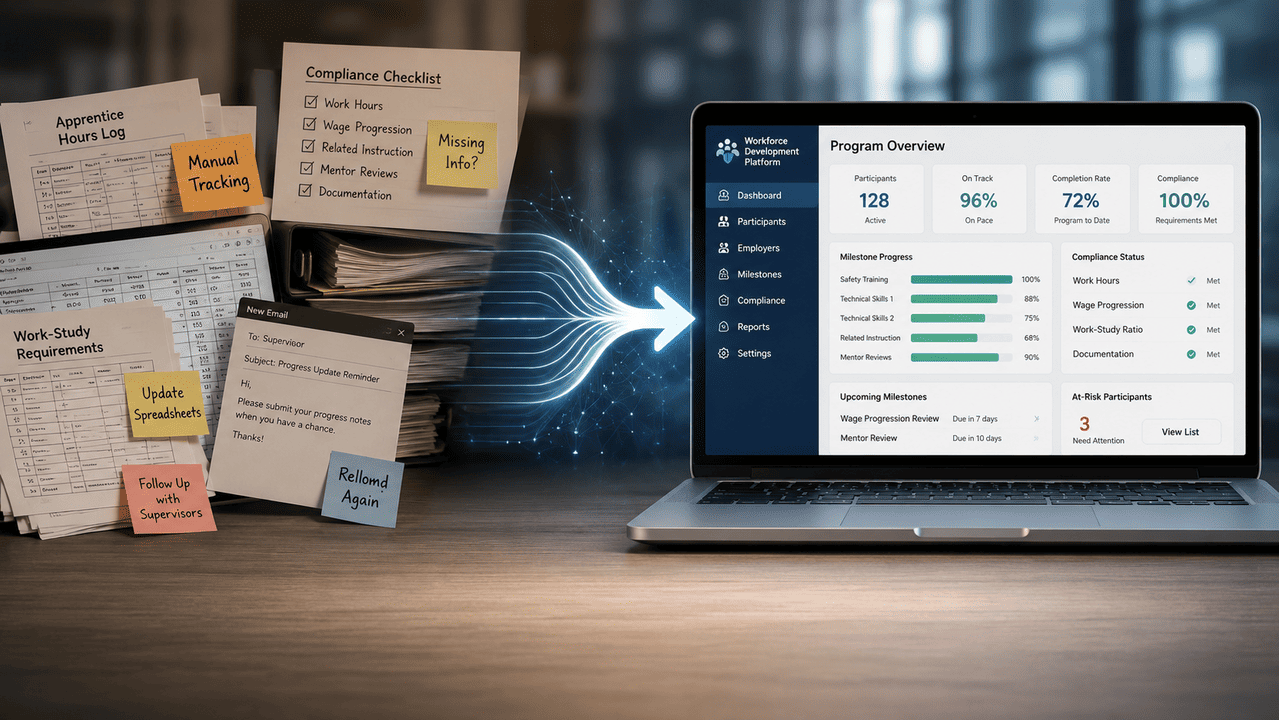
Organizations that treat intern programs as genuine talent pipelines need the infrastructure to run them that way. Internship reporting software is that infrastructure. It is what allows a program to scale without proportionally scaling the HR burden. It is what produces the evaluation data that makes conversion decisions defensible. It is what signals to candidates, universities, and regulators that the program is managed with the same operational competence as the rest of the business.
If the operational picture described throughout this article reflects your current experience, including fragmented tools, compliance uncertainty, evaluations that slip, and administrative work that consumes more time than it should, the productive next step is a direct evaluation of what a purpose-built platform would change for your specific program. GoSprout offers a starting point for that evaluation: a platform designed specifically for the intern and apprenticeship program lifecycle, built to replace the multi-tool problem with a single, auditable system of record.
Frequently Asked Questions
A capable internship management system should include centralized document storage for all intern records, automated timesheet tracking with supervisor approval workflows, structured evaluation tools tied to defined competencies, compliance audit trails, and role-based access for HR, supervisors, and interns. Strong platforms also offer customizable program templates, onboarding automation, and integration with existing HR or payroll systems. These features collectively ensure that compliance documentation is generated through normal program use rather than as a separate manual effort.
The most efficient approach is a purpose-built platform that captures intern timesheet submissions, routes them through a structured approval workflow, and stores both the submission and the approval with automatic timestamps. This eliminates manual follow-up, creates an unambiguous record of hours reviewed, and retains that data in a format that satisfies FLSA record-keeping requirements without additional steps from HR staff.
Small businesses typically benefit most from platforms that are fast to configure, simple enough for non-technical supervisors, and focused on the core compliance requirements without requiring extensive customization. Larger teams with multiple cohorts, distributed supervisors, and cross-departmental programs need deeper configuration options, robust role-based access controls, cohort-level reporting dashboards, and payroll or HR system integration. The right starting point for any organization is mapping current administrative pain points and matching them to platform capabilities rather than defaulting to the most feature-rich option available.
Purpose-built internship management software is typically priced per active user or per intern slot, which makes cost-per-intern a useful comparison metric. When weighed against the administrative labor a platform replaces, and the compliance exposure it reduces, the per-intern cost of a purpose-built platform is generally lower than the fully loaded cost of managing the same program manually. Custom-built solutions carry significantly higher initial development and maintenance costs and are rarely the most cost-effective option for organizations without dedicated technical resources.
Yes. Purpose-built internship reporting platforms can automatically send structured evaluation prompts to supervisors at predefined intervals, with competency-specific rating criteria and space for qualitative input. This removes the manual follow-up burden that causes missed evaluations in spreadsheet-based systems and ensures that every intern receives feedback against a consistent framework. The result is evaluation data that is comparable across interns and cohorts, which is the foundation for meaningful program improvement over time.
Most programs of moderate complexity reach operational readiness within two to four weeks. Larger or more complex programs with custom competency frameworks, multiple departments, or payroll integration requirements typically take four to eight weeks. The single most important factor in implementation timeline is organizational preparedness before configuration begins. Programs that define their evaluation structure, role assignments, required documents, and integration requirements in advance consistently move through setup faster and with fewer mid-implementation adjustments.