

Table of Contents
- Why Most Apprenticeship Programs Are One Missed Deadline Away From a Crisis
- The Core Architecture of Effective Apprentice Progress Tracking
- Compliance Is Non-Negotiable: RAPIDS, RAP Standards, and What Programs Must Document
- Manual Tracking vs. Apprenticeship Management Software: An Honest Cost-Benefit Analysis by Program Size
- Benchmarking Progress Metrics Across Apprenticeship Models: Trade-Based, Degree-Based, and Industry-Specific
- Solving the Remote and Hybrid Apprenticeship Tracking Problem
- The Motivational Dimension: How Real-Time Progress Visibility Drives Engagement and Reduces Dropout
- How to Evaluate Apprenticeship Tracking Software: A Decision Framework for HR Managers and Business Owners
- How GoSprout Centralizes and Automates Apprentice Progress Tracking
- Conclusion: From Compliance Obligation to Strategic Asset
- Frequently Asked Questions
Why Most Apprenticeship Programs Are One Missed Deadline Away From a Crisis
The Hidden Cost of Treating Progress Tracking as a Compliance Checkbox
Most apprenticeship programs track progress the same way they file taxes: reluctantly, at the last possible moment, and only because someone will penalize them if they don’t. The result is a system built around minimum viable documentation rather than meaningful oversight. Programs that treat tracking as a compliance checkbox accumulate invisible risk, including missed hour thresholds, unsigned competency assessments, and wage increases that weren’t triggered on schedule, until an audit or a program completion gap makes the cost visible all at once.
The real expense isn’t the fine or the failed audit. It’s the compounding administrative burden that grows every time a supervisor has to reconstruct hours from memory, every time a coordinator spends an afternoon chasing down signatures, and every time a reporting deadline forces a data scramble that pulls senior staff away from higher-value work. These costs don’t appear on any budget line, but they are consistently underestimated by programs that have normalized the chaos.
Want to Learn More About Your Registered Apprenticeship Opportunities?
BOOK A FREE CONSULTATION
How Disorganized Tracking Drives Apprentice Dropout and Administrative Overload
Disorganized tracking doesn’t just create paperwork problems. It creates people problems. When apprentices can’t see their own progress, they lose a critical source of motivation. When supervisors don’t have clear sign-off workflows, they deprioritize documentation until it becomes urgent. When program coordinators manage everything through email threads and spreadsheet tabs, they become the single point of failure for the entire program’s compliance posture.
The connection between tracking quality and dropout rate is direct. Apprentices who receive inconsistent feedback on their progress are more likely to disengage, and disengaged apprentices are more likely to leave. Programs that can’t demonstrate clear progression milestones also struggle to retain employer sponsors who expect a return on their training investment. Attrition isn’t a motivation problem. In most cases, it’s a visibility problem.
What the Spreadsheet-and-Email Approach Fails to Capture
Spreadsheets track what someone remembered to enter. They don’t track what didn’t happen: the sign-off that was skipped, the wage increase that should have triggered at the 2,000-hour mark, the RTI course that was attended but never logged against a competency. These omissions are invisible until they become audit findings.
The operational environment compounds this problem. Programs are more geographically distributed, supervisor populations are more transient, and regulatory scrutiny of registered apprenticeship programs has increased as federal and state investments in workforce development have grown. A spreadsheet-and-email system was a reasonable workaround for a single-site program with a handful of apprentices. For any program operating at scale today, it is a structural liability.
The Strategic Reframe: Progress Tracking as a Talent Pipeline Asset
Programs that reframe apprentice progress tracking as a talent pipeline function, rather than a compliance function, make better operational decisions. They build systems that produce data useful for forecasting completions, identifying at-risk apprentices before they drop out, and demonstrating program ROI to organizational leadership. They treat each apprentice’s record not as a documentation burden but as a longitudinal asset that proves the program works.
This reframe doesn’t require abandoning compliance rigor. It requires building systems where compliance is a byproduct of good program management, not a separate task that competes with it.
The Core Architecture of Effective Apprentice Progress Tracking
What Two Records Are Required to Track the Outcome of an Apprenticeship?
Every registered apprenticeship program is built on two foundational record types. Without both, a program cannot verify completion, cannot submit accurate RAPIDS reports, and cannot defend its outcomes in an audit.
On-the-Job Training Hour Logs and Time Records
OJT hour logs document the time an apprentice spends performing work-based learning under qualified supervision. These records must capture the date, hours worked, the work process or skill area practiced, and supervisor verification. Most programs set OJT hour targets ranging from 2,000 to 10,000 hours depending on the occupation and program type, meaning a single missing or unsigned log can create measurable gaps in a completion record.
The standard isn’t simply totaling hours. It’s demonstrating that hours were distributed across the required work processes defined in the program’s Standards of Apprenticeship. A program that logs time without mapping it to specific work processes is accumulating hours, not evidence of competency development.
Related Technical Instruction Completion and Competency Documentation
RTI records document the classroom, online, or hybrid instruction that complements on-the-job training. Federally registered programs require a minimum of 144 hours of RTI per year. These records must include course completion, attendance verification, and, in competency-based programs, assessment results tied to specific technical standards.
RTI documentation is where most programs maintain the weakest records. Course completions often live in an LMS or training vendor system that is never connected to the apprentice’s main progress record. When these records aren’t integrated, coordinators manually reconcile data at reporting time, which introduces both error and delay.
How to Keep Track of Apprenticeship Hours: Supervisor Sign-Off Workflows and Time Logging Standards
Accurate apprenticeship hour tracking depends on a supervisor sign-off process that is simple enough to complete consistently and structured enough to produce defensible records. The practical standard is a workflow where apprentices log hours at least weekly, supervisors review and sign off within a defined window (typically five to seven business days), and the program coordinator receives automatic notification of any unsigned entries.
Programs that rely on monthly batch approvals accumulate unsigned backlogs. Supervisors approve hours they no longer clearly remember, introducing the kind of reconstructed documentation that auditors flag as unreliable. Weekly logging with near-real-time supervisor review is the operational standard that holds up under scrutiny.
Competency Assessment and Skills Verification: Moving Beyond Hour Counts
Hour counts measure time. Competency assessments measure capability. The distinction matters because hours alone don’t prove that an apprentice has mastered a skill. They prove that an apprentice was present. Best-in-class programs pair hour milestones with structured competency checkpoints where a supervisor or journeyworker formally verifies that the apprentice can perform a defined task to standard.
Competency-based or hybrid programs require this documentation as a condition of completion. Even time-based programs benefit operationally from periodic skills verification: it catches performance issues earlier, creates a defensible record of development, and gives both the apprentice and the employer a shared language for evaluating progress.
Wage Progression Tracking as a Compliance and Retention Signal
Wage progression schedules are built into every registered apprenticeship program’s Standards of Apprenticeship, typically tied to hour thresholds or time intervals. Missing a scheduled wage increase is both a compliance violation and a retention risk. Apprentices who notice a delayed wage adjustment interpret it as either organizational disorganization or bad faith, neither of which supports program completion.
Tracking wage progression alongside hour milestones ensures that increases trigger when thresholds are met, creates an audit trail showing compliance with the program’s own standards, and removes the coordinator overhead of manually monitoring each apprentice’s pay schedule.
What a Best-in-Class Apprentice Portfolio Should Contain
A complete apprentice portfolio is the consolidated record that proves a program delivered what it promised. It should include:
- Cumulative OJT hour logs with supervisor sign-offs, organized by work process
- RTI completion records linked to the relevant competency standards
- Competency assessment results at each program stage
- Wage progression documentation showing actual increases against scheduled dates
- Certifications, licenses, or credentials earned during the program
- A completion verification record tied to RAPIDS submission
This portfolio serves multiple purposes simultaneously. It satisfies audit requirements, supports the apprentice’s credential documentation, and gives program leadership the data to evaluate whether the program is producing skilled workers at the rate it was designed to.

Core Tracking Components Checklist
Use this rubric to evaluate whether your current system meets the minimum architectural requirements for effective apprentice progress tracking.
| Tracking Component | Spreadsheet / Email | Generic HR Tool | Purpose-Built Platform |
|---|---|---|---|
| OJT hour logs with weekly supervisor sign-off | Manual entry, no sign-off workflow | Basic time entry, limited approval routing | Automated logging with structured sign-off and escalation alerts |
| RTI records linked to competency standards | Separate file or LMS, not integrated | Rarely integrated with training systems | Native integration or direct import from LMS |
| Competency assessments tied to skill milestones | Inconsistent, often text-based notes | Basic checklist, no milestone linkage | Structured assessment forms linked to program standards |
| Wage progression tracking against scheduled increases | Manual calendar reminders, high error rate | General HR payroll notes, not program-aware | Automated milestone triggers with audit trail |
| Complete apprentice portfolio for certification | Assembled manually at completion | Partial records across multiple systems | Continuously maintained, audit-ready at any point |
| RAPIDS-ready reporting output | Manual data extraction and formatting | Custom report required, no RAPIDS mapping | Native RAPIDS formatting with automated data population |
If your current system produces more manual or inconsistent answers than automated ones, the sections ahead will give you a clear picture of what the operational and compliance cost of that gap actually is.
Compliance Is Non-Negotiable: RAPIDS, RAP Standards, and What Programs Must Document
How RAPIDS Reporting Works and What Triggers a Compliance Gap
RAPIDS, the Registered Apprenticeship Partners Information Data System, is the federal database that the U.S. Department of Labor uses to track registered apprenticeship program data. Program sponsors are required to submit enrollment records when an apprentice enters the program, update records at key milestones, and submit completion or cancellation data when an apprentice exits. State apprenticeship agencies also use RAPIDS data for their own oversight functions.
A compliance gap typically triggers in one of three ways: a submission is late, a submitted record contains data that contradicts the program’s Standards of Apprenticeship, or a record is simply missing. The third case is the most common and the most preventable. It usually traces back to a coordinator who didn’t have reliable source data at submission time because the underlying tracking system failed to capture it accurately.
Registered Apprenticeship Program Standards: Documentation Requirements by Apprenticeship Stage
RAP standards specify documentation requirements that shift at each stage of the apprenticeship. Understanding what’s required at each phase allows programs to build tracking workflows that capture the right data at the right time, rather than reconstructing records retroactively.
Probationary Period Tracking Requirements
The probationary period is typically the first fraction of the total OJT hours, as defined in the program’s Standards of Apprenticeship. During this phase, programs must document that the apprentice is receiving required supervision, logging OJT hours against the defined work processes, and participating in RTI. Programs also need a formal record of the probationary review outcome, whether the apprentice is confirmed in the program or separated.
This documentation is foundational. An incomplete probationary record makes every subsequent hour log harder to defend, because the program cannot clearly establish when the formal apprenticeship relationship was confirmed.
Mid-Program Competency and Hour Benchmarks
Most programs define interim checkpoints where accumulated hours and competency progress are formally reviewed. These mid-program benchmarks serve two compliance functions: they verify that the program is delivering training at the rate its Standards commit to, and they create an intervention opportunity before a struggling apprentice reaches the completion stage with insufficient documentation.
Mid-program reviews should produce a dated record that captures hours to date against the program schedule, competency assessments completed, any RTI gaps, and supervisor observations. Programs that skip formal mid-program documentation often face completion-stage problems that could have been resolved months earlier.
Completion and Certification Documentation
Completion documentation is the record that closes an apprenticeship and supports the issuance of a Certificate of Completion from the DOL or the relevant state apprenticeship agency. It requires a full accounting of OJT hours by work process, RTI completion verification, competency assessment results in competency-based or hybrid programs, and a final supervisor attestation.
Incomplete completion packages delay certificate issuance, which creates a direct problem for the apprentice’s professional credentialing and a reputational problem for the program. Programs that maintain continuous, complete records throughout the apprenticeship produce completion packages as a natural output rather than a last-minute assembly task.
How Often Should Apprentice Progress Be Monitored? Regulatory Minimums vs. Best Practice Cadences
The DOL recommends at minimum an annual review of each apprentice’s progress, and many state apprenticeship agencies require semi-annual reviews. These represent the regulatory floor, not the operational standard.
Best-practice programs run monthly coordinator reviews of overall program metrics, quarterly formal check-ins with each apprentice and supervisor, and continuous monitoring of hour logging and sign-off completion through their tracking system. The monthly and quarterly cadences catch emerging problems, such as a supervisor who isn’t signing off or an apprentice whose hours have dropped sharply, while the data is current enough to act on.
Programs that rely on annual reviews often discover problems ten months after they could have been corrected.
How to Automate Apprenticeship Compliance Tracking: From Manual Submission to Automated Reporting
Manual compliance tracking follows a predictable failure pattern. Data lives in multiple systems, a coordinator aggregates it before each reporting deadline, errors are introduced during aggregation, and the submission reflects the system’s gaps as much as the program’s actual activity. Automating this pipeline requires connecting the source data, including hour logs, competency records, and RTI completions, to a reporting layer that maps directly to RAPIDS data fields.
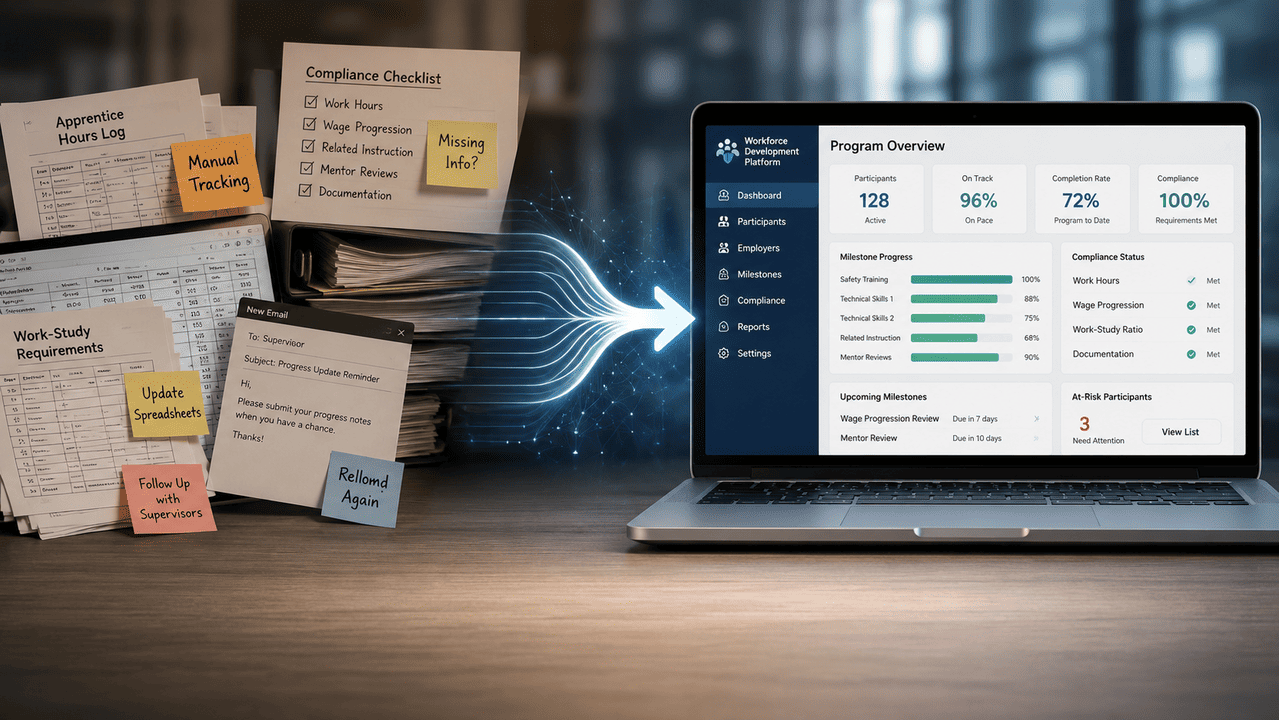
The practical steps for moving from manual to automated compliance reporting are:
- Standardize data capture at the source by building RAPIDS-required fields into hour log and assessment templates.
- Centralize all record types in a single system so aggregation is a query, not a manual task.
- Build exception alerts that surface missing records before reporting deadlines, not at them.
- Generate RAPIDS-formatted outputs directly from the tracking system rather than reformatting data in a separate step.
Each step reduces both coordinator time and error rate. Programs that complete all four steps typically find that their compliance reporting transitions from a multi-day deadline scramble to a routine review-and-submit process.
What Compliance Audits Actually Look For
Compliance auditors reviewing registered apprenticeship programs focus on a specific set of questions. Does the program’s actual operation match its Standards of Apprenticeship? Are OJT hours distributed across the required work processes or concentrated in a narrow subset? Do wage records align with the program’s progression schedule? Are there gaps between RTI requirements and documented completions?
The documentation gaps that most frequently appear in audit findings include:
- Hour logs that show total hours but don’t map to specific work processes
- RTI records that confirm attendance but don’t link to competency outcomes
- Wage records that show current pay rates but can’t document the progression history
- Mid-program review records that are absent or undated
- Supervisor sign-offs completed in batch after the fact rather than contemporaneously
None of these gaps are difficult to close when a program builds its tracking system to capture the right data at the right time. They are consistently difficult to close when a program tries to reconstruct them from spreadsheets and email archives under audit pressure.
Manual Tracking vs. Apprenticeship Management Software: An Honest Cost-Benefit Analysis by Program Size
Where Spreadsheets Break Down: Failure Modes That Grow With Program Scale
Spreadsheets don’t fail all at once. They fail incrementally, in ways that become visible only after the damage is done. A coordinator managing five apprentices can manually reconcile hour logs, chase supervisor sign-offs, and update wage schedules without the system visibly collapsing. At fifteen apprentices, the same coordinator is spending several hours a week on data hygiene tasks. At forty, the spreadsheet has become a full-time job that still produces unreliable output.
The failure modes are predictable. Version control breaks down when multiple supervisors update separate files. Conditional formatting that tracks wage thresholds stops working after a column is accidentally shifted. A formula error in one tab cascades silently through summary reports. None of these failures announce themselves. They surface as incorrect data in a RAPIDS submission or a missing competency record during a completion review.
The structural problem is that spreadsheets require a human to function as the integration layer between data sources. Every hour log, RTI completion, and sign-off that lives in a different location requires a manual step to consolidate. Each manual step introduces potential error. Programs with more than twenty active apprentices are compounding those error probabilities across hundreds of data points per reporting cycle.
Illustrative Cost Model: Time Overhead, Error Rate, and Compliance Risk Across Program Sizes
To make the cost tangible, consider a coordinator managing apprentice progress tracking across three program sizes.
At ten apprentices, manual tracking consumes roughly three to four hours per week in data entry, sign-off follow-up, and report preparation. The error rate is manageable, primarily because the coordinator knows each apprentice personally and catches gaps through direct communication.
At twenty-five apprentices, the same tasks consume eight to twelve hours per week. The coordinator is now managing both relationships and a data reconciliation problem simultaneously. One supervisor who consistently delays sign-offs creates a backlog that affects the entire program’s reporting accuracy. Compliance risk rises because no single person can maintain full visibility across all records.
At fifty or more apprentices, manual tracking becomes an institutional liability. Time overhead can run fifteen to twenty hours per week for a single coordinator. The program is statistically likely to carry documentation gaps at any given point. When a compliance review or audit arrives, the preparation cost alone can exceed what a purpose-built platform would have cost annually.
These figures reflect what programs consistently report when they audit their own administrative overhead before moving to software.
At What Program Size Does Purpose-Built Software Deliver Measurable ROI?
The break-even point is lower than most program managers expect. Apprenticeship management software typically delivers measurable return on investment at fifteen to twenty active apprentices, when the time saved on data entry, sign-off management, and reporting preparation exceeds the platform cost within the first year.
Below fifteen apprentices, the ROI case is still valid, but it rests more on error reduction and compliance risk mitigation than on hours saved. A single audit finding or a delayed completion certificate carries financial and reputational costs that can far exceed the annual cost of a purpose-built platform. Programs that weigh only the subscription cost against time savings are undercounting the risk side of the ledger.
Above thirty apprentices, the ROI case is unambiguous. The coordinator time savings alone typically justify the investment, with compliance accuracy and audit-readiness as additional gains.
How to Transition From Excel to Apprenticeship Management Software Without Disrupting Active Cohorts
Transitions fail when programs try to run two systems simultaneously for too long or when they migrate all data at once without validating accuracy. The practical path forward treats the migration as a phased operation with a defined cutover point.
Data Migration Planning and Audit-Readiness During the Switch
Start by auditing your existing spreadsheet data before importing anything. Identify which records are complete and verifiable, which records have gaps, and which records would fail an audit in their current state. Migrate only clean data. Document the gaps explicitly so the new system reflects the actual state of your records rather than an optimistic version of them.
Map your existing data fields to the new system’s structure before the migration date. Hour log formats, supervisor identifiers, and work process codes often require translation. Running this mapping exercise in advance prevents the most common migration problem: records that import successfully but land in the wrong field.
Maintain a read-only archive of your pre-migration spreadsheets for at least one full reporting cycle after cutover. If a compliance question arises about a record that predates the migration, you need access to the original source, not just the imported version.
Staff Adoption and Change Management for Supervisor Sign-Off Workflows
The biggest adoption barrier is supervisor behavior, not coordinator behavior. Coordinators have direct incentives to use the new system. Supervisors are being asked to change a workflow they didn’t request, often with limited visibility into why.
Address this directly. Before launch, show supervisors specifically what changes for them: they receive a notification, they review the apprentice’s logged hours, and they confirm with a single action. Quantify the time expectation clearly. If the weekly sign-off takes three minutes, say that explicitly.
Identify two or three supervisors who are likely early adopters and involve them in the setup process. Their peer credibility will do more for adoption than any top-down communication about the new platform.

Benchmarking Progress Metrics Across Apprenticeship Models: Trade-Based, Degree-Based, and Industry-Specific
Why One Tracking Framework Does Not Fit All Apprenticeship Types
The compliance floor for registered apprenticeship programs is consistent: OJT hours, RTI completion, and RAPIDS reporting apply across program types. What varies significantly is how progress is measured, what milestones matter, and what a complete record looks like at each stage. A tracking framework designed for a construction trades program will produce the wrong outputs for a healthcare degree apprenticeship and miss critical data points in a technology-sector program with custom competency requirements.
Trade-Based Apprenticeships: OJT Hour Thresholds, Journeyworker Ratios, and Skill-Block Completion
Trade programs are typically the most structured in terms of hour requirements, with OJT targets ranging from 4,000 to 10,000 hours depending on the occupation. These programs often divide work into defined skill blocks, each requiring a minimum hour allocation and a supervisor sign-off confirming the apprentice’s demonstrated competency in that area.
Journeyworker ratios add another tracking dimension. Many trade programs require documentation that each apprentice is supervised by a qualified journeyworker at a specified ratio. Tracking this requires linking apprentice hour logs to specific supervisors and verifying those supervisors’ credentials, not just their names.
Degree Apprenticeships: Integrating LMS Data With Work-Based Learning Records
Degree apprenticeships create a data integration challenge that trade programs don’t face. Academic records and work-based learning records live in completely separate systems. The apprentice’s LMS record, whether in Canvas, Blackboard, or a similar platform, tracks course completions and grades. The work-based record tracks OJT hours and competency assessments. Neither system knows what the other contains.
Without integration, coordinators manually reconcile academic progress against work-based progress at each review point. The practical requirement is either a direct data connection between the LMS and the apprenticeship tracking platform or a structured import process that maps course completions to the relevant competency standards in the apprentice’s record.
Industry-Specific Programs: Custom Competency Frameworks and Non-Standard Milestone Structures
Technology, healthcare, and financial services apprenticeships frequently use competency frameworks that don’t map cleanly to the hour-based structures common in trade programs. A cybersecurity apprenticeship might define progress through skill certifications and project milestones rather than cumulative OJT hours. A healthcare program might tie advancement to clinical competency assessments that occur on a patient-encounter basis rather than a time basis.
These programs require tracking systems that support configurable milestone structures. A platform built around a single hour-accumulation model forces these programs into workarounds that produce incomplete records and obscure actual progress.
What Metrics Matter Most in Apprentice Progress Tracking: A Model by Program Type
| Program Type | Primary Progress Metric | Secondary Metrics | Completion Trigger |
|---|---|---|---|
| Trade-based | OJT hours by skill block | Journeyworker ratio compliance, RTI hours | Hour threshold plus final competency sign-off |
| Degree apprenticeship | Academic credit completion plus OJT hours | RTI integration, grade benchmarks | Degree award plus OJT hour requirement |
| Healthcare / clinical | Competency assessments plus clinical encounters | RTI completion, licensure milestones | Competency verification plus credential award |
| Technology / IT | Project milestones plus certification completion | OJT hours, RTI modules | Certification plus program hour requirement |
How Hybrid and Remote Apprenticeships Change the Benchmarking Equation
Remote and hybrid programs introduce a measurement challenge that on-site programs don’t face: verifying that work-based learning is actually occurring in a distributed environment. The answer isn’t to apply stricter documentation requirements. It’s to build logging workflows that make real-time verification possible regardless of location.
For hybrid programs, the primary benchmarking shift is that supervisor observation becomes asynchronous. Progress documentation needs to carry more weight because direct oversight is intermittent. This makes structured competency assessments more important, not less, in hybrid contexts.
Solving the Remote and Hybrid Apprenticeship Tracking Problem
Why Geographic Distribution Breaks Traditional Supervisor Sign-Off Models
Traditional sign-off workflows assume proximity. When a supervisor and apprentice work at the same site, a weekly review and sign-off is a low-friction conversation. When they’re in different locations, that same workflow requires a digital process the supervisor can complete without being physically present and that generates a timestamped, verifiable record without relying on in-person confirmation.
Programs that try to port paper-based or in-person sign-off workflows into distributed environments typically end up with batched approvals, delayed documentation, and records that don’t reflect real-time progress. The structural solution isn’t a stricter policy. It’s a workflow that makes remote sign-off as simple and immediate as the in-person version.
Mobile Apprenticeship Tracking: What Field-Ready Access Actually Requires
Field-based apprentices log hours in conditions where desktop access isn’t available. A tracking system that requires a browser and a stable connection excludes most of the moments when logging is most natural and most accurate. Mobile-ready tracking means the apprentice can log hours from a job site at the end of a shift, the supervisor receives a notification and approves from their phone, and the record is timestamped and synced to the central system before either party has left the field.
The functional requirements for field-ready mobile access are: offline logging capability that syncs when connectivity is restored, a supervisor approval interface that works on mobile without requiring platform training, and push notifications that route sign-off requests without relying on email.
Maintaining Compliance Documentation Integrity When Supervisors and Apprentices Are Never in the Same Room
Remote documentation integrity depends on three controls. First, time-stamped entries that record when a log was created, not just the hours claimed. Second, supervisor attestation tied to a verified identity, not just a name typed into a field. Third, audit trail visibility that shows if a record was edited after initial submission and who made the change.
Programs that implement these controls produce remote documentation that holds up under compliance scrutiny because it demonstrates contemporaneous recording rather than reconstruction. Programs that don’t often find that remote records are the first to be questioned in an audit.

Centralized Data Management as the Solution to Multi-Site Visibility Gaps
The visibility problem in multi-site programs isn’t access to data. It’s the absence of a single place where all data lives. When each site maintains its own spreadsheet or uses a local process, the program coordinator’s view of overall progress is always lagging. An apprentice at a satellite location can fall months behind on documentation before a coordinator reviewing aggregate data notices the gap.
Centralized data management means every hour log, sign-off, and competency record flows to the same system regardless of location. The coordinator sees all sites in one view. Exceptions surface immediately rather than appearing at end-of-quarter reconciliation. The site doesn’t need to push data to the center. The center always has it.
The Motivational Dimension: How Real-Time Progress Visibility Drives Engagement and Reduces Dropout
Why Apprentice Self-Tracking Changes Retention Outcomes
Most apprentice progress tracking systems are built entirely for program administrators. The apprentice submits hours, receives a wage increase at some point, and eventually receives a completion certificate. What they don’t get, in most programs, is a clear picture of where they stand at any given moment relative to their goals.
This matters because apprenticeship is a multi-year commitment. An apprentice eighteen months into a four-year program, without clear visibility into their progress, is making a decision about continuing based on incomplete information. When progress is visible, the calculation changes. The apprentice can see that they’re on track, confirm that their next wage increase is approaching, and identify exactly what milestones remain. That visibility functions as a retention mechanism.
Milestone Achievement as a Psychological Driver: The Engagement Case for Transparent Progress Dashboards
Progress visibility isn’t just informational. It’s motivational. Research on goal progress consistently shows that people who can see measurable advancement toward a defined goal sustain higher engagement than those working toward the same goal without visibility. In the context of a three- or four-year apprenticeship, this effect is significant.
A transparent progress dashboard gives the apprentice concrete evidence that time invested is translating into documented advancement. Completing a skill block, reaching an hour milestone, or finishing a required RTI course produces a visible change in their record. These incremental completions function as evidence that the program is working, which is precisely the reinforcement that keeps apprentices engaged through the difficult middle stages of a long commitment.
How Lack of Visibility Creates Disengagement
An apprentice who seems checked out or increasingly passive is often an apprentice who doesn’t know where they stand. Without visibility into their own progress, they can’t distinguish between being on track and falling behind. That uncertainty produces avoidance behavior, not asking questions, not flagging problems, that can appear to a supervisor as an attitude or effort issue.
Employers frequently attribute disengagement to personal performance when the root cause is a visibility gap. The apprentice isn’t underperforming. They’re operating in an information vacuum that makes effort feel disconnected from outcome. This is a system problem, not a person problem, and it’s one that program design directly controls.
Connecting Individual Apprentice Engagement to Program-Level Retention Metrics
Apprentice-level engagement data aggregates into program-level outcomes. A program where the majority of apprentices log hours consistently, complete RTI on schedule, and actively engage with their progress dashboards will outperform a program where those behaviors are irregular, even if both programs have identical compliance structures.
The metrics that reflect engagement at scale include on-time hour logging rates, RTI completion rates by cohort, and mid-program attrition rates by site and supervisor. Programs that monitor these metrics can identify which cohorts or supervisors are producing disengaged apprentices and intervene before dropout rates reflect the problem. Individual engagement is a leading indicator. Completion and placement rates are the lagging outcome. Programs that track only the lagging outcome are always responding to problems they could have prevented.
How to Evaluate Apprenticeship Tracking Software: A Decision Framework for HR Managers and Business Owners
The Five Capability Categories That Separate Purpose-Built Platforms From Generic HR Tools
Generic HR platforms were built to manage employee records, not apprenticeship programs. The gap between them shows up in five specific capability areas that determine whether a system actually supports program management or simply stores data.
- Compliance-native reporting: The platform should generate RAPIDS-formatted outputs directly from operational data, not require a coordinator to reformat exports manually.
- Dual-audience access: Both the employer and the apprentice need their own dashboard view with role-appropriate data, not a single administrative interface where apprentice visibility is an afterthought.
- Structured sign-off workflows: Supervisor approval should be a built-in process with escalation alerts, not a manual step that requires coordinator follow-up.
- Configurable milestone structures: The system must support OJT hour thresholds, competency checkpoints, RTI tracking, and wage progression schedules configured to match the program’s actual Standards of Apprenticeship.
- Audit-ready record integrity: Every entry should carry a timestamp, a user identity, and an edit history. Records that can be altered without a visible trail are not audit-ready, regardless of how organized they appear.
Generic HR tools typically handle one or two of these well. Purpose-built apprenticeship management software is designed around all five.
What to Ask Vendors: Evaluation Questions That Reveal Operational Fit
Software demos are optimized to show what a platform does well. The questions that reveal operational fit are the ones that expose what a platform handles poorly, or doesn’t handle at all. Ask these specifically:
- “How does a supervisor complete a sign-off on a mobile device, and what happens if they don’t complete it within a set window?”
- “Show me how a coordinator views all unsigned hour logs across the entire program, not just one apprentice.”
- “What does RAPIDS submission look like from your system? Does it generate the file, or does a coordinator still map fields manually?”
- “How does the system handle an apprentice who transfers from one site to another mid-program without losing their record continuity?”
- “Can you show me what the apprentice sees when they log into their own account?”
The last question is particularly revealing. Vendors who hesitate or pivot to the employer dashboard are demonstrating that apprentice-facing visibility is not a core design priority. That is a meaningful signal about the platform’s underlying architecture.

Red Flags in Software Demos: When a Platform Is Built for Reporting, Not Program Management
A compliance-reporting tool and a program management platform look similar in a demo. The difference surfaces in how they handle the daily operational workflow, not the end-of-cycle report.
Watch for these red flags:
- The demo focuses on reports and exports but shows little about how data gets captured in the first place.
- Supervisor sign-off is described as “sending an email notification” rather than a structured in-platform workflow.
- The apprentice dashboard is either absent or displays read-only data with no interactive logging capability.
- Configuration of competency milestones or wage schedules requires vendor involvement rather than coordinator self-service.
- The system has no exception alerting, meaning there is no way to surface unsigned logs or approaching deadlines without running a manual report.
These aren’t edge cases. They’re the daily realities of running an active program. A platform that handles reports well but requires coordinator intervention for every operational step adds administration rather than removing it.
How Dual-Dashboard Systems Serve Both Apprentices and Employers Simultaneously
The architectural insight behind dual-dashboard design is that apprentice progress tracking serves two distinct users with different needs, and trying to serve both from a single administrative interface fails both. Employers need aggregate visibility, exception alerts, and compliance outputs. Apprentices need real-time progress visibility, personal hour logs, and milestone confirmation.
When these needs are served from separate, role-specific dashboards, something operationally important happens: the apprentice becomes an active participant in the documentation process rather than a subject of it. They log their own hours, see their own progress, and have a direct stake in keeping records current. This distributes the documentation workload and improves data quality simultaneously.
The employer dashboard sees the output of that distributed activity in real time, with exception alerts surfacing when something is missing. The result is a system where documentation happens continuously rather than being assembled at reporting time.
What an Apprentice Progress Report Should Include
A well-designed progress report is the clearest test of whether a platform captures the right data in the right structure. A report that includes only total OJT hours and RTI completion percentages provides a coordinator with almost nothing actionable. A report that meets the output standard for best-in-class apprentice progress tracking should contain:
- OJT hours by work process, with supervisor sign-off status for each period
- RTI completion by course and competency area, with dates
- Wage progression history showing each increase against the scheduled trigger date
- Competency assessment results at each milestone stage
- A current completion forecast based on hours logged to date versus the program schedule
- Outstanding exceptions, including unsigned logs, missed RTI, and overdue assessments
If a platform can generate this report as a standard output, it’s capturing the right data. If producing it requires a coordinator to pull from multiple screens and assemble it manually, the platform is a data storage system, not a program management tool.
Quick-Pick Minimum Viable Feature Guide
| Program Type | Minimum Required Features | Evaluate GoSprout If… |
|---|---|---|
| Small trade program (under 20 apprentices) | OJT hour logging with supervisor sign-off, wage progression alerts, RAPIDS export | You need structured compliance documentation without a full-time coordinator |
| Mid-size degree apprenticeship (20-50 apprentices) | LMS data integration, dual-dashboard access, RTI-to-competency mapping, completion forecasting | You’re reconciling academic and work-based records manually across two systems |
| Multi-site enterprise program (50+ apprentices) | Centralized multi-site visibility, mobile field logging, configurable milestone structures, audit-trail integrity | You have coordinators managing distributed programs with inconsistent documentation quality |
GoSprout is designed to meet the full feature set across all three program types. If your program fits any row above, it is worth evaluating directly against these criteria.
How GoSprout Centralizes and Automates Apprentice Progress Tracking
From Operational Chaos to a Single Source of Truth: GoSprout’s Platform Architecture
GoSprout replaces the multi-system, multi-file coordination model with a single platform where every OJT log, RTI record, competency assessment, wage milestone, and supervisor sign-off lives in one place. There is no reconciliation step before reporting because the data was never in separate systems to begin with. Program coordinators work from a live view of program status rather than assembling it from exports.
This architecture has a direct operational effect. The reporting cycle becomes a review-and-submit process rather than a data aggregation task. What previously required days of coordinator time becomes a quality check on data that is already current.
The Employer Dashboard: Automated Oversight, Predictive Completion Data, and Compliance Reporting
The employer-facing dashboard gives program administrators a real-time view across all active apprentices, with exception alerts surfaced automatically rather than discovered during reporting preparation. Unsigned hour logs, approaching wage thresholds, and RTI gaps appear as actionable items, not buried data points.
Predictive completion data shows each apprentice’s projected completion date based on their current logging rate against their program schedule. This allows coordinators to identify at-risk apprentices months in advance, when intervention is still practical, rather than at the completion stage when the documentation gap is already built up.
Compliance reporting generates in RAPIDS-compatible formats directly from the operational record. The submission data reflects what the program actually did, not a coordinator’s best reconstruction of it.
The Apprentice Dashboard: Real-Time Milestone Visibility, Hour Logs, and Portfolio Management
Apprentices access their own dashboard to log hours, view their progress against program milestones, and track their portfolio as it builds. The visibility they receive isn’t a simplified summary. It’s their actual record: hours by work process, RTI completions by course, upcoming milestones, and wage progression history.
This transparency converts the apprentice from a documentation subject into an active participant. They have direct confirmation that their work is being recorded, their milestones are advancing, and their program is on track. That confirmation is a retention mechanism built into the daily workflow.

RAPIDS-Native Reporting and RAP Compliance Built Into the Workflow
GoSprout treats RAPIDS reporting as a workflow output rather than a separate task. The data fields required for RAPIDS submission are captured through the platform’s standard logging and sign-off process. When a reporting period closes, the submission-ready data is already structured correctly. There is no separate formatting step and no field-mapping exercise.
RAP standards compliance works the same way. The platform’s hour log templates, competency checkpoints, and wage progression alerts are configured to match the program’s specific Standards of Apprenticeship. Compliance isn’t enforced after the fact. It’s built into the daily documentation workflow.
Placement Success Indicators and Program ROI Measurement Built for Leadership Reporting
Program administrators accountable to organizational leadership need data that goes beyond compliance. GoSprout tracks placement outcomes alongside program activity, giving coordinators the ability to connect completion rates, credential attainment, and wage progression to placement success. This produces the ROI evidence that workforce program leaders need to justify continued investment and support program expansion.
The reporting layer is designed to serve both operational oversight and executive communication, without requiring coordinators to build separate reports for each audience.
How GoSprout Addresses Remote and Hybrid Tracking Without Sacrificing Compliance Integrity
GoSprout’s mobile access allows apprentices to log hours from field locations at the end of a shift, with supervisor notifications routed immediately for sign-off from a mobile device. Records are timestamped at entry, tied to verified user identities, and synced to the central platform whether or not the apprentice had continuous connectivity during the workday.
For multi-site programs, every location contributes to the same centralized record. Site coordinators see their own program. Program administrators see everything. The documentation quality at a satellite location is no different from documentation quality at headquarters because the system, not the location, controls the workflow.
Conclusion: From Compliance Obligation to Strategic Asset
What Best-in-Class Apprentice Progress Tracking Actually Delivers
Effective apprentice progress tracking produces two outcomes simultaneously: compliance documentation that holds up under regulatory scrutiny and an operational system that actively supports apprentice success. These aren’t separate goals. They’re the same goal, achievable through the same system when the system is designed to serve both the employer and the apprentice at once.
Programs that achieve this don’t track progress reluctantly at deadline. They maintain continuous, accurate records as a natural result of the daily workflow, and those records produce compliance outputs, retention signals, and ROI evidence as a byproduct.
The Operational and Human Problems That Persist Without a Purpose-Built Solution
Without a purpose-built platform, the problems documented throughout this article continue to compound. Coordinators spend significant hours each week on data reconciliation that produces unreliable output. Supervisors batch-approve hours they no longer clearly remember. Apprentices operate without visibility into their own progress and disengage from programs they can’t see themselves advancing through.
These aren’t problems that process improvements or better spreadsheet design resolve. They’re structural problems produced by systems that require humans to function as the integration layer between disconnected data sources. The cost accrues in coordinator time, compliance risk, and apprentice attrition, all simultaneously.
Why Now Is the Inflection Point for Apprenticeship Program Modernization
Federal and state investment in registered apprenticeship programs has increased substantially in recent years, bringing with it higher regulatory scrutiny, expanded program requirements, and growing employer competition for skilled workers. Programs operating on manual tracking systems face this environment with infrastructure that was marginal a decade ago and is genuinely inadequate now.
The programs that modernize their tracking infrastructure build a compounding advantage: cleaner records, faster completions, better retention, and audit-readiness that doesn’t require emergency preparation. Programs that delay are accumulating the opposite.
Explore GoSprout’s Apprenticeship Management Platform
GoSprout is built specifically for the operational and compliance requirements of registered apprenticeship programs, with a dual-dashboard architecture that serves both employers and apprentices from a single centralized platform. If your current system produces more manual steps than automated ones, GoSprout is worth a direct evaluation against the criteria in this article.
Visit GoSprout to schedule a demo and see how the platform handles the specific tracking requirements of your program type and size.
Frequently Asked Questions
Effective apprenticeship hour tracking requires a structured logging workflow where apprentices record hours at least weekly, organized by the specific work processes defined in the program’s Standards of Apprenticeship. Each entry should carry supervisor sign-off within a defined window, typically five to seven business days, with the program coordinator receiving automatic notifications for any unsigned logs. Purpose-built apprenticeship management software makes this process significantly more reliable than spreadsheets by removing the manual steps that introduce error and delay.
Every registered apprenticeship program depends on two foundational record types: on-the-job training (OJT) hour logs and related technical instruction (RTI) completion records. OJT logs must document hours worked by work process with supervisor verification. RTI records must confirm course completion and, in competency-based programs, assessment results tied to technical standards. Without both record types maintained accurately and completely, a program cannot verify apprentice completion or submit compliant RAPIDS reports.
A complete apprentice progress report should include OJT hours organized by work process with supervisor sign-off status, RTI completion records by course and competency area, wage progression history showing actual increases against scheduled trigger dates, competency assessment results at each milestone stage, a projected completion date based on current logging rates, and a summary of outstanding exceptions such as unsigned logs or overdue assessments. A report that contains only total hours and RTI percentages provides insufficient data for meaningful program oversight.
Apprenticeship program ROI is most accurately measured by connecting program activity data to placement outcomes. Key metrics include completion rates relative to enrollment, average time-to-completion against the program schedule, credential attainment rates, wage progression compliance, and post-completion placement success. Programs that track these metrics through a centralized platform can demonstrate concrete workforce development returns to organizational leadership, rather than relying on anecdotal evidence or aggregate completion counts alone.
Registered apprenticeship programs must maintain documentation that satisfies both federal and state requirements. At the federal level, this includes RAPIDS reporting at enrollment, key milestones, and program exit, as well as records demonstrating that OJT hours meet the work process distribution defined in the program’s Standards of Apprenticeship and that RTI meets the minimum of 144 hours per year. Programs must also document wage progression in alignment with their stated schedules. State apprenticeship agencies may impose additional reporting cadences and documentation standards that vary by jurisdiction.
A successful transition begins with auditing existing spreadsheet data to identify complete records, gaps, and any entries that would not survive compliance scrutiny before importing anything into the new system. Clean data should be migrated with field mappings validated in advance to prevent records from landing in incorrect locations. A read-only archive of pre-migration files should be preserved for at least one full reporting cycle after cutover. For staff adoption, the focus should be on supervisors: demonstrating the specific workflow change, quantifying the time expectation, and identifying early adopters who can support peer adoption more effectively than top-down communication alone.