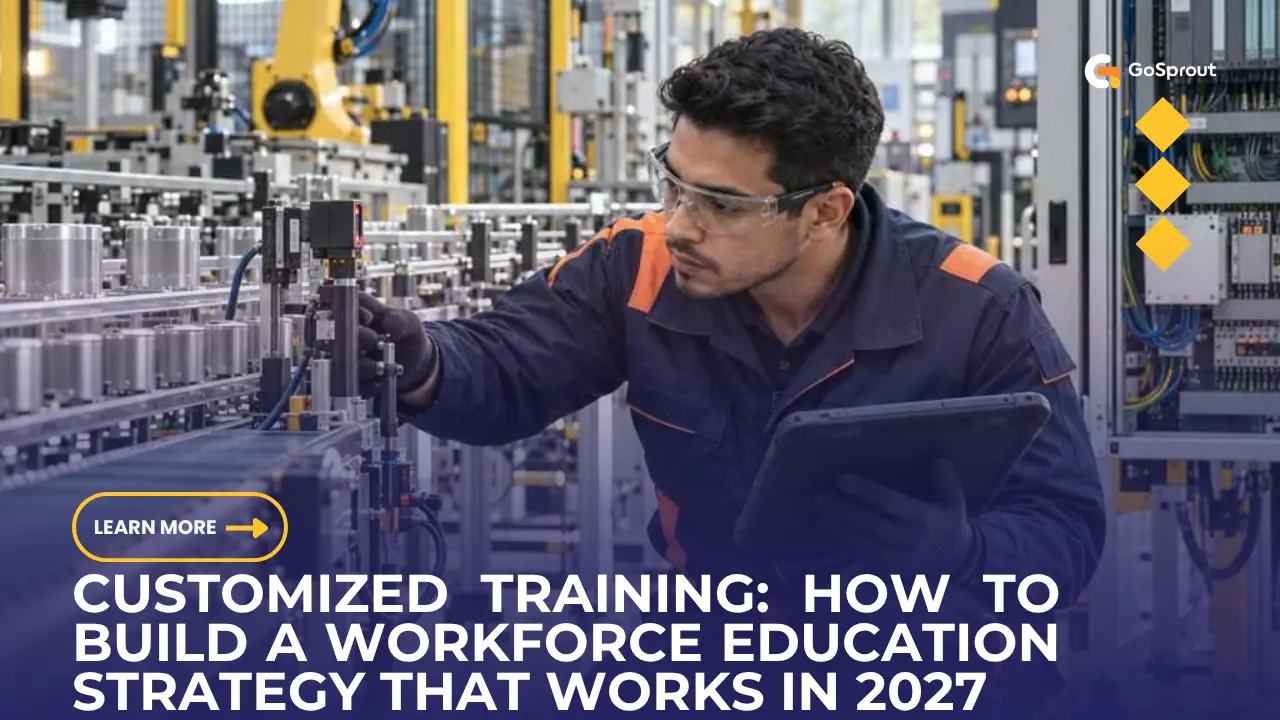
The gap between the skills your workforce has and the skills your organization actually needs is getting bigger faster than many leaders realize. Off-the-shelf courses and generic onboarding decks are not closing it. In 2027, with AI reshaping entire job families, automation spreading more and more across sectors, and compliance requirements tightening, organizations need something far more precise: a customized training program built around the specific roles, competencies, and business goals that drive outcomes.
This guide breaks down what customized training looks like today, why it matters for employers, educators, and learners alike, and how to design, launch, and evaluate a program that delivers measurable workforce development results. Whether you are an employer trying to train employees for a new technology rollout, a community college building career pathways, or an apprenticeship sponsor scaling across regions, you will find actionable steps and hard data to inform your next move.
Use the links below to jump to the topics that matter to you, from defining a customized training program and understanding its benefits, to step-by-step design guidance, common mistakes, and frequently asked questions about workforce education and workforce development.
Table of Contents
- What Is a Customized Training Program in Today’s Workforce Development Landscape?
- Why Customized Training Matters for Workforce Education and Business Results
- How to Design and Run an Effective Customized Training Program
- Common Mistakes to Avoid in Customized Training
- What to Know Before Launching a Customized Training Initiative
- FAQs About Customized Training and Workforce Development
- Why Choose Our Platform to Power Your Customized Training and Workforce Development Programs
- Take the Next Step With Customized Training
What Is a Customized Training Program in Today’s Workforce Development Landscape?
A customized training program is designed from the ground up around specific job roles, local labor market demand, and the precise competencies workers need to perform at a high level. Think cybersecurity analysts learning the exact tools and protocols your SOC uses, or industrial maintenance technicians trained on the equipment sitting on your production floor, not hypothetical machines from a textbook.
In 2027, employers, community colleges, high schools, apprenticeship sponsors, and regional workforce boards rely on customized training because generic content can no longer catch up with how fast roles grow. Tailored programs can address unique needs across different audiences such as new hires and experienced professionals. A pre-apprentice entering a healthcare facility and an incumbent worker reskilling to manage automated warehouse systems have fundamentally different starting points, but both deserve a program that meets them where they are.
Customized training fits within a broader workforce education ecosystem. It connects employers who define the skills they need, education providers who build and deliver content relevant to those skills, workforce development agencies that coordinate funding and placement, and the learners themselves who are building career pathways. This multi-stakeholder model is what separates modern workforce education from the training catalogs of a decade ago.

Customized training fits within a broader workforce education ecosystem. It connects employers who define the skills they need, education providers who build and deliver content relevant to those skills, workforce development agencies that coordinate funding and placement, and the learners themselves who are building career pathways. This multi-stakeholder model is what separates modern workforce education from the training catalogs of a decade ago.
These programs support both new hires stepping into pre-apprenticeships or internships and current employees who need upskilling or reskilling to meet 2027 technologies, from AI-driven analytics platforms to EV maintenance procedures and advanced manufacturing systems.
The typical structure of a customized program blends on-the-job training (OJT) with related technical instruction (RTI). Workers learn theory in a classroom, lab, or online module and then apply it under supervision on real tasks. Competency checklists define what mastery looks like. Scheduled evaluations and digital tracking keep everyone accountable and provide documentation for compliance.
Customized training is also tied to formal credentials. Industry certifications, micro-credentials, and Registered Apprenticeship completions make learning portable for workers and verifiable for regulators. Stackable credentials let learners build qualifications over time rather than committing to a single, monolithic program upfront.
Delivery formats have evolved well beyond the conference room. Customized training can include flexible scheduling and delivery methods: fully online modules, onsite sessions at the employer’s facility, hybrid evenings and weekends for shift workers, and mobile-first microlearning bursts that fit a fifteen-minute break. Research shows that humans exhibit enhanced learning when they progress at their own pace, and modern delivery formats make self-paced progression practical even for large, distributed teams.
Why Customized Training Matters for Workforce Education and Business Results
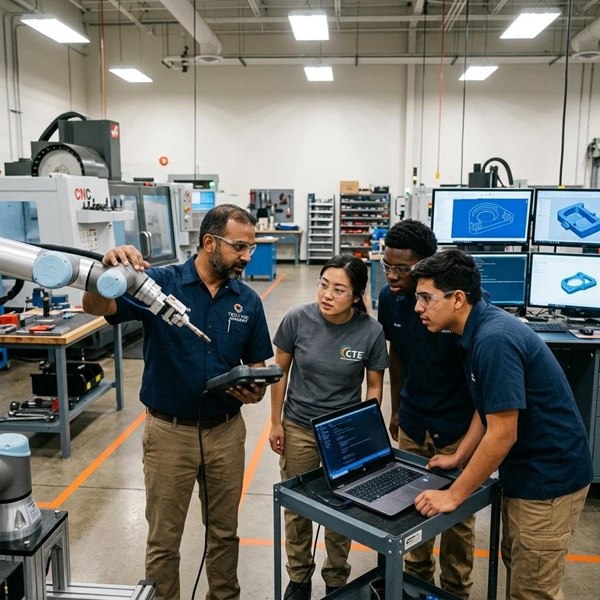
Too many organizations still treat training as a checkbox. Run an orientation, assign a compliance module, and move on. That approach fails because it does not connect what people learn to what they actually do. Customized training meets specific business needs and goals. It turns workforce education into a lever for productivity, quality, safety, and retention rather than a cost leaders tolerate.
Linking training to real training needs, identified through data like performance gaps, error rates, safety incidents, and skills assessments, is what produces measurable return on investment. Without that link, you are spending money on content that feels productive but changes nothing on the floor, in the clinic, or behind the keyboard.
Too many organizations still treat training as a checkbox. Run an orientation, assign a compliance module, and move on. That approach fails because it does not connect what people learn to what they actually do. Customized training meets specific business needs and goals. It turns workforce education into a lever for productivity, quality, safety, and retention rather than a cost leaders tolerate.
Linking training to real training needs, identified through data like performance gaps, error rates, safety incidents, and skills assessments, is what produces measurable return on investment. Without that link, you are spending money on content that feels productive but changes nothing on the floor, in the clinic, or behind the keyboard.
Benefits for Employers
The numbers tell a clear story. Customized training increases productivity by 8.6% on average when programs are aligned to role-specific competencies. Companies with comprehensive training programs have 218% higher revenue per employee. And companies investing in training report 24% higher profit margins compared to those that do not.
Here is what that looks like operationally:
- Faster time-to-productivity for new hires who learn exactly what their role requires, not a survey of everything the company does.
- Fewer compliance violations because training covers the specific regulations, standards, and procedures relevant to each position.
- More consistent processes across locations when every site uses the same competency framework and evaluation criteria.
- Better succession planning for critical roles because you can see who has demonstrated which competencies and who is ready for advancement.
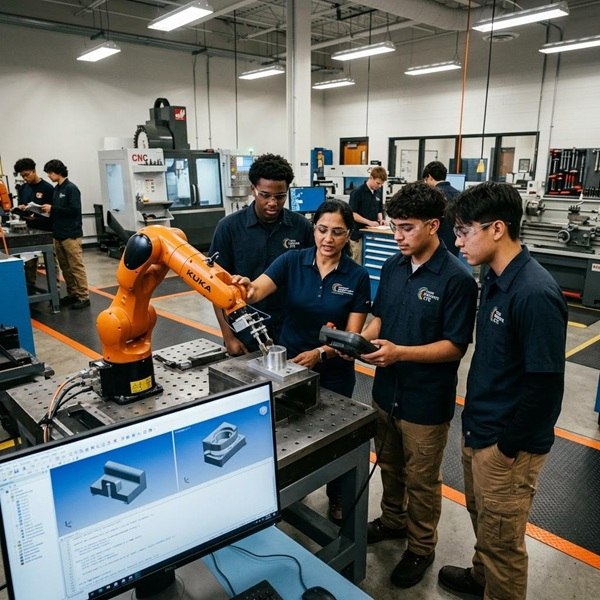
In construction, structured craft training delivered an average 3:1 ROI, with 11% productivity gains, 14% higher retention, and 26% fewer safety incidents across a study of roughly 1,400 craft workers and 200 employers. That is the difference a customized training program makes in day-to-day operations.
An electronics manufacturer working with a customized program that included online components and skill validation cut scrap costs from approximately $44 million to $16 million in a single year, a net benefit of about $28 million on a $3 million investment.
Benefits for Educators and Training Providers
For community colleges, high schools, and RTI providers, customized training solutions create stronger employer partnerships. When curriculum is built around what employers need, program completion rates climb and graduates are more employable. Alignment between what is taught and regional labor market demand is no longer aspirational in 2027. It is expected.
Educator-employer partnerships like those between community colleges and companies such as Tyson Foods and Nestlé Purina demonstrate the model: hands-on modules built for specific maintenance tasks, internal transfers aligned to roles, and completion rates that justify continued investment.
Benefits for Learners
Personalized learning experiences maximize efficiency and engagement. Workers get clearer career pathways, paid work-based learning opportunities, recognized credentials, and access to flexible formats that fit around work and family commitments.
Engagement and retention improve when training is relevant to personal interests and career goals. This is not abstract. Research shows that 94% of employees would stay with companies investing in training. Higher retention and morale result from personalized growth investments that show employees they are valued, not treated as interchangeable parts.
Employee development should connect with broader organizational goals for better training alignment. When a worker can see how their customized training program connects to a promotion path, a credential, or a meaningful pay increase, motivation shifts from compliance to ambition.
Equity in Workforce Education
Customized training also supports equity in workforce development by designing content and scheduling around real barriers faced by underrepresented groups. That means embedding support services such as childcare referrals, transportation assistance, digital device access, and evening or weekend scheduling so that the program reaches people who would otherwise be excluded. If your training only works for someone with a car, a laptop, and a nine-to-five schedule, you are leaving talent on the table.
How to Design and Run an Effective Customized Training Program
This section walks through a practical, step-by-step approach any organization can follow to build a customized training program, from the first needs analysis conversation to ongoing evaluation. Whether you are piloting a single-role program or building a multi-site apprenticeship initiative, the fundamentals are the same.
Step 1: Conduct a Training Needs Analysis
A training needs analysis identifies gaps in existing knowledge and skills. Start by gathering input from multiple perspectives:
- Supervisors who see daily performance firsthand
- Journey-level workers and experienced professionals who understand the nuances of each task
- HR teams with access to turnover, onboarding, and incident data
- Workforce partners, community colleges, or workforce boards who understand regional labor market trends
Needs assessments identify baseline capabilities and precise organizational or individual goals. Review job descriptions, analyze performance and safety data from the last 12 to 24 months, and map core tasks to the competencies required to perform them well. Targeted skill gaps focus on specific competency shortages within a team or department, so you can direct resources where they will have the greatest impact.
Step 2: Prioritize Skills
Not every gap deserves equal attention. Focus first on:
- Mission-critical tasks where errors create safety, compliance, or financial risk
- Compliance requirements mandated by regulators or industry standards
- Skills needed for planned technology changes, whether that is new software, automation, or equipment installations scheduled through 2027
This prioritization ensures your customized training program addresses the areas where the organization is most vulnerable before expanding to developmental or aspirational competencies.
Step 3: Build the Curriculum
The ADDIE model is the industry’s gold standard for instructional design. ADDIE includes five steps: Analysis, Design, Develop, Implement, Evaluate. Each phase builds on the previous one:
| ADDIE Phase | Key Activities |
|---|---|
| Analysis | Define learner profiles, job tasks, and skill gaps |
| Design | Set learning outcomes, sequence modules, choose delivery methods |
| Develop | Create content, build assessments, prepare facilitator guides |
| Implement | Deliver training, onboard mentors, launch OJT components |
| Evaluate | Measure completion, competency gains, business impact; refine |
Learning objectives should be specific, measurable, and aligned with desired behavioral outcomes. For each module, decide what is best taught via OJT versus classroom or online RTI and specify approximate hours for each component. Multiple learning styles should be considered in the development of training programs, so vary your methods: demonstrations, simulations, written materials, group discussion, and hands-on practice.
Training expenditures for large companies rose from $17 million to $19.7 million in 2018, and those numbers have only grown. Investing in thoughtful curriculum design upfront prevents wasted spend on content that does not connect to performance.
Step 4: Choose Delivery Formats
By 2018, 69% of training hours used a blended learning model. In 2027, blended is the baseline, not the exception. Your delivery format decisions should reflect the realities of your workforce and industry:
- Onsite at the employer’s facility: ideal for manufacturing, healthcare, and construction where hands-on practice on real equipment is essential
- Online and self-paced: effective for IT, cybersecurity, administrative roles, and distributed or remote teams
- Hybrid evenings and weekends: critical for shift workers in logistics, hospitality, and continuous-process manufacturing
- Intensive bootcamps: useful for rapid reskilling before a new technology launch or seasonal demand spike
- Mobile-first microlearning: fits training into short windows during busy shifts; supports reinforcement and just-in-time learning
Real-world application in training helps bridge the gap between understanding concepts and applying them. Whatever format you choose, make sure learners practice on tasks they will actually perform.
Step 5: Integrate Assessments
Assessments should be woven throughout, not bolted on at the end:
- Task-based skill demonstrations observed and scored by supervisors
- Digital competency checklists with supervisor sign-off
- Quizzes and knowledge checks tied to RTI modules
- Mid-program reviews to catch learners falling behind early
- End-of-program evaluations mapped directly to the competencies that matter for the role
Feedback loops are essential for tracking performance and refining training content over time. Build in structured touchpoints where supervisors, instructors, and learners review what is working and what needs adjustment.
Step 6: Use Technology for Tracking and Compliance
Organizations running Registered Apprenticeships, pre-apprenticeships, or grant-funded workforce development programs need technology platforms to track OJT and RTI hours, competencies, attendance, and progression in real time. In U.S. apprenticeship contexts, this means generating data compatible with RAPIDS, WIPS, and PIRL reporting requirements.
Centralizing this data in a single system eliminates spreadsheet chaos, reduces reporting errors, and gives program managers dashboards they can use to make decisions, not just satisfy auditors.
Step 7: Align With Broader Workforce Development Strategies
A customized training program does not exist in isolation. Connect it to:
- Registered Apprenticeship standards for occupational credentialing
- Pre-apprenticeship and internship pipelines that feed into full programs
- Dual-credit high school pathways that give students a head start on technical skills
- Incumbent worker training grants and tax credits that offset costs for an existing business expanding its workforce education efforts
Regional workforce development plans are increasingly designed to reduce administrative burden and increase access for small and mid-size businesses to customized training, OJT, and apprenticeship offerings.
Step 8: Address Common Implementation Challenges
| Challenge | Practical Fix |
|---|---|
| Scheduling across shifts | Rotate small cohorts, offer asynchronous modules, and use microlearning for schedule flexibility |
| Supervisor buy-in | Involve supervisors in curriculum design; show them how training reduces their daily firefighting |
| Keeping content current | Assign content owners per module; review and update on a quarterly or semi-annual cycle tied to 2027 industry or regulatory changes |
Effective customized training programs require ongoing evaluation to ensure continuous improvement. This is not a one-time project. It is an ongoing cycle of analysis, design, delivery, and evaluation connected to evolving business goals. The organizations that treat it as a living system, not a finished product, are the ones that see sustained results.
Common Mistakes to Avoid in Customized Training
Many customized training efforts fail for predictable reasons. The good news is that every one of these pitfalls can be avoided with better planning and a willingness to adjust.
Skipping a rigorous training needs analysis. Jumping straight to content creation without understanding the actual skill gaps wastes time and money. Fix: spend the first two to three weeks on structured interviews, task mapping, and data review before writing a single module.
Copying generic content without workplace context. Licensing an off-the-shelf course and calling it “customized” does not fool anyone, least of all the workers taking it. Fix: co-develop content with subject matter experts from the actual roles being trained. Keep content relevant to the tasks workers perform daily.
Ignoring input from front-line workers. Supervisors and executives define goals, but front-line employees know the realities of the job. Fix: include journey-level workers and apprentices in design reviews and feedback sessions.
Not defining clear outcomes for each module. Without measurable objectives, you cannot tell whether training worked. Fix: write a learning objective for every module that specifies what the learner will be able to do, under what conditions, and to what standard.
Administrative failures. Not tracking OJT and RTI hours accurately, losing paper sign-off sheets, and missing compliance reporting deadlines for apprenticeship or grant-funded programs can jeopardize funding and program registration. Fix: centralize documentation in a digital system that automates hour tracking and generates required reports.
Engagement issues. Delivering long, lecture-only sessions, scheduling training at peak production times, or failing to connect learning to real tasks kills motivation. Fix: use varied formats, keep sessions under 90 minutes, and schedule around production demands rather than against them.
What to Know Before Launching a Customized Training Initiative
Before you start designing content, leadership needs to clarify three key aspects: what success looks like, who is responsible, and what resources are available.
Identify decision-makers and champions. Determine who from HR, operations, the training coordinator’s office, partner schools or colleges, and workforce development agencies will co-own the program. Programs with a single champion and no cross-functional support rarely survive past the pilot.
Define success metrics up front. Pick the outcomes that matter most to your organization and measure them from day one:
- Reduced onboarding time
- Improved certification pass rates
- Promotion rates for apprentices and trainees
- Fewer safety incidents
- Higher retention at 6 to 12 months
Budget realistically. Account for instructor time, software or LMS costs, paid apprentice hours in training, materials, lab access, and any required facility setup. Investigate potential reimbursement from workforce grants, tax credits, or state-funded programs like Iowa’s 260E and 260F models that have helped companies develop and train employees at scale.
Confirm data and reporting requirements early. Especially for Registered Apprenticeships and publicly funded workforce development projects, make sure you choose tracking methods and technology that satisfy 2027 documentation standards before you launch, not after your first audit.
FAQs About Customized Training and Workforce Development
Below are answers to the questions organizations most frequently ask when exploring customized training to support their workforce education strategy.
How is a customized training program different from standard corporate training?
Standard corporate training typically uses generic, pre-packaged content delivered uniformly to all employees regardless of role or skill level. A customized training program is built around specific roles, local industry requirements, and your organization’s goals. It integrates tailored competency frameworks, OJT components, and direct alignment to performance metrics so that what workers learn maps precisely to what they do. The result is training that changes behavior, not just attendance records.
How long does it take to design and launch a customized training program?
A small pilot focused on one job role can typically be designed and launched in 6 to 10 weeks, assuming you have an engaged employer partner, clear labor market data, and existing competency frameworks to build from. Larger multi-occupation programs aligned to apprenticeship standards often require 4 to 6 months for design, registration, and initial delivery. Factors that slow timelines include cross-state regulations, lack of internal instructional design expertise, and complex facility or lab setup. Using modular content and platforms with built-in compliance integrations speeds things up considerably.
Can customized training be delivered online or to remote and hybrid teams?
Yes. Many customized training programs now use blended formats that combine synchronous virtual sessions, self-paced online modules, and local mentors for hands-on tasks. This works well for roles like remote IT support, distributed sales teams, and administrative positions. For roles requiring physical skill demonstrations, organizations pair online RTI with onsite or regional OJT sites. The key is matching delivery to the nature of the work, not defaulting to one format for everything.
How do we know if our workforce education efforts are working?
Track a combination of input and outcome metrics. On the input side, monitor the number of OJT and RTI hours completed, the number of participants, and cost per learner. On the outcome side, focus on completion rates, skills assessment scores, OJT competency sign-offs, retention at 6 to 12 months, promotion rates, error or safety incident trends, and feedback from supervisors and apprentices. Research indicates that well-designed sector programs can achieve roughly 10 times the earnings and employment gains of general job training, so specificity in both your program and your measurement matters.
What types of organizations benefit most from customized training?
Customized training is particularly valuable for employers in fast-changing sectors such as IT, advanced manufacturing, logistics, and healthcare where new skills are required continuously. School systems building career pathways, apprenticeship sponsors managing multi-employer programs, and workforce development nonprofits coordinating regional talent pipelines all benefit from the structure and accountability that customized programs provide. Any organization where a gap between what workers know and what the job demands creates risk, whether safety, quality, or competitive, is a strong candidate.
Can customized training support Registered Apprenticeship and internship programs?
Absolutely. Customized training can be mapped directly to apprenticeship standards and internship learning objectives, with structured OJT tasks, RTI curricula, and documentation that satisfies state and federal reporting requirements. In fact, this alignment is increasingly expected. Recent federal guidance has streamlined program registration to 30-day determinations and clarified design requirements, making it easier than ever to build a customized training program that doubles as a Registered Apprenticeship pathway.
Why Choose Our Platform to Power Your Customized Training and Workforce Development Programs
GoSprout is built specifically for the organizations doing this work: employers, schools, apprenticeship sponsors, and workforce agencies running customized training programs that need to be compliant, scalable, and easy to manage. It is not a generic LMS adapted for workforce education. It is a specialized work-based learning and apprenticeship management platform designed for the realities of 2027.
Here is what that means in practice:
- OJT and RTI tracking: Log hours, competencies, and attendance in real time from any device. Supervisors sign off on tasks from the floor, not from a stack of paper forms on a Friday afternoon.
- Competency and skill frameworks: Define, assign, and track the specific technical skills and soft skills each role requires. See who is on track, who is falling behind, and where additional support is needed.
- Mobile access for apprentices and staff: Learners access checklists, schedules, assignments, and progress dashboards from their phone. No laptop required.
- Stakeholder collaboration: Employers, educators, and sponsors work in one system with role-based views, so everyone sees the information they need without tripping over each other.
Automated compliance and reporting features reduce the administrative burden that slows down so many workforce development programs. GoSprout generates RAPIDS, WIPS, and PIRL data outputs directly from recorded training activities, eliminating the manual data entry and edit-check failures that plague organizations using spreadsheets or disconnected systems.
Real-time dashboards show progression by cohort, role, and site. Program managers can identify early warning indicators for learners who need intervention and produce evidence that funding partners and regulators require, without scrambling at reporting deadlines.
The platform scales with you. Start with a pilot cohort at a single location, then expand to multiple sites, occupational areas, and education partners without recreating your tracking systems from scratch. Whether you are an existing business adding one new role or an expanding organization building apprenticeship pipelines across a region, the infrastructure adapts.
And you are not on your own. GoSprout provides onboarding assistance, training for coordinators, and best-practice guidance informed by current apprenticeship and workforce development standards. The goal is to make you equipped to run your program confidently, not dependent on a vendor to do it for you. The platform is built to foster independence, not create bottlenecks.
Take the Next Step With Customized Training
A well-designed customized training program closes skill gaps, strengthens workforce education, and future-proofs your organization against the changes that are already reshaping every industry in 2027. The difference between organizations that excel and those that struggle is not budget or size. It is whether their training is designed around the work that actually needs to get done.
Start by auditing your current training needs. Identify one or two priority roles or departments where a customized training pilot could quickly show impact, whether that means reducing onboarding time, cutting errors, improving retention, or meeting compliance requirements you are currently falling short on.
Then gather the right people: operations leaders, HR, training coordinators, and any education or workforce development partners who should be at the table. Outline your target job roles. Pull together recent performance or safety data to inform a tailored training needs analysis.
When you are ready to move from planning to implementation, reach out to schedule a consultation or demo. We will discuss your workforce development goals, compliance requirements, and any existing apprenticeship or internship programs you want to build on. Bring your questions and your specific needs. We will bring the platform, the expertise, and a partnership approach designed to help you build adaptable, data-driven customized training programs that produce results and develop your people for the long term.
Contact us to get started.



