
Table of Contents
- The Hidden Cost of Managing Apprenticeships Without Dedicated Software
- Why Generic HR Tools Fail Skilled Trades Programs
- What Skilled Trades Apprenticeship Software Actually Does
- Key Features to Look for in a Trades Apprenticeship Management Platform
- How the Right Software Protects Compliance and Program Integrity
- The Operational Case for Hiring Managers and Trade Business Owners
- How to Evaluate and Transition to an Apprenticeship Management System
- Conclusion: Stop Managing Complexity Manually
- Frequently Asked Questions
The Hidden Cost of Managing Apprenticeships Without Dedicated Software
When Spreadsheets Become a Liability
A spreadsheet is a neutral tool. It does exactly what you tell it to do and nothing more. That limitation is manageable when you are tracking a single apprentice through a single job site. It becomes a liability the moment your program grows beyond that boundary, which every successful program eventually does.
Tracking OJT Hours Across Multiple Job Sites
On-the-job training hours are the foundation of any Registered Apprenticeship program. The U.S. Department of Labor sets specific hour thresholds by occupation, and meeting those thresholds requires accurate, verifiable records. When an apprentice splits time between two job sites, or when one supervisor logs hours in a shared spreadsheet while another emails a PDF timesheet, you have created a version control problem with real compliance consequences.

The practical result: reconciling OJT hours before a program review becomes a manual archaeology project. Someone on your administrative staff is cross-referencing rows, chasing confirmations, and trying to determine which figure is authoritative. That is not a workflow. It is a recurring risk event.
Managing Documentation for RAPIDS and State Apprenticeship Council Reporting
RAPIDS, the Registered Apprenticeship Partners Information Data System, is the federal reporting portal for registered programs. State apprenticeship councils layer additional documentation requirements on top of it. Both expect organized, timely, and accurate records. When your source data lives across spreadsheet tabs, email attachments, and shared drives, preparing those submissions becomes a multi-hour exercise in data assembly rather than data reporting.
The margin for error in that process is significant. A transposed number, a missing wage progression record, or a late submission puts your program’s registered status at risk. That status is not administrative paperwork. It is what makes your apprentices eligible for program recognition, your business eligible for potential tax credits, and your talent pipeline credible to prospective hires.
What Gets Missed When Compliance Lives in Email Threads
The most dangerous compliance gaps are not the ones you know about. They are the milestones that slipped through because no system flagged them.
When program documentation is distributed across email threads and shared folders, there is no mechanism to surface what is overdue: a related technical instruction requirement that was never logged, an apprentice approaching the end of a program period without the required hours on record, a wage progression trigger that passed without the corresponding pay adjustment. Each of these represents a compliance failure that a coordinator would have caught if there had been a single place to look.
Email threads do not send alerts. Shared drives do not track progress. They store information you already entered and surface nothing you have not already thought to check.
How Manual Tracking Undermines Your Workforce Development Investment
Beyond compliance, there is a program quality argument that is often overlooked. Skilled trades apprenticeship programs are a structured workforce development investment. You are committing resources, mentorship, and time to building craftworkers who will carry the quality of your business forward. That investment deserves management infrastructure proportional to its value.
When coordinator time is consumed by data reconciliation, less attention is available for what actually shapes apprentice outcomes: mentor pairing, progress conversations, technical instruction alignment, and early identification of apprentices who need additional support. Manual tracking does not just create compliance risk. It redirects capacity away from the developmental work that makes a program worth running.
What Is an Apprenticeship Management Platform?
An apprenticeship management platform is purpose-built software that centralizes every operational and compliance function of a structured apprenticeship program into a single system. It replaces the spreadsheet-email-shared drive patchwork with a dedicated environment designed around how registered apprenticeship programs actually work.
At its core, a platform of this type handles OJT hour logging and verification, milestone and competency tracking, related technical instruction documentation, apprentice onboarding, wage progression records, and audit-ready reporting. It serves both the employer and the apprentice, giving each party appropriate visibility into the program from their respective roles.
Businesses need one because the compliance demands and operational complexity of a registered program exceed what general-purpose tools are built to manage. The question is not whether your program is large enough to justify it. The question is whether you can afford the compounding risk of managing a compliance-dependent workforce development program without it.
| Dimension | Manual Management | Purpose-Built Platform |
|---|---|---|
| Compliance risk | High — gaps surface reactively, often after the fact | Low — automated alerts flag gaps before they become violations |
| Admin hours per apprentice | Estimated 3-5+ hours per month across data entry, reconciliation, and reporting | Reduced to review and oversight functions |
| Scalability ceiling | Typically breaks down past 5-10 active apprentices without additional headcount | Designed to scale program volume without proportional admin growth |
| Audit readiness | Requires manual assembly of records under time pressure | Records are structured and retrievable by design |
| Milestone visibility | Dependent on coordinator awareness and manual check-ins | Real-time dashboard visibility for all active apprentices |
Why Generic HR Tools Fail Skilled Trades Programs
The Core Mismatch Between HR Software and Trade Program Requirements
Generic HR software is built around employment administration: hiring workflows, benefits enrollment, time and attendance, performance reviews. It is designed to manage people within an organization. A skilled trades apprenticeship program is not primarily an employment administration problem. It is a structured, federally registered training program with its own compliance framework, documentation standards, and progress logic. The two categories overlap, but they are not the same thing.
HR platforms do not have fields for OJT hour categories broken down by work process. They do not track related technical instruction completion against a program standard. They do not generate the formatted documentation that state councils and RAPIDS require. You can build workarounds through custom fields, attached documents, and manual exports, but you are engineering a compliance solution on top of a tool that was never designed to provide one.
The Journeyworker Ratio Problem
Most trades apprenticeship programs operate under journeyworker-to-apprentice ratio requirements. These ratios vary by trade, by state, and sometimes by job site classification. They affect how many apprentices can be active on a given project, which in turn affects scheduling, billing, and resource planning.
No standard HR platform models this. It is a trades-specific operational constraint that sits entirely outside the design assumptions of general workforce management software. When ratio compliance is managed manually, typically by a coordinator who knows the rules from memory, that institutional knowledge does not transfer automatically if that person leaves or takes extended time away.

Why Learning Management Systems Fall Short
Learning management systems are built to deliver and track formal instruction. They are well-suited to course completion, assessment scoring, and training records for coursework-based programs, which covers a meaningful portion of a trades apprenticeship but only a portion.
The primary component of any Registered Apprenticeship is on-the-job training: hands-on, site-based, supervised work experience that accumulates toward a federally recognized hour threshold. An LMS has no native mechanism to document that a journeyworker supervised a second-year apprentice completing conduit bending on a commercial project for six hours. It cannot capture work process completion in the field. Trying to force OJT documentation through an LMS creates data that is technically present but structurally inadequate for audit purposes.
Compliance Features That Generic Platforms Treat as Optional
Generic platforms are built for the broadest possible market. Compliance features specific to registered apprenticeship programs represent a narrow use case, so they either do not exist or exist as bolt-on functionality requiring significant configuration.
Audit trail generation, wage progression documentation tied to hour milestones, program-specific reporting formats, and state council submission readiness are not optional features for a registered program. They are baseline requirements. A platform that treats them as edge cases leaves administrators constructing their own compliance infrastructure on top of a tool that was never intended to support it. That is not a solution. It is an additional source of compliance exposure dressed up as one.
What Skilled Trades Apprenticeship Software Actually Does
Centralized Program Administration Across the Apprenticeship Lifecycle
Purpose-built skilled trades apprenticeship software does not simply digitize your existing process. It replaces the architecture of that process with one designed around how registered programs actually operate, from the moment an apprentice is enrolled to the day they complete the program and earn their certificate of completion.
That means a single system holds the apprentice’s enrollment record, their OJT hour log, their related technical instruction history, their wage progression documentation, and their compliance status. A program coordinator does not need to pull from four sources to answer a basic status question. The answer is in one place, structured consistently for every apprentice in the program.
For multi-trade or multi-cohort operations, this centralization compounds in value. Program standards, sponsor details, and occupation-specific requirements are configured once. Every apprentice enrolled under that program inherits the correct structure automatically.
OJT Hour Logging and Verification Across Multi-Site Operations
The version control problem that plagues spreadsheet-based programs disappears when OJT hours are logged directly into a platform with supervisor verification built into the workflow. An apprentice logs hours from the job site. A journeyworker or site supervisor reviews and approves them. The record is timestamped, attributed, and stored with no reconciliation required.
For contractors running apprentices across multiple projects simultaneously, this matters in practical terms. A journeyworker on a commercial site in one city and a residential crew in another can both verify hours independently, and the program coordinator sees a consolidated, accurate record in real time. The platform does not require physical proximity or a shared spreadsheet to maintain data integrity. For construction firms specifically, see our guide to apprenticeship management software for contractors.
Milestone Tracking, Related Technical Instruction, and Progress Documentation
OJT hours are one dimension of a registered apprenticeship. Work process completion is another. A Registered Apprenticeship program defines specific work processes: the discrete skills and tasks that an apprentice must demonstrate competency in over the course of the program. Tracking those work processes requires more granularity than a simple hour count.
A purpose-built platform maps each apprentice’s progress against the work processes defined in their program standard. Coordinators and supervisors can see which competencies have been verified, which are in progress, and which have not yet been addressed. Related technical instruction is tracked alongside OJT hours, so the full picture of an apprentice’s development is visible in one view rather than split between a training database and a separate spreadsheet.
Apprentice Onboarding Automation and Sponsor-Side Program Setup
Manual onboarding scales poorly. When a new cohort starts, each apprentice requires a program enrollment record, a wage schedule, a work process checklist, and a documentation trail that begins on day one. Doing that by hand for five apprentices is tedious. Doing it for fifteen is a significant project.
Apprenticeship management software automates the onboarding sequence. Program sponsors configure the program structure once, covering occupation, term length, wage progression schedule, work processes, and RTI requirements, and each new apprentice is enrolled against that template. The system generates the required documentation, assigns the correct milestones, and establishes the apprentice’s record in a format that is audit-ready from the start.
Maintaining Audit-Ready Records for Registered Apprenticeship Compliance
A program audit is not something you prepare for when it is announced. By the time you know it is coming, the records either exist in a usable format or they do not. A purpose-built platform structures records continuously, not retroactively. Every hour logged, every milestone verified, and every wage adjustment recorded contributes to a documentation trail that is retrievable, organized, and formatted to match what auditors and state councils expect to see.
The difference between a program that passes an audit efficiently and one that scrambles is rarely a difference in compliance intent. It is a difference in documentation infrastructure.
Key Features to Look for in a Trades Apprenticeship Management Platform
Compliance and Reporting Infrastructure
Compliance infrastructure is where purpose-built platforms justify their existence most clearly. The features that matter are specific:
- RAPIDS-compatible reporting that exports data in the formats the federal system requires, without manual reformatting
- State apprenticeship council reporting support, which varies by jurisdiction and often includes documentation requirements that go beyond federal minimums
- Wage progression tracking tied directly to OJT hour milestones, so pay adjustments are triggered and documented automatically
- A full audit trail that logs who entered data, when, and what changes were made
- Automated alerts for approaching deadlines, incomplete documentation, and milestone gaps before they become violations

A platform that treats compliance reporting as a secondary feature rather than a core design principle will require manual intervention at exactly the moments when you have the least time to provide it.
Dual-Sided Platform Design: Serving Both the Employer and the Apprentice
An apprenticeship program has two active participants: the sponsor organization and the apprentice. A well-designed platform serves both. The employer side needs administrative visibility, reporting tools, and compliance oversight. The apprentice side needs a clear view of their own progress, covering hours logged, milestones completed, and what comes next.
When apprentices can see their own progress in real time, the administrative burden on coordinators drops. Apprentices do not need to ask where they stand. That transparency also supports retention. An apprentice who can see how far they have come and how much program structure surrounds their development is more likely to see the program through.
Milestone and Competency Tracking Tied to Trade-Specific Requirements
Generic milestone tracking is not sufficient for trades programs. Work processes and competency requirements differ meaningfully by trade, and a platform that treats all apprenticeships as structurally identical will not map cleanly onto any of them.
Electrical Apprenticeship Program Structures
Electrical apprenticeship programs typically run five years and follow program standards that define specific work processes: conduit installation, wiring methods, blueprint reading, motor controls, and others. Hour requirements are substantial, commonly reaching 8,000 hours of OJT, and competency verification is expected at the work process level, not just in aggregate. The platform needs to reflect that granularity.
Plumbing, HVAC, and Construction Program Variations
Plumbing, HVAC, and general construction programs vary in term length, hour requirements, and work process structure. An HVAC program may include both residential and commercial system categories as distinct work process tracks. A plumbing program may differentiate between service work and new construction. A platform that cannot reflect those distinctions forces coordinators to track the nuances manually, which defeats the purpose of having a platform at all.
Integration Readiness and Workflow Compatibility
Apprenticeship data does not live in isolation. Wage progression records connect to payroll. Enrollment records connect to HR files. A platform that operates as a closed system creates a duplicate-entry problem, where coordinators maintain records in two places and reconcile them periodically, reintroducing the manual burden the platform was supposed to eliminate.
Integration readiness means the platform can exchange data with your existing HR and payroll systems through direct integrations or structured data exports. Before selecting a platform, confirm specifically which systems it connects to and what the data flow looks like in practice.
Scalability Architecture: From Five Apprentices to Fifty
A program running five apprentices can be managed with moderate manual effort. A program running fifty cannot, not without either dedicated staff additions or a system designed to absorb the volume. Administrative work per apprentice does not decrease as the program grows without software. It stays roughly constant, which means total administrative burden scales linearly with headcount.
Purpose-built platforms break that relationship. The configuration work happens once. Onboarding a new apprentice takes minutes, not hours. Reporting covers the full cohort in the same time it previously covered five individuals. The platform creates the conditions for program growth without requiring a proportional increase in coordinator capacity.
How the Right Software Protects Compliance and Program Integrity
The Audit Trail Imperative
A gap in documentation is not a minor administrative imperfection. For a Registered Apprenticeship program, it is a compliance event. The U.S. Department of Labor and state apprenticeship councils require that OJT hours, work process completions, RTI records, and wage progressions be documented in a verifiable format. When records are incomplete or cannot be produced on request, program status is at risk.
The audit trail in a purpose-built platform is not just a log of activity. It is the evidence layer that demonstrates your program is operating as registered. Every record carries a timestamp and a user attribution. Every change is captured. That structure transforms an audit from a documentation recovery exercise into a straightforward records review.
Proactive Milestone Alerts vs. Reactive Compliance Scrambles
The operational difference between a proactive alert and a reactive scramble is the difference between a minor adjustment and a compliance crisis. When a platform flags that an apprentice is 200 hours behind pace six weeks before a program review, you have time to respond. When you discover the same gap the week before, your options are limited and your exposure is real.
Proactive alerts are only possible when all program data flows through a single system with logic built around the program standard. That is precisely what spreadsheets and email threads cannot provide, and what purpose-built platforms are designed to deliver as a baseline function.
How Purpose-Built Platforms Support U.S. Department of Labor Program Standards
DOL program standards for Registered Apprenticeships define the structure of a compliant program: equal opportunity requirements, wage progression schedules tied to OJT hour thresholds, minimum RTI hours, and documentation of work process completion. A purpose-built platform is designed around those standards, not adapted to them after the fact.
That alignment means the system’s default behavior is compliant behavior. Wage progressions trigger at the correct milestones. RTI tracking runs parallel to OJT documentation. Reporting outputs match what the DOL and state councils expect. The compliance logic is built in rather than configured manually by each program administrator.
An Illustrative Multi-Site Scenario
Consider a mid-sized electrical contractor running 18 apprentices across four active job sites. Three are in their second year, seven are in their third, and eight are in earlier stages. The program coordinator manages documentation alongside other HR responsibilities.
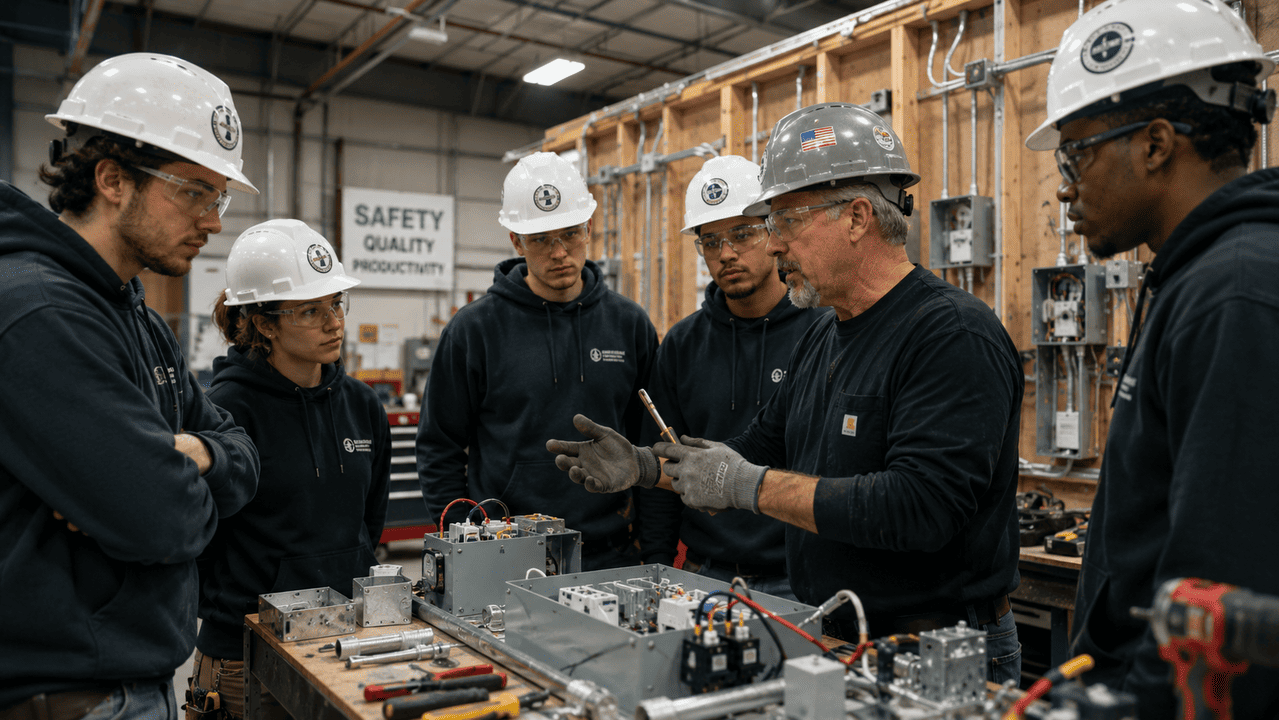
Without a platform, that coordinator is reconciling four separate hour logs, chasing supervisor confirmations by email, manually calculating which apprentices are approaching wage progression thresholds, and assembling RAPIDS submissions from a spreadsheet last fully audited three months prior. When the state council requests a program review, preparation takes two weeks of concentrated effort.
With a platform, each site supervisor verifies hours directly in the system. The coordinator sees a consolidated dashboard showing each apprentice’s current status, upcoming milestones, and any documentation gaps flagged automatically. The RAPIDS submission draws from structured data maintained continuously. Program review preparation takes hours rather than weeks. And if one apprentice is falling behind pace, the coordinator knows before the shortfall becomes a compliance problem, not after.
That is not a theoretical improvement. It is the operational difference between managing complexity and being managed by it.
The Operational Case for Hiring Managers and Trade Business Owners
How Much Administrative Time Does Apprenticeship Software Save?
The structure of the savings is consistent across programs regardless of size. Manual apprenticeship administration consumes time in three recurring categories: data entry and reconciliation, compliance preparation, and status communication. A hiring manager or program coordinator running even a modest cohort manually spends meaningful hours each month on work that a platform handles automatically.
For a program with 10 to 15 active apprentices, the reduction in administrative hours can be substantial, not because the platform works faster than a person, but because it eliminates entire categories of manual work. Hour reconciliation disappears when supervisors verify directly in the system. Compliance preparation disappears when records are maintained continuously rather than assembled on demand. Status inquiries disappear when apprentices can check their own progress without asking.
What remains is the work that genuinely benefits from human attention: mentor relationships, performance conversations, escalation decisions, and program development. A platform does not reduce the value of a skilled coordinator. It redirects their capacity toward work that requires judgment rather than data entry.
Reducing Administrative Overhead Without Reducing Program Quality
The concern that automation reduces program quality gets the relationship backwards. Manual administration does not improve program quality. It consumes the time that good program management requires.
When a coordinator spends two hours assembling a RAPIDS submission, those two hours are not available for identifying an apprentice who is struggling with a specific work process or ensuring that RTI completion is pacing correctly. The administrative burden of manual tracking is not neutral. It competes directly with the developmental oversight that determines whether your program produces skilled, career-ready craftworkers or simply produces paperwork.
Purpose-built skilled trades apprenticeship software reduces overhead by handling the documentation layer. Program quality improves because the people responsible for it have the capacity to focus on it.
Building a Scalable Talent Pipeline Through Repeatable Program Processes
An apprenticeship program is a talent pipeline. That framing matters because pipelines require consistent inputs and repeatable processes to produce reliable outputs. When each cohort is onboarded differently, tracked differently, and documented differently because the process lives in a coordinator’s institutional memory and a set of custom spreadsheets, the pipeline is not actually a system. It is a series of individual efforts that happen to share a name.
A platform standardizes the program structure without constraining individual apprentice development. Occupation-specific work processes, RTI requirements, wage progression schedules, and milestone sequences are configured once and applied consistently to every enrolled apprentice. A coordinator onboarding a new cohort in year three is running the same structured process as year one, not rebuilding it from scratch.
That consistency creates a genuine talent pipeline. It also creates program data that is comparable across cohorts, giving program administrators the ability to identify what works, where apprentices typically fall behind, and how to improve outcomes over time. You cannot optimize a process you cannot measure consistently.
The Dual-Sided Value: Improving the Apprentice Experience and Retention
Apprentice retention is not just a workforce planning metric. It is a direct measure of whether your program delivers on its promise to the people enrolled in it. Apprentices who leave programs early often do so because they feel unsupported, unclear about their progress, or uncertain whether the program is tracking toward a meaningful credential.
A dual-sided platform addresses each of those factors directly. When apprentices can log in and see their OJT hours to date, the work processes they have verified, their RTI completion status, and how far they are from the next wage progression, the program becomes concrete rather than abstract. They are not trusting that someone is tracking their progress correctly. They can see it themselves.
That visibility changes the nature of the apprentice’s relationship to the program, shifting it from passive participation to active engagement. Apprentices who understand their own trajectory are more likely to complete the program, which protects both your workforce development investment and the time already committed to their training.
Apprenticeship Software as a Long-Term Strategic Asset
Hiring managers who evaluate apprenticeship program management tools purely as administrative aids are solving a short-term problem while missing a longer-term opportunity. A well-run apprenticeship program is a direct-hire pipeline that produces workers trained specifically to your standards, your processes, and your trade’s requirements. That is a structural advantage in a labor market where experienced journeyworkers are consistently in short supply.
The businesses that build this advantage are not the ones with the best intentions. They are the ones with the operational infrastructure to run consistent, compliant, high-quality programs year over year. A skilled trades workforce development platform is not just a tool for managing today’s cohort. It is the foundation that makes a repeatable, scalable workforce development strategy possible.
How to Evaluate and Transition to an Apprenticeship Management System
The Evaluation Framework: What to Assess Before Selecting a Platform
Not every platform that claims to support apprenticeship management is built to handle the compliance and operational demands of a registered skilled trades program. The evaluation process should be direct and specific.
Compliance Coverage for Your Trade and State Requirements
Start with compliance architecture. Confirm that the platform supports RAPIDS reporting in the required format, handles wage progression documentation tied to OJT hour thresholds, and reflects the documentation standards of your state apprenticeship council. These requirements vary by jurisdiction, and a platform built for one state’s framework may not meet another’s. Ask the vendor specifically whether their compliance features cover your state, your trade classification, and your program’s registration structure.

Administrative Automation Depth and Reporting Capabilities
Evaluate what is actually automated versus what still requires manual input. A platform that centralizes data but still requires a coordinator to manually generate reports has reduced the storage problem without solving the reporting burden. The relevant questions are whether the system can generate RAPIDS-compatible exports without reformatting, whether it alerts program administrators to upcoming milestones and documentation gaps automatically, and whether it can produce a full audit trail on demand.
Ease of Adoption for Sponsors and Apprentices
A platform that coordinators find difficult to configure and that apprentices do not use provides only partial value. Evaluate the interface from both roles. Can a site supervisor verify OJT hours from a mobile device in the field? Can an apprentice navigate their own progress record without extensive training? Adoption drives data quality. If the platform creates friction, data entry will be inconsistent, and inconsistent data is not meaningfully better than a spreadsheet.
How to Transition From Manual to Platform-Based Management Without Disrupting Active Cohorts
The most common implementation concern is disrupting apprentices who are mid-program. The transition process does not require a clean break. Most programs can migrate active cohort records into a new platform in parallel with ongoing operations, using a defined cutover date after which all new hour logging and documentation flows through the system.
The practical steps are straightforward:
- Audit current records before migration. Identify gaps in existing documentation so they are resolved before the transition rather than inherited by the new system.
- Configure the platform to match your registered program standards before enrolling any apprentices. Work processes, RTI requirements, and wage schedules should reflect your current program structure exactly.
- Run a brief parallel period where both the legacy system and the platform are maintained to confirm data accuracy before fully retiring the old process.
- Communicate the change to supervisors and apprentices before go-live with clear instructions for how hour logging and milestone verification will work in the new system.
The disruption risk of a transition is real but manageable. The disruption risk of continuing manual management as a program grows is not.
Questions to Ask Any Platform Vendor Before You Commit
- Does your platform support RAPIDS reporting for our state and trade classification, and in what format?
- How does the system handle wage progression documentation tied to OJT hour milestones?
- What does the supervisor verification workflow look like from a mobile device in the field?
- Can the platform be configured to match our registered program standard, or does it require us to adapt our program structure to fit the platform?
- What does a full audit trail look like, and how is it generated?
- Which HR and payroll systems does the platform integrate with?
- What does the onboarding process look like for migrating an active cohort mid-program?
Assess Where Your Program Stands
| Indicator | General HR Tool May Suffice | Purpose-Built Platform Recommended |
|---|---|---|
| Active apprentices | 1-3, single site | 4 or more, or multiple sites |
| Compliance exposure | Informal program, no state registration | Registered Apprenticeship with DOL or state council |
| Administrative strain | Under 2 hours per month per apprentice | 3+ hours per month, or staff reporting reconciliation burden |
| Audit readiness | No formal audit history or risk | Prior audit, upcoming review, or registered status to protect |
| Scalability plans | No near-term growth anticipated | Planning to add apprentices or cohorts within 12 months |
If two or more indicators in the right column describe your program, the case for a purpose-built platform is not theoretical.
Conclusion: Stop Managing Complexity Manually
Why the Status Quo Is an Active Risk
Continuing to manage a registered apprenticeship program with spreadsheets and email threads is not a neutral choice. Every day that documentation gaps accumulate without automated alerts is a day that compliance exposure grows. Every hour a coordinator spends reconciling data is an hour not spent on the developmental work that determines whether your program actually produces skilled workers. Every apprentice who cannot clearly see their own progress is a retention risk you are carrying without knowing it.
The status quo has real costs. They are distributed and delayed rather than concentrated and immediate, which makes them easy to underestimate until a program review, a failed audit, or a key coordinator departure makes them visible all at once.
What a Purpose-Built Platform Like GoSprout Makes Possible
GoSprout is designed specifically for this problem. It centralizes OJT hour logging, milestone tracking, RTI documentation, and compliance reporting in a single system built around how registered apprenticeship programs actually operate. Supervisors verify hours in the field. Apprentices see their own progress in real time. Program coordinators work from a dashboard that surfaces gaps automatically rather than discovering them manually.
For a small contractor running five apprentices, GoSprout removes the administrative friction that makes compliance feel burdensome. For a mid-sized operation managing multiple cohorts across multiple sites, it creates the centralized visibility that makes program growth feasible without adding administrative headcount. The platform scales with the program rather than requiring the program to scale around it.
Want to Learn More About Your Registered Apprenticeship Opportunities?
BOOK A FREE CONSULTATION
Your Next Step
If you are currently managing your program manually, the most valuable first step is an honest audit of your current documentation. Pull the records for your most recently completed program period. Assess whether they are complete, organized, and retrievable in the format a state council or DOL reviewer would expect. That assessment will tell you more about your actual compliance exposure than any general framework can.
If the answer reveals gaps, inconsistencies, or a documentation structure that depends on one person’s institutional knowledge to interpret, you have the operational case for transitioning to a purpose-built platform. GoSprout offers a clear path to centralizing that infrastructure without requiring you to rebuild your program from scratch or disrupt the apprentices already in it.
Frequently Asked Questions
An apprenticeship management platform is purpose-built software that centralizes the operational and compliance functions of a structured apprenticeship program into a single system. It handles OJT hour logging and verification, milestone tracking, related technical instruction documentation, wage progression records, and audit-ready reporting. Businesses need one because the compliance demands of a registered apprenticeship program exceed what general-purpose HR tools or manual processes are built to manage reliably at scale.
At minimum, apprenticeship software should include RAPIDS-compatible reporting that exports in the required federal format, wage progression tracking tied to OJT hour milestones, state apprenticeship council reporting support, automated milestone alerts, and a complete audit trail with timestamps and user attribution. These are not optional enhancements. For any registered program, they are baseline operational requirements.
The savings depend on program size, but the structure is consistent across programs. Manual administration typically consumes time in three recurring areas: data entry and reconciliation, compliance preparation, and responding to status inquiries. A purpose-built platform eliminates all three as ongoing manual tasks. For programs managing 10 or more active apprentices, the reduction in monthly administrative hours is meaningful, freeing coordinators to focus on mentorship, performance oversight, and program development rather than data management.
Scaling without proportional headcount additions requires a structural change, not simply greater effort from existing staff. A purpose-built apprenticeship management platform automates documentation intake, generates compliance reports from continuously maintained records, and onboards new apprentices against pre-configured program templates. The configuration work happens once. Adding the fifteenth apprentice to a program takes roughly the same administrative effort as adding the fifth. That is the operational logic that makes growth feasible without expanding the coordination team.
A trade apprenticeship tracking system is built specifically around the compliance framework and documentation standards of registered apprenticeship programs, including OJT hour categories by work process, journeyworker ratio management, DOL and state council reporting formats, and wage progression tied to hour thresholds. A general HR platform is designed for broad employment administration and lacks native support for those requirements. The difference is not a matter of configuration. It reflects a fundamental difference in what each system was built to do.


