

Table of Contents
- Introduction: Why Construction Training Management Matters in 2026
- Core Concepts: What Is Construction Training Management?
- Linking Training to Construction Project Management Outcomes
- Designing a Construction Training Framework for Your Organization
- On-the-Job Training (OJT) and Classroom Learning: Getting the Mix Right
- Integrating Safety, Quality, and Technical Skills into One Training Plan
- Tracking Hours, Competencies, and Certifications Across Projects
- Budgeting, Cost Control, and ROI for Construction Training Programs
- Digital Tools and Systems for Managing Construction Training
- Aligning Training with Construction Career Pathways and Apprenticeships
- Common Mistakes in Construction Training Management (and How to Avoid Them)
- Why Choose a Dedicated Construction Training Management Platform
- Next Steps: Building a Modern Construction Training Management Program
- FAQs About Construction Training Management
Introduction: Why Construction Training Management Matters in 2026
Construction training management directly influences project safety and budget compliance. That is not a soft claim – structured craft training delivers roughly 11% productivity gains, 26% fewer injuries, and 14% higher retention according to a multi-year study by NCCER. For a mid-size general contractor coordinating training for 40 field employees across concrete construction, safety certifications, and project management skills, those numbers translate into real dollars saved and schedules kept.
The role of the construction project manager and construction manager has expanded well beyond scheduling and cost estimating. In 2026, these professionals are responsible for workforce development, skills tracking, and ensuring every crew member has the right certifications before stepping onto a jobsite. This article focuses on practical, people-first strategies tailored to the construction industry – not generic HR theory.
Core Concepts: What Is Construction Training Management?

Construction training management is the end-to-end process of planning, delivering, tracking, and improving training for everyone involved in a construction project. That includes apprentices, field crews, foremen, project managers, estimators, and office staff working in construction project management and operations roles.
The skills required fall into two categories:
- Technical/craft skills: concrete formwork, crane signaling, blueprint reading, equipment certifications, welding
- Management skills: project management, cost control, communication, scheduling, contract administration
OSHA compliance is essential in construction training programs, and training should be tailored to roles, equipment, and project conditions for maximum impact. Safety training should be continuous rather than a one-time event. Managing an effective construction training program requires balancing hands-on safety and technical competency with classroom instruction and digital learning.
Linking Training to Construction Project Management Outcomes
Training plans connect directly to construction project KPIs: schedule adherence, rework rates, RFIs, safety incidents, and change order volume. Construction project managers oversee projects from inception to completion, and they must manage budgets, schedules, and contractors effectively. When you tie specific courses – scheduling, cost estimating, contract administration – to project outcomes, you get measurable improvements.
Consider a multi-phase construction project where improved submittals and RFI training reduced field conflicts. Case studies show projects using BIM coordination saw up to 90% fewer RFIs and significant drops in rework. In Ontario, implementing mandatory working-at-heights training standards led to a 19.6% drop in lost-time claims from falls. Regular performance evaluation is needed to measure the effectiveness of construction training and connect it back to these outcomes.
Training should be part of project planning from preconstruction – not an ad-hoc reaction after problems emerge on a complex projects timeline.
Designing a Construction Training Framework for Your Organization
Effective training management requires structured needs assessments and compliance-driven safety protocols. Start by mapping key roles to competency profiles:
| Role | Core Competencies | Training Focus |
|---|---|---|
| Apprentice | Trade fundamentals, safety basics | OJT hours, OSHA 10, tool proficiency |
| Journeyman | Advanced craft, quality standards | ACI certifications, equipment certs |
| Foreman | Crew leadership, daily planning | Communication, scheduling basics |
| Project Engineer | RFIs, submittals, cost tracking | Contract admin, BIM coordination |
| Project Manager | Full project oversight | CPM scheduling, cost estimating, risk management |
| Superintendent | Field operations, safety leadership | Work breakdown structure, quality control |
Build learning pathways for each role that blend classroom instruction, online modules, and on-the-job training tied to real construction projects. Set concrete milestones – for example, “By month 12, assistant project managers complete a scheduling course and manage the look-ahead schedule on at least one active project.”
Construction training programs should build clear career development pathways, and customized training should align with business goals and site-specific risks.
On-the-Job Training (OJT) and Classroom Learning: Getting the Mix Right
Construction training must balance real jobsite field experience with structured instruction, especially for safety and high-risk tasks. OJT can be tied to specific project phases – foundation work, structural steel, concrete construction, finishes – so that industry professionals build both technical skills and project management experience simultaneously.
Combining traditional and digital training methods improves retention and applicability in construction training. Training programs should include practical, hands-on learning methods paired with relevant classroom topics. For example, learning CPM scheduling while updating a live schedule on an active job, or studying concrete testing standards while your crew pours walls.
Online courses allow flexible learning at your own pace. A practical 90-day onboarding plan might look like:
- Weeks 1–2: Safety orientation, OSHA 10, company procedures
- Weeks 3–8: Trade-specific OJT paired with self-paced courses on reading construction documents
- Weeks 9–12: Introduction to scheduling, cost control basics, first independent task assignments
Integrating Safety, Quality, and Technical Skills into One Training Plan
Training management should not silo safety, quality, and technical training. These need to be coordinated around actual construction workflows. Construction training should involve ongoing hazard recognition and emergency response training – not a single orientation day that everyone forgets.
Sequence certifications before high-risk work begins:
- OSHA 10/30 and fall protection before roofing or elevated structural work
- Scaffold training and equipment certifications before those tools appear on the job
- ACI concrete placement and curing standards training before major pours
Tracking certifications and compliance milestones is crucial for construction training management. Create project-specific training calendars aligned with the baseline schedule that highlight must-complete courses before critical path activities begin.

Tracking Hours, Competencies, and Certifications Across Projects
A robust training management system should maintain training records and compliance documentation across every jobsite. For apprentices and interns working on multiple projects, centralized tracking is essential.
What to track:
- Total OJT hours by task (formwork, layout, punch lists, RFIs)
- Exposure to roles (assistant project manager on a healthcare project, foreman on a commercial build)
- Completion of required certifications (OSHA, ACI, crane, welding, BIM)
- Classroom and RTI hours for apprenticeship compliance
Real-time dashboards help a construction manager or project executive see where skill gaps might impact an upcoming project award. Records should be audit-ready for apprenticeship sponsors, school districts, or public owners – especially on publicly funded construction projects in 2026.
Budgeting, Cost Control, and ROI for Construction Training Programs
Construction training management ties directly into cost control and long-term profitability. Entry-level construction project managers earn around $58,000 annually, experienced project managers can earn over $100,000 per year, and director or VP of construction roles can pay $200,000 to $300,000 annually. Investing in training to develop and retain these professionals is far cheaper than replacing them.
NCCER research shows roughly a 3:1 return on investment from structured craft training. To calculate ROI, compare:
- Direct costs: tuition, instructor hours, lost production time, exam fee payments
- Benefits: reduced rework, fewer safety incidents, faster project closeout, lower turnover
Evaluating training success can include measuring safety performance and employee feedback. Project teams should treat training like any other project cost center, integrating it into cost estimating and job cost reports so you can monitor ROI over time. General contractors who track these numbers consistently find that projects with trained superintendents and project managers produce fewer change orders and schedule extensions.
Digital Tools and Systems for Managing Construction Training
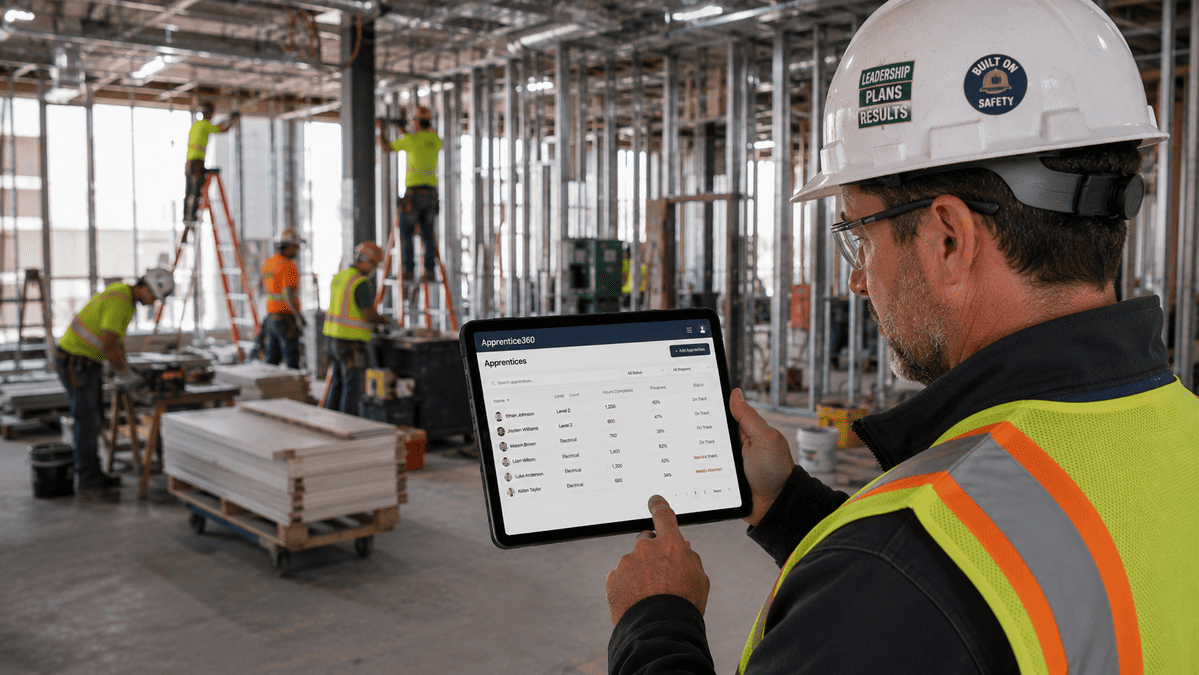
Digital tools can improve efficiency in managing construction training far beyond what spreadsheets and paper sign-in sheets allow. Modern platforms automate attendance tracking, course completion, OJT sign-offs, and compliance reporting – reducing the administrative burden that keeps many organizations from building structured programs.
Features that matter to construction professionals:
- Mobile access for field crews to log hours from the jobsite
- Competency matrices with mentor approvals and e-signatures
- Role-based dashboards so employers, sponsors, and training providers each see relevant data
- Integration with HR, payroll, and existing technology systems
- Export capabilities for RAPIDS, WIPS, and other compliance reporting
Successful adoption requires clear workflows and buy-in from field leaders. If a foreman sees the platform as extra paperwork with no benefit, adoption stalls. Show them how tracking helps with preparation for promotions, project assignments, and career advance opportunities.
Aligning Training with Construction Career Pathways and Apprenticeships
Construction education should connect to long-term career development – from pre-apprenticeship through project executive roles. No degree is required for many construction project management positions, which makes structured training pathways even more critical for helping people build expertise and advance.
NCCER offers a Construction Project Management Certification program, and the National Center for Construction Education offers a certification program that construction professionals use to validate existing skills. The PMDP consists of five courses for project managers. Candidates need a working knowledge of Microsoft Office and Windows 10, and many use a Pearson Vue testing center for certification exams.
For formal education and self-paced learning, Coursera offers construction management courses from top institutions, Udemy has over 150,000 courses available for various skills, and LinkedIn Learning offers construction management courses starting at $20/month. The Construction Project Management Course costs $499 or $150 in four payments, with typical completion time of 6–12 weeks. Graduates often finish the construction management course in 6–12 weeks, and graduates typically find jobs within 1 to 6 months.
Construction project management requires knowledge of construction materials and methods. Construction project management offers strong long-term job stability, making it a career worth investing in through continuing education and structured programs that help professionals stay relevant and enhance their LinkedIn profile.
Common Mistakes in Construction Training Management (and How to Avoid Them)
- One-off trainings not tied to projects: Fix by mapping each training session to a specific project phase or milestone in your work breakdown structure.
- No tracking of OJT hours: Fix by implementing centralized digital tracking with standardized task codes across all jobsites.
- Ignoring management skills and soft skills: Fix by including leadership, communication, and contract administration in every project manager’s development plan. Inadequate training in contract administration or cost control regularly leads to disputes, claims, and overruns.
- Failing to involve field leaders in training design: Fix by including superintendents and foremen in curriculum review – they know what the team actually needs on the job.
- Stale content that doesn’t reflect current codes or technology: Fix by scheduling annual reviews of safety and regulatory content, and research updates to software tools every 6–12 months.
Perform a quick internal audit of your current training processes against these pitfalls. Even one hour spent identifying gaps can prevent costly problems on your next construction project.
Why Choose a Dedicated Construction Training Management Platform
Specialized work-based learning and apprenticeship platforms offer advantages over generic learning systems for construction companies. They provide role-based curricula for apprentices, foremen, and project managers, along with job-specific OJT tracking tied to real projects and built-in support for compliance reporting to state and federal agencies.
A unified platform improves collaboration between employers, schools, training providers, and regulatory bodies overseeing Registered Apprenticeship Programs and internships. Instead of juggling spreadsheets, emails, and paper forms, every stakeholder accesses the same system with role-appropriate permissions.
When evaluating tools, focus on ease of use for field staff, integration with your existing business systems, and the ability to scale as your construction project portfolios grow. The right platform turns training from an administrative burden into a strategic resource that helps your organization build stronger teams and win more work.
Next Steps: Building a Modern Construction Training Management Program
Start with these actions:
- Assess current training: Audit what you track today and where gaps exist
- Define role-based competencies: Map skills required for each position from apprentice to project executive
- Align training to project outcomes: Tie every course and OJT assignment to measurable KPIs
- Implement tracking: Move from paper to a centralized platform that supports compliance and reporting
- Choose supporting technology: Select a platform built for construction workforce development, not repurposed corporate LMS tools
Pilot a structured training plan on a specific project starting in late 2026 to gather data and refine your approach. Involve field leaders from the beginning – their buy-in determines whether the program succeeds or collects dust.
Schedule an internal workshop or discovery session within the next 30 days to map out your training roadmap for upcoming construction projects. The demand for skilled construction professionals is not slowing down, and the organizations that develop their people systematically will be the ones that excel.
Want to Learn More About Your Registered Apprenticeship Opportunities?
BOOK A FREE CONSULTATION
FAQs About Construction Training Management
How much time should a construction project manager spend on training each week?
Early-career project managers might dedicate 2–4 hours per week to structured training during their first 6–12 months, then adjust based on project load. The best approach is to integrate training into existing routines – weekly coordination meetings and look-ahead planning sessions – rather than creating separate meetings that pull people off the job.
What is the best way to track OJT hours and competencies across multiple jobsites?
Centralized digital tracking via an apprenticeship management system captures real-time hours by task and project instead of relying on paper logs. Standardize task codes (layout, concrete forming, punch list, RFIs) so data is comparable across projects and crews, and ensure records are accessible to program sponsors and compliance auditors.
How can small contractors afford a structured construction training program?
Partner with local community colleges, unions, or workforce boards for access to low-cost or subsidized instruction. Use blended learning – short online modules plus targeted in-person coaching. Even a simple 90-day onboarding checklist and a handful of self-paced courses in scheduling, cost control, and safety can produce measurable benefits without a large budget.
Which topics should be prioritized for new construction project managers?
Focus on reading plans and specs, basic CPM scheduling, cost estimating fundamentals, change management, and effective communication with project teams and field crews. Sequence training so new hires start with safety and project communication, then progress to scheduling and cost control as they develop and take on more responsibility.
How often should training content be updated in the construction industry?
Safety and regulatory content should be reviewed at least annually or whenever codes and standards change. Software and technology training may need updates every 6–12 months. Collect feedback from project managers and superintendents after each major project to identify training gaps for the next cycle.
Can training really reduce change orders and claims on construction projects?
Not every change order can be avoided, but training in scope management, documentation, RFIs, and contract administration significantly reduces preventable changes and disputes. Track metrics like number of RFIs per million dollars of work and frequency of owner disputes before and after implementing a structured training program to sign whether improvements hold.