
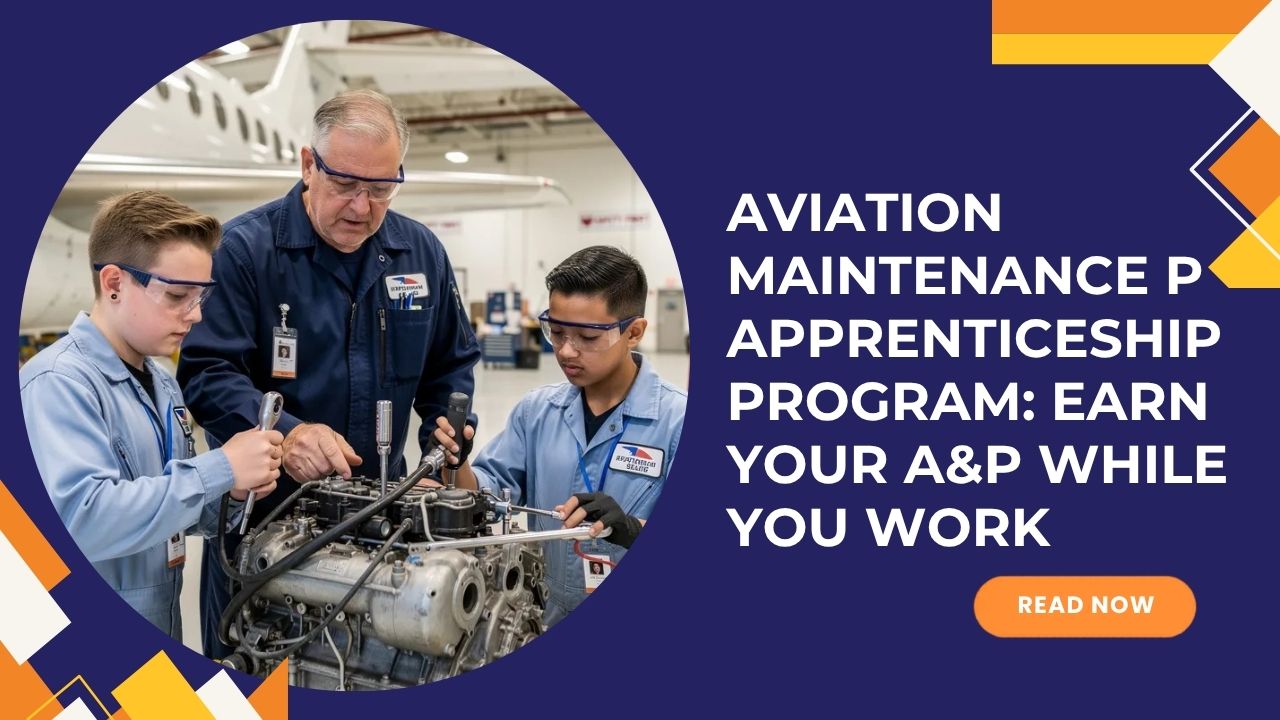
A P apprenticeship is a practical way to start an aviation career through an apprenticeship program that pays you while you train. If you are searching for an A P apprenticeship program, you are likely looking for a clear path into aircraft maintenance without taking on traditional school debt.
An Airframe and Powerplant (A&P) apprenticeship program is an employer-sponsored pathway to becoming a licensed aircraft mechanic that allows you to fulfill the Federal Aviation Administration (FAA) practical experience requirements while working a full-time, paid job.
Instead of spending 18–24 months in a 2-year aviation maintenance college and potentially paying tens of thousands in tuition, an A&P technician apprenticeship puts you in a real hangar, around real aircraft, learning from licensed mechanics. Later in this article, we’ll also link to our main apprenticeship program page so you can explore next steps.
Table of Contents
Scroll or click a heading to jump straight to answers about pay, schedule, FAA requirements, and career outcomes.
- What Is an Aviation Maintenance Technician Apprenticeship?
- How a P Apprenticeship Works Day to Day
- Program Length, Pay, and Benefits
- Training Curriculum: From Basic Tools to A&P Certification
- Eligibility Requirements and Application Timeline
- Career Path After Completing the Technician Apprenticeship
- Why Choose Our A&P Apprenticeship Program
- Frequently Asked Questions About Aviation Maintenance Apprenticeships
- Conclusion: Take the First Step Toward Your Aircraft Maintenance Career
What Is an Aviation Maintenance Technician Apprenticeship?
An aviation maintenance technician, also called an aircraft maintenance technician, inspects, repairs, services, and troubleshoots aircraft. This work can include airframe structures, engine systems, hydraulic equipment, landing gear, avionics, flight controls, fuel systems, and required maintenance documentation.
A registered technician apprenticeship is structured job training. You work under licensed A&P mechanics, complete classroom or workbook instruction, and gradually build the technical experience required to become a safe, capable mechanic.
Most aviation apprenticeship programs last between 30 to 36 months and provide a combination of on-the-job training and classroom instruction. Registered apprenticeship programs in aviation are approved by the U.S. Department of Labor and require a minimum of 5,360 hours of training, which is approximately 2.5 years.
There is no single, government-run national trade apprenticeship for aviation maintenance; individual aviation companies partner with the U.S. Department of Labor and local FAA Flight Standards District Offices to host structured programs. In other words, you apply to a company, not to one national government program.
The goal is simple: help you get the experience, education, and support needed for FAA Airframe and Powerplant certification. Completing an aviation apprenticeship can lead to a career as an Aircraft Maintenance Technician (AMT), which involves ensuring the safety and mechanical reliability of aircraft as a powerplant mechanic.
Apprenticeship vs. Aviation Maintenance School
A traditional aviation maintenance school can be a strong route, especially for students who prefer a classroom-first environment. The FAA A&P certification requires a minimum of 1,900 hours of training for those who complete an FAA-approved program, or 30 months of practical experience for those who do not attend a formal program.
An apprenticeship is different because you are an employee. You are paid to work, learn, and build documented experience in an actual aircraft maintenance environment.
| Path | Typical Time | Cost Structure | Training Environment | Outcome |
|---|---|---|---|---|
| FAA-approved aviation maintenance school | Often 18–24 months | Tuition, fees, tools | Classroom and lab | Eligibility for FAA exams |
| A&P apprenticeship | Often 30–36 months | Paid employment, lower school debt | Real aircraft and shop work | FAA exam eligibility plus work experience |
Many aviation apprenticeship programs combine on-the-job training with classroom instruction, often leading to an associate’s degree and full-time employment upon completion. That makes the p apprenticeship route especially attractive for people who want to start earning sooner.
How a P Apprenticeship Works Day to Day
A typical week for an apprentice may look like a full-time Monday–Friday schedule with about 40 hours split between hangar work, classroom sessions, workbook assignments, and supervised maintenance tasks. Depending on the operation, some weeks may include shift work, weekend coverage, or support during peak service periods.
Apprentices shadow experienced aircraft maintenance technicians during line maintenance, routine inspections, scheduled checks, and repair tasks. Early on, the focus is not speed. It is safety, accuracy, tool control, documentation, and learning how professional aviation maintenance teams make decisions.
How Apprentices Build Responsibility
Most apprentices start with foundational tasks, such as:
- Preparing and tracking tools
- Cleaning and organizing work areas
- Assisting with panels, interiors, and access points
- Reading maintenance manuals and technical drawings
- Completing basic documentation
- Learning safety procedures around aircraft, equipment, and air operations
As your skills grow, you may work on more complex procedures under close supervision. That can include airframe inspections, powerplant systems, turbine engine theory, fluid servicing, component removal and installation, corrosion checks, troubleshooting, and avionics basics.
Apprentices learn to work on aircraft types common in the employer’s fleet, such as Boeing 737, Airbus A320, business jets, regional aircraft, or other aircraft maintained by the company.
Mentors play a major role. A supervising licensed A&P mechanic checks your work, answers questions, reviews your progress, and signs off milestones. Apprentices must log every maintenance task performed, including dates, aircraft tail numbers, and component serial numbers, and have the logbook signed by a supervising licensed A&P mechanic.
That logbook matters. Poor documentation can delay certification even when the apprentice has done the hands-on work.

Program Length, Pay, and Benefits
Apprenticeship programs in aviation typically last between 30 to 36 months, providing a structured pathway for individuals to gain hands-on experience and training. Some registered programs use a 5,360-hour schedule, while FAA practical experience rules also recognize the 30-month path for combined airframe and powerplant experience.
Many apprenticeship programs offer competitive starting wages and various employment benefits including health insurance and retirement plan contributions.
Here is a realistic example of how pay may progress:
| Stage | Example Pay |
|---|---|
| Starting apprentice wage | Approximately $17 per hour |
| Milestone increases | Potential increases of $1 per hour every six months |
| Total apprentice pay over training | Around $95,000 over the course of the apprenticeship |
| After A&P certification | Minimum starting wage may increase to approximately $26 per hour |
Apprentices in aviation maintenance can earn a starting wage of approximately $17 per hour, with potential increases of $1 per hour every six months as they reach training milestones. The total pay an apprentice can expect to receive during their training period can amount to around $95,000 over the course of the apprenticeship.
This is the major financial difference between an apprenticeship and school. Instead of paying $40,000–$60,000 in aviation school tuition, an apprentice can earn wages while building experience.
Common benefits may include:
- Health insurance
- Paid time off
- Retirement plan contributions
- Tool purchase assistance
- Flight benefits where applicable
- Covered or reimbursed FAA exam fees
- Structured raises based on performance and training milestones
After obtaining their Airframe & Powerplant (A&P) certification, apprentices can see their minimum starting wage increase to approximately $26 per hour. From there, pay can grow with aircraft type experience, shift differentials, inspection authorization, leadership roles, and specialized repair skills.
Training Curriculum: From Basic Tools to A&P Certification
The training curriculum combines classroom instruction, self-paced learning, and supervised shop work on real aircraft. This balance helps you understand both the theory and the hands-on repair practices that aircraft maintenance requires.
Core subject areas often include:
- Airframe structures and materials
- Hydraulics and pneumatics
- Landing gear systems
- Powerplant systems
- Turbine engine theory
- Reciprocating engine basics
- Fuel, oil, and ignition systems
- Avionics basics
- Electrical fundamentals
- Regulations and technical documentation
- Weight and balance
- Maintenance forms, records, and logbooks
The curriculum is mapped to FAA Part 65 experience expectations, so apprentices are prepared for the Airframe and Powerplant written, oral, and practical exams. According to the FAA aviation mechanic requirements, applicants must meet age, language, experience, and testing standards before certification.
To obtain FAA A&P certification, candidates must pass a series of written, oral, and practical exams administered by the FAA. The FAA A&P certification is recognized nationwide and is essential for individuals seeking to work as aircraft maintenance technicians in the aviation industry.
A strong apprenticeship program also keeps detailed work process schedules and training records. These records support internal quality standards and, when applicable, U.S. Department of Labor apprenticeship guidelines. The department of labor framework is designed to make training more consistent, measurable, and portable.
Many apprenticeships also provide exam prep support near the end of the program, such as:
- Review classes
- Practice written tests
- Oral and practical coaching
- Study plans
- Scheduled exam days
- Help organizing FAA experience records and information
That support can make a real difference when you are ready to take the next step.
Eligibility Requirements and Application Timeline
Applicants must be at least 18 years old, be able to read, write, speak, and understand English, and possess a high school diploma or GED to become an aviation mechanic, per general FAA requirements.
You must pass TSA and Department of Transportation drug screenings and background checks to secure airport security clearance badges prior to becoming an aviation mechanic. Some employers may also require physical ability checks because the work can involve standing, lifting, climbing, reaching, and working around active airport operations.
Strong candidates usually show:
- Mechanical aptitude
- Comfort using tools
- Attention to detail
- A safety-first mindset
- Willingness to work nights, weekends, or holidays when operations require
- Interest in aviation, aircraft, and technical systems
- Ability to learn from feedback and apply new procedures
- Reliability and professionalism
Prior experience is helpful, but it is not always required. Automotive repair, military maintenance, manufacturing, welding, electronics, robotics, construction, or shop classes can all show useful mechanical ability. Military veterans and candidates with prior technical experience are often strongly encouraged to apply and may receive credit for relevant skills where the program allows it.
A typical application process may include:
- Online application
- Resume submission
- Mechanical or technical aptitude assessment
- Behavioral interview
- Background check
- Drug screening
- Airport badge clearance process
- Formal apprentice agreement and start date
A sample annual timeline may look like this:
| Step | Example Timing |
|---|---|
| Applications open | Spring |
| Interviews begin | Early summer |
| Offers made | Mid-summer |
| Cohort starts | August or September |
| First milestone review | After 6 months |
If you are ready to apply, prepare a resume that shows your hands-on experience, even if it comes from school, hobbies, volunteer projects, automotive work, or home repair.
Career Path After Completing the Technician Apprenticeship
Successful completion of the apprenticeship and FAA A&P certification can lead to full-time roles as aircraft maintenance technicians or aviation maintenance technicians. After completing an aviation apprenticeship and obtaining FAA A&P certification, individuals can expect to receive job placement assistance and opportunities for career advancement within the aviation industry.
Your first job after graduation may include:
- Line maintenance technician
- Hangar mechanic
- Heavy check technician
- Structures technician
- Engine shop technician
- Avionics support technician
- Component repair technician
From there, the career path can expand. Experienced p mechanics and A&P technicians may move into lead mechanic roles, inspection, quality assurance, maintenance control, technical training, planning, or maintenance management.
The demand is broad because aircraft maintenance is needed across:
- Airlines
- Cargo operators
- MRO facilities
- Corporate flight departments
- Charter operators
- Manufacturers
- Regional aviation companies
- Government and special mission fleets
Think of the technician apprenticeship as the foundation for a long career, not just an entry-level job. The first year teaches habits. The second year builds skill. The third year helps you become ready for certification and full responsibility.
Why Choose Our A&P Apprenticeship Program
We build our A&P apprenticeship program around safety, quality aircraft maintenance, and long-term technician development. Our goal is not only to help you get certified, but to help you become the kind of aviation maintenance technician that teams trust around aircraft, tools, documentation, and customers.
You should not have to guess what comes next. A strong apprenticeship provides clear expectations, structured training, and support from people who understand the industry.
What sets our program apart:
- Registered status with the U.S. Department of Labor where applicable
- Direct supervision by experienced A&P mechanics
- Structured raises tied to training milestones
- Covered or reimbursed FAA exam fees where offered
- Clear promotion pathways after certification
- Exposure to real aircraft, real systems, and real maintenance operations
- Support from a recruiting and training team that can answer questions before you start
Our apprenticeship program provides a transparent roadmap from entry-level apprentice to fully qualified aviation maintenance technician.
If you are looking for stable employment, hands-on learning, and a future in aviation, this is an opportunity worth exploring.
Want to Learn More About Your Registered Apprenticeship Opportunities?
BOOK A FREE CONSULTATION
Frequently Asked Questions About Aviation Maintenance Apprenticeships
How long does the technician apprenticeship take?
Most aviation maintenance apprenticeships take 30 to 36 months. Registered programs may require at least 5,360 hours of training, which is approximately 2.5 years, depending on the work schedule and program design.
Do I get paid while I train?
Yes. Apprentices are employees, so they get paid while completing job training. A starting wage may be approximately $17 per hour, with potential $1 per hour increases every six months as training milestones are completed.
Do I need experience before I apply?
Not always. Many programs are designed for entry-level applicants. However, mechanical experience, technical school classes, military service, automotive repair, or hands-on hobbies can make your application stronger.
What hours will I work as an apprentice?
Many apprentices work a full-time schedule of about 40 hours per week. The exact shift depends on the company, maintenance operation, aircraft schedule, and training plan.
Will I work nights, weekends, or holidays on aircraft maintenance?
Possibly. Aviation is a 24/7 industry. Some apprentices may work day shift at first, while others may rotate through evenings, weekends, or holidays as they gain experience and support live maintenance operations.
Will this program qualify me to sit for my FAA Airframe and Powerplant exams?
A properly structured A&P apprenticeship is designed to help you meet FAA practical experience requirements. You still must pass the required FAA written, oral, and practical exams before earning certification.
Do I need to buy my own tools?
Some companies provide starter tools, tool allowances, or purchase assistance. Others may require apprentices to buy tools from an approved starter list. Always ask what is included before you accept an offer.
What is the difference between an AMT and an A&P mechanic?
An aircraft maintenance technician, or amt, is a broad job title. An A&P mechanic is an aircraft mechanic who holds FAA Airframe and Powerplant ratings. Many AMT jobs require or strongly prefer the A&P certificate.
Conclusion: Take the First Step Toward Your Aircraft Maintenance Career
A P apprenticeship allows you to earn, learn, and build a long-term aviation maintenance career at the same time. You get paid work experience, hands-on training, mentorship from licensed A&P technicians, and a clear path toward FAA certification.
The benefits are practical: full-time pay, real aircraft maintenance experience, structured support, and a future in an industry that depends on skilled technicians to keep aircraft safe and ready for flight.
If you are ready to start, review the eligibility requirements, prepare a resume that highlights your mechanical interest, and explore the next open cohort. Contact our recruiting team, join the mailing list, or visit our dedicated apprenticeship page to find current opportunities and take the first step toward your aircraft maintenance career.