Table of Contents
- Why Most Apprenticeship Programs Underdeliver — and It Is Not a Talent Problem
- The Core Challenges Businesses Face Without a Structured System
- What Professional Apprenticeship Management Actually Involves
- Compliance and Reporting: The Pillar Most Programs Get Wrong
- How a Purpose-Built Platform Transforms Apprenticeship Administration
- How GoSprout Addresses the Full Apprenticeship Management Lifecycle
- Conclusion: From Administrative Burden to Strategic Workforce Advantage
- Frequently Asked Questions
Why Most Apprenticeship Programs Underdeliver — and It Is Not a Talent Problem
Apprenticeship programs fail quietly. Not through dramatic dropout events or headline compliance failures, but through the slow accumulation of administrative friction that makes a well-designed program increasingly difficult to run. The apprentices are often capable. The mentors are often committed. What breaks down is the infrastructure underneath.
The Infrastructure Gap: How Good Intentions Fail Without the Right Systems
Most programs launch with genuine organizational intent — a structured development path, clear role expectations, a defined timeline. What they rarely launch with is a system capable of sustaining that structure as the program runs. Enrollment details live in inboxes. Progress notes accumulate in personal folders. Compliance documentation gets assembled retroactively when someone asks for it.
The gap between what a program is designed to deliver and what it actually delivers is almost always an infrastructure gap, not a talent gap. Coordinators spend their time managing information instead of managing outcomes. Mentors receive inconsistent guidance. Apprentices experience a program that feels improvised rather than intentional, because operationally, it is.
The Hidden Cost of Spreadsheet-Based Program Administration
Spreadsheets are not a neutral choice. They carry real operational costs that compound over time and rarely appear as a single line item.
What Manual Tracking Actually Costs Coordinators
A coordinator managing ten apprentices across a spreadsheet-based system is not managing ten records. They are managing ten separate communication threads, ten sets of manual updates, ten reminders to submit documentation, and the inevitable errors that occur when information is entered, re-entered, and reconciled across multiple files. Knowledge workers consistently report spending a significant portion of their workweek managing information rather than acting on it. For apprenticeship coordinators, that ratio tends to run higher.
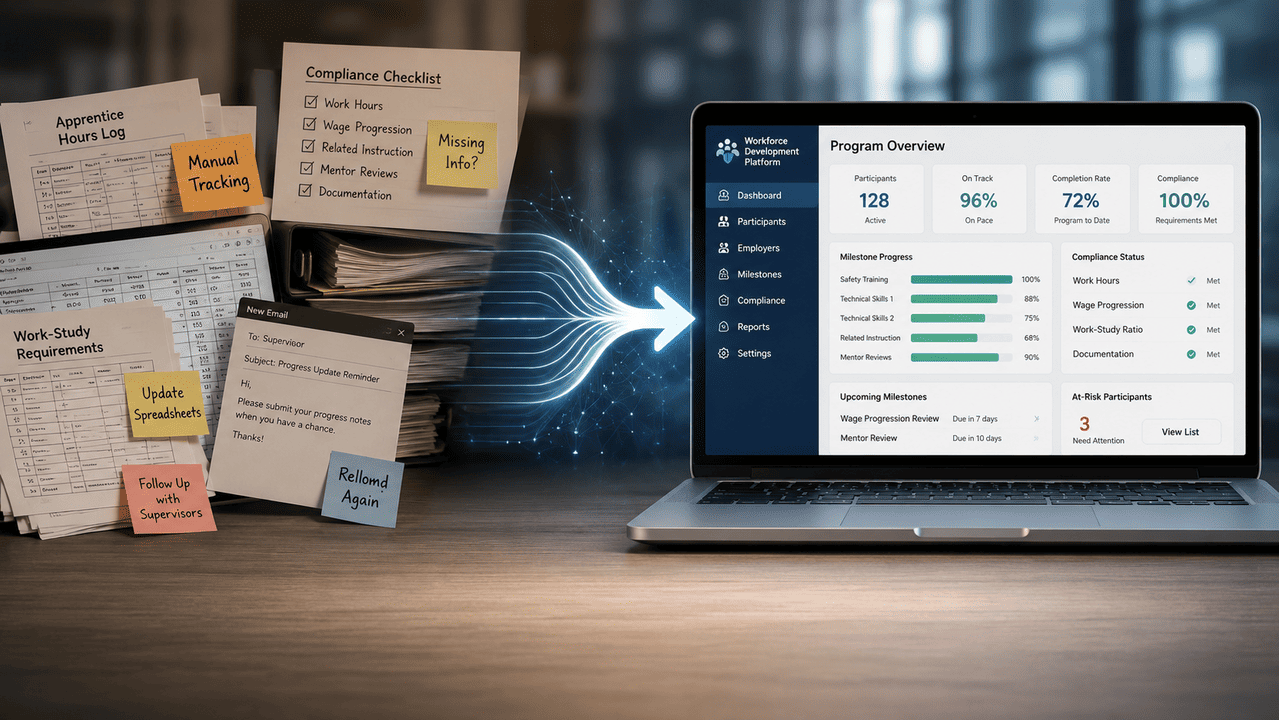
The hours lost to manual tracking are hours not spent on quality reviews, mentor coaching, or program improvement — the work that actually determines whether an apprentice succeeds.
The Audit Trail That Spreadsheets Cannot Provide
Registered apprenticeship programs operate under Department of Labor (DOL) oversight and require documented evidence of structured training, wage progression, and work-based learning hours. A spreadsheet can store numbers. It cannot enforce documentation standards, flag incomplete records, or produce a timestamped audit trail that demonstrates consistent compliance over the life of a program. When an audit occurs or a dispute arises, the question is not whether the information exists somewhere. It is whether it can be produced in a form that demonstrates intentional, systematic program management.
Spreadsheets fail that test routinely.
What Apprenticeship Management Actually Encompasses
Apprenticeship management is the full operational function of running a registered or structured apprenticeship program from initial candidate enrollment through to documented program completion. That scope includes candidate pipeline management, structured onboarding, competency tracking, work-based learning hour documentation, mentor coordination, wage progression records, RAPIDS reporting, and outcome tracking.
Each of these functions exists in every program. The difference between a managed program and an ad hoc one is whether those functions run on a defined system or on whoever happens to remember to do them. A purpose-built apprenticeship management system consolidates these functions into a single platform, replacing the distributed patchwork of spreadsheets, emails, and shared drives that most programs currently rely on.
Why the Status Quo Breaks Down at Scale
A coordinator managing three apprentices can hold most of the program in their head. At ten, cracks appear. At twenty or more, the system collapses under its own weight: missed check-ins, inconsistent documentation, and compliance gaps that accumulate invisibly until they become urgent.
Scale is where the cost of ad hoc management becomes undeniable, but the problems begin well before scale. Every manual process contains a failure mode. The question is not whether the current approach will cause problems, but how large those problems will need to become before the organization decides to address them.
Spreadsheet-Based Management vs. a Dedicated Apprenticeship Management Platform
The table below compares ad hoc management against a structured platform across five operational dimensions. Use it to identify where your current program is most exposed.
| Dimension | Spreadsheet / Ad Hoc Management | Dedicated Platform |
|---|---|---|
| Administrative effort | High. Coordinators manually update records, chase documentation, and reconcile information across multiple files. Each new cohort adds proportional overhead. | Low. Enrollment, progress updates, and reporting are centralized. Coordinators manage by exception rather than by data entry. |
| Compliance readiness | Inconsistent. Documentation depends on individual diligence. Audit trails are absent or reconstructed after the fact. RAPIDS reporting is a manual, error-prone process. | Consistent. The platform enforces documentation requirements, maintains timestamped records, and supports RAPIDS alignment by design. |
| Progress visibility | Limited. Competency status is updated when someone remembers to update it. Coordinators have no real-time view of where each apprentice stands. | Clear. Progress dashboards surface competency gaps, missed milestones, and at-risk apprentices before they become retention problems. |
| Scalability | Poor. Adding cohorts multiplies manual workload. Growth requires proportional headcount increases in administration. | Strong. A structured platform scales to support additional cohorts without proportional increases in coordinator time. |
| Program outcome tracking | Absent or anecdotal. Completion rates, retention figures, and workforce contribution metrics are rarely captured in any consistent format. | Structured. Outcome data is captured throughout the program lifecycle, enabling evidence-based improvement and stakeholder reporting. |
The dimension where most programs feel the gap first is administrative effort — the daily weight of manual tracking. The dimension where the consequences are most serious is compliance readiness. The two are directly connected: when coordinators are consumed by data entry, compliance documentation is the first thing that slips.
The Core Challenges Businesses Face Without a Structured System
The operational failure modes of unstructured apprenticeship program administration do not occur in isolation. They interact. A fragmented onboarding process produces an apprentice who never fully understands their role. An apprentice who lacks role clarity shows inconsistent performance. An apprentice whose performance goes untracked develops competency gaps that go unaddressed. A program that cannot demonstrate structured development loses its best candidates to attrition — and cannot explain why.
Fragmented Onboarding Workflows and the Candidate Experience Cost
First impressions in apprenticeship programs carry lasting weight. An apprentice who spends their first two weeks waiting for system access, receiving inconsistent information about expectations, or completing paperwork manually across disconnected channels does not conclude that the organization is busy. They conclude that the program is not serious.

Fragmented onboarding workflows are the most visible symptom of unstructured program management. When onboarding tasks live across email threads, shared drives, and verbal instructions, coordinators duplicate effort and candidates receive an inconsistent experience. The organizations that run the strongest apprenticeship programs treat intern onboarding as a structured workflow with defined steps, assigned owners, and completion tracking — not as a checklist someone emails on the first day.
Progress Tracking Without Structure: Why Competency Gaps Go Undetected
Competency-based apprenticeship programs require regular assessment against defined skill benchmarks. Without a structured tracking system, those assessments happen informally at best and not at all at worst. Mentors provide feedback verbally. Progress is assumed rather than verified. By the time a competency gap surfaces as a performance problem, weeks or months of development time have been lost.
Structured progress tracking is not bureaucratic overhead. It is the mechanism that allows coordinators and mentors to intervene early, adjust training delivery, and ensure apprentices are actually developing the capabilities the program was designed to build.
Compliance and Documentation Failures: The Regulatory Blind Spot
Registered apprenticeship programs are not self-certifying. They require ongoing documentation that demonstrates compliance with DOL standards throughout the program lifecycle — not just at registration.
What DOL Registration and RAPIDS Reporting Actually Require
The DOL’s Registered Apprenticeship Partners Information Data System (RAPIDS) requires employers to submit regular updates on apprentice status, hours worked, wage progression, and program completion. These are not optional filings. They are the documented record that a registered program is operating as approved. Incomplete or inaccurate RAPIDS submissions can trigger compliance reviews, jeopardize program registration, and in some cases affect access to workforce development funding.
Beyond RAPIDS, DOL-registered programs must maintain written apprenticeship agreements, documented on-the-job training hours, related technical instruction records, and evidence of wage increases tied to skill progression.
Why Manual Processes Cannot Reliably Enforce These Requirements
Compliance is a system problem, not a motivation problem. Coordinators who manage documentation manually are not negligent — they are operating without tools capable of enforcing the standards the program requires. Manual processes have no built-in triggers to flag missing documentation, no audit trail that demonstrates consistent record-keeping, and no mechanism to ensure that every apprentice’s record meets the same standard. A single coordinator departure or a period of high administrative load is enough to create compliance gaps that are difficult to reconstruct.
Why Apprentices Quit — and How Program Disorganization Contributes
Apprentice attrition is rarely attributed to program disorganization in exit interviews. Departing apprentices typically cite role fit, compensation, or career direction. But the conditions that accelerate those decisions — feeling unsupported, receiving inconsistent feedback, lacking visibility into their own progress — are conditions that structured program management directly addresses.
An apprentice who receives timely check-ins, clear competency milestones, and responsive coordination is an apprentice who feels invested in. Disorganized programs signal the opposite, even when the underlying intent is strong. Research on voluntary attrition in apprenticeship programs consistently points to the same cluster of factors: unclear expectations, insufficient feedback, and a sense that the program is not being actively managed on the apprentice’s behalf.
The False Choice Between DIY Management and Fully Outsourced Consulting
Many organizations frame their options as a binary: either manage the program internally with existing tools, or hand the entire function to an external consulting firm. Both options carry significant trade-offs. Full outsourcing transfers program control along with administrative burden, which means the organization loses visibility into its own workforce development pipeline. Internal management with ad hoc tools retains control but produces the operational problems described throughout this article.
A more accurate framing is a third path: a purpose-built platform that gives internal coordinators the infrastructure to manage their own program with professional-grade structure, compliance enforcement, and outcome visibility. That is what a well-designed apprenticeship management system provides — not a replacement for your team’s judgment, but a system capable of supporting it at scale.
What Professional Apprenticeship Management Actually Involves
Running an apprenticeship program well requires managing five distinct operational stages simultaneously. Most coordinators are aware of these stages in theory. What they lack is a system that holds them together in practice.
The Full Program Lifecycle: From Sourcing to Completion Documentation
The apprenticeship program lifecycle is longer and more structured than most organizations account for at the outset. Each stage carries its own administrative requirements, and a failure at any stage creates problems downstream.
Stage One: Candidate Pipeline Management and Program Registration
Before an apprentice starts, the program itself must be registered with the Department of Labor or a State Apprenticeship Agency. This involves submitting a Standards of Apprenticeship document that defines the occupation, training structure, wage schedule, and equal opportunity policy. Simultaneously, coordinators must manage candidate sourcing, application screening, and selection workflows — processes that are rarely linked to registration in any systematic way when programs rely on ad hoc tools.
Stage Two: Structured Onboarding and Role Orientation
Onboarding in a registered program is not just HR paperwork. It includes executing the apprenticeship agreement, confirming related technical instruction enrollment, and establishing the mentor relationship with documented expectations. Each of these steps has a defined owner and a completion dependency. Without a structured intern onboarding workflow, they happen in whatever order happens to be convenient — which means some of them do not happen at all.
Stage Three: Mid-Program Progress Reviews and Competency Assessment
Competency-based programs require periodic evaluation against defined skill benchmarks. Time-based programs require documented hours and satisfactory performance reviews at set intervals. Either model requires scheduled check-ins, documented assessments, and a mechanism for flagging apprentices who are falling behind. In practice, this is the stage where the most program value is created or lost — and it is the stage most likely to be informal or inconsistently executed.
Stage Four: Time Tracking, Attendance, and Work-Based Learning Logs
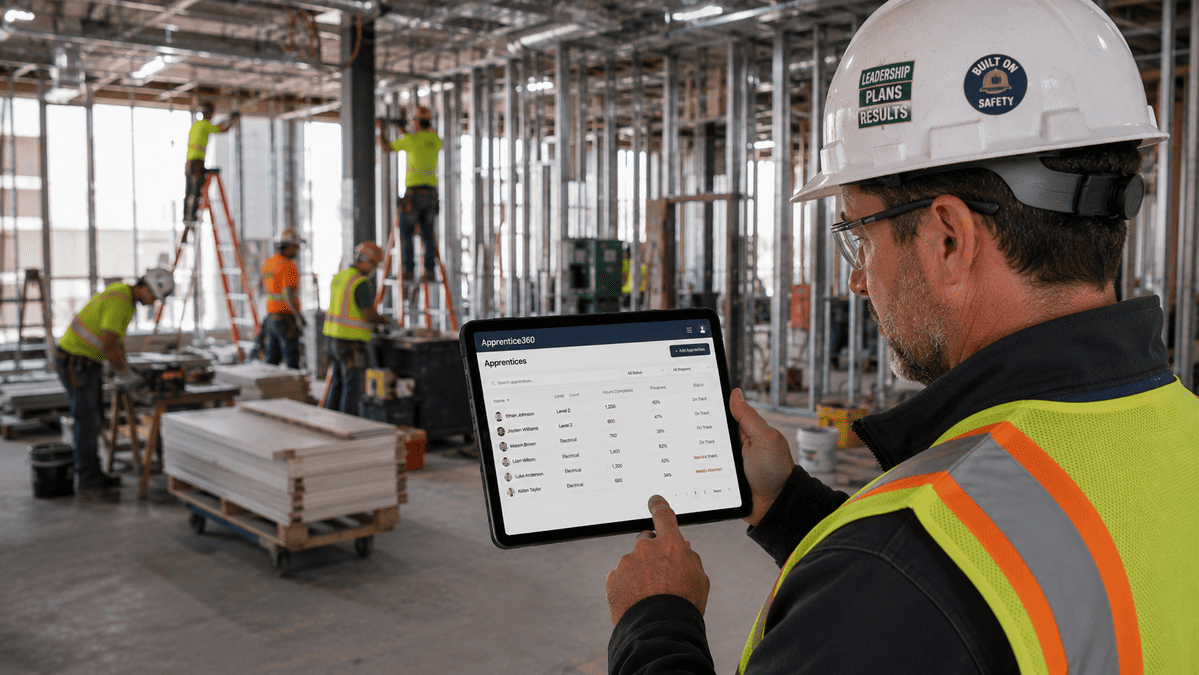
DOL-registered programs require documented on-the-job training (OJT) hours that correspond to the approved training outline. These records must be accurate, current, and attributable to specific competency areas. Manual time tracking via spreadsheet or paper log introduces errors, creates reconciliation work, and produces records that rarely survive an audit intact.
Stage Five: Compliance Reporting, Program Completion, and Outcome Documentation
Program completion requires more than an apprentice finishing their hours. It requires a completion certificate, a final competency sign-off, updated RAPIDS records reflecting program status, and documented wage progression through all approved levels. These closing requirements are straightforward when records have been maintained throughout the program. When they have not, the final stage becomes a reconstruction project.
The Four Types of Apprenticeship Programs and Why Management Complexity Varies
The DOL recognizes four primary apprenticeship program structures: time-based, competency-based, hybrid, and related technical instruction (RTI)-integrated models. Time-based programs define completion by hours. Competency-based programs define completion by demonstrated skill. Hybrid programs combine both. RTI-integrated models incorporate formal classroom or online instruction alongside OJT.
Each model carries a different documentation burden. Competency-based programs require detailed assessment records. Hybrid programs require coordinators to track hours and competencies simultaneously. RTI-integrated programs add training provider coordination to the administrative load. A system built for one model may not handle another well — which matters when an organization runs multiple program types or needs to adapt its structure over time.
How Long It Takes to Set Up a Program — and Where Time Is Actually Lost
Initial DOL registration typically takes between 60 and 90 days when the process moves smoothly. In practice, delays are common and almost always trace to the same causes: incomplete Standards documentation, inconsistent wage schedules, missing equal opportunity procedures, or back-and-forth with the sponsoring agency over training outline specifics.
After registration, setup time expands further when coordinators must build onboarding workflows from scratch, configure whatever tracking systems they plan to use, and brief mentors on documentation expectations. The actual administrative setup of a new program — separate from the registration process itself — is rarely factored into launch timelines. It should be.
Workforce Development Management as a Strategic Business Function
Apprenticeship programs that survive long enough to produce consistent outcomes share one structural trait: someone in the organization treats program management as a defined function, not a secondary responsibility.
When program coordination is distributed across HR, operations, and individual managers without a single owner or supporting system, accountability diffuses. When it is treated as a strategic workforce development management function with dedicated tools and defined processes, programs produce measurable outcomes: reduced time-to-productivity, lower turnover in skilled roles, and a documented pipeline of trained internal talent. The organizations seeing those outcomes are not necessarily running larger programs. They are running more structured ones.
Compliance and Reporting: The Pillar Most Programs Get Wrong
Most programs that lose their DOL registration or face compliance review did not intend to fall out of compliance. They simply did not have a system capable of maintaining it.
Understanding the Regulatory Landscape for Registered Apprenticeship Programs
Registered apprenticeship programs operate under Title 29 CFR Parts 29 and 30, which govern program standards and equal employment opportunity requirements respectively. Compliance is not a one-time event at registration. It is an ongoing obligation that requires consistent documentation throughout the program’s life. Sponsors must maintain apprenticeship agreements, OJT records, RTI records, wage progression documentation, and evidence of equal opportunity practices — all accessible and attributable on request.
State-registered programs carry additional requirements that vary by jurisdiction. Organizations operating across multiple states may be managing compliance obligations under more than one regulatory framework simultaneously.
What a Compliant Audit Trail Requires — and What Most Businesses Are Missing
A compliant audit trail is not a folder of records. It is a sequence of timestamped, attributable documentation that demonstrates continuous, intentional program management. Auditors specifically look for the following:
- Signed apprenticeship agreements for every enrolled apprentice
- OJT hour logs that align with the approved training outline
- Documented wage increases corresponding to progression milestones
- RTI completion records, including provider, course, and hours
- RAPIDS entries that reflect current apprentice status throughout the program
What most businesses are missing is not the intent to maintain these records. It is the infrastructure that ensures records are created at the right time, by the right person, in a format that holds up under review. When records are assembled retroactively or reconstructed from emails and calendar notes, the audit trail demonstrates exactly the kind of informal management that compliance standards are designed to prevent.
How to Measure Apprenticeship Program Success With Structured Data
A program cannot improve what it does not measure. The organizations that run strong apprenticeship programs track both leading and lagging indicators, and they use that data to make decisions mid-program, not just at completion.
Leading Indicators: Engagement, Competency Progression, and Attendance
Leading indicators reflect program health in real time. They include apprentice attendance rates, competency assessment completion rates, time between scheduled check-ins, and mentor engagement frequency. A drop in any of these signals is a warning worth investigating before it becomes an attrition event.
These indicators are only visible when data collection is structured. If check-ins happen informally and progress notes live in a mentor’s personal files, coordinators have no early warning system.
Lagging Indicators: Completion Rates, Retention, and Workforce Contribution
Lagging indicators measure program outcomes after the fact. Completion rates, 90-day post-completion retention, time-to-full-productivity in the target role, and internal promotion rates are the metrics that justify the program’s operational cost to leadership. They are also the metrics that most programs cannot produce on demand because no one was capturing them consistently.
Structured data collection throughout the program lifecycle makes these figures available without requiring a manual audit at the end of each cohort.
Transitioning From Ad Hoc Processes to Centralized Compliance Management
The transition from ad hoc processes to centralized compliance management is less disruptive than most coordinators expect, provided it is sequenced correctly. The highest-return first step is consolidating documentation into a single system before attempting to automate anything. Programs that try to automate fragmented processes simply automate the fragmentation.
A practical transition follows three phases: audit current records to establish a compliance baseline, migrate active apprentice data into a centralized platform, and then build forward-facing workflows around the platform’s enforcement mechanisms. Active programs do not need to pause. They need a clear data handoff point and a coordinator who owns the migration process.
How a Purpose-Built Platform Transforms Apprenticeship Administration
The gap between what spreadsheet management can deliver and what a dedicated apprenticeship management system provides is not incremental. It is structural.
Centralized Enrollment and Onboarding: Replacing the Email Thread Workflow
A purpose-built platform replaces the enrollment email thread with a structured intake workflow. Apprenticeship agreements, role documentation, and compliance acknowledgments are collected through a defined sequence with completion tracking. Coordinators see what is done, what is pending, and who is responsible. Candidates receive a consistent experience regardless of which coordinator manages their onboarding.
This alone eliminates a significant category of coordinator effort — the time spent chasing paperwork, resending documents, and manually confirming that required steps have been completed.
Automated Progress Tracking and Competency Management in Practice

Competency tracking in a structured platform works through defined assessment templates assigned to each apprentice based on their program type. Mentors complete assessments through the platform. Results are recorded automatically, linked to the apprentice’s profile, and surfaced on a coordinator dashboard. When a competency falls behind schedule, the system flags it. The coordinator acts on a signal rather than discovering the gap at a quarterly review.
This model shifts the coordinator’s role from data collector to program manager.
Compliance Enforcement by Design: Audit Trails, RAPIDS Alignment, and Reporting
A well-designed apprenticeship management system does not just store compliance records. It enforces compliance requirements as a function of normal program operation. OJT hours are logged through the platform and tied to training outline categories. Wage progression milestones trigger documentation prompts. RAPIDS-aligned reporting pulls from records that have been maintained throughout the program rather than assembled at the end.
The audit trail is not a separate process. It is a byproduct of using the system correctly.
Building a Scalable Talent Pipeline With Structured Tooling
Scaling an apprenticeship program on a spreadsheet-based system requires proportional increases in coordinator time. Scaling on a structured platform does not. The workflows, templates, and compliance requirements are already built. Adding a new cohort means enrolling new apprentices into existing processes, not rebuilding the administrative infrastructure from scratch.
Organizations that want to grow their programs — whether from five apprentices to twenty or from one location to several — need a system that separates program scale from administrative overhead. That separation only happens with structured tooling.
Integration With Training Management Systems and Existing HR Infrastructure
Apprenticeship programs do not operate independently of the rest of an organization’s HR and training infrastructure. Related technical instruction may be delivered through a training management system. Payroll integration may be required for wage progression documentation. HR information systems may already hold employee records that apprentice profiles should connect to.
A purpose-built apprenticeship management system should integrate with these systems rather than require coordinators to maintain parallel records across platforms. Integration reduces duplicate data entry, keeps records consistent, and ensures that the apprenticeship program operates as part of the broader talent infrastructure rather than alongside it.
How to Migrate From Spreadsheets Without Disrupting Active Programs
Migration is the concern that keeps most coordinators on spreadsheets longer than they should be. The practical reality is that migration does not require a program pause. It requires a structured data export, a clean import into the new platform, and a defined cutover date after which new records are created in the system and historical records are archived for reference.
The critical step is data validation before cutover. Coordinators should confirm that OJT hours, competency records, and apprentice status fields transfer accurately before the new system becomes the system of record. A phased approach — migrating one cohort fully before transitioning others — reduces risk and gives coordinators time to build confidence in the new workflows before the entire program depends on them.
How GoSprout Addresses the Full Apprenticeship Management Lifecycle
The platform decisions that matter most in apprenticeship management are not the ones that affect how a program looks on paper. They are the ones that determine whether the program can actually be run by the people responsible for it, at the scale they need, without breaking down under compliance pressure or administrative weight.
An End-to-End Platform Built for Both Employers and Program Participants
GoSprout is built around a structural premise that most apprenticeship tools miss: both the employer and the apprentice need a functional interface with the program, and those interfaces serve different purposes.
For employers and coordinators, GoSprout centralizes the full program lifecycle — from candidate enrollment and onboarding through competency tracking, time logging, compliance documentation, and program completion. For apprentices, it provides clear visibility into their own progress, upcoming milestones, and program expectations. That dual-sided design matters because one of the most consistent drivers of early attrition is apprentices feeling disconnected from their own development path. A platform that only serves the coordinator’s administrative needs does not solve that problem.
The result is a system where program management and participant experience reinforce each other rather than operate in parallel.
Removing Administrative Overhead Without Outsourcing Program Control
The concern most coordinators carry into a platform evaluation is losing control — that adopting a structured system means either surrendering program decisions to software logic or handing off program ownership to an outside vendor. GoSprout is designed around the opposite model.
Coordinators configure the program structure, define competency frameworks, set milestone schedules, and own the compliance record. GoSprout enforces the workflows they define and automates the documentation that those workflows produce. The platform removes the administrative overhead of maintaining records, chasing completions, and assembling audit-ready documentation — but it does not replace the coordinator’s role in shaping the program or making decisions about apprentice progress.
This distinction matters practically. Organizations that outsource program management to a consulting firm trade administrative burden for visibility and control. GoSprout offers a third path: internal ownership with professional-grade infrastructure.
Surfacing Program Outcomes in Real Time: Visibility That Manual Systems Cannot Offer
Spreadsheet-based apprenticeship management is inherently backward-looking. A coordinator can see what was entered last week. They cannot see which apprentices are trending toward an attrition risk, which competency areas are consistently lagging across a cohort, or whether a mentor’s engagement frequency has dropped in a way that signals an emerging problem.
GoSprout surfaces this information continuously. Coordinator dashboards show real-time competency progression, OJT hour accumulation against program targets, check-in completion rates, and apprentice engagement signals. When a leading indicator moves in the wrong direction, coordinators see it before it becomes a retention event or a compliance gap.
This is the capability that separates a managed program from a monitored one. Monitoring confirms what already happened. Managing requires the ability to act on what is happening now.
Who GoSprout Is Built For — and the Programs It Is Designed to Support
GoSprout is built for organizations running DOL-registered apprenticeship programs or structured workforce development programs with equivalent compliance and documentation requirements. That includes employers in skilled trades, healthcare, technology, and manufacturing who are operating time-based, competency-based, or hybrid program models.
It is specifically designed for program coordinators who are currently managing between five and fifty apprentices across manual tools and need a system that can grow with their program without requiring proportional increases in administrative headcount. It is also built for HR and operations leaders who need to demonstrate program outcomes to leadership and want structured data to support that case.
Is Your Program Ready for a Dedicated Apprenticeship Management System?
If two or more of the following are true, your program has outgrown the tools currently supporting it:

- Your coordinator spends more than five hours per week on data entry, document chasing, or compliance reconciliation
- You cannot produce a current, complete audit trail for every active apprentice on short notice
- You have experienced apprentice attrition that you cannot explain with data
- You are planning to add a new cohort or expand to a second location in the next twelve months
- Your RAPIDS submissions are completed reactively rather than maintained continuously
GoSprout is designed to resolve each of these conditions. The programs that benefit most are those where the intent is already strong and the infrastructure is what is holding outcomes back.
Conclusion: From Administrative Burden to Strategic Workforce Advantage
Recapping the Infrastructure Argument: Why Intent Alone Is Not Enough
Every program described in this article started with genuine organizational commitment. The coordinators were diligent. The mentors were experienced. The apprentices were capable. What those programs lacked was a system that could hold the operational complexity of structured apprenticeship management without relying on individual effort and institutional memory to compensate for missing infrastructure.
The infrastructure argument is not abstract. It shows up in compliance gaps that accumulate invisibly, in attrition events that could have been prevented, and in program outcomes that cannot be measured because the data was never captured. Good intentions do not produce structured data. Systems do.
The Operational Case for Centralizing Your Apprenticeship Program Now
The operational case for centralized apprenticeship management becomes clearer as programs grow, but the right time to build the infrastructure is before scale exposes its absence. The costs of ad hoc management compound: every cohort adds administrative weight, every coordinator transition creates a documentation risk, and every compliance gap makes the next audit more difficult to navigate.
Centralization does not require a program redesign. It requires moving the records, workflows, and documentation requirements that already exist in your program into a system capable of enforcing them consistently. The program structure stays the same. The infrastructure underneath it changes.
Next Steps: Evaluating GoSprout as Your Apprenticeship Management Foundation
The most productive way to evaluate GoSprout is to map your current program against the five operational stages described in this article and identify where your documentation is weakest, where coordinator time is most consumed, and where compliance exposure is highest. Those are the areas where a structured platform delivers the most immediate return.
GoSprout offers a direct path from that assessment to a working implementation. Program configuration, data migration support, and onboarding workflows are built into the platform’s setup process. Programs that are currently active do not need to pause. They need a coordinator willing to own the transition and a system capable of supporting what comes next.
Want to Learn More About Your Registered Apprenticeship Opportunities?
BOOK A FREE CONSULTATION
Frequently Asked Questions
Apprenticeship management is the full operational function of administering a registered or structured apprenticeship program from initial candidate enrollment through to documented completion. It encompasses candidate pipeline management, structured onboarding, competency tracking, work-based learning hour documentation, mentor coordination, wage progression records, compliance reporting, and outcome measurement. In practice, it is the difference between a program that runs on defined systems and one that runs on whoever happens to remember what needs to be done.
Apprentices most commonly leave programs due to unclear expectations, insufficient feedback, and a sense that the program is not being actively managed on their behalf. While departing apprentices often cite role fit or compensation in exit conversations, the underlying conditions — feeling unsupported, lacking visibility into their own progress, receiving inconsistent guidance — are directly addressable through structured program management. Disorganized programs signal a lack of institutional investment, even when the underlying intent is strong.
The Department of Labor recognizes four primary apprenticeship program structures. Time-based programs define completion by a set number of on-the-job training hours. Competency-based programs define completion by demonstrated mastery of defined skills. Hybrid programs combine both hour and competency requirements. Related technical instruction (RTI)-integrated models incorporate formal classroom or online instruction alongside on-the-job training. Each model carries a different documentation and tracking burden, which is why a flexible apprenticeship management system is essential for organizations operating across more than one program type.
DOL-registered apprenticeship programs operate under Title 29 CFR Parts 29 and 30, which govern program standards and equal employment opportunity requirements respectively. Sponsors are required to maintain signed apprenticeship agreements, documented OJT hours aligned to the approved training outline, related technical instruction records, wage progression documentation, and current RAPIDS entries throughout the life of the program. Compliance is an ongoing obligation, not a one-time registration event, and state-registered programs may carry additional jurisdiction-specific requirements on top of federal standards.
Strong programs track both leading and lagging indicators. Leading indicators — including competency assessment completion rates, apprentice attendance, check-in frequency, and mentor engagement — reflect program health in real time and enable early intervention. Lagging indicators — including program completion rates, 90-day post-completion retention, time-to-full-productivity, and internal promotion rates — measure the program’s long-term workforce contribution. Both categories of data are only consistently available when they are captured through a structured system throughout the program lifecycle, rather than reconstructed at the end of each cohort.
Initial DOL registration typically takes between 60 and 90 days when the process moves smoothly, though delays are common and most often trace to incomplete Standards of Apprenticeship documentation, inconsistent wage schedules, or missing equal opportunity procedures. Beyond registration, coordinators must also build onboarding workflows, configure tracking systems, and brief mentors on documentation expectations — an administrative setup phase that is frequently underestimated in launch planning. Organizations using a purpose-built apprenticeship management platform can significantly reduce this setup time by working within pre-built workflows rather than constructing administrative infrastructure from scratch.


