

Table of Contents
- The Hiring Manager’s Dilemma: When Manual Intern Management Starts Costing You More Than Time
- What Internship Program Management Software Actually Does: A Functional Definition
- The Features That Separate Capable Platforms from Costly Compromises
- Compliance and Onboarding: The Two Areas Where Unstructured Programs Fail First
- Scaling Your Intern Program Without Scaling Your Administrative Overhead
- How to Evaluate and Choose the Right Internship Management Solution for Your Business
- Conclusion: Stop Managing Intern Programs. Start Running Them
- Frequently Asked Questions
The Hiring Manager’s Dilemma: When Manual Intern Management Starts Costing You More Than Time
The Operational Reality of Running an Intern Program on Spreadsheets and Email Chains
Most internship programs start the same way: a shared spreadsheet for applications, a folder of onboarding documents, and a handful of calendar reminders to check in with supervisors. For a cohort of two or three interns, this works well enough. But “well enough” has a ceiling, and most programs hit it faster than their coordinators expect.
The spreadsheet becomes a source of problems the moment a second person touches it. Version conflicts appear. Columns get renamed. Status fields go stale because no one owns the update. Meanwhile, onboarding documents circulate through email threads, getting lost, ignored, or signed in the wrong order. What looks like a functional system from the outside is, operationally, a series of manual dependencies that one missed email can disrupt.
This is not a failure of effort. It is a structural problem. Spreadsheets and email chains were not built to manage multi-stage workflows involving dozens of stakeholders, compliance documentation, and repeatable program logic. Using them for internship management means rebuilding your process from scratch with every new cohort.
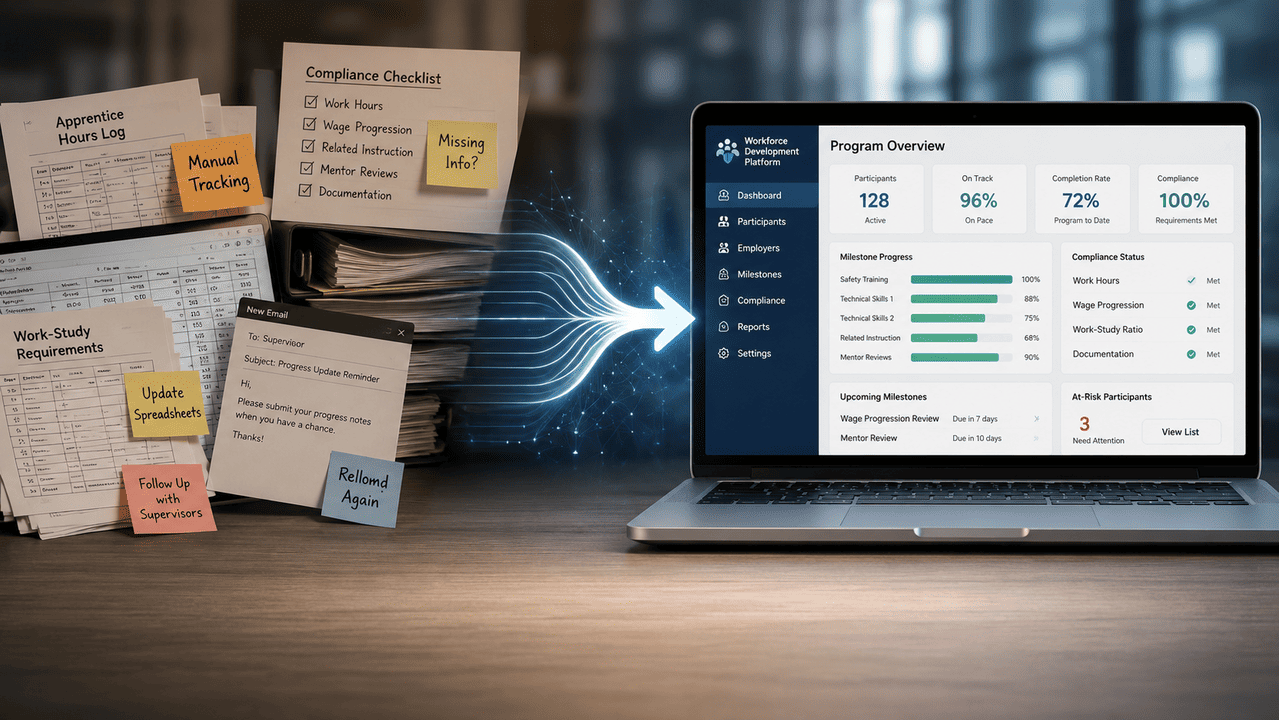
Where Manual Processes Break Down Across the Intern Lifecycle
Sourcing and Application Tracking Without a Centralized System
When applications arrive through a job posting, an email inbox, and a campus recruiting form simultaneously, the first casualty is consistency. Candidates end up in different stages of an informal review process with no shared record of where they stand. Hiring managers duplicate outreach. Strong candidates go cold because a follow-up fell through the cracks of an already crowded inbox.
Without a centralized pipeline, there is no reliable way to compare candidates across a cohort, track response times, or report on sourcing channel performance. What should be a structured selection process becomes a reactive effort to keep up with incoming volume.
Onboarding Delays Caused by Fragmented Document and Task Management
Onboarding is the first direct experience your intern has with your organization’s operational competence. When that experience involves resending forms, waiting on IT access that was never requested, or sitting through an orientation designed for a different role, the message is clear: this program was not built with them in mind.
Delays compound quickly. A missing background check holds up system access. Unsigned policy documents stall compliance sign-off. A supervisor who never received a task list skips the first check-in entirely. Each gap is individually minor, but collectively they create an onboarding experience that erodes intern confidence and increases early attrition.
Compliance Gaps That Emerge When Nothing Is Auditable
Internship programs carry compliance obligations that many coordinators underestimate until something goes wrong. Wage and hour classification, required training documentation, signed acknowledgment of workplace policies, data privacy consent — each of these requires a record that can be produced on request. A spreadsheet column that reads “done” is not an audit trail.
When documentation lives across email inboxes, shared drives, and individual supervisor notes, reconstructing a compliance record after the fact is time-consuming at best and incomplete at worst. For programs involving minor-aged participants, co-op agreements, or federally funded apprenticeships, the risk is not theoretical.
What Internship Program Management Software Is and Why It Matters Now
Internship program management software is a dedicated platform that centralizes every operational stage of running an intern program, from application intake through offboarding, in a single, structured system. It replaces the patchwork of spreadsheets, email, and generic tools with workflows built specifically for the intern lifecycle.
The category has grown in relevance as companies increasingly treat internship programs as the front end of their talent pipeline rather than a seasonal administrative obligation. Organizations that run structured, repeatable programs convert more interns to full-time hires, build stronger employer brands on campus, and can scale their program size without proportional increases in administrative overhead.
The shift toward purpose-built software reflects a broader recognition: intern programs that are managed well produce measurable returns, and managing them well requires the right infrastructure.
The Hidden Cost of Doing Nothing: Inconsistency, Attrition, and a Weakened Talent Pipeline
The most significant cost of staying with manual processes is not the hours spent on administrative tasks. It is the compounding effect of inconsistency on program quality. When each cohort is onboarded differently, supervised without a common standard, and offboarded without structured feedback, the program produces uneven outcomes that are difficult to improve because they are impossible to measure.
Interns who have a disorganized experience do not become advocates for your employer brand. They do not return as full-time candidates. They do not refer peers. The reputational cost accumulates quietly, and by the time it becomes visible in declining acceptance rates or weaker candidate quality, the root cause — a structurally unsupported program — has often been present for years.
What Internship Program Management Software Actually Does: A Functional Definition
Beyond the Label: The Core Purpose of a Purpose-Built Platform
The core purpose of internship program management software is operational reliability at every stage of the intern lifecycle. Not a better spreadsheet. Not a project management tool with a custom template. A system that treats the internship program as a repeatable, auditable, and improvable process, and gives every stakeholder — coordinator, supervisor, and intern — a clear role within it.
Purpose-built platforms encode your program logic directly into the software. Onboarding tasks trigger automatically on a new intern’s start date. Supervisor check-in prompts appear on a set schedule. Offboarding workflows launch when an end date approaches. The coordinator’s job shifts from manually tracking what should happen next to reviewing what the system has already initiated.
How Internship Management Software Differs from Generic Project Management or HR Tools
Generic project management tools are built for task completion within a team. Generic HRIS platforms are built for permanent employee record-keeping. Neither is designed for the specific operational pattern of internship management: cyclical cohorts, time-bound engagements, dual-audience workflows serving both administrative coordinators and the interns themselves, and compliance documentation requirements that differ from standard employment.
The difference is most apparent in onboarding and compliance. A project management tool can create a checklist. It cannot automatically route a signed offer letter to the correct storage location, flag an incomplete background check before system access is granted, or generate a compliance report at program close. Those capabilities require a platform designed for the problem.
The Intern Lifecycle as a System: From Application to Alumni
Application and Recruitment Workflow Automation
A structured platform manages inbound applications through a configurable pipeline covering intake, screening, interview scheduling, offer, and acceptance. Each stage has defined criteria, automated communication triggers, and a shared record accessible to every stakeholder involved in the decision. Coordinators see where every candidate stands without asking. Hiring managers receive review requests without chasing down a spreadsheet.
Structured Onboarding and Program Setup
Onboarding in a purpose-built system is a workflow, not a checklist handed to a new intern and forgotten. Tasks are assigned to specific owners — IT, HR, the direct supervisor, the intern — with deadlines and automatic reminders. Document collection, policy acknowledgment, and access provisioning happen in sequence. The coordinator’s dashboard reflects completion status across the entire cohort in real time.
Ongoing Progress Tracking and Supervisor Dashboards
Once an intern is active, the platform maintains a structured record of their progress: goals set, check-ins completed, feedback exchanged, and milestones reached. Supervisor dashboards surface this information without requiring a meeting to gather it. Program coordinators can identify disengaged interns, overloaded supervisors, or underperforming program segments before they become exit conversations.
Offboarding, Feedback, and Talent Pipeline Continuity
Offboarding is where most manual programs lose the most value. Structured platforms automate exit surveys, final performance documentation, and alumni record creation. The data captured during a well-managed offboarding process feeds directly into the next cohort’s planning, informing supervisor assignments, program design, and conversion strategy. Interns who complete a structured offboarding process are more likely to remain connected to the organization and more likely to consider returning as full-time candidates.
What Compliance and Audit Trail Functionality Looks Like in Practice
Compliance functionality in a purpose-built platform means every required action generates a timestamped, retrievable record. Signed documents are stored against the intern’s profile. Required training completions are logged with date and delivery method. Policy acknowledgments are version-controlled. When an auditor or legal team requests documentation, the coordinator runs a report rather than reconstructing records from multiple email inboxes and a shared drive.
For programs with specific regulatory requirements — paid internship classifications, apprenticeship agreements, or co-op program contracts — the platform enforces document collection as a precondition to program progression. An intern cannot be marked as onboarded until every required item is complete.
Internship programs intersect with several compliance frameworks depending on program type, participant age, and compensation structure. Purpose-built software typically supports documentation and record-keeping for the following areas:

- Wage and hour classification records, particularly for unpaid internship programs subject to the Department of Labor’s primary beneficiary test
- Signed offer letters, program agreements, and non-disclosure or confidentiality acknowledgments
- Required workplace safety and harassment prevention training completions
- Background check consent and results documentation
- Data privacy consent, particularly relevant for programs involving minor-aged participants
- Co-op and apprenticeship agreements with academic institutions or workforce development agencies
The platform does not replace legal counsel on classification decisions, but it ensures that whatever compliance obligations your program carries are documented completely and retrievably.
The Features That Separate Capable Platforms from Costly Compromises
Not every platform marketed as internship program management software delivers equal operational value. The category spans basic applicant tracking tools with an “internship” label to genuinely purpose-built systems designed around the full intern lifecycle. Knowing which features distinguish capable platforms from expensive compromises makes the difference between a system that solves your problem and one that replicates it at higher cost.
Use the rubric below when scoring platforms during your evaluation. Rate each criterion from 1 (absent or minimal) to 3 (fully supported).
| Criterion | What to Look For | Score (1–3) |
|---|---|---|
| Candidate Pipeline Management | Configurable stages, shared visibility, automated status updates | |
| Onboarding Automation | Task assignment by role, deadline triggers, document routing | |
| Progress Tracking | Supervisor dashboards, goal tracking, check-in scheduling | |
| Compliance and Audit Trail | Timestamped records, version-controlled documents, report generation | |
| Integration Capabilities | Native ATS/HRIS connectors or documented API access | |
| Admin Usability | Setup time, workflow configurability, reporting depth | |
| Intern-Facing Experience | Intuitive portal, task clarity, communication tools |
Any platform scoring below 2 on compliance or onboarding automation warrants serious scrutiny regardless of its strengths elsewhere. Those two categories carry the highest operational and legal risk for most programs.
Centralized Candidate Pipeline Management: What to Expect and Why It Matters
A capable platform gives every person involved in intern selection — recruiter, hiring manager, department lead — a single view of every candidate at every stage. Applications arrive in one place regardless of source. Stage transitions trigger automatic communications. Decision records are stored against the candidate profile, not in someone’s email drafts folder.
In practice, this prevents the duplication and dropout that undermines candidate experience in manual programs. The coordinator is not asking the hiring manager for an update. The hiring manager is not forwarding an email from three weeks ago. The candidate is not wondering whether their application was received. The pipeline runs on shared, current data rather than on whoever remembered to update the spreadsheet last.
Onboarding Automation and Workflow Customization
Onboarding automation is only as useful as it is configurable. A platform that offers a fixed onboarding template works for programs that match that template exactly. Programs with multiple departments, varied start dates, or role-specific requirements need workflows that adapt.
Look for platforms that allow task assignment by role, conditional task triggering based on program type or location, and deadline logic that calculates from the intern’s start date rather than a fixed calendar date. Document collection should route automatically to the correct storage location upon completion, not sit in an inbox waiting for someone to file it.
Intern Tracking, Progress Dashboards, and Supervisor Visibility
Once interns are active, the coordinator’s need shifts from setup to oversight. A progress dashboard should surface, at a glance, which interns are on track, which check-ins have been missed, and which supervisors have open action items — without requiring a weekly status meeting.
Supervisor dashboards serve a different but equally important function. Supervisors are rarely professional program managers, and a clean, focused view of their intern’s goals, recent feedback, and upcoming milestones makes them more effective without requiring them to learn a complex new system. Platforms that overload supervisors with administrative interface complexity see lower adoption and, as a result, gaps in the progress data the coordinator depends on.
Compliance Management, Data Privacy, and Audit-Ready Record-Keeping
Compliance functionality is not a single feature. It is a set of behaviors the platform enforces consistently. Required documents block program progression until completed. Signed acknowledgments are stored with timestamps. Training completions are logged with delivery method and date. When records are needed, a coordinator generates a report rather than manually reconstructing a paper trail.
Data privacy requirements add a separate layer, particularly for programs involving participants under 18 or organizations subject to GDPR, FERPA, or state-level privacy laws. The platform should document consent clearly, restrict data access by role, and support data retention and deletion policies without requiring manual intervention.
Integration Capabilities: Connecting with Your Existing ATS or HRIS
Internship management does not happen in isolation from your broader HR and recruiting infrastructure. If your organization already uses an applicant tracking system, a core HRIS, or a payroll platform, your internship software needs to connect with those systems rather than create a parallel data silo.
The practical questions are whether candidate records transfer cleanly into your HRIS upon hire, whether intern personal data is entered once rather than twice, and whether completed program records feed into the broader employee profile if an intern converts to full-time. These connections reduce administrative duplication and keep your records consistent across systems.
Most purpose-built internship management platforms support integration through one of three methods: native connectors built specifically for major platforms, API access that your technical team can configure, or CSV and data export workflows for organizations without development resources. Before committing to a platform, confirm which of your existing systems it connects to, how data flows in each direction, and whether the integration is maintained by the vendor or requires ongoing internal configuration.
Want to Learn More About Your Registered Apprenticeship Opportunities?
BOOK A FREE CONSULTATION
User Experience for Both Administrators and Interns: Why Dual Usability Matters
An internship management platform serves two distinct user groups with entirely different needs. Administrators need depth — configurability, reporting, bulk actions, and audit tools. Interns need clarity — a simple view of what is required of them, by when, and what comes next.
Platforms that prioritize administrative power at the cost of the intern-facing interface create adoption problems that undermine program data quality. If interns find the portal confusing or incomplete, they stop using it, and the coordinator is back to chasing completions manually. Evaluate both interfaces during any product demonstration, and test the intern portal with someone who has no prior exposure to the system.
Compliance and Onboarding: The Two Areas Where Unstructured Programs Fail First
Why Compliance Belongs at the Top of Your Evaluation Criteria
Most software evaluations lead with feature breadth and price. Compliance belongs at the top of the criteria list, not because it is the most exciting capability to evaluate, but because it carries the most asymmetric risk. An onboarding workflow that is slightly inconvenient creates friction. A compliance gap that surfaces during an audit or litigation creates exposure that no feature set can offset retroactively.
The compliance risk in intern programs is specific and often underestimated. Wage and hour misclassification, missing training records, unsigned policy acknowledgments, and improper data handling are not hypothetical risks — they are live vulnerabilities for any program that lacks a documented, enforceable record-keeping process.
How a Centralized Platform Eliminates Onboarding Delays and Inconsistencies
Onboarding delays in manual programs almost always trace to the same root cause: tasks that depend on other tasks with no system enforcing the sequence. Background check results are needed before system access is granted. System access must be confirmed before the first-day schedule is set. The supervisor cannot complete their intake checklist until HR closes their portion. When each dependency lives in a different person’s inbox, the chain breaks routinely.
A centralized platform enforces task sequencing automatically. Dependent tasks unlock only when their prerequisites are complete. Responsible parties receive reminders on schedule, not when someone remembers to follow up. The coordinator sees the entire cohort’s completion status in one view, which means delays surface in hours rather than days.
Structured Onboarding Workflows: What the Before and After Looks Like
A 10-Intern Cohort: Manual Process vs. Unified Platform
Consider a coordinator managing ten interns starting on the same date across three departments.
In a manual process, the coordinator sends offer letters individually, tracks responses in a spreadsheet, emails the IT checklist to each department separately, follows up on missing documents through reply-all threads, and holds recurring status calls with department leads to confirm who has completed what. By day three, two interns are missing system access. By day five, one department never received the policy acknowledgment form. By the end of week one, the coordinator has spent roughly twelve hours on logistics that produced inconsistent results.
Through a unified platform, the coordinator configures the onboarding workflow once — tasks, owners, deadlines, document templates — and assigns all ten interns to it upon acceptance. From that point, the system sends task notifications to IT, HR, and each supervisor on the appropriate dates. Interns complete their portion through a guided portal. The coordinator’s dashboard shows, in real time, that eight interns are on track, one has a missing background check flagged for follow-up, and one supervisor has not completed their intake step. Total active coordinator time for the same cohort: closer to two hours.
The difference is not effort. It is structure.
Apprenticeship Management and Co-Op Programs: Compliance at Greater Complexity
Apprenticeship and co-op programs carry compliance obligations that exceed standard internship requirements. Registered apprenticeships involve federal or state program registration, structured on-the-job training hour tracking, related technical instruction requirements, and wage progression documentation. Co-op agreements typically involve tri-party contracts between the employer, the academic institution, and the student, each with specific documentation and reporting requirements.
A platform built for standard internship management may handle basic document collection and task tracking but fall short on the structured hour logging, wage schedule enforcement, and institutional reporting that apprenticeship and co-op programs require. If your program falls into either category, verify that the platform explicitly supports those program types before committing.
Scaling Your Intern Program Without Scaling Your Administrative Overhead
The Scalability Threshold: When Manual Management Becomes a Growth Constraint
Manual intern program management does not fail suddenly — it degrades. A coordinator managing five interns absorbs the inefficiency of manual processes as personal workload. At fifteen interns, the same coordinator is spending a meaningful portion of every week on logistics that produce diminishing returns. At thirty interns across multiple cohorts and departments, the manual process is no longer a management approach. It is a constraint on how large the program can grow.
The scalability threshold is the point at which adding more interns creates more administrative work than the program’s strategic value justifies. Most programs hit this threshold well before their coordinators recognize it as a structural problem rather than a capacity one.
How Purpose-Built Software Decouples Program Size from Administrative Burden
The administrative work in a well-configured platform does not grow proportionally with program size. Onboarding a cohort of twenty interns through an automated workflow requires the same coordinator setup time as onboarding a cohort of five. The system sends notifications, routes documents, tracks completions, and surfaces exceptions regardless of volume. The coordinator’s active time concentrates on decisions and exceptions rather than on task execution.
This decoupling is what makes scaling feasible. A coordinator who spends several hours per intern on manual onboarding at a small program size cannot simply scale that effort linearly across a much larger cohort. A platform that significantly reduces active coordinator time per intern can support program growth without requiring a proportional increase in headcount.
Supporting Rotational, Cohort-Based, and Multi-Site Intern Programs from a Single Dashboard
Rotational programs — where interns move through multiple departments during a single engagement — and multi-site programs, where interns are distributed across locations, create coordination complexity that manual tools handle poorly. Tracking which intern is in which rotation phase, which supervisor is currently responsible, and which site-specific compliance requirements apply requires a system that accommodates structured program logic, not a spreadsheet with color-coded tabs.
A capable platform manages this through configurable program templates. A rotational program defines each phase as a discrete workflow segment with its own task set, supervisor assignment, and timeline. The coordinator dashboard shows all interns across all phases simultaneously. A multi-site program applies location-specific onboarding requirements automatically based on the intern’s assigned site, without requiring the coordinator to manually differentiate.

Workforce Development as a Strategic Asset: Building a Repeatable Talent Pipeline
The programs that generate the strongest return on investment — measured in conversion rates, offer acceptance rates, and quality of full-time hire — share one characteristic: they are designed as repeatable systems, not seasonal events.
A platform that captures structured data across every cohort makes this repeatability possible. Which sourcing channels produce candidates who complete the program and accept offers? Which supervisors have the highest intern satisfaction scores? Which program segments consistently produce early attrition? These questions cannot be answered from memory or from a folder of exit surveys. They require consistent data collection across multiple cycles, which only a structured system can provide. The result is a program that improves with each cohort rather than one that resets.
How to Evaluate and Choose the Right Internship Management Solution for Your Business
Building Your Evaluation Framework: Matching Platform Capabilities to Operational Priorities
A software evaluation that starts with pricing or feature lists typically ends with a platform that solves the wrong problem. Start instead with your program’s specific failure points. Where does your current process break down most predictably — in application tracking, onboarding sequencing, compliance documentation, or supervisor visibility? The platform that addresses your actual gaps is a better investment than the platform with the longest feature list.
Map your evaluation criteria to three tiers of operational priority:
- Critical: capabilities where a gap creates compliance risk or program failure, including audit-ready record-keeping, onboarding task enforcement, and document routing
- High: capabilities that directly affect program quality and coordinator efficiency, such as candidate pipeline management, supervisor dashboards, and integration with your ATS or HRIS
- Supportive: capabilities that improve experience without blocking function, including reporting depth, mobile access, and branding customization
A platform that scores well on critical and high-priority criteria but lacks some supportive features is a better choice than one with polished design and shallow compliance functionality. Use the comparison rubric earlier in this article to score platforms consistently across each tier before any pricing conversation.
Transitioning from Spreadsheets to Software: A Practical Migration Approach
The mechanics of migration are simpler than most coordinators expect. The real work is not data transfer — it is deciding what structured data your new system actually needs, and what historical spreadsheet content is worth carrying forward versus archiving.
A practical migration follows four steps:
- Audit your current data. Identify which spreadsheet fields map to fields in the new platform — candidate name, start date, department, program status — and which are program-specific notes that need a new home.
- Clean before you import. Duplicate rows, inconsistent field values, and incomplete records are harder to fix inside a new system than in a spreadsheet. Resolve them first.
- Import active records first. Prioritize current or upcoming cohort data. Historical records for closed cohorts can be archived outside the platform or imported in a second phase.
- Validate with a test cohort. Run one cohort through the full platform workflow before retiring your spreadsheet entirely. Identify gaps in your configuration before they affect a live program.
Most purpose-built platforms provide onboarding support and import templates that reduce the technical lift considerably. The coordinator’s role in migration is primarily organizational, not technical.
To protect your data during the transition, export your spreadsheet to a clean CSV file before beginning any import. Standardize column headers to match the new platform’s field names, remove duplicate entries, and flag records with missing required fields for manual completion. Import historical records as read-only archives if the platform supports it. The goal is a complete transition, not a parallel system — plan to retire the spreadsheet entirely after your first successfully managed cohort on the new platform.
Change Management for Busy Hiring Managers: Reducing Implementation Friction
The coordinators most likely to delay implementation are not the ones who doubt the software — they are the ones who cannot find a low-pressure window to set it up. The practical answer is to configure the platform around your next cohort’s timeline rather than waiting for a hypothetical ideal moment.
Identify one person responsible for platform configuration. Give that person a defined setup window — typically two to three weeks before the next application cycle opens — and a clear scope: build the onboarding workflow, configure the application pipeline, and test the intern-facing portal. Anything beyond that scope is phase two.
Supervisor adoption is the most common friction point. Supervisors are not program managers, and they will not invest time in a system that feels like administrative overhead added to their existing role. Platforms with clean, focused supervisor interfaces see significantly higher adoption rates. During implementation, schedule a single thirty-minute walkthrough for supervisors rather than sending a user guide and expecting self-directed adoption.
Sizing the Decision: What SMBs and Growing Teams Should Prioritize Differently
Smaller organizations and growing teams face a different evaluation question than enterprise HR departments. A large organization may already have dedicated program managers, integrated HR infrastructure, and an established compliance function. The platform needs to fit into existing systems. A small or mid-sized business typically has one coordinator managing the entire program alongside other responsibilities, limited IT support, and a compliance posture that depends almost entirely on what the software enforces.
For SMBs, the priority is a platform that is fast to configure, does not require technical implementation support, and enforces compliance requirements without relying on coordinator memory. Integration depth matters less than setup simplicity. A platform that connects to your existing ATS is valuable, but not if the integration requires weeks of configuration your team cannot support.
Growing teams should also weight scalability explicitly. A platform priced per intern or per cohort can become expensive as programs expand. Understand the pricing model before committing, and model what your cost looks like at two to three times your current program size.

Pricing structures across the category vary. Common models include per-intern or per-seat pricing, flat monthly or annual subscription tiers based on program size bands, and enterprise licensing for large organizations with custom configuration and support requirements. For most SMBs running programs of ten to fifty interns per cohort, purpose-built platforms are available at a range of price points that, when evaluated against the administrative hours your current process consumes, most programs recover through time savings alone within the first cohort.
Matching Your Program Stage to the Right Platform Tier
| Program Stage | Primary Need | Recommended Platform Focus |
|---|---|---|
| Early-stage (1–10 interns, first structured cohort) | Fast setup, basic compliance, guided onboarding | Simple, all-in-one platform with pre-built workflows and minimal configuration overhead |
| Growing program (10–50 interns, multiple departments) | Pipeline management, supervisor dashboards, HRIS integration | Mid-tier platform with configurable workflows, integration support, and cohort reporting |
| Scaled program (50+ interns, multi-site or rotational) | Scalable workflows, audit-ready compliance, advanced analytics | Purpose-built platform with full lifecycle management, structured program templates, and data export for pipeline analysis |
| Apprenticeship or co-op program | Hour tracking, wage documentation, institutional reporting | Specialized apprenticeship management platform with registered apprenticeship support or co-op contract management |
Conclusion: Stop Managing Intern Programs. Start Running Them
Recapping the Operational Case for Structured Internship Software
The argument for internship program management software is not that spreadsheets are inadequate tools. It is that internship programs are not spreadsheet problems. They are multi-stage, multi-stakeholder workflows with compliance obligations, repeatable logic, and strategic value that manual processes structurally cannot support at any meaningful scale.
Every operational challenge described in this article traces back to the same root cause: when program management depends on individual memory, manual follow-up, and documents scattered across inboxes and shared drives, quality degrades, compliance gaps accumulate, and the program produces results that are difficult to measure and impossible to improve systematically. The solution is not more effort. It is the right infrastructure.
The Cost of Inaction: Compliance Risk, Talent Pipeline Erosion, and Missed Scale
The coordinator who runs another cohort on a spreadsheet does not experience the cost of that decision as a single event. It arrives as hours of status emails that a dashboard would have replaced, as an incomplete audit trail discovered when documentation is requested, as an intern who disengages in week two because no one had visibility to intervene, and as a conversion opportunity lost because offboarding was disorganized.
None of these outcomes is catastrophic in isolation. Together, over multiple cohorts, they define a program that underperforms its potential and fails to build the repeatable talent pipeline it was designed to produce. The cost is real — it accumulates quietly.
Why GoSprout Is Built for This Problem
GoSprout is designed specifically for the operational challenges this article has described. The platform manages the full intern lifecycle — application intake, onboarding workflow automation, progress tracking, compliance documentation, and offboarding — in a single system built for the way internship programs actually run.
For coordinators managing their first structured cohort, GoSprout’s pre-built workflows reduce setup time to hours rather than weeks. For growing programs, configurable templates and supervisor dashboards provide the visibility and structure that manual processes cannot sustain. For programs with compliance complexity, audit-ready record-keeping and document enforcement make every required step traceable and retrievable.
GoSprout is not a generic project management tool adapted for intern tracking. It is a purpose-built platform that treats the internship program as a professional process and gives the people running it the infrastructure to deliver consistent, measurable results.

Your Next Step: Moving from Fragmented Workflows to a System That Grows With You
If your current process has a ceiling — a program size above which the administrative burden outpaces the strategic value — the practical next step is a structured evaluation before your next cohort cycle opens. Use the criteria and rubric in this article to assess your current gaps, score platforms against your specific priorities, and identify the one that addresses your highest-risk areas first.
The programs that build durable talent pipelines are not the ones with the largest budgets or the most dedicated staff. They are the ones with the right systems. GoSprout is built to be that system, from your first structured cohort to your fiftieth.
Frequently Asked Questions
Internship program management software is a dedicated platform that centralizes every operational stage of running an intern program, from application intake and onboarding through progress tracking, compliance documentation, and offboarding. Companies need it because manual processes — spreadsheets, email chains, and generic project management tools — are not designed to handle the multi-stage workflows, compliance obligations, and repeatable program logic that a well-run internship program requires. As programs grow, the structural limitations of manual management become a direct constraint on program quality and scalability.
The most important features to evaluate are a centralized candidate pipeline with shared visibility and automated communications, onboarding workflow automation with role-based task assignment and document routing, compliance record-keeping with timestamped storage and report generation, supervisor and coordinator dashboards showing real-time program status, and integration with your existing ATS or HRIS. An intern-facing portal that participants can use without extensive guidance is equally important, as is the ability to configure workflows across multiple departments, locations, or program types. Programs with apprenticeship or co-op components should also evaluate structured hour tracking, wage progression documentation, and institutional reporting capabilities.
Purpose-built internship management platforms support documentation and record-keeping for several compliance areas, including wage and hour classification records for unpaid internship programs, signed offer letters and program agreements, workplace safety and harassment prevention training completions, background check consent and results, data privacy consent for programs involving minor-aged participants, and co-op or apprenticeship agreements with academic institutions or workforce development agencies. The platform does not replace legal counsel on classification decisions, but it ensures that whatever compliance obligations your program carries are documented completely and retrievably.
Most purpose-built internship management platforms support integration with common ATS and HRIS systems through native connectors, API access, or CSV and data export workflows. Before committing to a platform, confirm which of your existing systems it connects to, how data flows in each direction, and whether the integration is maintained by the vendor or requires ongoing internal configuration. A platform that integrates cleanly with your current stack on day one is significantly easier to adopt and sustain than one that promises future compatibility.
Begin by exporting your spreadsheet data to a clean CSV file. Standardize column headers to match the new platform’s field names, remove duplicate entries, and flag records with missing required fields for manual completion before importing. Prioritize active or upcoming cohort data in your initial import, and archive historical records for closed cohorts separately. Run one cohort through the full platform workflow before retiring your spreadsheet entirely — this allows you to identify configuration gaps before they affect a live program.
Most purpose-built internship management platforms are operational within two to four weeks for a standard program configuration. Basic setup — building your onboarding workflow, configuring the application pipeline, and connecting existing integrations — typically requires a few hours of coordinator time distributed across the initial setup period rather than a dedicated IT project. Administrative time savings are visible immediately in the first cohort, and compliance risk reduction begins from the first completed audit trail. Improvements in conversion rate and talent pipeline quality are typically measurable after two to three cohort cycles, once the platform has accumulated enough structured data to inform program design decisions.
Genuinely free internship program management software is limited in scope. Some platforms offer free tiers, typically capped at a small number of active interns or with restricted feature access — compliance documentation and integration capabilities are usually reserved for paid tiers. Open-source options exist but require technical configuration and ongoing maintenance that most HR teams are not positioned to support. If compliance and onboarding automation are active pain points in your current program, the cost of a purpose-built paid platform is justified from the first cohort, particularly when evaluated against the administrative hours your manual process currently consumes.