Table of Contents
- Why Most Apprenticeship Reporting Software Is Solving the Wrong Problem
- What Apprenticeship Reporting Software Actually Is — and Who Genuinely Needs It
- The Evaluation Framework: A Decision Rubric for Selecting the Right Platform
- Compliance Reporting and RAPIDS Integration: What to Demand from Any Platform
- Core Features That Separate Purpose-Built Platforms from Generic Workforce Tools
- Beyond the Back Office: How the Best Platforms Serve Employers and Apprentices Equally
- Integration, Implementation, and Time-to-Value: The Practical Questions That Decide Adoption
- The Outcome Metrics That Actually Matter: Measuring Program Performance Beyond Compliance
- How GoSprout Approaches Apprenticeship Reporting Differently
- Conclusion: From Compliance Infrastructure to Program Performance
- Frequently Asked Questions
Why Most Apprenticeship Reporting Software Is Solving the Wrong Problem
The Compliance-Only Trap: How Administrative Tools Create a False Sense of Program Health
A program that files clean RAPIDS reports on time is not necessarily a healthy program. It may have high dropout rates, disengaged apprentices, and zero visibility into whether completers are actually converting to long-term employment. Compliance-only software makes it easy to miss all of that, because it measures activity, not outcomes.
Most apprenticeship reporting software is architected around a single stakeholder: the program administrator who needs to submit accurate data to a regulatory body. That is a real and serious need. But when the platform stops there, it produces a reporting posture rather than a management capability. Program coordinators get dashboards full of enrollment counts and hours logged, while the questions that actually drive workforce ROI go entirely unanswered. Who is at risk of dropping out? Where is wage progression stalling? Which employer relationships are underperforming? A compliance-only platform offers no answers. Reporting is one piece of broader apprenticeship management software, which also covers onboarding, hour tracking, and compliance.
Want to Learn More About Your Registered Apprenticeship Opportunities?
BOOK A FREE CONSULTATION
Reframing the Category: From Regulatory Burden to Talent Connection Infrastructure
The most useful reframe for any buyer evaluating this category is to stop thinking about apprenticeship software as a compliance cost center and start thinking about it as talent infrastructure. Registered Apprenticeship Programs exist because employers need skilled workers and candidates need structured pathways into careers. The software managing those programs should actively serve both sides of that equation.
A platform built as talent connection infrastructure does not skip compliance. It automates it. But it does so as a foundation for something larger: matching employer needs to apprentice progression, surfacing retention signals before they become dropout events, and generating outcome data that justifies program investment to leadership. That architecture changes everything about how a platform is built and what it ultimately delivers.
Who This Guide Is For
This guide is written for decision-makers who are past the awareness stage. You already know you need a better system. You may be managing a registered apprenticeship program through a combination of spreadsheets, a generic HRIS, and email, and you are feeling the compounding cost of that fragmentation. Or you may have a tool in place that handles RAPIDS submissions adequately but gives you nothing useful beyond that.
The evaluation framework here is designed to help you assess platforms against a complete set of capability requirements, not just compliance checkboxes. It applies whether you run a single-site program with 15 apprentices or a multi-location program spanning several occupational categories.
What Separates a Compliance Checkbox Platform from a Program Performance System
The distinction comes down to data directionality. Compliance platforms collect data so you can report it outward, to the Department of Labor, to a sponsor, to an auditor. Program performance systems collect the same data and then turn it inward, using it to surface actionable intelligence about apprentice progress, employer engagement, and overall program health.
A compliance checkbox platform asks whether you submitted the right information on time. A program performance system asks that question and also asks whether your apprentices are progressing at the required rate, which cohorts are underperforming, and what your completion rate reveals about your onboarding process. Buyers who evaluate only on the first question consistently underinvest in capability and overpay in long-term administrative cost.
What Apprenticeship Reporting Software Actually Is — and Who Genuinely Needs It
Defining the Apprenticeship Management System: Core Function vs. Full Capability
An Apprenticeship Management System (AMS) is purpose-built software for administering structured work-based learning programs, including Registered Apprenticeship Programs, pre-apprenticeships, and employer-designed training pathways. At minimum, a functional AMS handles enrollment tracking, hours and wage progression documentation, competency assessment records, and regulatory reporting outputs such as RAPIDS data submissions. If your work starts before registration, see how pre apprenticeship management software supports those earlier programs.
Full-capability platforms extend well beyond that minimum. They include apprentice-facing portals, employer workflow tools, document management, integration with payroll and HR systems, and reporting layers that connect compliance data to program performance metrics. The gap between minimum and full capability is where most buying decisions go wrong.
Apprenticeship Management Software vs. General Workforce and LMS Tools
General HR platforms and learning management systems were not designed for the structural requirements of apprenticeship programs. The core difference lies in how the software handles the relationship between time-based progression, competency milestones, wage schedules, and regulatory documentation.
An LMS tracks course completions. An HRIS tracks employment records. Neither is built to manage the simultaneous requirements of a registered apprenticeship: occupational standards alignment, OJT hour verification, Related Technical Instruction (RTI) coordination, wage progression tied to competency thresholds, and RAPIDS reporting at defined intervals. Forcing those requirements into a general tool recreates the same fragmentation problem organizations are trying to solve.
The Fragmented-Tools Problem: Why Spreadsheets and Standalone Trackers Break Down
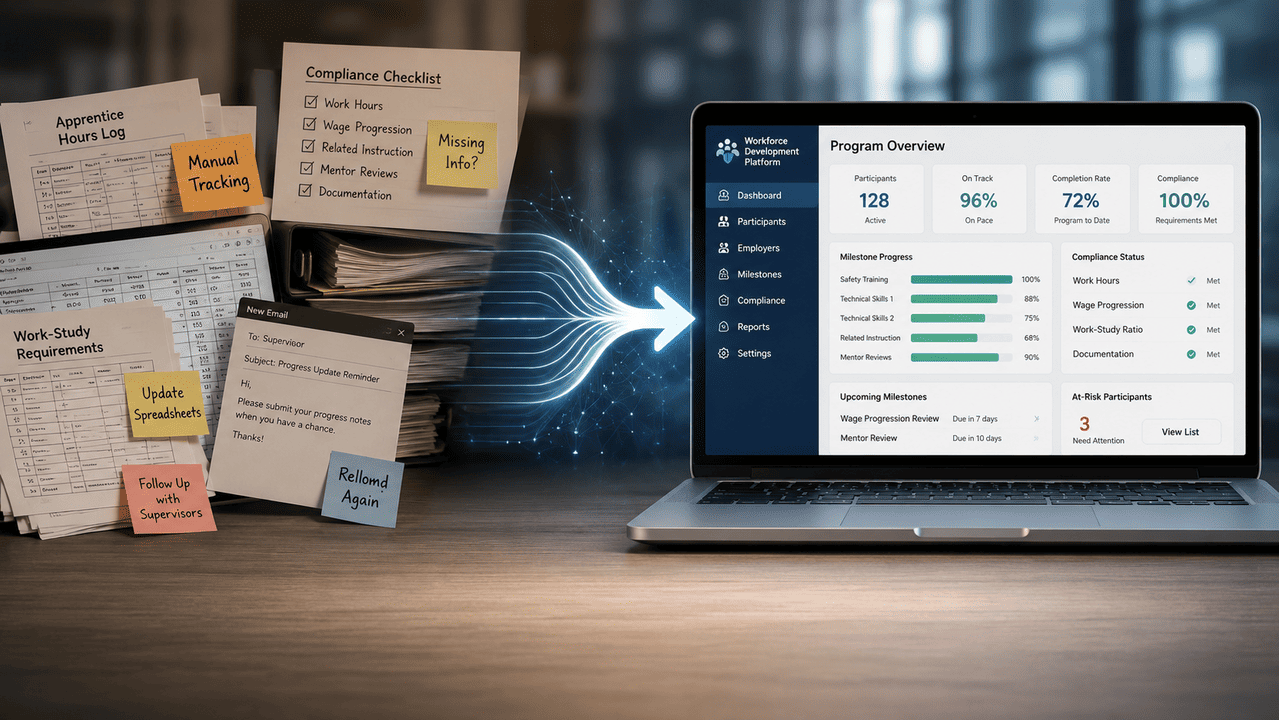
The typical fragmented setup looks like this: enrollment tracked in a spreadsheet, hours logged in a timekeeping app, competency progress noted in a separate document, wage schedules managed in payroll, and RAPIDS submissions handled through manual data re-entry. Every handoff between tools is a point of error, and every manual re-entry step is a compliance risk.
The operational cost of that fragmentation scales with program size. At five apprentices, it is manageable. At 50, it consumes coordinator bandwidth that should be directed toward apprentice support and employer communication. At 200, it becomes a material compliance liability.
Is There Free Apprenticeship Reporting Software Available — and When Does It Stop Being Enough
Free and low-cost tools exist in this category, primarily as basic tracking utilities or open-access government-adjacent resources. For programs in early formation, still defining occupational standards and working with a small initial cohort, a free tool can serve as a functional placeholder while program design matures.
The Real Cost of Free
Free tools tend to create costs in three areas that do not appear on a budget line. Compliance gaps emerge when a tool cannot generate the specific data format RAPIDS requires, forcing manual workarounds that introduce error. Visibility gaps appear when there is no dashboard connecting hours and competencies to program outcomes. Retention gaps develop when the apprentice has no mobile-accessible interface and disengages from a process that feels designed for administrators rather than for them.
When a Dedicated Platform Becomes Non-Negotiable
A dedicated platform becomes non-negotiable at the intersection of two conditions: when your program is subject to formal regulatory reporting requirements, and when program scale makes manual error correction a recurring event rather than an occasional one. If you are operating a DOL-registered program, managing IRA compliance for prevailing wage purposes, or running more than one program type simultaneously, free tools are not an adequate foundation.
The Evaluation Framework: A Decision Rubric for Selecting the Right Platform
How to Structure Your Platform Evaluation Before Sitting Through a Single Demo
The most common evaluation mistake is starting with vendor demos. A demo is designed to show a platform’s strengths and obscure its gaps. Before you schedule a single call, define your program’s specific requirements across five capability areas and assign a weight to each based on your current operational pain. That weighting becomes your scoring rubric, applied consistently across every platform you evaluate.
The Five Capability Tiers Every Serious Buyer Should Score
Tier 1: Compliance Automation and Regulatory Reporting
This tier covers the platform’s ability to automate RAPIDS data submissions, generate DOL-required documentation, track OJT hours against occupational standards, and produce audit-ready records. For programs subject to IRA apprenticeship requirements, it also includes prevailing wage documentation and apprentice-to-journeyworker ratio tracking. This is the floor, not the ceiling.
Tier 2: Apprentice-Facing Experience and Engagement Tools
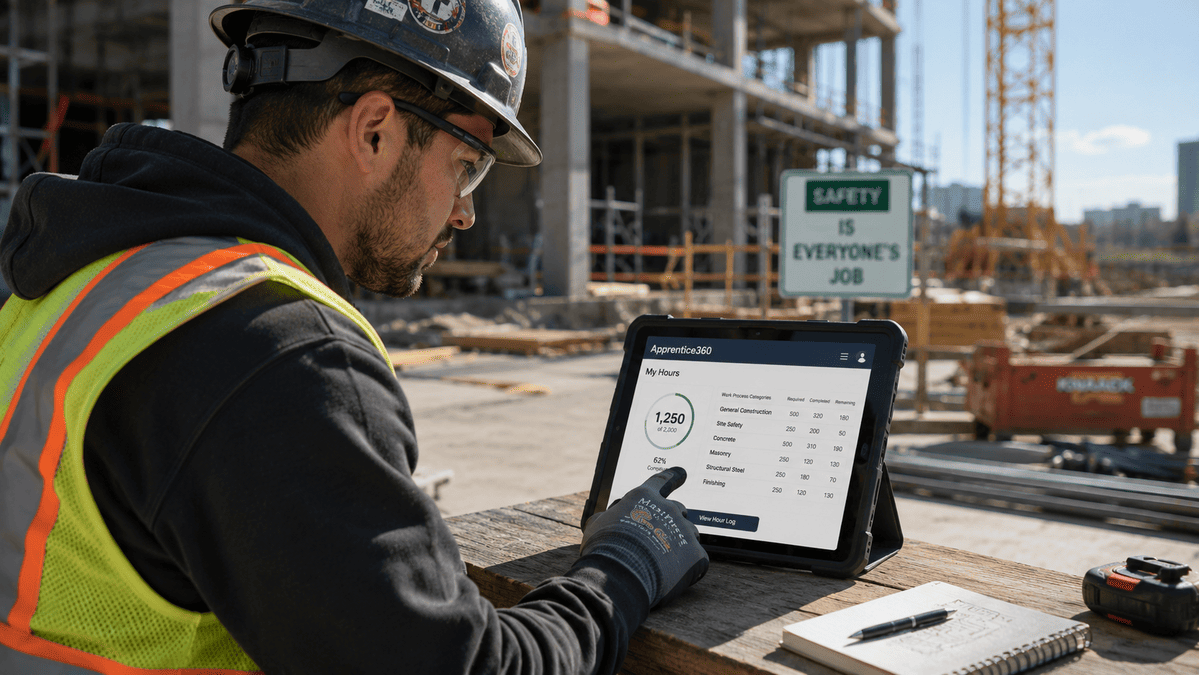
A platform that only serves administrators will struggle with adoption. Evaluate whether the software gives apprentices direct access to their progress records, hour logs, competency milestones, and communication tools. Mobile accessibility is not optional here. Apprentices working in the trades, healthcare, or manufacturing are not sitting at desks.
Tier 3: Program Lifecycle and Administrative Workflow
This tier covers the operational backbone: onboarding automation, document collection, enrollment workflow, mentor assignment, and off-boarding or completion processing. Evaluate how many manual steps the platform eliminates across the full apprentice lifecycle, from application to certification.
Tier 4: Integration Depth with Existing HR and Payroll Systems
A platform that cannot connect to your existing HRIS or payroll system will create a parallel data environment requiring manual maintenance. Evaluate API availability, pre-built integrations, and the implementation support the vendor provides for connecting the platform to your current tech stack. Rip-and-replace is rarely necessary, but shallow integration is a common hidden cost.
Tier 5: Outcome Visibility and Reporting Intelligence
Beyond compliance, evaluate whether the platform produces metrics that matter for program management: completion rates, job placement rates, apprentice retention by cohort, wage progression velocity, and employer satisfaction. A platform without this tier is reporting to regulators but not to the people running the program.
Red Flags to Identify Before You Commit
Three signals indicate a platform that will underdeliver. First, if the onboarding process requires extensive professional services engagement before the platform is functional, that complexity will resurface every time you need to make a program change. Second, if the vendor demo focuses entirely on the administrator interface and never shows the apprentice experience, the platform was built for compliance filing, not program management. Third, watch for compliance theater: platforms that generate impressive-looking reports but cannot confirm whether the underlying data is accurate or audit-ready.
How to Evaluate Apprenticeship Software When Managing Multiple Program Types
Multi-program environments add a dimension most single-program evaluations miss: the platform must handle structural variation. A registered apprenticeship in the electrical trades has different occupational standards, wage schedules, and reporting requirements than a healthcare apprenticeship or a non-registered employer training pathway. Evaluate whether the platform supports configurable program templates, multi-program reporting views, and role-based access that allows administrators to manage programs independently without data bleed between them.
Platform Evaluation Rubric: Scoring Guide for Active Buyers
Use this rubric to score each platform on a 1-3 scale per tier (1 = does not meet requirement, 2 = partially meets requirement, 3 = fully meets requirement). Set your minimum acceptable total before you begin evaluation.
| Capability Tier | What to Look For | Demo Question to Ask | Pass Threshold |
|---|---|---|---|
| Tier 1: Compliance Automation | Automated RAPIDS submission, OJT hour tracking, IRA wage documentation, audit-ready records | “Show me how a RAPIDS data file is generated and submitted from your platform.” | Score 3 required |
| Tier 2: Apprentice Experience | Mobile-accessible portal, progress visibility, direct communication tools, self-service hour logging | “Can you show me the apprentice’s view of their own record on a mobile device?” | Score 2 minimum |
| Tier 3: Admin Workflow | Enrollment automation, document collection, mentor assignment, completion processing | “Walk me through onboarding a new apprentice from application to first day in the system.” | Score 2 minimum |
| Tier 4: Integration Depth | API availability, HRIS and payroll connectors, implementation support, no rip-and-replace requirement | “What integrations do you support out of the box, and what does custom integration require?” | Score 2 minimum |
| Tier 5: Outcome Reporting | Completion rates, placement rates, retention by cohort, wage progression metrics, employer dashboards | “Show me a report that connects compliance data to program completion outcomes.” | Score 2 minimum |
Minimum passing total: 12 out of 15. A platform that scores 3 on Tier 1 but 1 on Tiers 2 and 5 is a compliance tool, not a program management system. Adjust tier weights based on your program’s current priorities, but do not eliminate any tier from the evaluation entirely.
Compliance Reporting and RAPIDS Integration: What to Demand from Any Platform
How Apprenticeship Management Software Improves Compliance Reporting
Compliance reporting fails at the data collection stage, not the submission stage. Most programs that struggle with RAPIDS submissions or audit readiness are not struggling because they lack a reporting tool. They are struggling because the underlying data is incomplete, inconsistently captured, or stored across systems that do not communicate with one another. Dedicated apprenticeship reporting software fixes this at the source by embedding compliance data capture into every program workflow, from initial enrollment through wage progression events and final completion records.
The practical improvement is structural. Rather than assembling compliance documentation at reporting time, the platform generates it continuously as program activity occurs. Hours logged against OJT requirements, competency assessments completed, wage schedule transitions triggered, and enrollment status changes all produce compliance-ready records in real time. When a reporting deadline or audit arrives, there is nothing to reconstruct.
How Apprenticeship Software Handles RAPIDS Integration
RAPIDS — the Registered Apprenticeship Partners Information Data System maintained by the Department of Labor — requires registered apprenticeship programs to submit structured data on apprentice enrollment, demographic information, OJT hours, Related Technical Instruction, wage progression, and program completions or cancellations. A capable platform handles this through direct data formatting and submission workflows, not manual export-and-reformat cycles.
What to demand specifically: the platform should generate RAPIDS-formatted data files automatically from program records, flag missing or out-of-range fields before submission, and maintain a submission history that documents what was reported and when. Platforms that require a coordinator to manually extract data from one screen and reformat it for a separate RAPIDS upload introduce error risk at exactly the point where accuracy is non-negotiable.
RAPIDS vs. IRA Compliance: Understanding the Difference and What Software Must Handle
These are distinct compliance frameworks with different documentation requirements, and conflating them is a common source of program risk.
RAPIDS Reporting: Registered Apprenticeship Program Tracking
RAPIDS compliance governs the ongoing reporting obligations of DOL-registered programs. It tracks program structure, apprentice activity, and outcome data over the full program lifecycle. The documentation burden is longitudinal. Programs report at enrollment, at defined intervals, and at program completion or cancellation. Software handling RAPIDS compliance must maintain continuous records and support structured data outputs aligned with DOL reporting specifications.
IRA Compliance: Inflation Reduction Act Apprenticeship Requirements
The Inflation Reduction Act introduced a separate compliance framework for employers claiming clean energy tax credits. To qualify, those employers must meet apprenticeship labor hour requirements, maintain apprentice-to-journeyworker ratio requirements, and document prevailing wage payments for all workers on qualifying projects. This is project-level compliance, not program-level compliance, and it requires a different documentation architecture.
Software handling IRA requirements must track labor hours at the project level, verify ratio compliance at specific workforce snapshots, and produce prevailing wage documentation capable of surviving IRS scrutiny. A platform built only for RAPIDS reporting will not have this project-level data structure, and adding it manually recreates the same fragmentation a purpose-built system is supposed to solve.

What Compliance Violations Do Hiring Managers Most Commonly Face — and How Should Software Prevent Them
The most common compliance failures in registered apprenticeship programs fall into a predictable set:
- OJT hours logged against the wrong occupational category, creating a discrepancy between reported and actual standards alignment
- Wage progression events not documented at contractually required intervals, triggering retroactive back-pay liability
- Apprentice demographic data submitted incompletely to RAPIDS, causing record rejection or audit flags
- Related Technical Instruction hours not tracked separately from OJT, violating program standards ratios
- Enrollment records not updated at status changes, leaving terminated apprentices active in RAPIDS
Each of these failures has a workflow root. The software should prevent them by building required documentation steps into the workflow itself. Wage progression cannot be recorded without a corresponding date and rate entry, RTI hours log separately by design, and RAPIDS data submissions validate completeness before they are finalized.
Audit Trails, Document Management, and the Back-Office Foundation That Must Work Flawlessly
An audit is not the time to discover that your document management system is a shared drive folder with inconsistent naming conventions. Every enrollment, wage change, competency assessment, and status update should create a timestamped, attributed record that cannot be retroactively altered. This is not a premium feature. It is a baseline requirement for any program operating under federal oversight.
Document management in a capable platform means more than file storage. Apprenticeship agreements, sponsor certifications, training plans, and completion certificates should be linked directly to the apprentice record they govern. A coordinator should be able to pull a complete, audit-ready record for any apprentice in seconds, not by assembling documents from multiple systems.
Core Features That Separate Purpose-Built Platforms from Generic Workforce Tools
What Features Should You Look for in Apprenticeship Reporting Software
The feature set that matters is the one that eliminates manual steps across the program lifecycle while producing compliance and outcome data as a byproduct of normal program activity. Prioritize time and wage tracking integrated with occupational standards, competency progression management, automated onboarding workflows, and cloud-based access that works on a mobile device as well as a desktop. Each of these addresses a specific breakdown point in how programs are typically managed without dedicated tools.
Time Tracking, Wage Compliance, and Occupational Standards Progression
Time tracking in an apprenticeship program is not generic timekeeping. Hours must be categorized by OJT type, matched to occupational standards categories, and accumulated against defined thresholds that trigger wage progression and competency advancement. A platform that treats apprentice hours the same way it treats employee PTO is not fit for this purpose.
Wage compliance adds another layer. The platform must store the wage schedule from the apprenticeship agreement, track hours against progression thresholds, and generate alerts when a wage increase is due. This is not a payroll function. Payroll executes the wage change, but the platform should be the system of record that tells payroll when and how much.
Competency Management and Skills Tracking Across the Apprenticeship Lifecycle
Competency-based apprenticeships require documentation that goes beyond hours. Individual competencies must be assessed, rated, and recorded against the occupational standards framework, with the assessor identified and the date of assessment captured. Over a multi-year apprenticeship, this produces a skills record that serves both compliance and talent development purposes.
Platforms that handle this well allow competency frameworks to be configured per program type, support mentor or supervisor assessments directly in the system, and surface competency gaps against program timelines so coordinators can intervene before a gap becomes a completion risk.
Onboarding Workflow Automation: Reducing the Administrative Burden at Program Entry
Program entry is where administrative burden peaks. A new apprentice enrollment typically requires collecting a signed apprenticeship agreement, verifying eligibility, establishing the training plan, creating records in multiple systems, and completing initial RAPIDS registration, all before the first day of work. Platforms that automate this sequence with configurable workflows and digital document collection reduce coordinator time at enrollment from hours to minutes.
The downstream benefit is data quality. Automated onboarding workflows enforce required fields and document uploads at entry, which means the compliance record starts clean rather than requiring retrospective cleanup.
Cloud-Based Accessibility and the Case for Mobile-First Apprentice Engagement
Apprentices in construction, healthcare, manufacturing, and the trades are not working at desks. A platform that requires a desktop browser to log hours, view competency progress, or communicate with a coordinator is a platform that apprentices will not use consistently. Inconsistent use produces incomplete records, which creates compliance risk and retention risk simultaneously.
Cloud-based platforms with mobile-optimized interfaces close this gap by meeting apprentices where they actually work. The apprentice who can log OJT hours from a job site at the end of a shift is far more likely to maintain an accurate record than one who has to remember to do it later on a laptop.
Beyond the Back Office: How the Best Platforms Serve Employers and Apprentices Equally
The Dual-Sided Marketplace Distinction: Why Serving Only Administrators Is a Strategic Failure
A platform that serves only administrators produces compliance records. A platform that serves administrators, employers, and apprentices simultaneously produces program outcomes. The distinction is architectural. Dual-sided platforms are built with distinct user experiences for each stakeholder, while compliance-first platforms bolt on an apprentice portal as an afterthought that apprentices ignore after the first week.
The strategic failure of administrator-only design shows up in adoption. When apprentices do not engage with the platform, the coordinator manually updates records on their behalf, recreating the administrative burden the platform was supposed to eliminate, while also losing the ground-level program signals that come from active apprentice engagement.
What to Look for in an Apprenticeship Platform to Avoid Poor User Adoption Among Apprentices
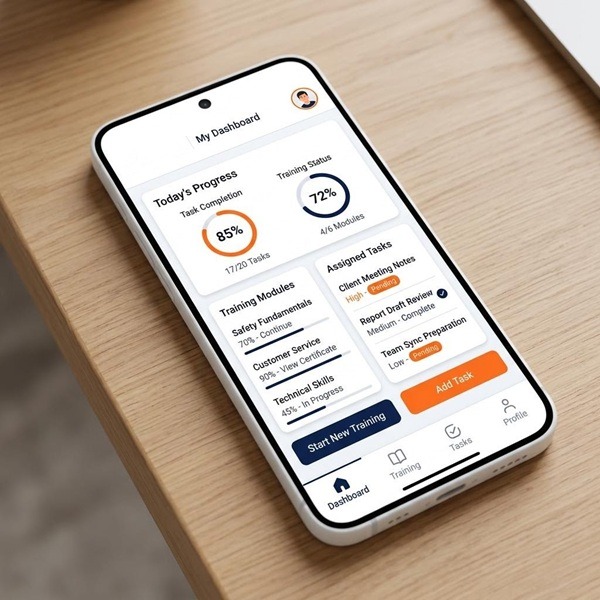
Adoption depends on perceived value, not feature completeness. Apprentices will use a platform consistently when it shows them something they care about: their own progress toward completion, their hours accumulated toward the next wage increase, and which competencies they still need to demonstrate. If the platform surfaces that information clearly on a mobile device, adoption follows.
Evaluate adoption readiness by asking vendors to show you the apprentice’s first login experience. If the first screen an apprentice sees is a form to fill out, adoption will struggle. If it is a progress dashboard that answers “where am I in this program,” you have a tool that serves apprentices as participants rather than as data entry subjects.
Candidate Sourcing, Recruitment Management, and Connecting Opportunity-Seekers to Employers
The most complete platforms extend upstream from enrollment into recruitment. For employers who need to fill apprenticeship seats, the ability to post opportunities, screen candidates, and move qualified applicants through a structured selection process within the same system that manages enrolled apprentices closes a gap that most compliance-focused platforms leave wide open.
This matters practically because the quality of who enters the program affects every downstream metric: completion rates, competency progression velocity, employer satisfaction, and long-term workforce impact. Platforms that treat recruitment as outside their scope force employers to manage candidate pipelines in a separate tool and then transfer records manually at enrollment, which is exactly the fragmentation a unified platform should solve.
Work-Based Learning Coordination: Aligning Employer Needs with Apprentice Progression in Real Time
Employers and apprentices do not always have the same view of program status, and that misalignment creates friction. An employer may not know that an apprentice is two competency assessments behind schedule until a quarterly check-in surfaces it. By that point, the gap is harder to close and the apprentice may already be disengaged.
Platforms that provide employer-facing dashboards with real-time progression data close this visibility gap proactively. A supervisor who can see an apprentice’s current competency status, upcoming OJT milestones, and any flagged issues is a supervisor who can act before problems compound. That coordination function is program management, not compliance filing, and it is what separates outcome-oriented platforms from record-keeping tools.
Dedicated Apprenticeship Platform vs. General HR or LMS System
For programs with fewer than ten apprentices running informally, a general HR system can serve as a temporary foundation. For any program subject to DOL registration, IRA compliance, or active employer-apprentice coordination across multiple cohorts, a general system will create more work than it saves.
The functional gaps are structural, not cosmetic. General HR systems do not carry occupational standards frameworks. LMS tools do not produce RAPIDS-formatted data. Payroll platforms do not track competency milestones. Bridging those gaps requires custom configuration, manual data movement, or accepting that some part of the compliance record will always be incomplete. A dedicated platform eliminates those gaps by design.
Integration, Implementation, and Time-to-Value: The Practical Questions That Decide Adoption
Can Apprenticeship Software Integrate with Existing HR and Payroll Systems
Rip-and-replace is rarely necessary, and any vendor who implies otherwise is describing their own implementation limitations, not the category norm. The practical integration question is more specific: does the platform offer API access or pre-built connectors for the HRIS and payroll systems you already use, and does the vendor provide implementation support to configure those connections?
The goal is a bi-directional data relationship. The apprenticeship platform should receive basic employee records from the HRIS at enrollment and push wage change events to payroll when progression thresholds are met. That eliminates dual data entry without requiring either system to be replaced. If a vendor cannot describe this workflow clearly in a demo, the integration capability is likely shallower than the sales materials suggest.
What Is the Typical Implementation Timeline and Training Burden
Implementation timelines vary based on program complexity and integration requirements, but a reasonable benchmark for a mid-sized registered apprenticeship program with one or two HRIS integrations is four to eight weeks from contract to active use. Programs with multiple occupational standards frameworks, complex wage schedules, or IRA compliance requirements should plan for the higher end of that range.
Training burden is a function of UX quality. Platforms with intuitive interfaces and role-specific onboarding flows typically require a single training session for coordinators and minimal guidance for apprentices. Platforms that require multi-day administrator training before the system is usable are signaling a complexity that will resurface every time a new coordinator joins the team.
How Much Time and Cost Does Apprenticeship Reporting Software Actually Save
The time savings profile looks different at different program scales, but the savings are real at every level.
Illustrative Model: Administrative Hours Recovered in a Mid-Sized Program
Consider a program with 50 active apprentices managed manually. A reasonable estimate of recurring coordinator time includes:
- RAPIDS data preparation and submission: 4-6 hours per reporting cycle
- Hour log collection, verification, and entry: 2-3 hours per week
- Document collection and filing at enrollment: 1-2 hours per new apprentice
- Wage progression tracking and payroll notifications: 1-2 hours per week
- Audit preparation when requested: 8-15 hours per event
Across a year, that represents a substantial volume of administrative hours consumed by tasks a capable platform handles automatically. At a fully loaded coordinator cost, the direct labor savings justify a mid-market platform subscription before accounting for any downstream program value.
Scaling the ROI Argument: Where the Gains Shift from Compliance Savings to Retention Value
At program scales above 100 apprentices, the compliance automation savings remain significant, but the ROI argument shifts. The larger return comes from retention and outcome improvement. A platform that surfaces at-risk apprentices early, keeps employer-apprentice alignment current, and produces completion rate data by cohort allows coordinators to act on signals they would otherwise miss entirely.
A meaningful improvement in program completion rate translates directly into additional completers per cohort. If those completers convert to long-term employees in roles that would otherwise require external hiring, the workforce value is measurable in recruitment cost avoidance alone. That is the ROI conversation compliance-only platforms cannot participate in.
Onboarding Complexity as a Buying Signal
How a vendor implements their own product tells you exactly how the product will behave once you own it. A vendor who requires weeks of professional services engagement to configure basic workflows has built a platform that requires expert intervention to change. A vendor who can get a mid-complexity program operational in under a month has built a platform your team can maintain and adapt without calling for help every time program requirements evolve.
Ask vendors directly: what does a coordinator need to do to add a new program type or modify a wage schedule after implementation? The answer reveals whether you are buying a tool or a dependency.
The Outcome Metrics That Actually Matter: Measuring Program Performance Beyond Compliance
What Reporting Metrics Matter Most for Apprenticeship Programs
Compliance metrics tell you whether your program is legal. Outcome metrics tell you whether it is working. Most apprenticeship reporting software is built to produce the first category and leaves the second entirely to the program coordinator’s judgment. That gap is where program value gets lost.
The metrics that matter for actual program management fall into three groups: completion and attrition, wage and skills progression, and downstream workforce impact. Completion and attrition data tells you whether apprentices are finishing what they started and where in the lifecycle they drop out. Progression data tells you whether they are advancing at the rate the program design requires. Workforce impact data tells you whether completers are staying with the employer and building careers in the occupation, which is the return on investment the program exists to generate.
Job Placement Rates, Program Completion Rates, and Apprentice Retention as Strategic KPIs
These three metrics function as a linked diagnostic. A low completion rate points to problems inside the program: inadequate mentorship, misaligned employer expectations, or onboarding gaps that surface early attrition. A high completion rate paired with low job placement suggests the program is producing credentials but not employment connections. High placement with low one-year retention indicates the program is filling roles but not building careers.
Each metric is actionable in a different way, which is why reporting them together matters. A coordinator who sees only completion rates may declare success at graduation without ever knowing that a significant share of completers left their employer within six months. A platform that tracks all three and presents them at the cohort level gives program leadership the full picture and the ability to intervene at the right point in the lifecycle rather than after the fact.
How to Build a Reporting Dashboard That Connects Compliance Data to Talent Outcomes
The architecture of a useful dashboard starts with compliance data as the input layer. Hours logged, competency assessments completed, and wage progression events are compliance records, but they are also leading indicators. An apprentice whose hour accumulation is running behind schedule is a completion risk. An apprentice who has not completed a required competency assessment in eight weeks may be disengaged, or may have a mentor capacity problem the coordinator does not know about.
A reporting dashboard that connects these inputs to outcome projections allows coordinators to act on trends rather than events. The practical design requires four views: individual apprentice status against program milestones, cohort-level completion trajectory, employer engagement status, and aggregate program performance against historical benchmarks. Platforms that produce only regulatory submission summaries are generating one of those four views and leaving the rest to spreadsheets.
From Time-to-Hire to Long-Term Workforce Development: The Full Lifecycle View
The full lifecycle of a successful apprenticeship program starts before enrollment and extends well past completion. Time-to-hire measures the efficiency of the recruitment and selection process. Time-to-productivity measures how quickly a new apprentice reaches meaningful contribution after onboarding. Completion rate measures program delivery quality. Post-completion retention and career progression measure whether the program built something durable.
Platforms that report only on the enrolled apprentice period are measuring the middle of a story. The organizations that extract the most strategic value from apprenticeship programs are those tracking the full arc, from initial candidate pipeline to multi-year workforce outcomes, and using that data to refine program design continuously.
How GoSprout Approaches Apprenticeship Reporting Differently
The Strategic Architecture: Compliance Capability Built on a Talent Connection Foundation
GoSprout is built on a different structural premise than most apprenticeship reporting software. Rather than starting with regulatory reporting and adding program management features around it, GoSprout starts with the employer-apprentice relationship and builds compliance capability as the operational layer that supports it. That architectural choice determines what the platform produces and who it serves.
The result is a system where compliance documentation is a byproduct of program activity, not a separate administrative task. When an apprentice logs hours, records a competency milestone, or transitions through a wage progression threshold, the compliance record is generated automatically. The coordinator does not manage two workflows, one for program management and one for regulatory reporting. They manage one, and the reporting follows.
RAPIDS and IRA Compliance Without Implementation Debt
The core paradox in apprenticeship software buying is that platforms with the most complete compliance capability tend to carry the heaviest implementation burden. GoSprout addresses this by separating compliance depth from implementation complexity. RAPIDS data formatting and submission, OJT hour categorization, and IRA prevailing wage documentation are built into the platform’s core workflows rather than configured through custom professional services engagements.
For programs subject to IRA apprenticeship requirements, this matters at the project level, not just the program level. GoSprout’s data structure supports labor hour tracking and apprentice-to-journeyworker ratio verification by project, which is the documentation architecture IRA compliance actually requires. Programs that handle IRA requirements through manual workarounds accumulate audit risk with every project they complete.
The Employer-Apprentice Connection Layer: What a Dual-Sided Platform Looks Like in Practice
GoSprout operates as a dual-sided platform, delivering a distinct and purposeful experience to both the employer and the apprentice. This is not a cosmetic distinction. Employers access real-time dashboards showing apprentice progression, upcoming milestones, and any flagged gaps in competency completion. Apprentices access their own progress view on mobile, log hours from the job site, and see exactly where they stand against the next wage progression threshold.
The practical effect is that program engagement does not depend on coordinator mediation. An employer supervisor who sees that an apprentice is behind on two competency assessments can act on that information without waiting for a quarterly review. An apprentice who can see their wage increase is 40 OJT hours away has a concrete and motivating target. Both outcomes improve program performance without adding coordinator workload.

End-to-End Program Management Across Registered, Non-Registered, and Customized Program Types
GoSprout supports registered apprenticeships, pre-apprenticeships, and employer-customized training pathways within the same platform. Each program type can carry its own occupational standards framework, wage schedule, competency requirements, and reporting configuration, managed independently but visible in aggregate for multi-program coordinators.
This matters for organizations running mixed program portfolios. A workforce development organization managing a DOL-registered electrical apprenticeship alongside a non-registered employer training pathway needs program-level configuration control and portfolio-level reporting in the same system. Maintaining those in separate tools recreates the fragmentation a unified platform exists to solve.
Why GoSprout’s Approach to Onboarding, Integration, and Apprentice Adoption Changes the Evaluation Calculus
GoSprout’s implementation model is designed to get a mid-complexity program operational without extended professional services dependency. Coordinators can configure occupational standards, wage schedules, and enrollment workflows through the platform’s administrative interface without custom development. Integration with existing HR and payroll systems is supported through API access and pre-built connectors.
Apprentice adoption is addressed through the mobile-first interface and a progress-centered first login experience. When an apprentice’s first interaction with the platform shows them their program timeline, current standing, and next milestone, they engage. When it shows them a form, they disengage. GoSprout is designed around the first scenario, which is why adoption rates remain high beyond the initial onboarding period.
Quick-Pick: Which Capability Tier to Prioritize First
| Buyer Profile | Prioritize First | Why |
|---|---|---|
| Small business owner running a first registered apprenticeship | Tier 1: Compliance Automation | RAPIDS accuracy and audit readiness are non-negotiable from day one. |
| Enterprise HR manager with 100+ apprentices | Tier 5: Outcome Reporting | At scale, retention and completion data drives ROI justification to leadership. |
| Multi-program coordinator managing diverse occupational pathways | Tier 3: Admin Workflow | Configuration flexibility and program separation prevent data bleed and coordinator burnout. |
| Operations lead with IRA prevailing wage obligations | Tier 1 and Tier 4: Compliance and Integration | IRA documentation requires project-level data that must connect to payroll systems accurately. |
Conclusion: From Compliance Infrastructure to Program Performance
The Central Trade-Off Every Buyer Must Resolve
Every buyer in this evaluation faces one fundamental trade-off: short-term compliance adequacy versus long-term program performance capability. A compliance-only platform solves the immediate problem of RAPIDS submissions and regulatory documentation. It does not solve the problem of apprentice attrition, employer misalignment, or the inability to demonstrate workforce ROI to program sponsors. Choosing the simpler tool now typically means facing a second platform decision in 18 to 24 months when those gaps become operationally visible.
The organizations that avoid that cycle are the ones that define outcome requirements alongside compliance requirements before they evaluate anything. If your program exists to develop workforce talent, your platform needs to measure talent outcomes. Compliance is the floor, not the product.
A Final Checklist: Non-Negotiable Capabilities for Any Serious Apprenticeship Management System
Before committing to any platform, confirm it delivers on each of the following:
- Automated RAPIDS data formatting and submission with pre-submission validation
- IRA prevailing wage and labor hour tracking at the project level, if applicable
- Mobile-accessible apprentice interface with real-time progress visibility
- Competency tracking configured to your occupational standards framework
- Enrollment workflow automation with digital document collection
- Integration with your HRIS and payroll system through API or pre-built connectors
- Outcome reporting across completion rates, placement rates, and retention by cohort
- Audit-ready record trail with timestamped, attributed entries for every program event
A platform that cannot confirm each of these in a demo is not ready for programs operating under federal oversight.
Why the Organizations That Win with Apprenticeship Programs Choose Connection Over Compliance Theater
The programs that produce the strongest workforce outcomes share a common design principle: they treat the employer-apprentice relationship as the core product and use technology to strengthen that relationship rather than merely document it. Compliance is the condition for operating, not the purpose of operating.
Organizations that choose platforms built for connection over platforms built for compliance theater gain two capabilities their competitors lack: apprentices who stay engaged through completion, and employers who can act on program data in real time rather than reacting to problems after they compound. Those two capabilities produce the completion rates, placement rates, and retention figures that justify continued program investment and expansion.
Next Steps: How to Evaluate GoSprout Against Your Program’s Specific Requirements
The most productive first step with GoSprout is a structured requirements conversation, not a demo. Bring your current administrative workflow, your compliance obligations, your integration requirements, and your outcome measurement gaps to that conversation. Ask to see the apprentice mobile experience, the RAPIDS submission workflow, and a reporting view that connects compliance data to completion outcomes.
Use the five-tier evaluation rubric from this guide to score what you see. If GoSprout meets your pass thresholds across all five tiers, you have found a platform built for program performance, not just program paperwork.
Frequently Asked Questions
RAPIDS governs the ongoing reporting obligations of DOL-registered programs, covering apprentice enrollment, OJT hours, wage progression, and program completion data across the full program lifecycle. IRA compliance, introduced through the Inflation Reduction Act, is a separate framework that applies at the project level, requiring employers to document apprenticeship labor hour percentages, apprentice-to-journeyworker ratios, and prevailing wage payments on qualifying clean energy projects. A capable apprenticeship management system handles both by maintaining program-level records for RAPIDS and project-level data structures for IRA documentation, rather than treating them as the same reporting requirement.
For smaller programs, the most immediate savings come from eliminating manual RAPIDS data preparation, hour log collection, and document assembly at enrollment. These recurring tasks can consume dozens of coordinator hours per month that a purpose-built platform handles automatically. For larger programs operating at 100 or more apprentices, the compliance savings remain significant but the larger return comes from improved retention and completion rates. Identifying at-risk apprentices earlier, keeping employer and apprentice records aligned in real time, and reducing the administrative burden on coordinators all contribute to measurable gains in program outcomes that translate into direct workforce value.
Adoption is driven by perceived value, not feature count. Apprentices will engage consistently with a platform that shows them their own progress, hours accumulated toward the next wage increase, and remaining competency requirements, presented clearly on a mobile device. Evaluate adoption readiness by asking vendors to demonstrate the apprentice’s first login experience. If the first screen is a form, adoption will suffer. If it is a progress dashboard that answers “where am I in this program,” you have a tool that treats apprentices as active participants rather than data entry subjects.
Rip-and-replace is rarely necessary. The practical question is whether the platform offers API access or pre-built connectors for the systems you already use, and whether the vendor provides implementation support to configure those connections. The goal is a bi-directional relationship: the apprenticeship platform receives basic employee records from the HRIS at enrollment and pushes wage change events to payroll when progression thresholds are met. If a vendor cannot clearly describe this workflow during a demo, their integration capability is likely shallower than their materials suggest.
For a mid-sized registered apprenticeship program with one or two HRIS integrations, a reasonable implementation benchmark is four to eight weeks from contract to active use. Programs with multiple occupational standards frameworks, complex wage schedules, or IRA compliance requirements should plan for the higher end of that range. Training burden correlates directly with UX quality. Platforms with intuitive, role-specific interfaces typically require a single coordinator training session and minimal guidance for apprentices. Platforms requiring multi-day administrator training before the system is functional are signaling a complexity that will resurface every time your team needs to make a program change.
The most frequent compliance failures in registered apprenticeship programs include OJT hours logged against the wrong occupational category, wage progression events not documented at required intervals, incomplete apprentice demographic data submitted to RAPIDS, Related Technical Instruction hours not tracked separately from OJT, and enrollment records left unchanged after a status change. Each of these has a workflow root, and purpose-built software prevents them by requiring the relevant documentation steps before a record can be saved or submitted. Wage progression entries require a corresponding date and rate, RTI hours are logged in a separate category by design, and RAPIDS submissions validate completeness before they are finalized.
For informal programs with a very small number of participants, a general HR system may serve as a temporary foundation. For any program subject to DOL registration, IRA compliance, or active employer-apprentice coordination across multiple cohorts, a general system will create more work than it saves. The gaps are structural: general HR systems do not carry occupational standards frameworks, LMS tools do not produce RAPIDS-formatted data, and payroll platforms do not track competency milestones. Bridging those gaps through custom configuration or manual data movement means some portion of the compliance record will always carry risk. A dedicated apprenticeship management system eliminates those gaps by design.