
Table of Contents
- What Is Industrial Maintenance and Why It Matters Today
- Core Types of Industrial Maintenance and How They Work
- Roles, Skills, and Daily Work in Industrial Maintenance
- Training, Apprenticeships, and Education Pathways in Industrial Maintenance
- Common Industrial Maintenance Mistakes and How to Avoid Them
- Why Choose a Structured Platform to Manage Industrial Maintenance Training and Apprenticeships
- Take the Next Step in Building a Strong Industrial Maintenance Workforce
- FAQs About Industrial Maintenance
What Is Industrial Maintenance and Why It Matters Today
Industrial maintenance is the systematic care, inspection, repair, and optimization of industrial machinery, production lines, and facility systems across plants, utilities, and large commercial sites. It includes planned upkeep, preventive checks, and data-driven actions designed to keep equipment safe, reliable, efficient, and available for production. Unlike general building maintenance that focuses on lighting, roofing, or office HVAC, industrial maintenance centers on production machinery, automation systems, process lines, and the utilities that directly feed manufacturing operations.
The stakes are concrete. A single unmaintained pump or conveyor in a bottling plant can halt output for an entire shift, costing thousands in lost product, labor, and utility expenses. Industrial maintenance is critical in industries like manufacturing, energy, and transportation, where unplanned failures cascade quickly through interconnected systems. It enhances workplace safety by identifying equipment hazards before failures occur and ensures compliance with safety regulations and industry standards. Proper industrial maintenance extends the lifespan of equipment and reduces operational costs, while effective maintenance minimizes unexpected downtime and maximizes return on asset investments.
The field has shifted dramatically since the era of purely reactive repairs. Between 2020 and 2026, widespread adoption of IoT sensors, CMMS and EAM platforms, and condition-based strategies has reshaped how facilities approach equipment reliability. Around 70% of plants now use some form of CMMS or EAM, though nearly half still rely on spreadsheets or paper for certain tasks. Meanwhile, over 1 in 5 skilled tradespeople are over age 55, creating urgent demand for new technicians who can step into roles that require both mechanical aptitude and digital fluency. Industrial maintenance minimizes downtime in production lines, and the people who make that happen are increasingly difficult to find.
Core Types of Industrial Maintenance and How They Work
Most facilities do not rely on a single maintenance philosophy. Instead, they blend strategies depending on each asset’s criticality, cost of failure, and safety risk. A non-critical dust collector might get a different treatment than a core CNC machine. Understanding these approaches is essential for anyone entering or managing the field.
Reactive maintenance repairs equipment only after it fails. It may appear cost-effective on paper since there is no upfront planning, but it typically leads to overtime labor, emergency parts shipping, safety risks, and significant production losses. Picture a bearing in a motor failing during a night shift: the packaging line stops, technicians scramble, and parts must be expedited at premium cost.
Preventive maintenance involves scheduled servicing to prevent failures. Tasks like lubrication, filter changes, and parts replacement happen on fixed intervals—every 250 operating hours, every month, or every 6 months. Bearing replacement on a high-speed compressor, for example, might be calendared at regular intervals regardless of condition. Preventive maintenance programs enhance machinery longevity, and preventive maintenance is essential for minimizing equipment downtime. The trade-off is occasional premature replacement of components that still have useful life remaining.
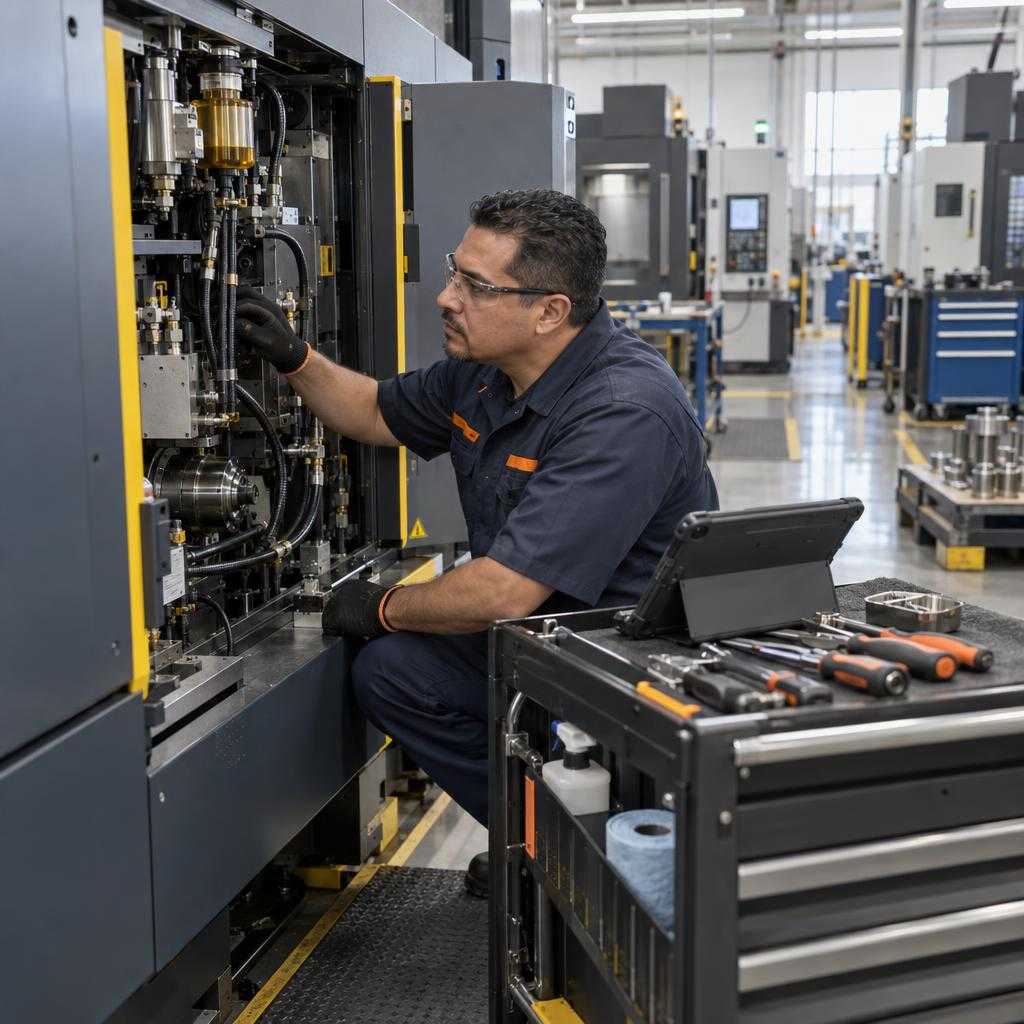
Predictive maintenance uses data from sensors to forecast failures before they occur. Condition monitoring involves collecting asset health indicators—vibration levels, oil particle counts, thermal readings—to trigger work orders only when thresholds are crossed. Instead of replacing belts every 6 months, you replace them when vibration analysis shows misalignment or wear. This approach requires investment in diagnostic equipment and trained analysts, but it significantly reduces both unnecessary maintenance and surprise breakdowns.
Reliability-centered maintenance tailors maintenance strategies based on criticality and failure modes. RCM systematically evaluates each asset’s function, potential failure modes, and consequences, then assigns the most cost-effective strategy: run-to-failure for low-impact items, preventive for moderate-risk components, predictive for high-value assets, and sometimes redesign to eliminate failure risk entirely.
A typical plan for a small manufacturing cell might assign the CNC machine to predictive monitoring (vibration and thermal sensors), the conveyor to preventive scheduling (routine inspections, belt replacement on calendar), and the dust collection system to run-to-failure if its replacement cost is low. Modern digital tools—CMMS platforms with mobile apps, QR-coded equipment, and digital checklists—help technicians log work, track schedules, and share real-time issues with supervisors and engineers.
Facilities that track performance use metrics like Mean Time Between Failures (MTBF), which measures the average time a machine operates successfully between breakdowns; Overall Equipment Effectiveness (OEE), which evaluates availability, performance, and quality to measure manufacturing productivity; Planned Maintenance Percentage (PMP), which tracks the ratio of scheduled work orders versus emergency work orders; and Mean Time to Repair (MTTR), which measures the average time required to restore an asset to normal operation.
Roles, Skills, and Daily Work in Industrial Maintenance
Industrial maintenance is a team effort. Mechanical technicians, electrical technicians, HVAC specialists, automation experts, planners, reliability engineers, and maintenance managers each play interlocking roles. Planners schedule work and coordinate parts. Engineers analyze failure data and drive improvements. Technicians do the hands-on repairs and inspections that keep everything running.
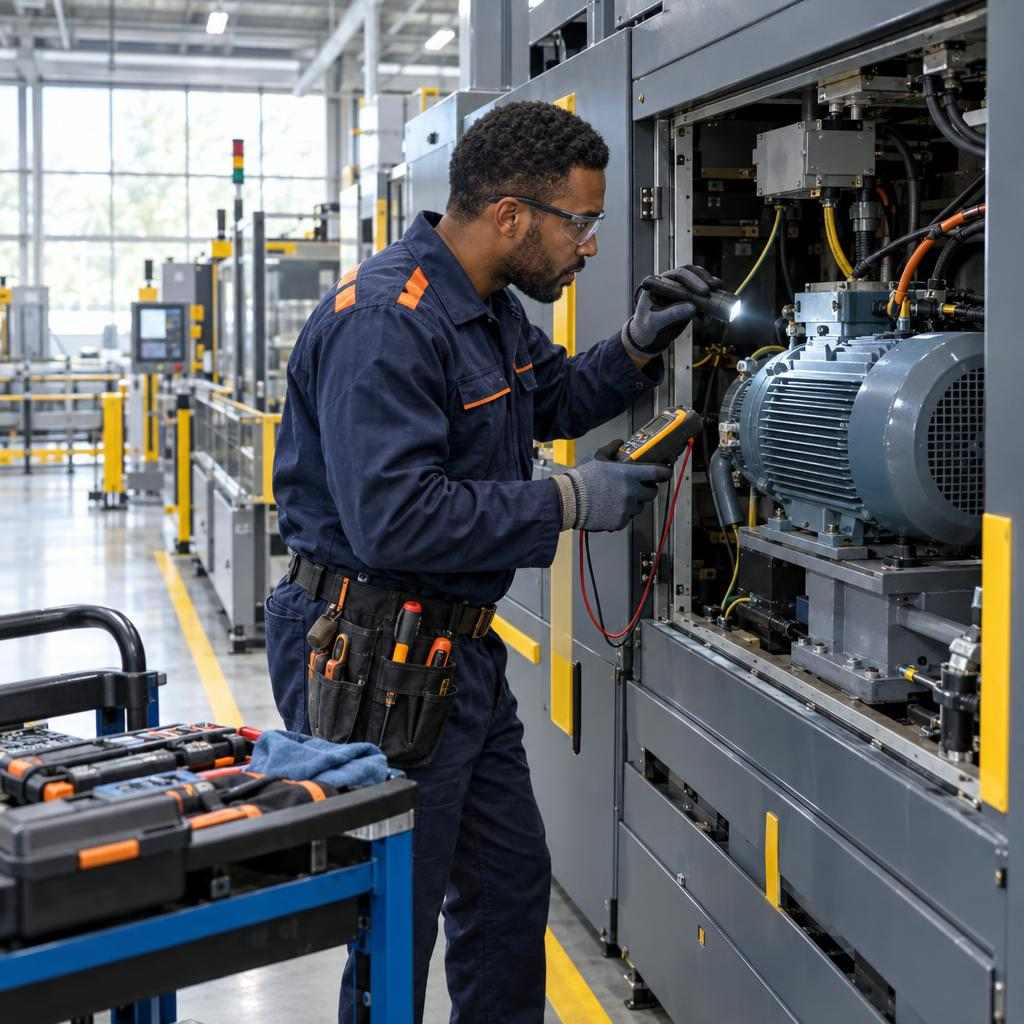
Industrial maintenance technicians repair and maintain commercial machinery, from conveyor systems and pumps to presses, packaging lines, and robotic arms. They perform routine maintenance to minimize equipment downtime and ensure equipment meets operational specifications. The role spans mechanical systems (bearings, couplings, gearboxes), hydraulics and pneumatics, industrial electricity, drives and motors, PLC interfaces, air conditioning systems, and basic welding or fabrication. Technicians diagnose mechanical and electrical issues in machinery, and they use computerized diagnostic systems for troubleshooting. Vibration analysis is a key skill for industrial maintenance mechanics, alongside thermal imaging interpretation and oil analysis.
Structured problem solving matters more than speed. Reading symptoms, consulting technical manuals, using diagnostic equipment, and following a logical process prevents the costly habit of trial-and-error part swapping. Soft skills are equally important: communication with operators to understand problems, clear documentation in work order systems, collaboration with production and safety teams, and time management during high-pressure breakdowns.
A typical 12-hour shift might start with preventive walk-downs—checking lubrication, inspecting bearings on major conveyors and motors. At midday, an unscheduled shutdown arrives: a motor overheated on a packaging line. The technician responds, uses a thermal camera and multimeter to diagnose the root cause, performs the corrective repair, and logs every step in the CMMS. Later in the shift, they join a reliability team meeting to review recent failures and adjust predictive schedules. It is work that rewards people who can read a situation, adapt quickly, and carry responsibility across a range of heavy machinery and construction-grade equipment.
Career paths typically move from junior technician to multi-craft mechanic, then into maintenance planner, reliability engineer, or maintenance manager roles. Continuing education, certifications in predictive technologies or instrumentation, and cross-training in automation and electrician skills all support progression.
Training, Apprenticeships, and Education Pathways in Industrial Maintenance
The retirement wave is real. With over 1 in 5 skilled tradespeople over age 55 and the BLS expecting 69,200 new positions in industrial maintenance by 2034, structured training is not optional—it is urgent. An estimated 54,200 job openings will occur annually for the next decade, driven by both growth and retirements. The people needed to fill these roles require a deliberate blend of classroom knowledge and hands-on experience.
Most industrial machinery mechanics need a high school diploma as a starting point. From there, typical education routes include technical certificates, 2-year associate degrees in industrial maintenance or mechatronics, or upskilling from related trades like welding, HVAC, or electrical work. Students learn industrial electrical systems and hydraulics in training, alongside topics like industrial pumps, pneumatics, piping systems, mechanical power applications, blueprint reading, and troubleshooting skills. Many industrial maintenance programs can be completed in seven to ten months, giving students a fast path into an in-demand field.
Registered apprenticeship programs combine paid on the job training with related technical instruction. A common structure spans 2 to 3 years, with 2,000 hours per year of OJT plus at least 144 hours of classroom or online instruction covering safety, blueprint reading, advanced troubleshooting, and automation fundamentals. Modern programs increasingly use mobile apps, dashboards, and automated reports to document hours, verified competencies, and compliance data for sponsors, schools, and regulators.
For prospective students and employers evaluating programs, three recommendations stand out. First, evaluate curricula for alignment with the specific industrial equipment and services in your region—what machines will graduates actually work on? Second, ensure exposure to real, functioning industrial machinery during training, not just simulations. Third, verify that the program includes strong safety and problem-solving components supported by documented competency tracking, so graduates arrive ready to contribute from day one.
Common Industrial Maintenance Mistakes and How to Avoid Them
Many facilities struggle not because they lack technicians, but because processes, documentation, and training culture are inconsistent. Recognizing these patterns is the first step toward building a more reliable operation.
Under-investing in preventive maintenance is one of the most expensive mistakes a manufacturing facility can make. Running equipment to failure, skipping scheduled inspections, and deferring minor fixes until they become major shutdowns always costs more in the long run. The short-term savings disappear when a $200 bearing replacement becomes a $15,000 motor rebuild plus two shifts of lost production.
Poor documentation compounds the problem. Handwritten notes that never get entered into a central system, missing histories on critical assets, and no standardized method for capturing root causes or repair steps all weaken reliability analyses. Without data, you cannot identify patterns or make informed decisions about where to invest maintenance resources.
Lack of structured problem solving leads to recurring failures and wasted parts inventory. Diagnosing an issue requires more than swapping components until something works. Technicians need to verify root cause, cross-reference failure history, and understand the machines at a system level. Jumping to conclusions wastes time, money, and trust.
Training gaps create their own cascade of problems. New hires or apprentices thrown directly into night shifts without mentorship, no clear competency requirements, and no tracking of OJT versus RTI progress for junior technicians all undermine workforce development. Communication issues between maintenance and production teams—limited operator feedback, unclear work order priorities during peak demand—make everything worse.
Building a stronger maintenance culture requires standard procedures, clear skill matrices, digital tracking of tasks and training, and regular reviews of failure data to guide improvement projects. These are not luxuries. They are the foundation that separates facilities with 90% uptime from those constantly fighting fires.
Why Choose a Structured Platform to Manage Industrial Maintenance Training and Apprenticeships
Employers, schools, and workforce organizations managing industrial maintenance programs face a common challenge: tracking OJT hours, RTI completion, competencies, and compliance across dozens or hundreds of apprentices using spreadsheets, email threads, and paper forms. The administrative burden is real, and it creates risk—missed documentation, audit gaps, and inconsistent training quality.
A dedicated work-based learning platform solves this by providing real-time dashboards that track each apprentice’s hours and competency progress, aligning tasks with specific skill requirements, and generating automated reports for federal and state compliance. Sponsors, educators, and regulators can see exactly where each trainee stands without chasing down paperwork.
For employers, the advantages include reduced administrative overhead, clearer visibility into skill gaps across the maintenance team, easier coordination between HR, maintenance managers, and training providers, and faster onboarding of new technicians. For schools and training centers, a structured platform provides better alignment between course content and industry needs, structured feedback from employer partners, and measurable data on how students perform once they enter real industrial maintenance roles.
As facilities adopt increasingly complex machinery, face strict safety requirements, and require traceable, high-quality training, the old methods of managing apprenticeships simply cannot keep pace. A modern platform is how you scale industrial maintenance workforce development without sacrificing quality or compliance.
Take the Next Step in Building a Strong Industrial Maintenance Workforce
Effective industrial maintenance reduces downtime, improves safety, and supports long-term competitiveness for manufacturers and industrial employers. The technicians, planners, and engineers who carry out this work are in high demand, and the programs that train them need to be as reliable as the equipment they will maintain.
If you are an employer, school, or workforce organization, now is the time to review your current training, apprenticeship, and tracking processes for maintenance technicians. Identify where gaps exist—in documentation, competency verification, compliance reporting, or coordination between stakeholders.
Explore how a modern work-based learning management platform can help you design, launch, and scale industrial maintenance apprenticeships and internships with clear competencies and robust reporting. Request a demo or schedule a consultation to discuss your specific workforce development needs and see how the right tools can join your efforts to build a skilled, supported, and job-ready maintenance team.
Want to Learn More About Your Registered Apprenticeship Opportunities?
BOOK A FREE CONSULTATION
FAQs About Industrial Maintenance
What is industrial maintenance in simple terms?
Industrial maintenance means keeping industrial machinery, equipment, and systems safe, reliable, and efficient through inspection, cleaning, lubrication, adjustments, repairs, and upgrades. It covers everything from tightening a loose chain on a conveyor to overhauling a high-pressure hydraulic system or troubleshooting an electrical fault on a production line.
What are examples of industrial machinery that maintenance technicians work on?
Technicians work on pumps, compressors, conveyors, CNC machines, packaging lines, robotic arms, boilers, chillers, industrial HVAC units, and plant electrical distribution equipment. Depending on the facility, they may also maintain utility systems like air compressors, steam systems, and water treatment equipment. The range of components varies by industry, but the core troubleshooting and repair skills transfer across sectors.
What is the difference between preventive maintenance and predictive maintenance?
Preventive maintenance follows a fixed schedule—servicing equipment every 250 hours, every month, or after a set number of cycles regardless of condition. Predictive maintenance is triggered by actual data: vibration levels, temperature trends, oil condition, or sensor alarms that indicate something is changing. For example, changing belts every 6 months is preventive; changing them only when vibration analysis shows misalignment or wear is predictive. Both reduce downtime, but predictive maintenance avoids unnecessary part replacements.
Is industrial maintenance a good career choice in 2026?
Demand is strong across manufacturing, utilities, food production, logistics, and large commercial facilities. Automation growth and retirements of experienced technicians have created a talent gap that employers are actively working to fill. Industrial maintenance technicians can earn over $60,000 annually, and the median pay for industrial maintenance jobs is above $63,000. The role offers variety—mechanical, electrical, HVAC, automation—and pathways into planning, supervision, and reliability engineering.
How long does it take to become an industrial maintenance technician?
Many people enter the field after 1 to 2 years of technical training or a 2-year associate degree, often combined with an apprenticeship lasting 2 to 4 years. Industrial maintenance programs can be completed in seven to ten months for foundational certificates. Employers typically look for a mix of classroom knowledge, hands-on practice with real industrial machinery, and documented experience or OJT hours. Most technicians need a high school diploma and on the job training to get started.
Do industrial maintenance technicians need strong math or programming skills?
Basic math—fractions, measurements, tolerances, and simple trigonometry—is essential for tasks like alignment, machining, and electrical calculations. While not every role requires advanced programming, understanding PLC logic, HMI screens, and basic automation concepts is increasingly valuable in modern plants. The ability to read technical manuals, interpret schematics, and use digital tools matters more than advanced calculus.