Table of Contents
- What Is Related Technical Instruction (RTI) in a Registered Apprenticeship?
- Who Are RTI Providers? Types of Institutions and Their Roles
- RTI Requirements and Compliance: What the DOL and States Actually Expect
- Challenges RTI Providers Face (and How to Avoid Common Mistakes)
- How to Choose, Partner With, or Become an RTI Provider
- Designing High-Impact RTI for Apprenticeship and Pre-Apprenticeship Programs
- How GoSprout Supports RTI Providers, Sponsors, and Employers
- FAQs About RTI Providers and Apprenticeship Programs
- Why RTI Providers Choose GoSprout
- Next Steps: Launch or Scale Your RTI Provider Role with GoSprout
Every registered apprenticeship program runs on two engines: on-the-job training and related technical instruction. RTI reinforces on-the-job learning with theoretical knowledge, giving apprentices the classroom foundation they need to perform safely and skillfully at work. The organizations that deliver this instruction – community colleges, technical schools, workforce development boards, and approved private institutions – are the RTI providers that keep the whole system moving.
If you serve as an RTI provider today, or you’re considering stepping into that role, this article walks you through what RTI requires, who provides it, common mistakes, and how GoSprout simplifies program management and compliance so your team can focus on teaching.
What Is Related Technical Instruction (RTI) in a Registered Apprenticeship?
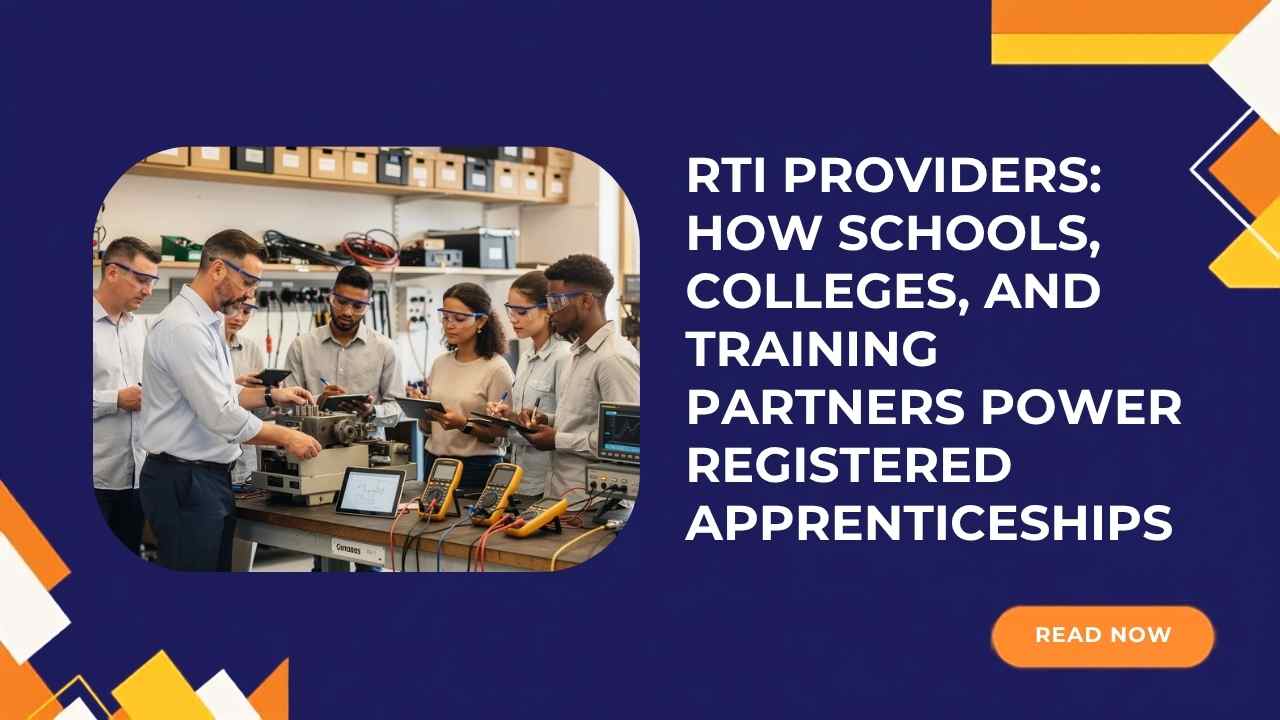
RTI is the structured classroom or online coursework that complements hands-on training in apprenticeship programs. In education settings, RTI also refers to the Response to Intervention framework, but within apprenticeships, it means organized related instruction in technical subjects tied directly to the occupation. RTI is developed by industry subject matter experts and should cover technical subjects related to the occupation, including safety, theory, math, and digital literacy.
RTI typically requires at least 144 hours per year – the DOL recommends a minimum of 144 hours of RTI annually. Safety training alone can range from 10 to over 40 hours, depending on the industry. RTI encompasses both academic and behavioral interventions for students, and common delivery formats include:
- In-person classes and lab sessions
- Asynchronous online modules
- Hybrid courses combining classroom and digital learning
- Industry certifications and micro-credentials
RTI providers use a three-tier model to deliver interventions. Tier 1 offers high-quality classroom instruction for all students. Tier 2 provides supplemental small-group instruction for additional support. Tier 3 involves intensive individualized support for students needing more help. This structured tiered system with escalating support levels drives higher completion rates, stronger wage gains, and portable credentials.

Who Are RTI Providers? Types of Institutions and Their Roles
An RTI provider is any organization responsible for delivering the related technical instruction portion of an apprenticeship or pre-apprenticeship. RTI providers can include community colleges and approved private institutions, and online training providers can also serve as RTI providers. Key types include:
- Community colleges and technical schools
- K-12 districts and CTE centers
- Universities and labor unions
- Joint apprenticeship training centers
- Employer-operated training academies and intermediaries
Approximately 60% of registered apprenticeship programs use colleges as their RTI providers. Many also act as sponsors or partner with a program sponsor such as an industry association or workforce board. RTI providers contribute to workforce development by aligning curriculum to local industry needs, awarding college credit, and connecting apprentices to stackable certifications.
GoSprout is built for this multi-stakeholder world, where employers, RTI providers, sponsors, and apprentices all need to share data, track rti hours, and stay aligned on competencies.
RTI Requirements and Compliance: What the DOL and States Actually Expect
Compliance with federal regulations is mandatory for registered apprenticeship programs. Apprenticeship programs must include at least 144 hours of RTI, and curriculum alignment ensures teaching meets specific learning needs and standards. RTI providers track attendance and completion to meet educational standards, and the following must be documented:
- RTI curriculum outlines mapped to work processes
- Delivery method (in-person, online, hybrid)
- Instructor qualifications
- Assessment methods and schedules
- Hours per apprentice per period
RTI activity appears in required reporting to RAPIDS, WIPS, and PIRL. Incomplete tracking creates audit risk or jeopardizes funding. State department agencies may layer additional requirements like minimum instructor credentials or state-level approval of RTI providers.
GoSprout keeps RTI compliant by design – capturing syllabus data, linking course completions to apprentice records, and automating reports aligned with federal and state regulations.
Challenges RTI Providers Face (and How to Avoid Common Mistakes)
Managing apprenticeship programs stretches limited staff and systems. Here are common challenges and the mistakes to avoid:
| Challenge | Mistake to Avoid |
|---|---|
| Aligning curriculum with changing industry needs | Designing RTI in isolation from employer partners |
| Coordinating calendars across multiple employers | Relying on email threads instead of shared dashboards |
| Tracking OJT and rti hours across cohorts | Managing records in standalone spreadsheets |
| Managing funding and reporting | Missing RAPIDS/WIPS/PIRL deadlines |
| Scaling enrollments | Burning out staff without technology support |
Data-based decision-making uses student data to inform intervention needs. Robust progress monitoring involves frequent tracking of student progress. Without a centralized platform, a youth apprenticeship launch can easily collapse when reconciling attendance, grades, and OJT hours across three employers.
Proactive program management – defined roles, consistent data standards, and regular check-ins – keeps RTI partnerships healthy. GoSprout addresses these pain points in a single platform for program development, tracking, communication, and compliance.

How to Choose, Partner With, or Become an RTI Provider
Choosing RTI providers depends on the specific educational needs of the students and the occupation. Vetting RTI providers involves assessing alignment with program standards. For sponsors selecting providers:
- Confirm experience with the specific occupation or industry
- Verify the ability to map the curriculum to work processes
- Ensure capacity for data sharing and reporting
- Evaluate delivery methods for access across locations
- Check completion rates and job placement outcomes
For schools becoming RTI providers: conduct employer listening sessions, inventory existing courses, align to DOL frameworks, pilot a course sequence, and pursue formal registration. Written agreements should cover roles, data-sharing under FERPA, tuition and funding arrangements, and a process for updating curriculum.
RTI providers should prioritize evidence-based practices and data-driven decision-making. GoSprout serves as shared infrastructure – hosting standards, mapping RTI to OJT, and making it easy for new partners to join an existing registered apprenticeship program.
Designing High-Impact RTI for Apprenticeship and Pre-Apprenticeship Programs
Effective RTI requires teacher-led interventions rather than reliance on technology alone. RTI providers implement a proactive approach to support struggling students, and early intervention aims to provide help quickly to prevent failure. Core design principles:
- Competency-based structure over seat time
- Clear mapping between classroom topics and on-the-job tasks
- Scaffolding from foundational to advanced skills
- Embedded safety, digital tools, and communication training
- Evidence-based interventions supported by research
- Culturally responsive practices to ensure interventions are effective for diverse students
Universal screening involves assessing all students to identify those at risk. Progress monitoring tracks the progress of at-risk students regularly. High-quality RTI involves ongoing training and support for educators, and mentorship from experienced instructors strengthens the apprenticeship experience.
RTI providers can create progression pathways: pre-apprenticeship courses for youth, full registered apprenticeship, and advanced training stackable into certifications or degrees. Employer engagement through guest lectures, site visits, and co-developed assessments mirrors real-world performance expectations.
GoSprout’s course and competency tracking features let RTI providers align learning objectives, assignments, and completion data with each apprentice’s work log.
How GoSprout Supports RTI Providers, Sponsors, and Employers
GoSprout is an all-in-one work-based learning and apprenticeship management platform. It supports RTI providers, sponsors, employers, and apprentices with:
- Automated enrollment workflows and central apprentice profiles
- OJT and RTI hour tracking with alerts for missing hours
- Separate logins for all stakeholders with shared views of progress
- Structured data for RAPIDS, WIPS, and PIRL reporting
- Audit-ready documentation and configurable program standards
GoSprout helps manage over half a million apprentice records. Employers can increase program enrollment by 20% with streamlined processes. Organizations like RADD Training have been active in apprenticeship development since 2023, and GoSprout supports this kind of growth across sectors.
Schools and training providers can say yes to more partnerships, capture more funding opportunities, and focus staff energy on teaching instead of spreadsheets.

FAQs About RTI Providers and Apprenticeship Programs
What is an RTI provider in a registered apprenticeship program?
An rti provider is the organization delivering the related technical instruction portion of an apprenticeship. Examples include community colleges, technical schools, and approved private training providers that develop and teach structured coursework aligned to occupational standards. Trade schools often act as RTI partners for programs like trade school welding, where classroom hours support on-the-job training.
Do all apprentices need 144 hours of related technical instruction each year?
The DOL recommends at least 144 hours of RTI per year as guidance. Some occupations and states require more, depending on complexity and regulations. Your program sponsor and registration agency will confirm exact requirements.
Can an employer be its own RTI provider?
Yes. Employers can deliver RTI if they document curriculum, employ qualified instructors, and meet all compliance requirements. Many still partner with community colleges for access to credit, resources, and expertise in program management.
How do RTI providers get funding for apprenticeship programs?
Funding sources include state apprenticeship grants, federal workforce development funds, WIOA and workforce board partnerships, tuition models, and fee-for-service arrangements. Investment in RTI infrastructure often qualifies for multiple funding streams.
How does GoSprout help RTI providers manage apprenticeship programs?
GoSprout automates enrollment, tracks RTI and OJT hours, connects all stakeholders on one platform, and generates compliance reports for RAPIDS, WIPS, and PIRL. It supports apprenticeships, pre-apprenticeships, and internships in a single system.
What makes a strong RTI provider for apprenticeship programs?
Strong providers maintain employer partnerships, keep curriculum current with industry needs, invest in technology for program management, and treat apprenticeship as a strategic part of their education and workforce development mission. Tools like GoSprout let these providers operationalize their vision with simplified tracking and compliance.
How do RTI providers coordinate with employers and sponsors?
Through quarterly reviews, shared dashboards, standard communication templates, and collaborative updating of work processes and RTI outlines. GoSprout centralizes this coordination and gives all parties real-time visibility into apprentice progress.
Can RTI in apprenticeship programs count toward college credit?
Many RTI courses are designed as credit-bearing classes or can be evaluated through prior learning assessment. Tracking competencies and hours accurately in systems like GoSprout makes it easier to document learning for credit decisions and build stackable pathways to degrees.
What’s the difference between RTI providers and training providers in general?
All RTI providers are training providers, but not all training providers deliver instruction in the structured way required for a registered apprenticeship. RTI providers must align curriculum to approved standards, document hours and outcomes, and coordinate with sponsors and employers.
Why RTI Providers Choose GoSprout
GoSprout reduces administrative burden, strengthens partnership coordination, and improves outcomes for participants and employers. Key differentiators:
- Purpose-built for apprenticeship and work-based learning, not a generic LMS
- Multi-sided design serving employers, schools, sponsors, and apprentices
- Built-in compliance support for RAPIDS, WIPS, and PIRL
- US-based onboarding and ongoing support for your team
GoSprout supports apprenticeship program development, program management, OJT and RTI tracking, and stakeholder collaboration in one platform – making it easier for RTI providers to launch and grow their registered apprenticeship and pre-apprenticeship portfolios.
Next Steps: Launch or Scale Your RTI Provider Role with GoSprout
Whether you’re ready to identify your first apprenticeship partnership or scale across multiple occupations and employers, GoSprout can support your journey. Schedule a guided tour to see how RTI tracking, compliance reporting, and stakeholder collaboration work in practice. Starting small with one pilot program is the right advice – you can develop and expand from there.
Strong RTI providers build sustainable talent pipelines, serve local employers, and create equitable access to paid, earn-and-learn training. The right technology makes that mission achievable without drowning your team in paperwork. Reach out to GoSprout today to take the next step.