
Table of Contents
- Core Federal Requirements for Registered Apprenticeship Compliance
- State Rules, Project Incentives, and Tax Credits (Including IRA 2022–2026)
- Designing a Compliant Registered Apprenticeship Program Structure
- Ongoing Monitoring, Audits, and Recordkeeping
- Common Compliance Pitfalls and How GoSprout Helps Avoid Them
- Frequently Asked Questions About Registered Apprenticeship Compliance
- Why Choose GoSprout for Registered Apprenticeship Compliance
- Get Your Registered Apprenticeship Program Audit-Ready
Federal and state regulators have increased monitoring of registered apprenticeship programs heading into 2026. The DOL Office of Apprenticeship and State Apprenticeship Agency reviewers are conducting more frequent compliance checks, and DOL audits approximately 5-10% of programs yearly, increasing to 15% in 2026. If your program is not ready, the consequences are real.
Registered apprenticeship compliance refers to adhering to U.S. Department of Labor standards for programs, following federal and state regulations under 29 CFR Parts 29 and 30, and meeting project-specific conditions like Inflation Reduction Act tax credits. Failure to meet required standards may result in corrective action plans or deregistration of the program, loss of grants, and repayment of workforce funding. Compliance with registered apprenticeship standards grants access to government workforce funding and tax incentives, and employers can receive tax credits for hiring apprentices.
GoSprout is an apprenticeship and work-based learning management platform that helps employers, sponsors, and schools keep programs audit-ready without drowning in spreadsheets. This guide covers core federal rules, state and incentive-specific requirements, how to design a compliant registered apprenticeship program, and tools to automate ongoing compliance tasks.

Core Federal Requirements for Registered Apprenticeship Compliance
Every registered program, regardless of industry, must comply with 29 CFR Parts 29 and 30 and DOL Office of Apprenticeship guidance. Ongoing oversight by registration agencies ensures that apprenticeship programs meet federal and state standards. Compliance starts at program registration but continues through daily operations: agreements, wage progression, on-the-job learning, related technical instruction, and equal employment opportunities.
A Registered Apprenticeship assures quality through validated standards combining on-the-job learning and technical instruction. Employers must register their apprenticeship programs with the appropriate agency. Here are the core federal elements every sponsor must address:
- Approved apprenticeship standards including a work process schedule, wage schedule, and related instruction outline, all reviewed and accepted by OA or a state apprenticeship agency.
- A signed apprenticeship agreement for each apprentice, filed within 45 days of the start date and registered in RAPIDS or the state system. Apprenticeship programs must use formal agreements to document training and keep track of apprentice progress.
- At least 144 hours of related instruction annually, often delivered as classroom instruction or hybrid courses. Instructors must meet state vocational standards or be recognized subject matter experts.
- Progressive wage increases tied to time-based or competency-based milestones. Apprentices must receive a paycheck from day one with progressive wage increases as they gain skills, starting at or above federal and state minimum wage and meeting any prevailing wage requirements.
- EEO and anti-harassment requirements under 29 CFR Part 30. Programs must adhere to Equal Employment Opportunity regulations for non-discrimination in apprenticeship, including universal outreach, reasonable accommodation processes, and documented complaint procedures.
- Safety and health training appropriate to the occupation, referencing OSHA standards. Compliance helps demonstrate a commitment to quality training and safe working conditions for apprentices.
GoSprout can map OJT tasks and RTI courses directly to the work process schedule, making it easier to demonstrate that apprentices actually receive the structured training described in the standards.
Key Compliance Documents DOL and State Auditors Commonly Request
Most compliance reviews are document-driven. Sponsors must maintain detailed, accurate records as part of compliance with apprenticeship rules, and programs must maintain accurate records for compliance audits, including apprentice progress and demographics. Records must be kept for at least five years post-completion or cancellation.
Auditors typically request:
| Document Type | What It Includes |
|---|---|
| Apprenticeship Standards & Amendments | Work process schedule, ratios, occupations, wage schedule |
| Individual Agreements | Signatures, registration dates, probationary period terms |
| OJL Logs / Competency Checklists | Task codes matching the approved WPS |
| RTI Records | Transcripts, attendance, course titles, hours from training providers |
| Wage Progression / Payroll | Step increases at required intervals, fair wages documented |
| EEO Documentation | Recruitment outreach logs, demographic data, complaint files |
| RAPIDS / State Reports | Enrollments, cancellations, completions |
Misalignment between RAPIDS data and internal logs is one of the fastest ways to trigger audit findings. Inconsistent dates, occupation codes, or missing signatures create problems. GoSprout can auto-generate many of these reports from a single dataset, reducing discrepancies.
State Rules, Project Incentives, and Tax Credits (Including IRA 2022–2026)
More than half of U.S. states operate as SAA states with additional rules on ratios, registration processes, and reporting. Many apprenticeship programs must navigate these layered requirements, especially when operating across multiple jurisdictions. State apprenticeship tax credits can also benefit employers financially, and employers can access WIOA funding for apprenticeship programs. Grants are available to help cover apprenticeship training costs, alongside GI Bill benefits for veteran apprentices.
Common state-level variables include:
- Apprentice-to-journeyworker ratios stricter than federal guidance, especially in construction trades
- State licensing or certification requirements tied to OJL and RTI documentation for trades like electricians and HVAC technicians
- Additional demographic reporting for state-funded incentives
Multi-state employers may need separate registrations in multiple SAA jurisdictions or a national program standard with reciprocity plus supplemental state regulations documentation.
For clean energy projects, the Inflation Reduction Act requires 15% of total labor hours on qualifying projects beginning 2024 onward to be performed by registered apprentices for full federal tax credits, including the Investment Tax Credit and production tax credit. Apprenticeship programs utilize daily ratio tracking to ensure journeyworker supervision meets requirements. Only W-2 hours from officially registered apprentices in DOL-approved programs count. Project-level labor hour logs by worker classification, proof of registration status, and certified payroll showing wage rates are essential for substantiating claims.
GoSprout can track hours by project, occupation, and worker type, giving clean energy employers one central source of truth for IRA-related compliance and tax credit documentation.
Coordinating Federal, State, and Project-Level Compliance
Create a compliance matrix for each registered apprenticeship program mapping federal requirements, state rules in each jurisdiction, and project-specific requirements like IRA thresholds or grant conditions.
Assign a lead compliance coordinator who bridges HR, payroll, operations, and training providers to ensure alignment across systems. Before submitting bids on public or clean energy projects, forecast apprentice utilization by occupation and project phase, confirm approved occupations and work process schedules match the work, and verify that pre-apprenticeship pipelines are ready to meet recruitment goals and diversity targets for diverse populations.
GoSprout centralizes data from schools, employers, and workforce partners, making it easier to manage this matrix in real time.
Designing a Compliant Registered Apprenticeship Program Structure
Compliance is easier when the program is structured correctly from day one. DOL recognizes three primary models:
- Time-based: Fixed hours of on-the-job learning (minimum 2,000 hours total), with many trades requiring 4,000-8,000 hours over 2-5 years
- Competency-based: Advancement based on demonstrated mastery, verified via assessments and observations
- Hybrid: Combines time and competency requirements for schedule predictability with skills verification
Registered Apprenticeship programs typically take 2-5 years to complete. Apprentices must complete at least 144 hours of related instruction per year. Apprenticeships provide paid work experience with mentorship from an experienced mentor, and apprentices earn a nationally recognized credential upon completion.
The work process schedule is the backbone of compliance. Define occupational tasks, expected hours per task area, and performance expectations. Align OJL tasks with RTI curricula so apprentices practice on the job what they learn in class and meet education requirements.
GoSprout allows sponsors and schools to build digital WPS templates, link tasks to competencies and courses, and update them when occupations evolve.
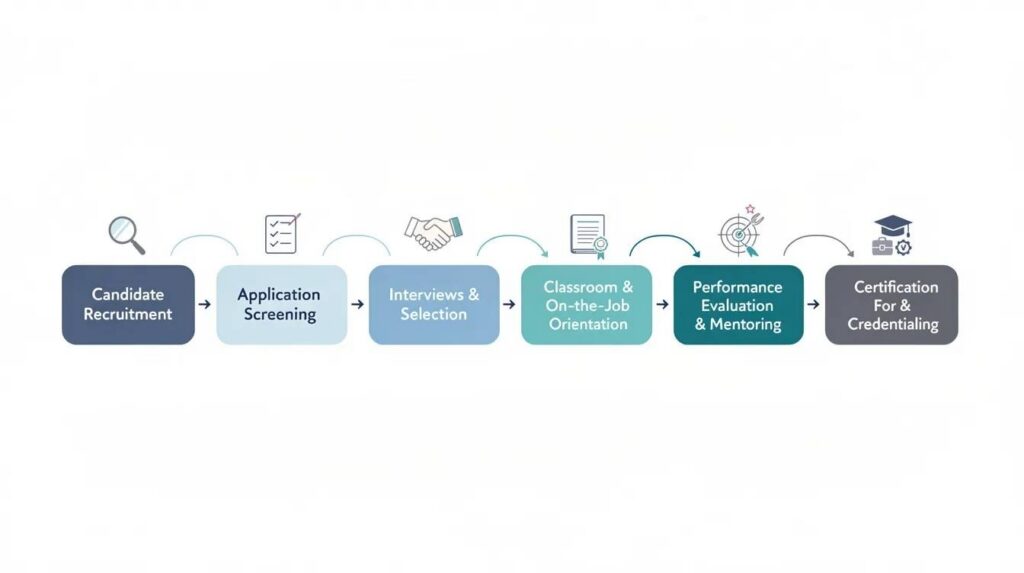
Policies, Handbooks, and Written Standards
Every registered apprenticeship program should maintain written policies consistent with its apprenticeship standard, covering:
- Eligibility criteria and a fair and open process for selection of eligible candidates
- Credit for prior experience or previous RTI
- Probationary period terms, discipline, and termination conditions
- Wage schedule, benefits, and when apprentices move between pay steps
- Safety, harassment, and EEO policies with clear reporting channels
Maintain a program handbook for apprentices and journeyworker mentors explaining how OJL is logged, who signs off on competencies, and how reviews occur. Apprenticeship programs require a signed apprenticeship agreement on file for every participant.
Review and update these documents at least annually, especially when wage rates change, new occupations or locations are added, or regulatory updates like IRA guidance shift requirements. GoSprout stores and version-control standards, handbooks, and policy documents.
Ongoing Monitoring, Audits, and Recordkeeping
Compliance is ongoing. Sponsors must monitor data throughout the apprenticeship program lifecycle, not just before a DOL visit. Programs must maintain records for at least five years after completion.
Good monitoring habits include:
- Monthly or quarterly checks of OJL hours and RTI attendance to ensure apprentices are on track
- Periodic verification that wage increases were applied on time and recorded in payroll to maintain records accurately
- Annual reviews of completion rates, cancellation reasons, and demographic groups data to identify equity gaps
Registered apprenticeship programs should maintain a real-time log of OJL hours and competencies per apprentice, RTI progress reports and certificates, and timely updates to RAPIDS or state systems when apprentices start, pause, transfer, or complete. Providing structured training and tracking it consistently is what separates audit-ready programs from those scrambling to catch up.
GoSprout dashboards provide live completion, hours, and wage progression data, along with documentation exports for RAPIDS, WIPS, PIRL, and common state formats.
Preparing for DOL or State Compliance Reviews
Run an internal mock audit at least every 12-24 months:
- Sample apprentice files and check them against RAPIDS or state system records for accurate records
- Verify that work process schedules are followed for each occupation
- Review EEO outreach documentation, including contact logs from the recruitment process and responses from partners
Typical compliance reviews include advance notification, interviews with apprentices, journeyworkers, and HR staff, and site visits to verify compliance. Create an audit readiness binder for each cohort containing signed agreements, WPS, RTI plans, OJL logs, wage progression records, and EEO documentation. GoSprout users can pull standard reports in minutes and grant auditors read-only dashboard access.
Common Compliance Pitfalls and How GoSprout Helps Avoid Them
Even experienced sponsors struggle with compliance as they scale across locations and occupations. Employers benefit from compliance through increased retention rates and a highly skilled workforce tailored to local employer needs. Apprenticeships lower employee turnover and increase productivity, leading to good paying jobs and better retention outcomes that directly lower employee turnover.
Frequent pitfalls include:
- Expanding into a new state without updating standards, work process schedules, and ratios
- Relying on paper timesheets or scattered spreadsheets, leading to gaps and inconsistent data
- Missing wage progression steps or failing to document delays
- Treating pre apprenticeship participants as registered apprentices, causing record confusion
- Not aligning apprenticeship utilization tracking with tax credit requirements for clean energy projects
GoSprout addresses these with a centralized database, automated alerts for behind-schedule apprentices, built-in templates for work process schedules and competency frameworks, reporting modules compatible with RAPIDS and state tools, and project-based tracking against IRA 15% thresholds. Investing in compliance infrastructure early reduces administrative burnout, protects funding, and improves apprentice experiences.

Frequently Asked Questions About Registered Apprenticeship Compliance
How often are registered apprenticeship programs audited?
DOL OA and many SAAs conduct periodic reviews. Some programs see a formal review every 3-5 years, more often if there are complaints, low completion rates, or rapid expansion. Keep records current at all times rather than catching up when an audit is announced.
What records must I keep, and for how long?
Maintain apprenticeship standards, agreements, OJL logs, RTI records, wage progression documents, EEO and candidate recruitment records, and RAPIDS reports. The typical minimum is five years after completion or cancellation. Check state grant or tax credit rules for longer requirements. Maintain records consistently to verify compliance at any point.
Can I change my work process schedule or add new occupations?
Sponsors can request amendments via OA or SAA. Document the reasons for changes, such as new clean energy equipment or updated industry standards, and update all internal materials and systems to match. This keeps job assignments aligned with the registered program.
How do pre-apprenticeship programs fit into compliance?
Pre-apprenticeship is not the same as a registered apprenticeship. Pre-apprentices lack the same status in RAPIDS. Quality pre-apprenticeships should have formal agreements with registered apprenticeship programs and document training that can be credited when individuals become registered apprentices, helping meet minimum eligibility requirements and connect diverse populations to the open process.
How do I document hours for IRA apprenticeship and tax credit requirements?
Track apprentice labor hours by project, occupation, and date. Payroll, timesheets, and apprenticeship system records must align. GoSprout can tag hours to specific projects and generate reports showing the percentage of labor hours performed by registered apprentices, supporting tax credit claims for both the production tax credit and investment tax credit on clean energy projects.
What happens if my program falls out of compliance?
Consequences range from corrective action plans to temporary suspensions and deregistration. Loss of grants, tax credits, and access to additional resources like WIOA funding can follow. Early communication with OA or your SAA is critical. Tools like GoSprout help sponsors quickly identify and correct gaps before they escalate. Training apprentices consistently and maintaining industry-vetted labor standards protects your investment.
Why Choose GoSprout for Registered Apprenticeship Compliance
GoSprout is a purpose-built platform for managing registered apprenticeship programs, pre-apprenticeship, and internships across employers, schools, and sponsors. It supports the development of skilled workers at every stage.
- End-to-end tracking for OJT, RTI, competencies, and evaluations in a single system accessible to employers, RTI providers, and apprentices
- Automated compliance reporting for RAPIDS, WIPS, PIRL, and state templates, reducing manual data entry errors
- Real-time dashboards showing completion rates, hours, wage progression, and EEO metrics
- Mobile app for apprentices to log hours, view tasks, and track progress
- Flexible program design tools to build and update work process schedules and course plans aligned with DOL and SAA standards
GoSprout supports multi-state sponsors, clean energy employers, school districts, and workforce organizations who need to scale while staying compliant. Whether you need to meet recruitment goals across demographic groups, ensure alignment with state regulations, or track apprentice utilization for IRA thresholds, GoSprout keeps everything in one place.
Get Your Registered Apprenticeship Program Audit-Ready
Stop treating compliance as a fire drill. Schedule a demo of GoSprout to see how OJL, RTI, and reporting can be automated, or request a compliance readiness checklist tailored to your state and industry. You can also contact GoSprout to review your existing apprenticeship standards and identify quick improvements before your next audit cycle.
Less time on paperwork means more time on quality training, protection of tax credits and funding, and a better experience for apprentices, mentors, and administrators. GoSprout supports organizations at any stage, from launching a first registered apprenticeship program to scaling multi-state, multi-occupation initiatives that deliver a highly skilled workforce and meet the demands of providing structured training at scale.


