Table of Contents
- Introduction: What Is Plumber Training Management (and Why It Matters in 2026)?
- Why Structured Plumber Training Management Is Critical Today
- Core Components of an Effective Plumbing Training Program
- Balancing Online Plumbing Courses and Hands-On Plumbing Training
- Building a Competency Framework: From Plumbing Math to Specialized Skills
- Managing Plumbing Certifications, Licensing, and Compliance
- Designing Pathways for Residential, Commercial, and Industrial Plumbing Systems
- Digital Tools and Data: How to Run Plumbing Training Like a Modern Operation
- Common Mistakes in Plumber Training Management (and How to Avoid Them)
- Why Choose a Dedicated Platform for Plumber Training Management
- Next Steps: Turn Your Plumbing Training into a Managed, Measurable System
- Frequently Asked Questions About Plumber Training Management
Introduction: What Is Plumber Training Management (and Why It Matters in 2026)?
Plumber training management is the organized design, delivery, and tracking of plumbing training across apprenticeships, trade school programs, and employer-sponsored pipelines. It covers everything from curriculum development and competency sign-offs to certification tracking and regulatory reporting.
If you manage a plumbing training program today, you already know the pain points: scattered spreadsheets for OJT hours, paper sign-offs that disappear into filing cabinets, confusion around which plumbing certifications each apprentice still needs, and code updates that arrive faster than your curriculum can absorb. The U.S. plumbing industry is valued at over $169 billion, yet many organizations still run their training the same way they did a decade ago.
In 2026 the pressure is real. An aging workforce is retiring faster than new skilled plumbers enter the trade. Plumbing systems are growing more complex – smart fixtures, graywater reuse, building distribution systems drains in multi-story logistics facilities. State and federal agencies expect tighter documentation. Managing a plumber training program requires technical mastery and safety compliance, and a high-performing plumber training program includes hands-on technical training and modern tracking to match. This guide gives program managers, school coordinators, apprenticeship sponsors, and HR leads at plumbing contractors a concrete blueprint for building, tracking, and scaling programs that actually produce job ready skills relevant to the modern plumbing and piping industry.
Why Structured Plumber Training Management Is Critical Today
Structured training management ties directly to safety, code compliance, and business outcomes. Companies that track training rigorously see fewer callbacks, safer installations, and faster paths to licensure for their apprentices.
When training is disorganized, predictable problems follow:
- Apprentices develop gaps in foundational knowledge about plumbing fixtures and sewage disposal building materials, leading to costly rework.
- Misapplied physical principles essential to system design – like pressure calculations and siphon behavior – create inspection failures.
- Hours and competencies go undocumented, delaying an apprentice’s eligibility for journeyman exams.
Registered Apprenticeship Programs are recognized by the U.S. Department of Labor and come with specific compliance expectations. Apprenticeships combine on-the-job training with classroom instruction, and sponsors must report data into systems like RAPIDS and PIRL. Plumbing training programs cover IPC, UPC, and OSHA guidelines, so state plumbing boards and local inspectors expect documented proof that learners have met those standards. Plumbers must adhere to strict safety codes and continuous certification requirements, and regulatory compliance is critical for apprenticeship programs to be successful.
The upside of getting it right is just as significant. Implementing standardized operating procedures promotes uniform training across technicians. You gain predictable time-to-licensure, better retention among new technicians, and easier succession planning as senior plumbers retire. Workforce development nonprofits support the management of registered apprenticeship programs and can serve as valuable partners in scaling your efforts. When your program runs on structure rather than tribal knowledge, everyone – from the newest apprentice to the licensing board – benefits.
Core Components of an Effective Plumbing Training Program
Think of this section as a checklist for building or auditing a plumbing training program in 2026. Technical curriculum should cover:
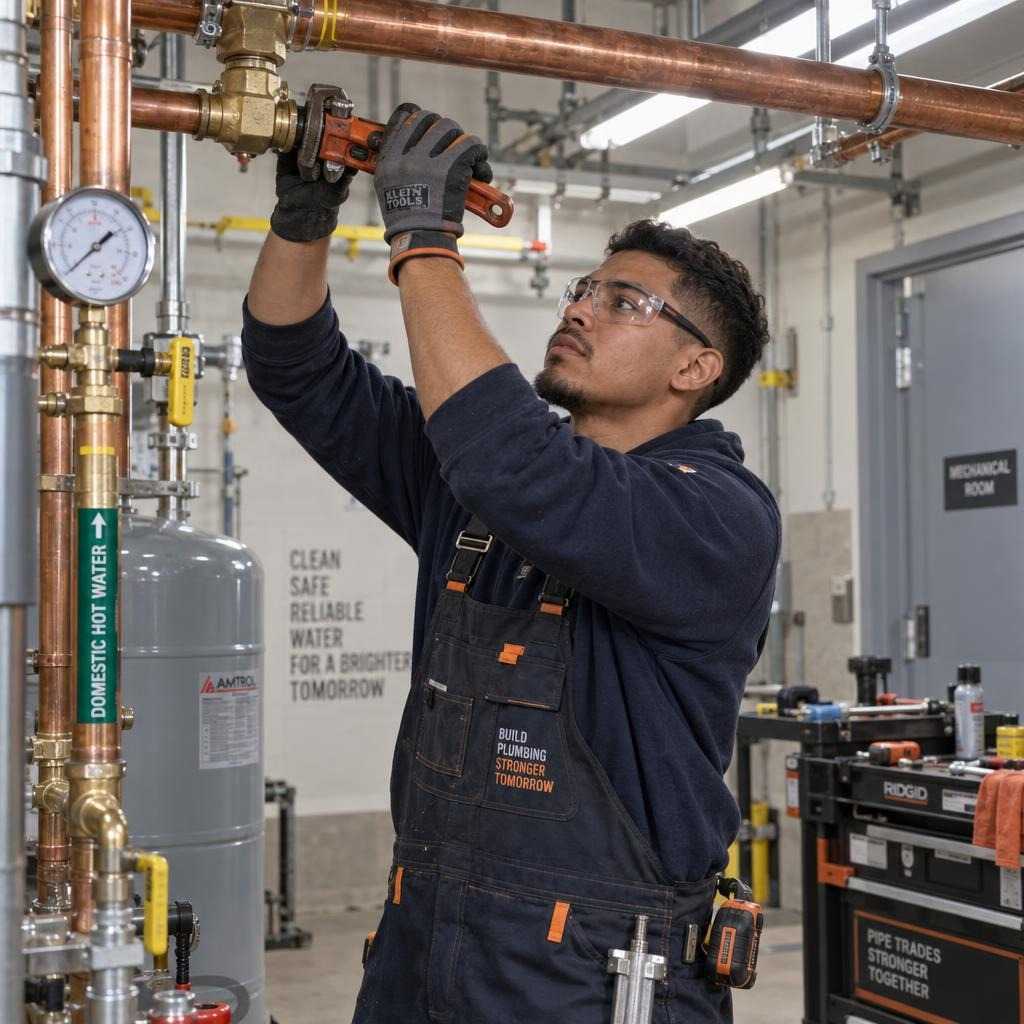
- Residential, commercial, and industrial plumbing systems including water supply and drainage and venting systems
- Plumbing water supply design, stacks drainage fixture units, plumbing traps fixture configurations, and common plumbing fixtures like water heaters fixtures faucets, interceptors, and backflow devices
- Treatment water pipe sizing, connection methods plastic pipes, and joining methods general principles for copper, PEX, PVC, cast iron, and stainless steel
- Responsibility piping materials selection, flame cutting welding techniques, and pneumatics testing methods
- Explore potable water distribution, sewage disposal systems, and disposal systems identify hazards in both residential and commercial settings
Foundational theory must include plumbing math – fractions, offsets, pipe area, flow rates – and more plumbing math concepts like water apply math concepts for slope calculations and vent sizing. Apprentices need to understand plumbing geometry backflow protection, the physical principles essential to pressure and flow, and materials science basics. Sketches midterm exam pipes exercises and diagrams discuss safety guidelines to reinforce code reading.
Safety and code training is non-negotiable. Plumbing training includes safety standards like IPC, UPC, and OSHA. This means coverage of lockout/tagout, confined space awareness, excavation safety air protocols, PPE standards, and systematic coverage of relevant local plumbing codes. Training programs cover safety standards and regulatory compliance, and training programs emphasize compliance to prepare for licensed technician roles. Safety training should be continuous rather than a one-time orientation – treat it as a thread woven through every module.
Professional skills round out the program. Training programs should incorporate both technical skills and soft skills development. Apprentices need to learn essential soft skills like customer communication, documentation via digital work orders, job site etiquette, and teamwork with other trades. These essential soft skills are what separate a competent technician from a trusted professional.
Balancing Online Plumbing Courses and Hands-On Plumbing Training
Strong plumber training management blends digital theory with in-shop and on-the-job practice intentionally. Blending digital theory and hands-on practice is essential in plumber training, and training management systems should balance digital tracking with hands-on experiences.
Where an online plumbing course excels:
- Code interpretation, plumbing math drills, and safety water heater sizing scenarios
- Multimedia demos of complex assemblies – pipe routing, drainage layouts – that apprentices can replay on demand
- Plumbing training should include microlearning modules for quick access to information between job site tasks
- Modern plumbing training incorporates digital simulations for skill development; VR-based simulations enhance hands-on learning in plumbing training, and immersive VR modules improve hands-on accuracy in plumbing education
- SkillCat offers simulation-based training for plumbing students, while CourseCareers provides AI support for plumbing training questions
What must stay hands-on:
- Cutting and joining pipe, sweating copper, solvent welding PVC
- Setting and testing plumbing fixtures, troubleshooting plumbing systems with real leaks and blockages
- Using safety plumbing tools and essential tools correctly under supervised conditions
Hybrid training models combining online learning and hands-on verification improve flexibility across diverse schedules. Field technicians need mobile access to training materials for effective on-the-job learning, so a mobile-friendly platform is essential. Manual assessments should complement digital training evaluations in plumbing education – digital quizzes verify theory retention, but a supervisor watching an apprentice sweat a joint verifies competence.
A practical scenario: a 12-week introductory plumbing training program alternates two evenings of online plumbing per week with one in-shop lab night. Attendance and competency sign-offs are captured digitally, creating an automatic audit trail. Technology can improve training consistency and tracking in plumbing programs, especially when you scale beyond a handful of learners.
Building a Competency Framework: From Plumbing Math to Specialized Skills
A competency framework is a clearly structured list of skills and knowledge areas every apprentice must master, grouped by level – Helper, Year-1 Apprentice, Year-2, and so on through journeyman and beyond. Competency-based training ensures apprentices understand how each skill builds toward proficiency, rather than just logging hours.
Base competencies (Helper / Year-1):
- Plumbing tools identification and safe use of ladders
- Reading simple isometric drawings and plumbing math building plans
- Basic math concepts like calculating fall on a 3-inch drain at ¼ inch per foot for a 40-foot run
- Foundational knowledge of various plumbing materials and building materials
Intermediate competencies (Year-2 / Year-3):
- Rough-in for a full bathroom group, including drainage and venting systems
- Installing water heaters with expansion tanks and related devices water heaters
- Sizing vent stacks and diagnosing low-pressure complaints
- Troubleshooting plumbing systems in residential and light commercial settings
Advanced competencies for those who want to learn specialized plumbing skills:
- Medical gas systems in healthcare facilities
- High-rise booster pump systems and industrial plumbing systems with process piping
- Advanced plumbing geometry backflow protection and complex pump sizing
- Specialized plumbing skills for environments with high-temperature or corrosive fluids
Effective plumber training programs incorporate frequent assessments and feedback at every level. Effective mentorship practices enhance the learning experience for apprentices – pair each learner with a supervisor who provides regular, documented evaluations. Continuous evaluation of programs helps ensure their effectiveness and quality. Present the framework visually as a matrix or ladder so apprentices, employers, and educators can see exactly where each learner stands and what technical knowledge needed to advance remains.
Managing Plumbing Certifications, Licensing, and Compliance
In 2026, plumbers often need multiple credentials: state plumbing licenses, OSHA safety cards, backflow tester certifications, and manufacturer-specific trainings. Plumbing codes and licensing requirements vary significantly across different jurisdictions – Alaska requires 8,000 OJT hours for a journeyman certificate, while Colorado sets the bar around 6,800 hours and California requires four years of experience for its C-36 contractor exam. Salaries vary widely depending on location and credentials, but certified plumbers can earn starting salaries around $43,000, and advanced plumbing certifications can lead to higher-paying positions.
Common stages to track:
- Pre-apprentice safety and plumbing fundamentals
- Registered apprenticeship hours: OJT (typically 2,000 hours/year) plus RTI (at least 144 hours/year)
- Journeyman exam eligibility after accumulating required hours and competency sign-offs
- Continuing education for renewal-code updates, new plumbing materials, and emerging technologies
Training managers should track exam dates, CE deadlines, and certification expirations in a centralized dashboard with automated alerts 60–90 days before renewal dates. For a four-year apprenticeship, that means monitoring roughly 8,000 OJT hours, 576 hours of RTI, and recurring code-update courses each licensing period.
Compliance reporting ensures adherence to IPC, UPC, and OSHA standards. Effective compliance reporting supports safe and environmentally responsible practices, and compliance reporting is crucial for passing certification exams in plumbing. Digital management tools can track compliance records and training progress, making it far easier to generate audit-ready exports than pulling data from scattered files. For multi-state contractors and schools, a flexible training management platform is essential because what satisfies one state board may not transfer to another.
Designing Pathways for Residential, Commercial, and Industrial Plumbing Systems
Not every apprentice follows the same path. Some will focus on residential service plumbing, others on commercial build-outs, and a smaller number on heavy industrial plumbing systems. Plumbing apprenticeships typically last 2 to 4 years, but the specialization track shapes what those years look like.
Residential track:
- Emphasis on fixture replacement, small-diameter piping, water heaters swaps, and emergency service workflows
- Customer communication and benefit gain practical experience solving plumbing related problems in a family’s plumbing business or small shop
- Learn plumbing online modules paired with field ride-alongs under a licensed plumber
Commercial track:
- Multi-story water distribution, restroom battery installations, grease interceptors, and roof drains
- Coordination with general contractors and inspectors on the job site
- Detailed course materials on building distribution systems drains and large-diameter DWV systems
Industrial track:
- Process piping, high-temperature or corrosive fluids, specialized valves and controls
- Collaboration with engineers to interpret P&IDs and detailed specifications
- Focus on industrial plumbing systems and heavy equipment
OJT is essential for developing hands-on plumbing skills across all three tracks, and plumbing apprenticeships provide hands-on experience under licensed plumbers. OJT tracking monitors hours spent on practical training, while RTI tracking ensures compliance with technical instruction standards. RTI includes classroom instruction on plumbing systems and safety. Effective OJT programs improve apprentice engagement and retention, which matters when the plumbing industry learn curve is steep and turnover is costly. A well-designed training management system lets you configure shared core modules that branch into specialized courses and OJT tasks – all tracked in the same place.
Digital Tools and Data: How to Run Plumbing Training Like a Modern Operation
Spreadsheets and paper timesheets cannot keep up with multi-cohort plumbing training in 2026, especially when programs must report to state apprenticeship councils or workforce funding agencies like workforce development boards.
Essential software capabilities to evaluate:
- A mobile app or portal for apprentices to log OJT hours daily – mobile apps can facilitate the tracking of on-the-job training hours
- Instructor tools to record hands on plumbing training evaluations with dated, supervisor-verified sign-offs
- Dashboards that visualize progress across plumbing training cohorts, flag lagging competencies, and surface expiring certifications
- Automated reporting that maps OJT and RTI data directly to DOL Registered Apprenticeship work processes, cutting weekly admin time
- Direct platform support feature for multi-stakeholder collaboration – employers, schools, sponsors, and apprentices each see what they need
Training management systems should support ongoing learning and not just initial training. Tracking safety performance is essential in plumbing training programs, and the system should make it easy to audit safety modules alongside technical knowledge. Technology can improve training consistency and tracking in plumbing programs when the platform is intuitive enough that field supervisors actually use it.
A practical example: an employer sponsoring 40 plumbing apprentices uses a single platform to assign online plumbing modules, track lab attendance, capture supervisor sign-offs, and export quarterly reports for regulatory compliance. What once required a full-time coordinator and hours of spreadsheet reconciliation now runs on automated workflows and real-time dashboards.
Common Mistakes in Plumber Training Management (and How to Avoid Them)

Even well-intentioned plumbing training programs stall because of avoidable management errors. Here are the most common ones and how to fix them:
- Relying on informal mentoring without documented standards. Tribal knowledge is valuable, but it does not scale. Create instructional materials required for each level, standardize them, and require supervisors to follow a consistent evaluation rubric.
- Failing to link online plumbing content to real job tasks. Apprenticeship programs are most effective when classroom instruction reinforces field training. Tie each module to at least one real-world task – if the apprentice completes a venting theory course, schedule a vent installation within the following week.
- Overemphasizing classroom theory while neglecting structured hands on plumbing training. This produces plumbing students who can recite code but cannot confidently install or service plumbing systems. Balance every block of theory with supervised practice and a suitable completion date for competency demonstration.
- Poor recordkeeping. Missing OJT hours, lost certificates, or inconsistent supervisor evaluations create disputes when apprentices try to sit for licensing exams. Run quarterly data audits and keep all records in a centralized digital system.
- Ignoring ongoing development. Training should not end at licensure. Online courses for code updates, new plumbing fixtures, and emerging technologies keep your team current and reduce liability.
Why Choose a Dedicated Platform for Plumber Training Management
Generic LMS tools and spreadsheets struggle with the specific demands of plumbing training: OJT hour tracking broken down by task type, competency-based progression through multiple apprenticeship years, mobile access for field staff on the job site, and compliance reporting that maps to state and federal formats.
A purpose-built work-based learning platform should offer:
- The ability to define plumbing-specific work processes, log time by task, attach evaluations, and align everything with plumbing training standards
- Role-based access for multiple stakeholders – employers, schools, apprenticeship sponsors, and apprentices – so each can update and see relevant data in real time without sending emails or paper forms
- Scalability that lets an organization expand from a handful of apprentices to dozens or hundreds without overwhelming the training team, driven by automation and dashboards
- Practical and durable skills tracking that extends beyond initial training into continuing education and career-long development
These capabilities connect directly to your goals: faster progression from apprentice to licensed plumber, fewer compliance surprises, and a more consistent learning experience across every plumbing training cohort. GoSprout was built specifically for this kind of multi-stakeholder, compliance-driven training environment – offering real-time OJT and RTI tracking, automated reporting for RAPIDS and PIRL, mobile apps, course development tools, and the collaboration features that plumbing programs actually need.
Next Steps: Turn Your Plumbing Training into a Managed, Measurable System
Plumber training management is about converting ad-hoc teaching into a structured, data-driven system that supports learners, protects the organization, and meets regulatory standards. Whether you run a small family operation or coordinate apprenticeships across multiple states, the principles are the same: define competencies from plumbing math to advanced industrial systems, blend online plumbing and hands on plumbing training deliberately, rigorously track hours and skills, and use software to automate reporting and communication.
You now have a practical roadmap. The next step is execution. Schedule an internal audit of your training records this month. Map out a competency framework before the next intake of apprentices. Pilot a small cohort on a digital training management workflow within the next quarter to see how much time and confusion it eliminates.
If you are ready to centralize OJT tracking, RTI delivery, certification records, and stakeholder collaboration in one platform, explore what GoSprout can do for your plumbing training program. The plumbing industry needs more skilled plumbers – and better training management is how you build them.
Want to Learn More About Your Registered Apprenticeship Opportunities?
BOOK A FREE CONSULTATION
Frequently Asked Questions About Plumber Training Management
These FAQs address common questions from employers, schools, and apprenticeship sponsors who are launching or restructuring plumbing training in 2026.
How long should a structured plumbing training program last?
It depends on the program type. Short pre-apprenticeship or self paced plumber course programs run 8 to 24 weeks. CourseCareers Plumbing Course can be completed in one to three months. Trade school plumbing programs usually last 6 to 24 months, and PHCC educational foundation plumbing programs through the PHCC Academy take 12 to 24 months to complete. Most plumbing training programs take 3 to 24 months to complete for initial coursework, while formal apprenticeships run 2 to 4 years with roughly 8,000 OJT hours plus several hundred hours of RTI. Plumbing training programs typically take 3 to 12 months to complete for foundational certificates. The exact length depends on state regulations, local standards, and whether the focus is standard residential or advanced industrial plumbing systems.
What is the best way to combine online plumbing courses with field training?
Use a “learn, then apply” pattern. Assign an online plumbing module on a topic – say, venting theory or fixture rough-in – and then schedule a lab or OJT task within a week that requires applying that knowledge. Track completion of each online plumbing course alongside a corresponding supervisor evaluation of the related hands on plumbing training task, linking both to the same competency in your system. This is where you can learn plumbing online effectively without sacrificing practical skill.
How do I objectively measure whether apprentices are ready for more specialized plumbing skills?
Use a mixture of written checks (plumbing math quizzes, code interpretation scenarios), performance assessments (observed installations with rubrics), and time-in-role thresholds. Set clear prerequisites inside your training platform before unlocking advanced content, such as modules on industrial plumbing systems or complex pump sizing. According to labor statistics, more skilled plumbers consistently command higher wages, so verified progression benefits both the learner and the employer.
What records should I keep to support plumbing license applications and audits?
Keep total OJT hours by work process (rough-in, finish, service), RTI hours by topic (code, safety, plumbing systems design), evaluation dates, exam scores, and copies of any plumbing certifications earned. Store these in a centralized digital system with exports in PDF and CSV formats so they can be shared with state boards, auditors, or funding agencies on request.
Can a small plumbing company manage training without a full-time training director?
Yes. Many small shops in 2026 use a foreman or owner as part-time training coordinator, supported by a streamlined training management platform that automates reminders, hour tracking, and basic reporting. Start with a simple competency list, a few structured online plumbing modules, and a routine weekly check-in where supervisors approve logged hours and mark off completed skills. Plumbing training programs typically cost between $499 and $20,000, so even modest budgets can support formal structure.
How often should I update my plumbing training curriculum?
Review curriculum at least annually, with interim updates any time major code changes, new plumbing fixtures, or new technologies – such as updated heat-pump water heaters or graywater reuse systems – are adopted in your local market. Solicit feedback from field supervisors and recent apprentices twice per year to identify gaps between training content and real-world job demands. The plumbing industry evolves constantly, and your curriculum must keep pace.


