
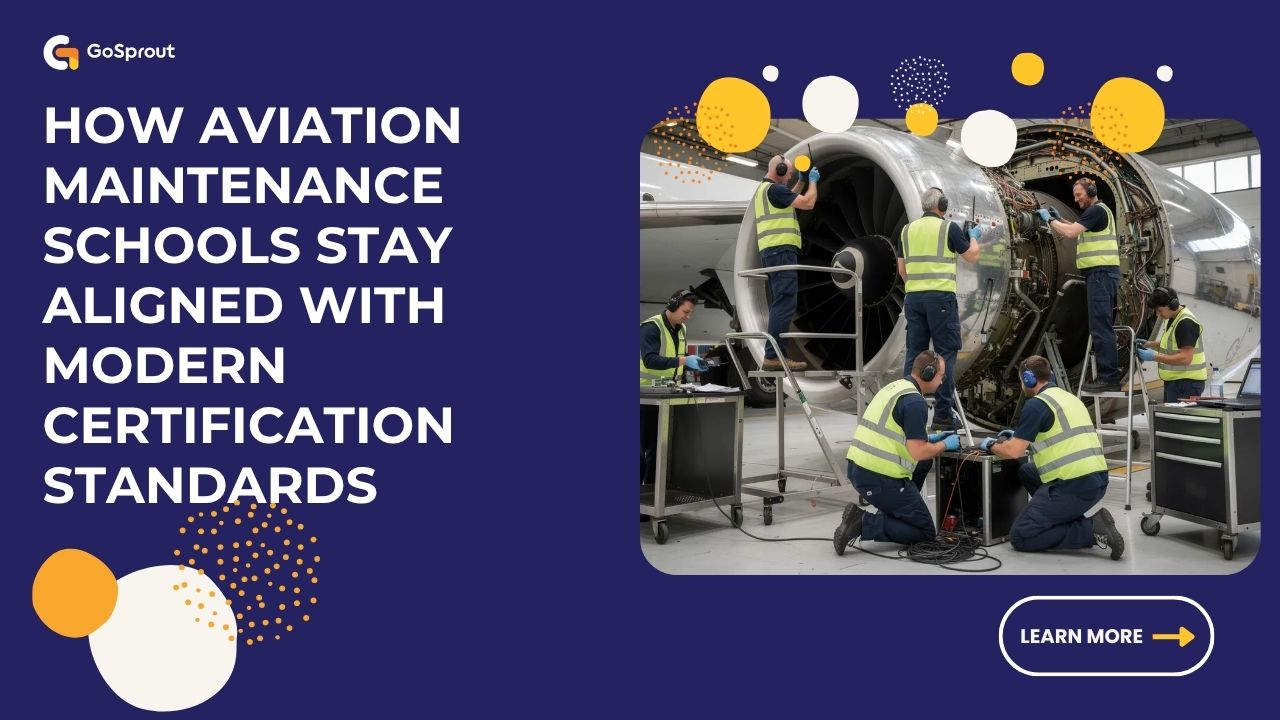
For aviation maintenance schools, compliance is no longer just a binder on a shelf. Since the 2022 rule change, the FAA expects AMTS programs to show that students can meet defined mechanic certification standards through measurable performance, current curriculum, qualified instructors, and reliable records.
Table of Contents
Use this quick navigation guide to find the main areas of part 147 oversight, from regulatory updates to audit-ready records, following the latest FAA requirements.
- Overview of part 147 compliance
- Regulatory Framework and 2022 Updates
- Facilities, Tools, and Quality Control Requirements
- Curriculum, Instruction, and Student Assessment
- Compliance Management, Audits, and Records
- How Our Solutions Support Part 147 Compliance
- FAQs on Part 147 and Aviation Maintenance Training
- Conclusion and Next Steps
Overview of Part 147 Compliance in Aviation Maintenance Training
Part 147 compliance typically points to either the United States Federal Aviation Administration under 14 CFR Part 147, or the European Union Aviation Safety Agency under Annex IV to Regulation (EU) No 1321/2014. In the U.S., 14 CFR part 147 governs Aviation Maintenance Technician Schools, or AMTS, that prepare students for FAA mechanic certification.
Compliance covers the full training environment: curriculum, facilities, instructor qualifications, equipment, records, quality control, and student outcomes. Training programs must directly prepare students for mechanic licensing exams, aligning with the Mechanic Airman Certification Standards (ACS) as required by the FAA and matching Part 66 licensing guidelines as mandated by EASA.
This differs from Part 65, where a mechanic may qualify through documented experience rather than an approved school. The AMTS route provides a structured process with consistent theory, practical tasks, and assessment. Our role is to help regulated training organizations maintain continuous compliance, document evidence, and avoid findings during FAA inspection activity.
Regulatory Framework and 2022 Part 147 Modernization
The legal foundation is 14 CFR Part 147, enforced by the FAA to govern certification and continuing operation of aviation maintenance technician schools. A school must clear a multi-phase certification process managed by local aviation authorities to establish and maintain Part 147 status.
The certification process includes five phases, starting from pre-application to the issuance of the Air Agency Certificate and operations specifications, ensuring compliance with curriculum and operational requirements. To obtain a certificate to operate an aviation maintenance technician school, an applicant must demonstrate compliance with the requirements outlined in 14 CFR Part 147, including providing a description of facilities, curriculum, and qualified instructors. See the following section for additional curriculum requirements.
The 2022 revision of Part 147 shifted from prescriptive time-based requirements to an outcome-based model, allowing AMTS programs greater flexibility in curriculum design as long as they demonstrate student achievement of defined learning standards. Under the new regulations, the previous fixed hourly minimums for curricula have been removed, allowing schools to focus on competency-based completions while still maintaining training programs of similar duration to meet the technical content depth required by the ACS standards. Aviation maintenance is just one trade path; programs such as trade school welding follow their own certification and training standards.
Key references to check include:
- §147.17 for training requirements and curriculum concepts
- §147.19 for instructor requirements
- §147.21, under the revised curriculum framework, requiring each AMTS to develop and maintain an FAA-approved curriculum organized around learning objectives tied to Aviation Maintenance Technician Airframe, Powerplant, and General Airmen Certification Standards
- §147.23 for quality control system approval
- §147.25 for minimum passage rate
- §147.29 and related guidance for records
The FAA’s AMTS information and Advisory Circular guidance such as AC 147-3B and current updates help schools interpret the regulation without turning every policy into a legal chapter.
Facilities, Equipment, and Quality Control Requirements
Physical resources matter because aviation maintenance education is hands-on. Each certificated aviation maintenance technician school must maintain facilities, equipment, and materials appropriate to the ratings held and the number of students taught, as specified in 14 CFR Part 147.
Schools must provide climate-controlled classrooms and maintain dynamic instructional workshops containing functional aircraft components, engines, and specialist tools. Student-to-instructor ratios are federally capped, such as a strict 25:1 limit during shop and lab classes according to FAA standards.
A practical facility check should include:
- Classrooms, labs, hangars, lighting, ventilation, and safety systems
- Representative aircraft, engines, components, and testing equipment
- Current technical data, maintenance manuals, regulatory references, and manufacturer publications
- Documented calibration, inspection, and removal of unserviceable tools or training material
Each certificated aviation maintenance technician school must provide and maintain facilities, equipment, and materials that are appropriate to the ratings held by the school and the number of students taught. A certificated aviation maintenance technician school must display its aviation maintenance technician school certificate at a visible location accessible to the public at each school location.

Curriculum Design, Instruction, and Student Assessment
\Programs must adopt syllabi that align directly with FAA’s Mechanic Airman Certification Standards (ACS) to ensure necessary theory and practical skills are mastered. That means curriculum design starts with a detailed ACS gap analysis across general, airframe, and powerplant areas.
A strong curriculum should sequence knowledge before application. For example, electrical theory should lead into troubleshooting an electrical fault, and composite structures content should lead into a practical repair exercise. Certification standards should influence lesson planning, assessment rubrics, graduation criteria, and the final test readiness process.
Instructors must hold appropriate A&P certificates, ratings, and relevant experience for the content they teach. Schools should also document instructor competence, continuing professional development, and how each instructor supports standard educational delivery.
\\\\\\Student assessment must measure performance, not just attendance. Written tests, oral questioning, and practical projects should show mastery of ACS elements. The FAA measures a program’s overall educational quality based on student test outcomes rather than arbitrary nationwide norms.
Compliance Management, Audits, and Recordkeeping
Sustained part 147 compliance depends on a documented management system, internal audits, corrective action, and reliable records-not one-time approval. Schools must formalize their oversight framework to ensure standard educational delivery and comply with FAA regulations.
Each certificated aviation maintenance technician school must establish and maintain a quality control system that meets specific requirements and is approved by the Administrator. The quality control system must provide procedures for recordkeeping, assessment, issuing credit, issuing final course grades, attendance, ensuring a sufficient number of instructors, granting graduation documentation, and corrective action for addressing deficiencies.
Each certificated aviation maintenance technician school must allow the Administrator access to inspect its locations to determine compliance with the quality control system requirements. An aviation maintenance technician school must allow the FAA Administrator access to inspect its locations to determine compliance with operational requirements.
Each certificated aviation maintenance technician school must maintain a minimum passage rate of at least 70 percent for students who take an FAA mechanic test within 60 days after graduation. The minimum passage rate is calculated based on the number of students passing any combination of written, oral, or practical tests, with failures on any one test counted as a student failure unless subsequently passed within the 60-day window. If a school’s pass rates fall below acceptable thresholds, it may trigger mandatory curriculum review or, in extreme cases, certificate action by the FAA.
Common surveillance issue areas include outdated syllabi, incomplete student records, missing tool calibration logs, and weak evidence of practical competency. The best prevention is routine internal audit activity, version control, and FAA-ready data with clear date tracking.
How Our Solutions Support Part 147 Compliance
Because our approach is designed for aviation-specialized training organizations, it supports both initial certification and ongoing surveillance. The result is less administrative workload, clearer performance data, and better visibility before a small issue becomes a finding.
Our solutions support aviation maintenance schools by connecting daily training activity to regulatory evidence. Instead of chasing spreadsheets before an inspection, teams can use one system to manage curriculum, instructors, students, facilities, and quality records.
We help with:
- ACS curriculum mapping and change control
- Configurable student records and competency tracking
- Instructor credential management
- Calibration reminders and quality control tasks
- Audit-ready reports for FAA review

Want to Learn More About Your Registered Apprenticeship Opportunities?
BOOK A FREE CONSULTATION
FAQs on Part 147 and Aviation Maintenance Training
Who needs to comply with Part 147, and what does it cover?
Any organization operating or applying to operate an FAA-certificated Aviation Maintenance Technician School must comply. It covers curriculum, facilities, equipment, qualified instructors, quality control, records, ratings, and student outcomes.
How did the 2022 changes to Part 147 affect existing aviation maintenance schools?
The new rule became effective in 2022 and removed fixed national hour minimums. Schools now have more flexibility, but they must show students meet ACS-based learning objectives.
What documentation does the FAA typically review during a Part 147 inspection?
The FAA may review syllabi, lesson plans, student progress records, attendance, grades, instructor files, tool calibration logs, quality procedures, corrective actions, and certificate display. Schools should keep current information available on demand.
How are student outcomes measured under the outcome-based model?
Outcomes are measured through competency evidence and FAA mechanic test performance. Written, oral, and practical results within the 60-day graduation window are especially important for the 70 percent minimum passage rate.
Can online or hybrid training be used for Part 147 curricula, and under what conditions?
Online or hybrid content may be used where approved and appropriate, but hands-on practical standards still must be met. The school must show that delivery methods support ACS mastery and regulatory requirements.
How often should we update our curriculum to stay aligned with current ACS standards?
Review curriculum whenever ACS guidance, FAA policy, equipment, or industry practice changes. Many schools also run scheduled annual or semiannual reviews to catch gaps early.
How can digital systems simplify continuing compliance?
Digital systems can track lessons, assessments, instructor credentials, quality control checks, and records retention in one place. They also help produce audit-ready reports during an FAA inspection.
Conclusion and Next Steps for Maintaining Part 147 Compliance
Part 147 compliance is an ongoing process that connects facilities, curriculum, instructors, quality control, and records to FAA certification standards. The 2022 regulatory change means schools must focus on measurable competency and accurate data, not just hours logged.
Review your current aviation maintenance programs against ACS requirements, recent FAA guidance, and your own internal procedures. If gaps appear, close them with documented action plans before the next inspection cycle.
To prepare for curriculum revisions or FAA surveillance, explore our solutions or contact our team for support. We help aviation maintenance education stay compliant, visible, and future-ready.