Table of Contents
Updated for current FAA Part 147 rules after the 2022 modernization.
Introduction: Why FAA Part 147 Schools Matter for Your Aviation Maintenance Career
Air travel keeps expanding, fleets are aging, and experienced maintenance technicians are retiring. That creates a real need for skilled aviation maintenance professionals who can inspect, repair, and return aircraft to service safely.
For high school graduates, career changers, military veterans, and mechanically inclined individuals, faa part 147 schools are often the most direct route into aircraft maintenance. These programs typically take 18 to 24 months to complete, integrating both theory and hands-on practices for comprehensive training.
This guide explains what Part 147 means, how each school works, what training costs, what exams you must pass, and how to compare programs before you apply.
What Is FAA Part 147? (And Why It Matters)
FAA Part 147 is the section of 14 CFR that governs Aviation Maintenance Technician Schools, often called AMTS, in the United States. FAA Part 147 prescribes the requirements for issuing aviation maintenance technician school certificates and associated ratings, as well as the general operating rules for the holders of those certificates and ratings.
Part 147 approval means the federal aviation administration has oversight of the curriculum, instructors, tools, facilities, and safety compliance. Part 147 schools must ensure compliance with safety regulations established under 14 CFR Part 147, which applies to the standards for training facilities, instructors, and curriculums.
The new faa part 147 rules became effective in 2022 and moved schools toward performance-based training. Performance-based training at Part 147 schools emphasizes competency over rigid “seat time” requirements, and curricula at Part 147 schools can be tailored to meet industry demands, provided they align with the Mechanic ACS. The Mechanic Airman Certification Standards (ACS) was introduced to replace older testing standards (PTS).

Key distinction:
- FAA Part 65 covers the individual mechanic certificate, eligibility, experience, and testing.
- Part 147 covers approved aviation maintenance school operations and curriculum.
- Under 14 CFR Part 65, obtaining an A&P license requires documented experience or graduation from an FAA-approved Part 147 school.
Graduates from Part 147 schools can immediately sit for their FAA exams, bypassing the typical 30-month on-the-job experience requirement.
What Is an FAA Part 147 Aviation Maintenance Technician School?
An aircraft mechanic school is where students train to become an Aircraft Maintenance Technician (AMT), which includes maintaining, repairing, and overhauling airplanes and jets to meet FAA standards. These schools prepare students for airframe and powerplant ratings, commonly called an A&P.
Part 147 schools offer three core program tracks: Airframe (A), Powerplant (P), and Combined Airframe & Powerplant (A&P). Some programs are stand-alone academy models, while others are offered through a community college, technical institute, or college that awards a diploma, certificate, or associate degree.
To operate an aviation maintenance technician school, a certificate is required, and no person may operate such a school without it or in violation of the operations specifications issued under Part 147.
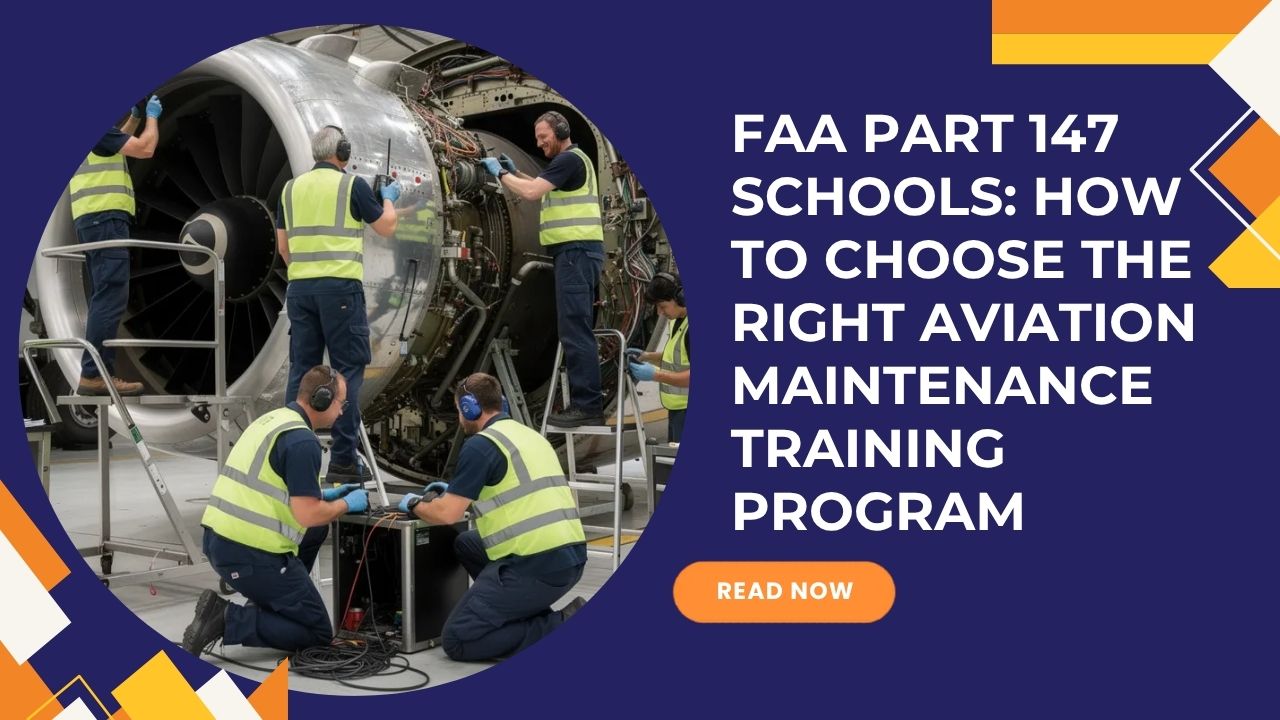
Training usually happens in classrooms, labs, hangars, and airport-area facilities with real aircraft, engines, tools, components, and systems. FAA regulations allow Part 147 schools to host satellite programs inside regional high schools, introducing aviation technical fundamentals early.
How FAA Part 147 Schools Work: Structure, Hours, and Training Format
Most programs begin with general aviation maintenance fundamentals, then move into airframe systems and powerplant systems. In plain terms, students first learn how maintenance works, then how aircraft structures work, then how engines and related systems work.
Each FAA Part 147 aviation maintenance technician school must establish, maintain, and utilize a curriculum designed to align with the mechanic airman certification standards, ensuring students have the necessary knowledge and skills to test for a mechanic certificate. Each certificated aviation maintenance technician school must establish and maintain a curriculum that aligns with the mechanic airman certification standards, ensuring students have the necessary knowledge and skills to test for a mechanic certificate.
Although the FAA no longer uses the old rigid model in the same way, many approved programs still follow roughly 1,800 to 1,900 instructional hours across general airframe and powerplant areas. A common format is around 40% classroom and 60% practical shop or lab work.
Students at Part 147 schools receive both theoretical and practical training aligned with the Mechanic ACS. After completion, graduates generally take the FAA written tests, then schedule oral and practical exams with a Designated Mechanic Examiner.
Curriculum Overview: What You Learn in an Aviation Maintenance Technician Program
The curriculum at Part 147 schools includes essential topics mandated by the FAA, such as maintenance records, general math, physics, structures, and engine systems. The three major content areas are:
- General: basic electricity, tools and hardware, drawings and blueprints, maintenance forms and records, regulations, human factors, physics, and shop safety.
- Airframe: aircraft structures, sheet metal, composites, welding basics, landing gear, hydraulics, pneumatics, environmental systems, aircraft rigging, and inspection procedures.
- Powerplant: turbine engines, reciprocating engines, ignition systems, fuel and metering systems, propellers, engine inspection, troubleshooting, and engine maintenance.
Modern programs may also include digital manuals, electronic logbooks, contemporary airline maintenance procedures, and exposure to advanced materials used in today’s aviation industry.
Program Length and Schedule Options
FAA rules focus on approved instructional content and competency, so calendar length varies. In the industry, common formats include 18 to 24 months full time, accelerated options where available, evening programs, weekend programs, and two-year associate degree tracks.
Expect full-time schedules to feel like a job, often 25 to 35 hours per week in class, lab, or shop. Night and weekend schedules may take longer but can help students keep work or family commitments.
Cohort start dates may happen several times per year, sometimes every few months. Before enrolling, compare the time commitment with your work schedule, family responsibilities, military transition date, and preferred location.

Admissions: Requirements to Enroll in an Aircraft Maintenance Program
Typical admissions requirements include a high school diploma or GED, basic English ability, and the ability to meet FAA testing rules. Students must usually be 18 by the time they test for the mechanic certificate.
Schools may also require reading and math assessments, an application, orientation, and sometimes a background or drug screening because many aviation employers use similar standards.
International students may need Form I-20, SEVIS payment, a student visa, proof of financial support, and English proficiency. Previous mechanical experience may help, but it is not required; a strong Part 147 program is designed to take beginners to entry-level aviation mechanic readiness.
Costs, Tuition, and Funding Options
Costs vary by state, institution type, and whether the program includes one rating or both ratings. The average cost for FAA Part 147 aircraft mechanic training programs is approximately $36,995, which includes tuition, books, materials, and exam fees.
Common cost categories include:
- Tuition
- Books and digital materials
- Tools or tool access
- Uniforms and safety gear
- FAA written exam fees
- Oral and practical exam fees
- Application and certification costs
Tuition for FAA Part 147 programs typically requires students to pay per course, with costs around $6,700 per course, plus additional fees for application and exams. Many FAA Part 147 schools offer financing options, including student loans, to help students manage the cost of their training.
Funding may include federal financial aid at eligible accredited institutions, private education loans, scholarships, state workforce programs, employer sponsorships, and GI Bill® or other veterans benefits when the exact campus and program are approved.
What Certificate or License Will You Earn?
A school completion document is not the same as the FAA mechanic certificate. Your school may award a diploma, completion certificate, transcript, or degree, but the FAA A&P certificate comes after testing.
To become an aircraft mechanic, students typically complete FAA-approved aviation maintenance training or qualify through documented experience, then pass the FAA written, oral, and practical exams. The FAA written exams usually cover General, Airframe, and Powerplant knowledge.
Some students earn only Airframe or only Powerplant, but most complete both ratings for the best career flexibility. Some programs also articulate into college credit toward an associate or bachelor’s degree in aviation maintenance or related fields.
Skills You Develop in an Aircraft Maintenance Training Program
You will learn how to read maintenance manuals, interpret wiring diagrams, use precision measuring tools, inspect aircraft parts, document work, and make repairs to FAA standards.
Specific aircraft maintenance skills may include troubleshooting avionics issues, repairing sheet metal damage, servicing landing gear, performing scheduled engine maintenance, and understanding airworthiness directives.
The best programs also build soft skills: attention to detail, safety culture, teamwork, communication with pilots and inspectors, and documentation accuracy. Those habits matter because a mechanic’s signature carries real responsibility.
Career Paths After Graduating from an FAA Part 147 School
Common first jobs include airline line maintenance mechanic, repair station technician, corporate jet mechanic, helicopter mechanic, regional airline maintenance technician, and support roles in MRO facilities.
Aircraft mechanics can work in various sectors, including commercial airlines, aircraft manufacturers, government agencies, and private jet owners, providing a wide range of career opportunities. Over time, technicians may become lead mechanic, inspector, maintenance supervisor, maintenance controller, or maintenance training instructor.
The demand for aircraft mechanics is high, with over 670,000 new jobs expected to open in the next 10 years due to increasing air travel and a shortage of skilled technicians. The U.S. Bureau of Labor Statistics also reports steady demand for aircraft and avionics technicians.
Salary Expectations for Aviation Maintenance Technicians
Starting salaries for aircraft mechanics are around $60,000, with potential earnings reaching up to $127,500 for specialized roles, reflecting the financial rewards of this career path.
Pay depends on employer type, region, shift, overtime, union contract, aircraft type, certifications, and experience. Major airlines, cargo operators, corporate flight departments, and specialized engine or avionics roles may pay more than entry-level general aviation jobs.
Many employers also offer benefits such as health insurance, retirement plans, travel privileges, tool allowances, and signing or retention bonuses where shortages exist. Research your local city, valley, or state wage data before choosing a program.
How to Compare and Choose the Right FAA Part 147 School
Start by verifying approval on the official FAA AMTS list. Make sure the specific campus, location, ratings, and operations specifications are listed and approved.
Ask each school about:
- Total program cost and what is included
- Class size and lab access
- Instructor experience
- Training aircraft and powerplants
- FAA test pass rates
- Job placement support
- Schedule flexibility
- Tutoring and exam prep
A certificated aviation maintenance technician school must provide qualified instructors who either hold a mechanic certificate with appropriate ratings or are otherwise specifically qualified to teach their assigned content, ensuring a student-to-instructor ratio that does not exceed 25:1 for any shop class. Each certificated aviation maintenance technician school must maintain a minimum passage rate of at least 70 percent for students who take an FAA mechanic test within 60 days after graduation.

Tour the hangars, inspect the labs, talk to current students, and ask how the program keeps training current with industry demand.
Why Choose Our Aviation Maintenance Program
Our aviation maintenance program is built for students who want structured training, practical shop time, and clear preparation for FAA exams. We focus on current ACS-aligned instruction, experienced A&P instructors, modern training aircraft, and powerplants that reflect real maintenance environments.
Students benefit from flexible day or evening options where available, multiple annual start dates, small lab groups, and built-in FAA exam preparation support. Our admissions team can also help explain financing, scholarships, veterans benefits, and employer sponsorship options.
If you are comparing schools, request information, schedule a campus tour, or speak with admissions about the next available aviation maintenance technician cohort.
Want to Learn More About Your Registered Apprenticeship Opportunities?
BOOK A FREE CONSULTATION
Frequently Asked Questions About FAA Part 147 Schools
Here are quick answers to common questions students ask before choosing a program.
How long does it take to become an A&P mechanic?
Most Part 147 programs take 18 to 24 months, depending on schedule and format. Evening or weekend options may take more months than full-time daytime training.
Do I need previous mechanical experience?
No. Mechanical experience helps, but approved training is designed for students who are new to aircraft maintenance.
Can I work while attending a Part 147 program?
Yes, but choose your schedule carefully. Full-time programs can be demanding, while night or weekend formats may be better for students who need to work.
Are Part 147 schools better than OJT paths under FAA Part 65?
They are usually faster and more structured. OJT can work, but it requires documented experience and may take longer before you qualify for exams.
Can international students enroll in an FAA Part 147 school?
Yes, if the school is approved to enroll international students and the student meets visa, English, and financial requirements.
Are there age limits for becoming an aviation maintenance technician?
You generally must be at least 18 to receive the FAA mechanic certificate. There is no upper age limit if you can meet the requirements.
Do students need to buy tools?
Some schools require personal tool sets, while others provide tools during training. Always ask what is included before you compare costs.
Does the school help with jobs after graduation?
Strong programs provide resume help, interview support, employer introductions, and connections with airlines, repair stations, and other aviation maintenance employers.
Conclusion and Next Steps
FAA Part 147 schools provide one of the clearest routes into aviation maintenance, especially if you want a structured program instead of years of documented on-the-job experience.
The right choice depends on cost, schedule, facilities, instructors, pass rates, and career support. Use this article as a checklist when you call, tour, or compare Part 147 programs.
Ready to take the next step toward your FAA A&P mechanic certificate? Request program information, schedule a tour, or apply for the next aviation maintenance technician class today.


