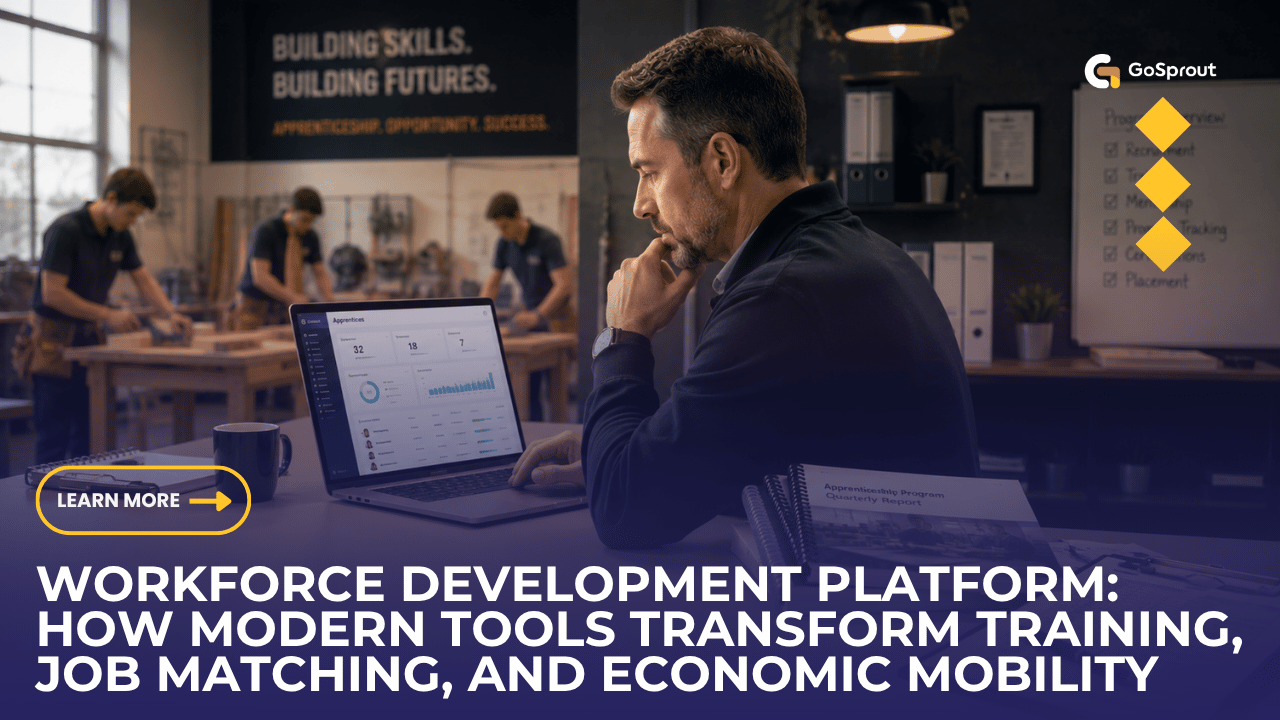
Running workforce development programs on spreadsheets and disconnected tools worked well enough a decade ago. It doesn’t anymore. Between shifting labor market demands, expanding apprenticeship funding, and growing compliance requirements, workforce development organizations need a system that ties training, job matching, employer services, and reporting together in one place. This guide breaks down what a workforce development platform actually does, why it matters right now, and how to evaluate one for your organization.
Table of Contents
- What Is a Workforce Development Platform?
- Why Workforce Development Platforms Matter in 2026
- Core Components of a Modern Workforce Development Platform
- How a Workforce Development Platform Works Across the Participant Journey
- Key Features to Look For in Workforce Development Software
- AI, Automation, and Real-Time Insights in Workforce Development
- Key Benefits for Workforce Agencies, Schools, and Employers
- Designing Programs that Align Training with Business Needs
- Self-Service Tools and Participant Experience
- Implementation, Change Management, and Common Pitfalls
- How to Choose the Right Workforce Development Platform
- Why Choose Our Platform for Work-Based Learning and Apprenticeships
- Taking the Next Step: Turning Workforce Strategy into Action
- Frequently Asked Questions About Workforce Development Platforms
What Is a Workforce Development Platform?
A workforce development platform is an integrated, cloud-based system that connects job seekers, employers, schools, and workforce leaders around a shared goal: aligning skills training with real business needs and employment outcomes. It serves as a centralized system for talent strategy and skills management, handling everything from participant intake and skills assessments through job training, credential tracking, job matching, placement, and long-term retention monitoring.
This is fundamentally different from a traditional LMS or a job board. An LMS delivers courses and tracks completion. A job board lists openings. A workforce development platform ties those functions together with real time data, multi-stakeholder collaboration, case management, compliance reporting, and end-to-end participant tracking. It supports workforce development, career development, and economic development simultaneously by making data flow between everyone involved, rather than living in silos.
Here’s a practical example. A regional workforce board managing WIOA programs and registered apprenticeships can use a single platform to enroll participants, assign them to pre-apprenticeships or training programs, track OJT and RTI hours, match participants to employer-posted roles, monitor placements, and automatically generate compliance reports. Without a platform, each of those steps involves a different spreadsheet, a different login, or a phone call. Workforce development creates opportunities for economic growth and competitiveness when organizations can actually coordinate at that level.
Why Workforce Development Platforms Matter in 2026
The labor market in 2026 looks nothing like it did five years ago. AI adoption has accelerated sharply. By mid-2025, roughly 45.9% of U.S. firms reported using large language models at work, up from 30.1% in December 2024. Meanwhile, young adults aged 22–25 in AI-exposed occupations have seen a 12–19% drop in employment relative to less-exposed peers. Demographic shifts, an aging workforce, and lingering post-COVID disruptions in education delivery have created a situation where many regions face both talent shortages and underemployment at the same time. Research suggests that 50% of employees will need new skills to work effectively with AI, and that urgency is already here.
This is where coordinated workforce development initiatives become essential for economic development. When a plant closes or a major employer announces layoffs, agencies need to respond quickly with rapid response services that connect dislocated workers to reskilling pipelines and new employment plans. Platforms make that possible by consolidating participant data, employer demand signals, and training programs into a single system that frontline staff can act on immediately.
The policy context adds more urgency. Federal investment in apprenticeship expansion continues through programs like the State Apprenticeship Expansion Formula grants, with $85 million anticipated in 2026 targeting industries like AI infrastructure, advanced manufacturing, and clean energy. The Workforce Pell Grant program, effective July 1, 2026, now allows Pell Grants to support short-term credential and apprenticeship programs. Organizations investing in training see 24% higher profit margins, and the funding landscape is making it easier than ever to secure funding for workforce development programs that can demonstrate outcomes. But demonstrating outcomes requires the right data infrastructure, which starts with the platform.
Core Components of a Modern Workforce Development Platform
Think of this as a tour of the product anatomy. Every modern workforce development platform should include these building blocks:
- Participant profiles: Demographics, education, work history, barriers to employment, skills assessments, credentials earned, and individual employment plans.
- Employer profiles: Job descriptions, OJT and RTI commitments, wage data, apprenticeship capacity, and industry sector.
- Program and course catalogs: Registered apprenticeship tracks, pre-apprenticeships, internships, short-term credential programs, and metadata linking each to wages, competencies, and duration.
- Job matching engine: Algorithms that match participants to roles based on skills, credentials, location, and scheduling preferences, pulling in labor market data to keep suggestions relevant.
- Case management tools: Intake workflows, Individual Employment Plans, barrier tracking (transportation, childcare, digital access), document uploads, and coaching tools.
- Reporting and compliance layers: PIRL and ETA reports are essential for compliance. Platforms capture data for WIOA performance indicators, support RAPIDS for apprenticeship registration, and enable grant reporting through WIPS.
Skill inventories allow organizations to identify skill gaps and target training effectively, and a well-built platform makes that data accessible through real time dashboards, mobile access, and role-based permissions. Cloud hosting supports remote and hybrid teams across local areas, while communication tools (SMS, email) keep participants and employers engaged.
How a Workforce Development Platform Works Across the Participant Journey
Here’s how the full journey works, from discovery through long term growth: discover → train → match → place → retain.
Intake and assessment. The process starts by capturing demographics, barriers, skills, and career interests. Tools may include standardized skills assessments for literacy, numeracy, and technical competencies. From that data, the platform generates an Individual Employment Plan outlining goals, timelines, and action steps. Assessments like the MAPP, which has been taken by over 12.5 million people globally, can feed into these profiles to support career exploration.
Train and develop. Participants are assigned to pre-apprenticeships, registered apprenticeships, internships, or short-term credential programs. The platform tracks RTI hours (classroom instruction) and OJT logs (supervised work experience), along with competency milestones. Personalized career pathways boost employee retention and engagement by providing clear advancement routes, even during training.
Match. The job matching engine connects participants to employer-posted roles using skills, credentials, location, and schedule preferences. These platforms enhance internal mobility by matching employees with job opportunities based on skills, and the same logic applies to matching apprenticeship candidates with sponsors. Employer services within the platform let businesses review candidate profiles and monitor apprentice progress directly.
Place and retain. The platform documents placements, tracks wage levels, and monitors retention at the 2nd and 4th quarters after exit, which are key WIOA metrics. Real-time visibility into employee skills aids in succession planning and talent development. Early warning systems flag participants at risk of disengagement, triggering follow-up from coaches or rapid response support before someone falls through the cracks.
Want to Learn More About Your Registered Apprenticeship Opportunities?
BOOK A FREE CONSULTATION
Key Features to Look For in Workforce Development Software
When you’re evaluating platforms, focus on what the tool actually does for your team day to day, not just what looks good in a demo. Here are the feature groups that matter most:
- Centralized case management: A unified record for each participant across all programs, providers, and case managers, eliminating duplicate data and conflicting notes.
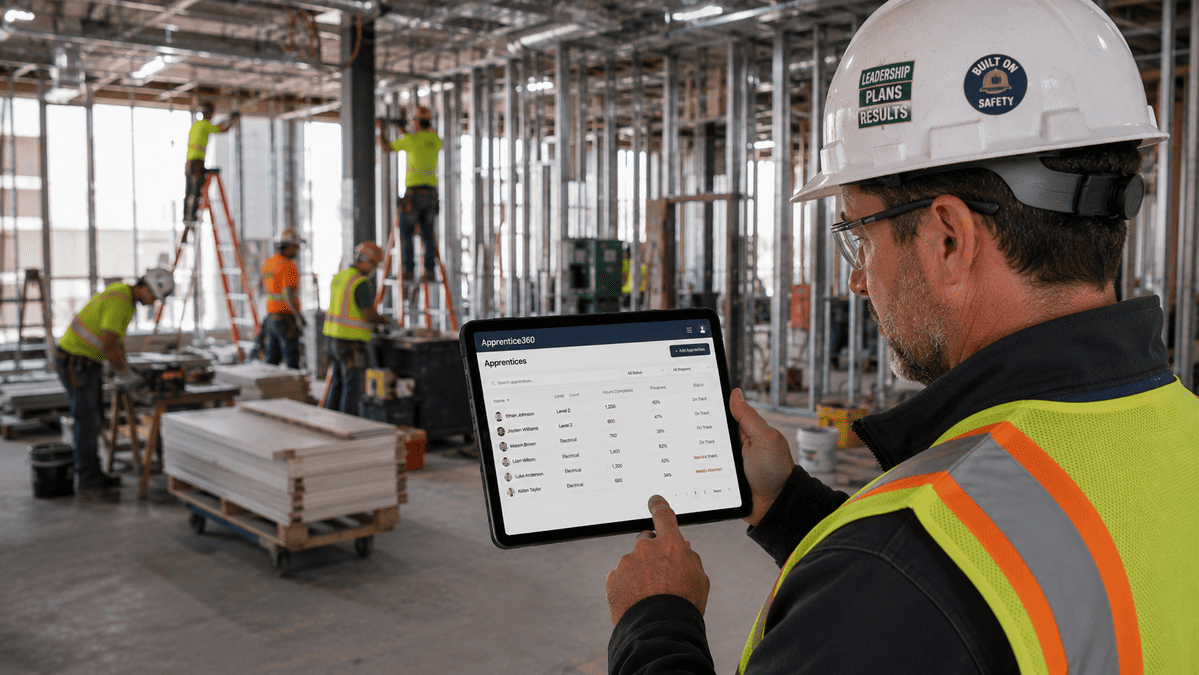
- OJT/RTI tracking: Employers and sponsors log and verify on-the-job training hours and classroom instruction hours, with competency tracking built in.
- Job matching: Bidirectional search where both participants and employers can find each other, weighted by skills, credentials, and preferences.
- Self service portals: Participants apply, upload documents, track progress, and message coaches. Employers post roles, review candidates, and sign off on hours.
- Automated communication: SMS and email reminders for appointments, RTI classes, and OJT check-ins, reducing no-shows and missed milestones.
For compliance and reporting, look for built-in support for WIOA metrics, RAPIDS, WIPS, and PIRL. Automated reporting reduces administrative load for compliance tracking, and compliance reporting ensures adherence to federal and state standards. Over 150 agencies modernized compliance reporting systems using Launchpad, which shows how much demand exists for replacing manual spreadsheet exports.
Real time dashboards let workforce leaders monitor enrollment, progress, completions, placements, and retention by program, region, and population. Workforce development platforms integrate with existing HR systems, SIS platforms (for schools), and HRIS/ATS tools (for employers) to avoid duplicate data entry and ensure data integration across stakeholders.
AI, Automation, and Real-Time Insights in Workforce Development
Artificial intelligence is now standard in 2026 platforms for labor market insight, job matching, and automating administrative work. The numbers back this up: 78% of enterprises now use AI tools in workforce development, and adoption is accelerating.
AI-powered platforms analyze skills data in seconds, matching participants to realistic roles by weighing credentials, work preferences, local wage trends, and employer signals. AI systems analyze skills data across organizations in seconds, which means a case manager can see recommended placements instantly instead of spending hours cross-referencing spreadsheets. AI-powered platforms can reduce recruitment costs by 30%, which makes them attractive to employers looking for a competitive advantage in tight labor markets.
Automation handles routine admin tasks that drain staff capacity. Platforms can create and update Individual Employment Plans, draft case notes, and flag when participants are at risk of disengaging based on activity patterns. AI can personalize learning paths, increasing efficiency by 57%, so participants spend time on emerging skills they actually need rather than repeating what they already know. Personalized learning paths increase learning efficiency by 57%.
Real time labor market data pulls in local postings, wage trends, and in-demand skills so programs can adjust training and employment plans quickly. This is how workforce professionals stay ahead of sector strategies rather than reacting to shifts after they’ve already happened.
A short note on responsible use: human oversight must remain on decisions that affect participants. Case managers should be able to override AI matches or flags, criteria should be transparent, and role-based access to sensitive data should prevent misuse. Bias audits on matching algorithms are not optional, especially when serving populations that historically face barriers.
Key Benefits for Workforce Agencies, Schools, and Employers
The key benefits of a workforce development platform differ by stakeholder, but they compound across the ecosystem.
For workforce agencies and nonprofits:
- Higher placement and retention rates through holistic tracking and early intervention
- Easier WIOA reporting, with automated data capture replacing manual reconciliation
- Ability to scale services without proportional increases in staff headcount
- Stronger grant applications backed by real outcome data from multiple sources
- Workforce development platforms provide data-driven analytics for strategic workforce planning decisions
For schools and training providers:
- Coursework connected directly to employment plans and employer demand
- RTI hour tracking with accountability built in
- Proof of outcomes (credential attainment, wage data) for funders and accreditation

For employers:
- Faster access to vetted candidates with relevant transferable skills and employee skills
- Visibility into apprenticeship cohorts and talent pipelines
- Training that aligns with real business needs, reducing onboarding costs
Cross-cutting benefits: Companies with workforce development programs see 30% productivity boosts. Employees in strong learning cultures have 57% higher retention rates. 80% of employees feel more connected to their employer through learning opportunities.
Continuous learning is essential for employee satisfaction and reducing turnover rates, and workforce development reduces turnover costs significantly. Organizations use workforce development platforms to close critical skill gaps proactively, and that translates to better data quality, more equitable access to opportunities, and stronger ties between workforce development and economic development strategies.
Designing Programs that Align Training with Business Needs
Platforms are only effective when programs are aligned with current and future employer demand. The technology is the enabler, not the strategy.
Workforce leaders can use platform analytics and labor market data to determine which job training programs to expand, pause, or redesign based on placements and wage outcomes. These platforms deliver continuous, targeted learning and career pathing, which means program design can be iterative rather than static. Practical steps include convening employer advisory groups, analyzing in-demand occupations and skills gaps, and adjusting curriculum, apprenticeships, and internships accordingly. Business engagement at the design stage ensures that training produces workforce capabilities employers actually need.
Consider how federal SAEF4 grant guidance explicitly encourages states to target industries like AI infrastructure, advanced manufacturing, and clean energy when designing apprenticeship expansion. A region that shifts investment from low-demand service sector training into clean-energy apprenticeships, backed by platform data showing wage outcomes and employer demand, is making the kind of evidence-based decision that funders want to see and that drives meaningful impact for participants.
Self-Service Tools and Participant Experience
Participants expect 24/7 access via mobile, and staff capacity is limited. Self service tools solve both problems.
A modern participant portal should offer application forms, document upload, program and course search, job matching, progress tracking, and messaging with navigators or coaches. Mobile accessibility supports remote learning and engagement for diverse employee groups, including young adults, dislocated workers, justice-involved individuals, and people with disabilities. Self service configurations should account for low-bandwidth access, language options, and accessibility standards to prevent digital exclusion. When participants can handle routine tasks on their own, frontline staff can focus on coaching and career advancement support rather than data entry.
Implementation, Change Management, and Common Pitfalls
Technology alone doesn’t fix workforce challenges. Success depends on rollout, training, and governance.
Common pitfalls to avoid:
- Trying to replicate every legacy spreadsheet instead of rethinking workflows
- Underinvesting in staff training, which kills adoption
- Launching without clear workflows or a pilot phase
- Failing to clean legacy data before migration
A practical implementation sequence:
- Discovery: Map stakeholders, current systems, data sources, and specific requirements.
- Configuration: Design workflows, set up role-based permissions, configure reporting.
- Staff training: Hands-on sessions for case managers, coordinators, and leadership.
- Pilot (60–90 days): Test with a focused scope (one region, one program) and gather feedback.
- Refinement: Adjust based on real-world usage patterns.
- Phased scale-up: Expand across regions, program types, and employer partners.
Ongoing change management matters as much as the initial rollout. Identify internal champions, maintain clear communications, set realistic timelines, and build feedback loops with frontline staff and participants. Professional development for staff on the platform should be continuous, not a one-time event.
How to Choose the Right Workforce Development Platform
If you’re a workforce board, community college, or employer evaluating options in 2026, here are the dimensions that matter:
| Evaluation Dimension | What to Look For |
|---|---|
| Apprenticeship support | OJT/RTI tracking, competency frameworks, sponsor tools |
| Compliance reporting | WIOA, RAPIDS, WIPS, PIRL, state-level exports |
| Integrations | SIS, HRIS/ATS, state MIS, LMI data feeds |
| Scalability | Multi-program, multi-site, cloud infrastructure |
| Ease of use | Intuitive for non-technical staff, mobile-ready |
| Vendor partnership | Responsive support, configuration help, policy-aligned roadmap |
Map platform capabilities to your specific goals. Are you trying to increase placements? Expand work-based learning? Improve rapid response services? Operational efficiency gains should be measurable, not promised vaguely.
Run a structured pilot with clear success metrics: time saved on reporting, number of completed employment plans, job placements, retention rates. Use those results to justify long term growth of the investment. A vendor that treats you as a partner, not just a customer, will make a significant difference in whether the platform delivers on its promise.
Why Choose Our Platform for Work-Based Learning and Apprenticeships
GoSprout was built specifically for the pain points described throughout this article: heavy administrative burden, fragmented data, compliance complexity, and the challenge of scaling programs across multiple employers, sites, and regions.
Our platform handles registered apprenticeship, pre-apprenticeship, internship, and broader work-based learning management with tools for OJT and RTI tracking, skill competency frameworks, and multi-stakeholder collaboration between sponsors, schools, and employers.
Over 150 workforce development agencies modernized systems using Launchpad, and our compliance automation covers RAPIDS, WIPS, and PIRL exports so your team spends less time on data entry and more time on the work that matters. Effective compliance reporting improves program effectiveness and accountability, and our real time dashboards give workforce leaders the insights they need to act.
Scaling is where many platforms fall short. GoSprout supports growth across multiple employers, regions, and program types while maintaining consistent standards and data quality.
One organization used our platform to launch a registered apprenticeship initiative in under 90 days and expand to over 200 participants across 30 sites within two years, achieving an 86% retention rate. That kind of success comes from a platform designed for fostering collaboration between every stakeholder in the ecosystem.

Taking the Next Step: Turning Workforce Strategy into Action
The core value of adopting a workforce development platform comes down to three things: better alignment of training with business needs, improved outcomes for participants, and clearer proof of impact for funders. If your team is still managing workforce development programs across disconnected spreadsheets, manual reporting processes, and siloed data, the gap between where you are and where the field is headed is only growing.
Take a practical next step. Assess your current processes and identify where a platform could immediately reduce friction. Bring together workforce leaders and frontline staff. Outline your goals for job training, career development, and economic development over the next 12–24 months.
Then schedule a discovery call or demo with GoSprout. We’ll help you see exactly how a modern workforce development platform can help you scale programs, support your community, and deliver better outcomes for job seekers and employers alike. Your participants deserve a system that works as hard as they do.
Frequently Asked Questions About Workforce Development Platforms
Here are the questions we hear most from workforce leaders, program administrators, and employers evaluating their options.
What’s the difference between a workforce development platform and a traditional LMS or job board?
An LMS delivers courses and tracks completion. A job board lists openings. A workforce development platform connects skills data, training, job matching, case management, and compliance reporting in one ecosystem. For example, an LMS tracks who finished a safety course. A workforce development platform tracks who took the course, logged OJT hours, earned a credential, and then secured and retained employment. It covers career development and career trajectory from intake through long-term outcomes.
Who typically uses a workforce development platform day to day?
Case managers update employment plans and track participant progress. Apprenticeship coordinators manage OJT and RTI logs. Instructors record competency achievements. Career coaches communicate with participants through the portal. Employers post jobs, review candidates, and sign off on training hours. Workforce leaders monitor regional outcomes through dashboards. Each user group has role-based access tailored to their daily work.
How do these platforms support WIOA and other funding requirements?
Platforms collect and structure the data needed for WIOA performance measures, state reporting, and grant reporting. Built-in tools create standardized participant records and activity logs, with automated exports to state or federal systems. This replaces manual spreadsheet work and reduces the risk of errors that can jeopardize funding. Data analysis capabilities help organizations demonstrate the economic impact of their programs to funders and stakeholders.
Is a workforce development platform only for large state agencies?
Not at all. While state and regional workforce boards are common users, mid-sized nonprofits, school systems, and consortiums managing apprenticeships and internships benefit equally. Smaller organizations can start with core features like case management and compliance reporting, then expand into job matching, employer portals, and advanced analytics as their programs and partnerships grow. The platform should serve your scale, not force you into features you don’t need yet.
How long does it take to implement a workforce development platform?
Initial pilots can launch in 60–90 days with a focused scope. Full statewide or multi-institution deployments typically take several phases across 6–18 months. Timeline depends on data migration complexity, integrations with existing systems, decision-making speed, and availability of staff for configuration and testing. Starting with a pilot lets you prove value quickly and build internal support for broader rollout.
How do platforms protect sensitive participant and employer data?
Common safeguards include role-based access control, encryption in transit and at rest, audit logs, and compliance with relevant privacy and security standards. Ask vendors about data retention policies, incident response processes, and how participant consent and data minimization are handled. Given the sensitivity of participant information (PII, wage data, demographics), security isn’t a feature to compromise on.


