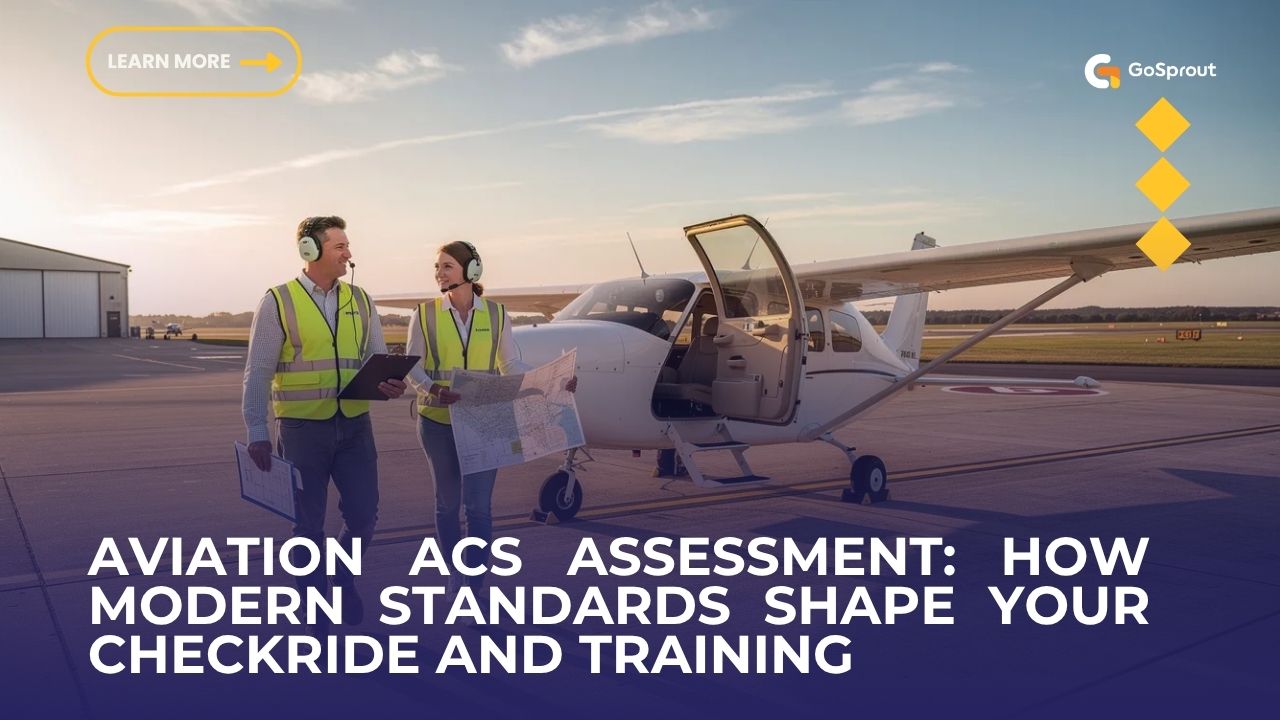
Preparing for a checkride in 2026 means preparing for the ACS, not an old maneuver-only checklist. The FAA now evaluates applicants on what they know, how they manage risk, and how well they fly the aircraft in real scenarios.
Table of Contents
- What Is the Airman Certification Standards (ACS) and Why It Matters Today
- ACS vs. Practical Test Standards (PTS): What Changed and Why It Matters for You
- How Aviation ACS Assessment Works on Your Practical Test
- Risk Management as a Core Pillar of Airman Certification Standards
- Using the ACS Effectively in Private Pilot Training and Checkride Prep
- Leveraging Technology and Scenario-Based Training for ACS Readiness
- How Instructors and Examiners Use ACS in Everyday Training and Testing
- FAQ: Common Questions About Aviation ACS Assessment
- Why Choose Our ACS-Focused Flight Training Programs
- Conclusion and Next Steps for ACS-Aligned Pilot Success
What Is the Airman Certification Standards (ACS) and Why It Matters Today
An aviation Airman Certification Standards (ACS) assessment is used by the FAA to test an applicant’s readiness for a pilot certificate or rating. In practical terms, aviation acs assessment means how an examiner applies ACS tasks during the oral and flight portions of a checkride.
The airman certification standards acs replaced much of the older PTS system beginning in 2016, with major updated documents effective May 31, 2024. The Airman Certification Standards (ACS) represent the FAA’s commitment to enhancing aviation safety through comprehensive pilot evaluation, integrating knowledge, risk management, and flight proficiency elements.
The ACS integrates three critical components into each evaluation task: knowledge elements, risk management elements, and skill elements, ensuring a comprehensive assessment of pilot competency. That is why a private pilot applicant must show more than proficiency in one stall, landing, or navigation exercise.

ACS vs. Practical Test Standards (PTS): What Changed and Why It Matters for You
The practical test standards pts focused heavily on maneuvers and tolerances. The ACS replaces the older Practical Test Standards (PTS) and reflects the aviation industry’s evolution toward scenario-based training and evidence-based safety practices.
Three changes matter most. First, risk management is built into each task, not treated as a side topic. Second, ACS codes identify weak areas precisely, such as a knowledge, risk, or skill deficiency. Third, missed written-test questions connect directly to oral exam questions through ACS codes.
The FAA Private Pilot Airplane ACS-6C is the current private pilot airplane reference, and similar current ACS documents exist for instrument, commercial, and other ratings on the FAA ACS page. Some instructors may still say pts casually, but applicants must study the document required for their certificate and class.
While many tolerances look familiar, the ACS emphasizes the integration of knowledge, risk management, and skill elements to assess pilot competency during practical tests, ensuring pilots are evaluated on their decision-making abilities as well as technical skills.
How Aviation ACS Assessment Works on Your Practical Test
During a practical test, the DPE uses ACS areas of operations, tasks, and elements as the rubric. The ACS provides clear, objective rubrics for evaluators, reducing subjective testing bias.
Each task includes knowledge elements, risk management elements, and skill elements. Knowledge elements in the ACS encompass theoretical understanding necessary for informed decision-making, including aerodynamics, weather theory, and federal aviation regulations.
For example, in weather information, an examiner may ask you to interpret forecasts, consider alternates, and explain whether your plan still makes sense. In the flight, that judgment must reflect safe aircraft control, correct procedures, and standard aviation terminology.
Your Airman Knowledge Test Report also matters. If you missed questions tied to ACS codes, the examiner is required to revisit those topics during the oral exam. Satisfactory performance means you can fly within standards, explain why you made decisions, and adapt when conditions change.
Risk Management as a Core Pillar of Airman Certification Standards
Risk management elements are a primary evaluation criterion in the ACS, focusing on a pilot’s ability to identify, assess, and mitigate risks in real-world scenarios. This includes weather, fuel, performance, weight and balance, runway conditions, fatigue, and external pressure.
A private pilot applicant might need to explain personal minimums, calculate whether density altitude affects takeoff distance, or choose a different runway when wind shifts. Tools like PAVE and IMSAFE help, but the goal is not reciting acronyms. The goal is sound judgment.
Integrating risk management discussions into every training flight is essential, as examiners evaluate not just what you do, but why you do it and how you adapt to changing conditions during the checkride. Poor risk management alone can lead to a notice of disapproval, even if the stick-and-rudder flying looks polished.
Using the ACS Effectively in Private Pilot Training and Checkride Prep
Using the ACS as your primary study guide ensures that every lesson addresses specific tasks and evaluation criteria necessary for checkride preparation. Instead of studying “navigation” broadly, connect lessons to the exact ACS task, required knowledge, risk management elements, and skill standards.
A strong study method is simple:
- Match each lesson to an ACS area of operation.
- Mark whether knowledge risk management and skill elements are complete.
- Review weak ACS codes from practice tests.
- Ask your instructor how each lesson will appear on the checkride.
Implementing a continuous assessment approach throughout training helps identify areas needing additional attention while building confidence in demonstrated competencies for the checkride. This approach also helps applicants know when they are truly ready to pass.
Leveraging Technology and Scenario-Based Training for ACS Readiness
Modern tools can make ACS training more realistic. Simulators and FAA-approved training devices are useful for emergency procedures, instrument failures, weather decisions, and abnormal operations that may be difficult to practice often in the airplane.
EFBs, weather apps, and performance tools are helpful, but they do not replace understanding. A student should know how the information is derived and what to do if a single device fails.
Scenario-based lessons work best when they combine multiple ACS tasks in one flight: airspace analysis, ATC communication, diversion, fuel checks, and weather reassessment. A mock checkride should include a full oral, a flight phase, and a debrief organized by ACS code.

How Instructors and Examiners Use ACS in Everyday Training and Testing
Instructors use ACS to build syllabi, lesson plans, stage checks, and progress reviews. Examiners use the same standards to evaluate applicants consistently and document any unsatisfactory task by ACS code and element.
For add-on ratings or category/class changes, CFIs and DPEs use ACS appendices and task tables to determine what is required. This makes the process more transparent for applicants.
Because ACS is public, students can review the same page of standards the examiner will use. Bring questions to each lesson: “Which ACS task did we cover today?” and “What would make this unsatisfactory on the practical test?”
Want to Learn More About Your Registered Apprenticeship Opportunities?
BOOK A FREE CONSULTATION
FAQ: Common Questions About Aviation ACS Assessment
What is the difference between ACS and PTS?
PTS focused mostly on maneuver performance. ACS includes aeronautical knowledge, risk management, and skill in each task. Some specialized tests may still use PTS, but most major pilot certificates and ratings now use ACS.
How do I know which ACS document applies to me?
Check the current FAA ACS list for your rating. Private Pilot Airplane uses ACS-6C, Instrument Rating uses ACS-8C, and Commercial Pilot uses ACS-7B as of the 2024 updates.
How is risk management graded?
You must identify hazards, assess the risk, and choose a mitigation. Failures often involve ignoring weather trends, runway limits, personal minimums, fuel reserves, or aircraft performance margins.
Can ACS help with the written exam?
Yes. ACS codes connect written knowledge test topics to practical test tasks. If you miss questions, use those codes to target oral prep and future flight lessons.
Are test prep apps enough?
Apps can help, but they should not be your only source. Always cross-check with the current ACS because outdated materials can miss required elements.
Why Choose Our ACS-Focused Flight Training Programs
Our training programs are built around current FAA standards, not outdated checkride folklore. We use up-to-date ACS editions in every syllabus, regular mock checkrides, and personalized debriefs mapped to ACS codes.
Our instructors emphasize real-world decision-making, communication, systems knowledge, and risk management from the first lesson. That gives students clearer expectations, focused study plans, stronger safety habits, and better readiness for private pilot, instrument, or advanced checkrides.

Conclusion and Next Steps for ACS-Aligned Pilot Success
Aviation ACS assessment now defines how pilots are evaluated: knowledge, risk management, and flight skill working together. The sooner you use ACS in training, the more predictable your checkride becomes.
Download the latest FAA ACS, review it with your instructor, and build a task-based plan. If you want an ACS-focused readiness review, mock checkride, or customized training path, contact us and take the next step toward safer, more professional aviation.
Success on a checkride starts long before test day. Visit our website to learn more about Aviation ACS Assessment standards, checkride preparation strategies, mock evaluations, and ACS-focused training resources. Whether you are preparing for a private pilot certificate, instrument rating, or advanced qualification, our guidance can help you build confidence, strengthen decision-making skills, and approach your practical test with greater readiness.


