
Running a registered apprenticeship program isn’t just about filing paperwork and hoping for the best. It’s an ongoing management discipline that touches HR, operations, compliance, and workforce strategy. Whether you’re launching your first cohort or refining an established program, this playbook covers what you actually need to know to keep your program compliant, effective, and aligned with your business objectives.
This guide walks you through the complete lifecycle of apprenticeship management—from early strategy through continuous improvement. Use these links to jump to the section you need:
Table of Contents
- What Is a Registered Apprenticeship Program & Why Management Matters
- Core Components of a Well-Managed Registered Apprenticeship
- 9 Steps to Successfully Managing a Registered Apprenticeship Program
- Continuous Improvement: Evaluating and Evolving Your Apprenticeship
- Why Partner With Us to Manage Your Registered Apprenticeship Program
- Frequently Asked Questions About Managing Registered Apprenticeship Programs
What Is a Registered Apprenticeship Program & Why Management Matters
A registered apprenticeship in the U.S. is an earn-and-learn model formally approved by the U.S. Department of Labor (DOL) or a State Apprenticeship Agency (SAA). A Registered Apprenticeship Program (RA) is validated to meet the standards defined by the U.S. Department of Labor and/or a State Apprenticeship Agency, requiring compliance with applicable laws and regulations, as well as recordkeeping and reporting requirements.
Most registered programs run 1–5 years and combine paid on the job training (at least 2,000 hours per year) with at least 144 hours per year of related technical instruction. In 2021, there were over 593,000 registered apprentices enrolled across almost 27,000 registered apprenticeship programs in the United States, though participation remains low compared to other countries like Germany or Switzerland.
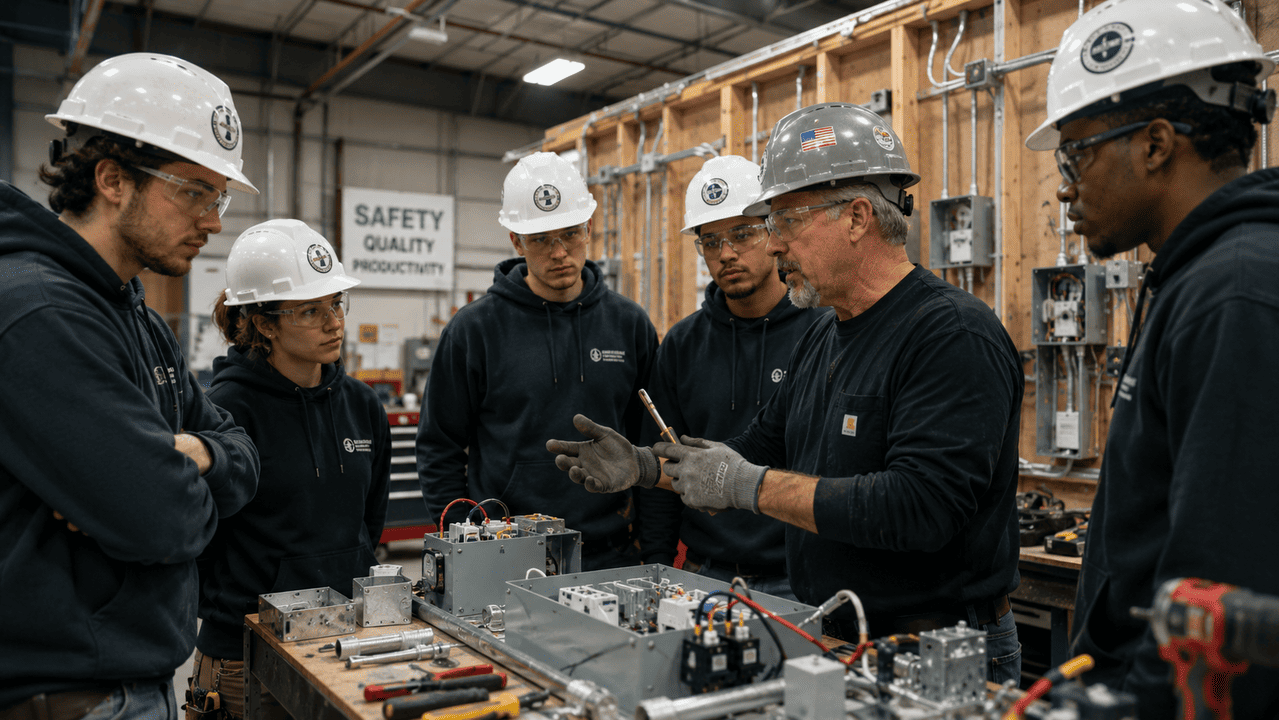
“Managing” a registered apprenticeship means handling design, registration, day-to-day operations, compliance, and continuous improvement after launch. Consider a four-year electrician apprenticeship registered with DOL in 2024 that operates in both California and Nevada—the program manager must coordinate multi-state reciprocity, track hours across job sites, ensure alignment between classroom instruction and field work, and prepare for periodic agency audits.
Core Components of a Well-Managed Registered Apprenticeship
Every registered apprenticeship system rests on five DOL-recognized components. Here’s your operational checklist for what ongoing management looks like for each:
- Paid job status: Registered apprentices are paid employees of record with progressive wage schedules tied to milestones—not interns or volunteers. Every apprentice must sign a written Apprenticeship Agreement that outlines their roles, responsibilities, and wage progression.
- Structured on the job learning: A written work process schedule breaks down tasks and required hours by year. For example, a Construction Craft Laborer program might require 8,000 total hours across four years, with specific allocations for excavation, material handling, and site preparation.
- Related technical instruction: RTI is delivered by community colleges, online training providers, or in-house certified trainers. Content must align with occupational standards and industry standards, updated annually when codes or technologies change. Integrating classroom training and on-the-job training can reinforce learning and increase retention for apprentices.
- Mentorship: Each apprentice pairs with one or more journey-level workers. Managers must track mentor capacity, provide formal mentor training, and maintain required apprentice-to-journeyworker ratios.
- Credential outcome: Completion leads to a nationally recognized credential—specifically, a DOL Certificate of Completion—and where applicable, eligibility for state licensing exams (electricians, plumbers, HVAC technicians).
Program managers must keep all five components synchronized and documented. The sponsor of an apprenticeship program is responsible for the program’s operations and administration, ensuring compliance with federal regulations, enforcing policies, maintaining records, and reporting.
9 Steps to Successfully Managing a Registered Apprenticeship Program
Step 1 – Define Your Apprenticeship Strategy and Apprenticeable Occupations
This step typically occurs 3–6 months before registration and shapes every management decision that follows.
- Identify business goals: Are you trying to fill critical vacancies, reduce turnover, meet Inflation Reduction Act (IRA) clean energy labor requirements starting in 2024, or build internal career pathways? The IRA instituted new apprenticeship and prevailing wage requirements for clean energy projects to realize the full value of federal tax credits, which incentivizes the use of registered apprentices.
- Use DOL’s occupation list: The Department of Labor maintains a list of 1,000+ apprenticeable occupations spanning different occupations like Construction Craft Laborer, Electrician, Industrial Maintenance Technician, Medical Assistant, and emerging roles in health care and IT.
- Adapt existing occupations: If a dedicated “Solar Installer” or “Battery Technician” isn’t yet on the list, employers develop their own program by adapting an existing occupation’s WPS by up to 25% to match company-specific tasks while staying program approved.
- Propose new occupations: When multiple employers share the same need, a trade association or labor-management committee can propose a new apprenticeable occupation through the appropriate state agencies.
Example: A clean energy contractor in 2025 might choose Construction Craft Laborer as the gateway occupation for rooftop solar work, adding hours for fall protection, PV mounting systems, and manufacturer-specific training within the 25% modification allowance.
Want to Learn More About Your Registered Apprenticeship Opportunities?
BOOK A FREE CONSULTATION
Step 2 – Choose and Manage Your Program Sponsor Model
The sponsor is legally responsible for registering and managing the program with the DOL Office of Apprenticeship or the relevant state apprenticeship agency. An apprenticeship sponsor can be an individual employer, consortium of employers, educational institution, union, trade association, or another entity like a nonprofit community-based organization.
- Employer-sponsored programs: A single company acts as sponsor, controls standards, and manages all compliance. This works well for larger employers or those planning to hire apprentices at scale (20+ apprentices).
- Group-sponsored programs: Industry associations, joint labor-management organizations, workforce development boards, or workforce intermediaries serve multiple employers under one registration. Participating employers share compliance burdens and benefit from peer learning.
- Joint vs. non-joint programs: Joint programs involve unions and collective bargaining agreements. Non-joint programs operate independently, offering more wage-setting flexibility but requiring independent EEO compliance.
Concrete examples: A regional construction association in Texas might sponsor apprenticeships for 30 member contractors, while a community college-led healthcare consortium in Ohio manages Medical Assistant apprenticeships across five hospital systems.
Decision factors: Company size, internal HR capacity, number of locations, union presence, and desire for standardization across states all influence sponsor model selection.
Sponsors must comply with Title 29 Code of Federal Regulations (CFR) subpart A, part 29, “Labor Standards for the Registration of Apprenticeship Programs,” and part 30, “Equal Employment Opportunity in Apprenticeship.” Apprenticeship programs should maintain active communication with sponsoring entities to ensure all administrative and reporting requirements are met.
Step 3 – Select Approach and Duration (Time-Based, Competency-Based, Hybrid)
The chosen approach shapes scheduling, record-keeping, assessments, and how managers measure completion.
- Time-based programs: Progression is measured primarily in hours—for example, 2,000 hours per year for four years. Common in building trades and manufacturing since at least a year-based tracking method emerged in the 1970s.
- Competency-based programs: These focus on demonstrated new skills rather than fixed time, using documented assessments or third-party certifications (NIMS, NCCER, NABCEP) to validate competence. An apprentice might complete faster or slower depending on skill acquisition.
- Hybrid programs: Combine minimum hours with required competencies. Often used in IT, cybersecurity, and healthcare programs launched after 2019.
Practical tip: Time-based works well for predictable, unionized trades with structured learning progressions. Competency-based or hybrid can be better for fast-changing tech roles where a college degree alternative path appeals to incumbent workers.
The ApprenticeshipUSA Standards Builder is used to formally define a program’s structure, which includes a detailed Work Process Schedule and a Related Instruction Outline. All approaches must still comply with DOL minimums, and managers are responsible for tracking both hours and competencies in records.
Step 4 – Build Your Work Process Schedule (WPS) and Training Plan
The work process schedule and related instruction outline are the backbone of daily program management. They must be specific, measurable, and aligned with industry vetted standards.
- WPS structure: Break down tasks and hours by year. Example: 500 hours of safety and tools, 1,000 hours of electrical installation, 500 hours of troubleshooting per apprentice annually.
- Start from templates: Employers can begin with DOL model WPS templates and adjust up to 25% to incorporate company-specific equipment, software, or processes.
- Related instruction outline: Specify course titles, delivery modes (evening classes, online modules, weekend labs), and ensure alignment with at least 144 hours per year of classroom instruction. Educational institutions like community colleges often partner as training providers.
Mini-example: A clean energy contractor aligns WPS tasks with OSHA 30 certification, NEC code classes through a local college, and manufacturer training for solar inverters—creating a registration package that satisfies both DOL requirements and company-specific skill needs.
To register an apprenticeship program, employers or sponsors must submit a structured training plan that meets industry skills, wages, and instruction standards, which is typically developed with guidance from the DOL or a state apprenticeship agency. The sponsor’s Apprenticeship Standard must define requirements the apprentice must complete, and the policies that they and the sponsor are expected to follow.
Program managers must maintain version control for WPS and training plans, updating them when standards change and documenting the approval date with the SAA or DOL.

Step 5 – Develop Program Policies, Wage Progression, and Ratios
Managing a registered apprenticeship requires formal written standards addressing wages, ratios, safety, evaluation, and equal opportunity through training administration.
- Wage progression schedules: Establish clear progressions—for example, starting at 60% of journey-level wage in Year 1, increasing to 80% by Year 3, and 95% in the final year. Apprentice wages must never fall below minimum wage requirements.
- Apprentice-to-journeyworker ratios: Ratios of 1:1 up to 4:1 are required to maintain quality and safety. These must be enforced during scheduling and dispatching.
- Work hours policies: Define overtime eligibility and ensure apprentices are not assigned tasks they are not yet trained or permitted to perform under state law.
- Evaluation procedures: Implement quarterly performance reviews, competency checklists aligned with the WPS, and attendance requirements for RTI. Document and share results with apprentices.
- EEO and affirmative action: Written EEO plans are required, including non-discriminatory selection processes, accommodations procedures, and annual reviews of workforce development demographics.
- Disciplinary policies: Include progressive discipline, suspension of apprenticeship agreements, and appeal or grievance processes.
Mentorship is a primary driver of apprentice success, and experienced employees acting as an experienced mentor should receive formal training to provide effective guidance. These policies create the framework managers use to keep decisions consistent and defensible.
Step 6 – Register, Launch, and Operate Your Program
Registration is not the end point—it’s the starting line for ongoing operations and compliance.
- Registration steps: Prepare standards using a standards builder interface, submit via SAA portal or DOL directly, respond to agency feedback, and obtain provisional approval (often one year) before permanent status.
- VA coordination: Once a program is registered, it is recommended that it also be registered with the Department of Veterans Affairs (VA) to become “Approved for the GI Bill,” allowing veterans to access their benefits while participating. This supports recruiting military veterans into construction and clean energy apprenticeships.
- First cohort launch: Set start dates, finalize mentor assignments, confirm RTI schedules with training providers, and issue apprenticeship agreements for signature by your first apprentice and subsequent new apprentices.
- 90-day operational timeline:
- Week 1: Orientation covering program expectations, wage progression, support resources
- Month 1: Safety boot camp and initial WPS task assignments
- Day 90: First performance review comparing progress against targets
The program needs to be registered with the appropriate apprenticeship agency or agencies, which may be either a State Apprenticeship Agency (SAA) or the federal DOL Office of Apprenticeship, depending on the state. Managers at multi-state employers must understand reciprocity rules and any state-specific additions beyond federal requirements.
Step 7 – Recruit, Select, and Support Apprentices
Managing recruitment and selection is both a talent strategy and a compliance obligation under EEO regulations. Apprentice recruitment and selection must be conducted in a fair and open process, requiring sponsors to engage in “universal outreach” to reach all demographic groups within the relevant area.
- Inclusive recruitment campaigns: Partner with American Job Centers, community colleges, high schools, veteran organizations, community based organizations, and other community organizations to reach diverse candidates.
- Documented outreach: Use resources like the Universal Outreach Tool available from the Department of Labor, which provides a searchable directory of nonprofit, state, local, and community organizations to help apprenticeship sponsors reach diverse candidates. Nearly half of working-age Americans without a four-year degree are persons of color, yet they are underrepresented in registered apprenticeship programs—making intentional outreach essential.
- Fair selection processes: Use validated aptitude tests if needed, structured interviews, clear minimum requirements, and consistent scoring rubrics to retain skilled workers through merit-based hiring.
- Pre-apprenticeship integration: Many apprenticeship programs utilize pre-apprenticeship programs as a component of the recruitment process, designed to help meet recruitment goals for diverse populations and provide training to meet minimum eligibility requirements.
- Ongoing support: Provide tutoring for RTI, transportation or childcare referrals through workforce boards, mental health resources, and regular check-ins. Retention improves by 10-15% when apprentices are provided with “wraparound” supports, such as transportation assistance, childcare stipends, and career coaching.
Track and analyze recruitment, selection, and retention data to identify barriers affecting demographic groups and adjust processes to improve diversity and completion rates.
Step 8 – Day-to-Day Management: Record-Keeping, Reporting, and Quality Assurance
Consistent documentation is what turns a good training program into a compliant registered apprenticeship. Without it, even well-run programs fail audits.
- Mandatory records: Maintain signed apprenticeship agreements, WPS logs, OJT hours, RTI attendance, wage increases, evaluations, and disciplinary actions for each paid job apprentice.
- RAPIDS system: Use the Registered Apprenticeship Partners Information Database System for federal programs and any SAA-specific portals for state-only registrations. This is where you track paid employees enrolled as apprentices and report completions.
- Digital tracking systems: Utilizing digital management systems can help accurately log OJT hours/competencies, RTI completion, and automatically trigger required wage increases based on milestones. Avoid fragmented spreadsheets and lost paper forms by integrating an LMS or HRIS solution.
- Periodic internal audits: Conduct quarterly checks to confirm hours, ratios, and wages align with standards. Document all changes and ensure reporting requirements are met.
- Agency responsiveness: Respond promptly to agency requests, update contact information, and file required annual reports on active registered apprentices, completions, and cancellations.
2026 audit scenario: A state agency requests three years of apprentice records to renew program status. Programs with organized digital systems generate compliant reports within days; those relying on paper files scramble for weeks—risking delayed renewal.
The registered apprenticeship system faces significant challenges, including a burdensome registration process that places a heavy administrative burden on employers, particularly small businesses. The lack of comprehensive data on registered apprenticeships makes it difficult for policymakers and workers to understand barriers faced in starting and completing programs. Strong record-keeping helps address both issues.

Step 9 – Funding, Incentives, and Financial Management
A well-managed program has a clear financial plan covering wages, training costs, and available incentives—especially for clean energy projects and infrastructure work after the 2022 Inflation Reduction Act.
- Cost categories: Budget for apprentice wages and benefits, mentor time, tuition and fees for RTI, tools and PPE, and training administration overhead.
- Federal and state incentives: Direct financial incentives, including tax credits and grants, are available from local, state, and federal sources to help cover costs associated with hiring and training apprentices. Look for state apprenticeship grants and wage subsidies for priority sectors.
- IRA requirements: To be eligible for certain federal tax credits, clean energy projects commencing construction in 2024 or later need to ensure that 15% of construction labor hours are provided by registered apprentices, creating a financial incentive for employers to sponsor apprenticeships in solar, wind, energy storage, and grid modernization.
- Braid funding sources: Work with workforce development boards and American Job Centers to combine WIOA funds, state training funds, and local initiatives to support your new apprenticeship program. Federal support through multiple channels reduces employer cost-share.
- Track ROI: Monitor costs per apprentice, project ROI through reduced turnover and higher productivity, and build budget justifications for leadership. Industry leaders increasingly view apprenticeship as a strategy to retain skilled workers and build a skilled workforce.
Sustainability for apprenticeship programs depends on diversifying funding streams beyond temporary grants. Programs that rely on a single funding source face vulnerability when that source ends.
Continuous Improvement: Evaluating and Evolving Your Apprenticeship
DOL and SAAs expect programs to evolve as technology, safety standards, and labor markets change. A new program launched today should look different five years from now.
- Key performance indicators: Track completion rates (target 70%+), time-to-journey status, and post-completion wages as measures of program health. These metrics help you retain skilled workers and demonstrate value to leadership.
- Gather feedback: Apprenticeship programs benefit from conducting systematic program evaluations using feedback from apprentices, mentors, and employers at least annually through surveys, focus groups, and one-on-one interviews.
- Update content: Refresh WPS and RTI content when codes change (the National Electrical Code updates every three years) or when new technologies like battery storage systems become standard. This keeps your apprenticeship model current.
- Document revisions: Secure approval from DOL or SAA before implementing major changes. Maintain version control with approval dates.
Example: A manufacturing employer in 2025–2026 adds automation and robotics modules to their mechatronics apprenticeship after identifying that PLC programming and robotic systems integration are increasingly required. They update the WPS, secure agency approval, and roll out revised training to the next cohort.
To improve effectiveness, policymakers are encouraging creation of Virtual Apprenticeship Institutes to expand virtual instruction and job training offerings, making programs more accessible and flexible for workers and employers.
Why Partner With Us to Manage Your Registered Apprenticeship Program
We specialize in designing, registering, and operating registered apprenticeship programs for employers across industries—with particular depth in clean energy, construction, and technical trades where high paying jobs await skilled workers.
- Multi-state expertise: We navigate both DOL Office of Apprenticeship and multiple State Apprenticeship Agency requirements, including multi-state reciprocity and national program standards that help industry associations standardize training.
- Custom WPS development: We translate your company’s job descriptions into compliant work process schedules and training plans that still reflect your unique tools, processes, and technologies—not generic templates.
- End-to-end management: From standards development and registration paperwork to mentor training, record-keeping systems, and preparation for agency audits, we handle the administrative burden so you can focus on developing your own apprenticeship talent pipeline.
- Funding connections: We connect employers with state grants, tax incentives, and workforce partners to lower net apprenticeship costs and ensure you’re capturing available federal support.
Success example: We helped a mid-sized contractor launch a multi-occupation apprenticeship program covering Construction Craft Laborer and Electrician roles in under 9 months—from initial strategy through first cohort enrollment—while securing state grant funding that offset 40% of first-year training costs.
Ready to get started? Contact us for a 30–45 minute consultation to review your current or planned apprenticeship and identify quick wins in management and compliance.
Frequently Asked Questions About Managing Registered Apprenticeship Programs
This FAQ addresses practical management questions employers ask in 2024–2026 when starting or improving their own program.
Typical timelines range from 3–9 months depending on occupation complexity, state requirements, and sponsor capacity. A small employer registering a single occupation may complete registration in 3–4 months; a group sponsor launching across multiple employers and occupations may take 9–12 months.
A registered apprenticeship carries DOL or SAA approval, operates under documented standards (WPS, RTI outline, wage schedule), and results in a nationally recognized credential upon completion. Informal training lacks external validation, cannot access federal incentives, and may not prepare workers for professional licensure.
Yes, but the administrative burden is significant. The registered apprenticeship system faces challenges particularly for small businesses. Many join group-sponsored programs through industry associations or workforce intermediaries to share compliance responsibilities.
Legal limits depend on apprentice-to-journeyworker ratios (typically 1:1 to 4:1), but practical limits reflect mentor capacity and supervision quality. A five-person company with three journeyworkers might realistically support 3–6 job apprentices depending on workload.
Document the reasons, update RAPIDS or SAA systems within 30 days, and conduct exit reviews for program learning. High dropout rates may signal inadequate support services or unrealistic skill requirements—use the data to improve.
Plan formal reviews every 2–3 years or when major industry standards change. Annual feedback collection often surfaces needed adjustments between formal reviews.