
Table of Contents
- Introduction: What Education Do You Really Need to Become a Welder?
- Minimum Education Requirements for Becoming a Welder
- Formal Education Options: Trade School, Community College, and Degree Programs
- Hands-On Training, Apprenticeships, and On-the-Job Training
- Welding Certifications and the AWS Certified Welder Program
- Recommended Education Roadmaps for Aspiring Welders
- How Education Affects Your Welding Career Path and Advancement
- What to Look For in a Welding Education or Training Program
- Why Structured, Tracked Training Matters for Welders and Employers
- Conclusion: Building a Welding Career on the Right Educational Foundation
- Common Questions About Welder Education Requirements
Introduction: What Education Do You Really Need to Become a Welder?
The minimum education to become a welder is usually a high school diploma or GED, but the actual training you need depends on what kind of welding career you want. A shop welder running repetitive MIG joints on mild steel has a different educational path than a pipeline welder performing 6G pipe tests or a certified welding inspector reviewing code compliance on a refinery turnaround. Becoming a welder typically doesn’t require a college degree, but most employers expect a combination of hands-on training, technical education, and industry certifications before they hand someone a stinger and point at a joint.
This article breaks down welder education requirements step by step: from minimum education through formal training options, apprenticeships, and advanced certifications. Whether you are an aspiring welder mapping your first career path, an employer building a training program, or an educator designing apprenticeship pathways, each section addresses the specific decisions and timelines you need to plan around.
Minimum Education Requirements for Becoming a Welder
In the U.S. in 2026, the minimum education requirement for entry-level welding jobs is almost always a high school diploma or GED. According to the Bureau of Labor Statistics, this is the standard entry-level education for welders, cutters, solderers, and brazers. About 74.4% of working welders hold a high school diploma or less, making it the most common credential in the welding industry.
A high school diploma or GED serves as the baseline because welders need foundational knowledge that these programs provide. Reading blueprints requires interpreting weld symbols and section views. Measuring material means working with fractions and decimals daily. Successful welders often develop skills in reading engineering drawings and blueprints, and that process starts with basic geometry and drafting.
High school courses that directly prepare aspiring welders include Algebra I and II, basic geometry, physics, shop classes or CTE welding tracks, drafting or technical drawing, and computer literacy. Many high school CTE programs now offer two-year welding tracks where students can graduate with NCCER credentials or preparation for AWS testing.
If you lack a high school diploma, adult GED programs typically take three to six months. Workforce development boards and community education centers in most states offer subsidized or free GED preparation. Earning a school diploma or GED first opens the door to community college welding programs, Registered Apprenticeships, and union applications that would otherwise be closed.
Formal Education Options: Trade School, Community College, and Degree Programs
Welding programs often take several months to two years to complete, depending on the credential. Three main routes exist, and each serves a different goal.
Trade school certificates focus almost entirely on practical skills. Postsecondary trade school programs typically last from 7 months to 2 years. A basic welding certificate at a community college like Pima CC runs about $2,983 for in-state students, while private vocational school programs can cost $5,000 to $15,000 or more. Welding trade schools offer intensive hands-on instruction in various welding processes, covering shielded metal arc welding (SMAW), gas metal arc welding (MIG), gas tungsten arc welding (TIG), and flux cored arc welding. Certificate programs usually take 6 months to 1 year to complete, and many employers prefer candidates with formal training from these programs. Welding training programs typically last from a few weeks to several months, and the output of welding training should prepare students for entry-level positions.
Community college welding programs offer two main options. A one-year certificate covers core welding techniques, safety training, and blueprint reading. A two-year Associate of Applied Science (AAS) degree in welding technology adds general education courses like English, applied math, metallurgy, and computer applications. Community colleges may offer a two-year AAS degree in welding technology, and an AAS in Welding Technology takes about two years to complete. That broader coursework supports long term career growth into inspection, estimation, or supervisory roles. An Associate of Applied Science in welding technology can help with advancement opportunities that pure certificate holders may not qualify for.
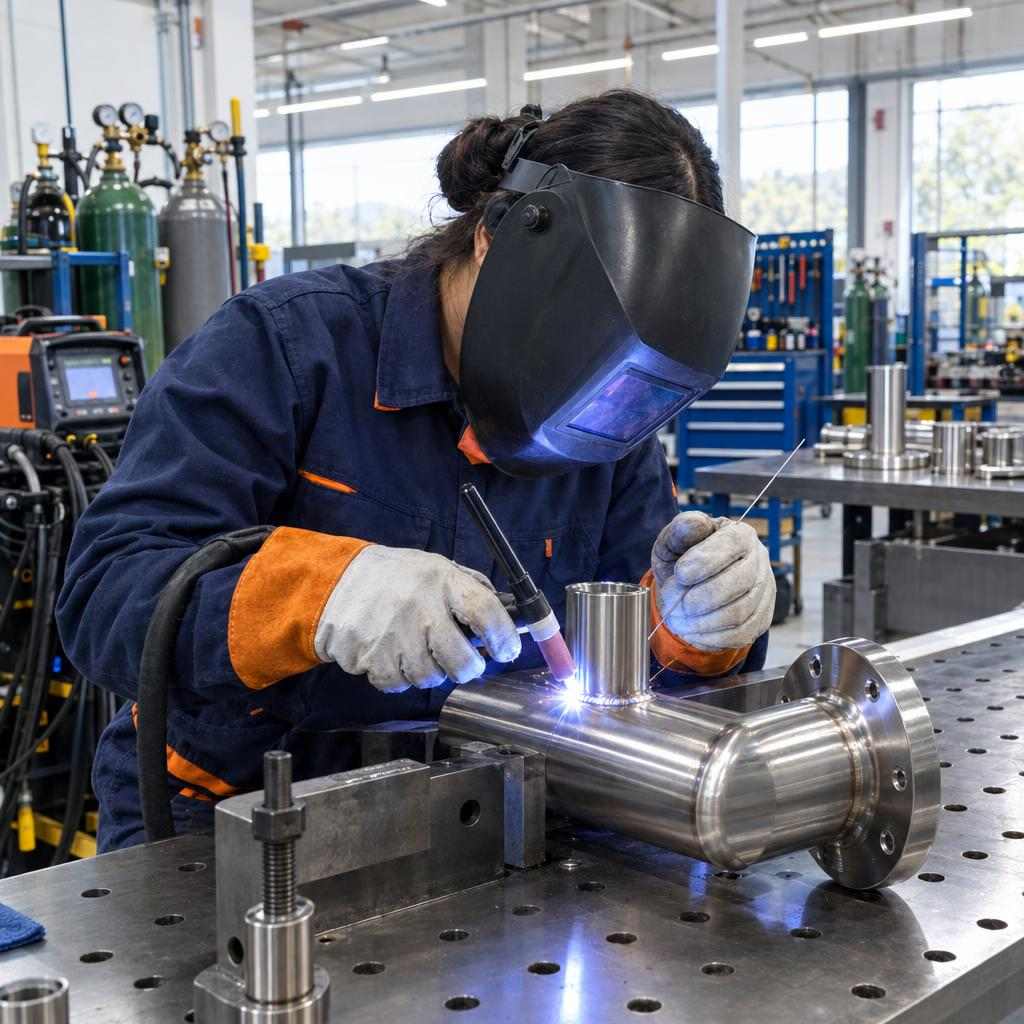
Advanced degrees in welding engineering or welding technology are uncommon among working welders (fewer than 1% hold a bachelor’s or higher) but are required for roles in R&D, metallurgical engineering, and some specialized programs in design or quality. For most people becoming a welder, a trade school or community college credential is the practical starting point.
Hands-On Training, Apprenticeships, and On-the-Job Training
No amount of classroom instruction replaces time under a hood. Hands-on training is crucial for welding skill development because welding demands manual dexterity, consistent travel speed control, and the ability to produce sound welds in flat, horizontal, vertical, and overhead positions. Hands-on training enhances job readiness for aspiring welders in ways that theory alone cannot replicate.
Registered Apprenticeships in welding typically require a minimum of 2,000 hours of on the job training per year plus at least 144 hours of Related Technical Instruction (RTI) per year, per federal standards under 29 CFR Part 29. Apprenticeships can last from 1 to 4 years, combining work and education. Apprenticeships often combine paid on the job training with classroom instruction delivered by a community college, school district, or training provider. Apprenticeships provide real-world experience alongside skilled professionals, and apprentices earn wages while they learn.
In the first months, apprentices typically handle basic fitting, tack welding, grinding, and material prep. After 12 or more months, they progress to welding in harder positions, working with thicker materials, and performing code-required welds under inspection. Final-stage apprentices may tackle pipe in 6G position or structural steel welding on complex joints.
Outside formal apprenticeship programs, many welders enter through “helper” roles in fabrication shops, construction, or manufacturing. These workers learn welding techniques by observing experienced welders, performing prep tasks, and gradually taking on welds with supervision. Many employers prefer candidates with hands-on training experience regardless of whether it came from a formal or informal path. Employers increasingly use digital tools to track on the job training hours, skill checklists, and competency milestones so both the worker and the organization can document progress toward journeyworker status.
Welding Certifications and the AWS Certified Welder Program
Formal education gets you into the shop. Certifications prove you can produce sound welds to a specific code. The distinction matters: a diploma or associate degree shows you completed coursework, while a welding certification demonstrates you passed a performance test under controlled conditions.
The American Welding Society is the primary certification body for welders in the U.S. The AWS Certified Welder program is performance-based, covering multiple welding processes and requiring welders to pass a hands-on test at an AWS Accredited Testing Facility. No formal education is required to become an AWS Certified Welder, and no prerequisite certifications are required for AWS certification. Candidates must schedule tests at AWS Accredited Testing Facilities, where they weld test coupons (plate or pipe) according to a Welding Procedure Specification. Results are evaluated through bend tests, radiographic testing, or other methods depending on the applicable code. AWS certifications validate a welder’s skills and are widely recognized. AWS certifications are among the most recognized welding credentials in the U.S., and AWS certification is recognized nationally and internationally.
The codes that matter most depend on the industry. A structural shop typically requires certification under AWS D1.1 for structural steel welding. Chemical refinery welding industries and pressure vessel fabricators require ASME Section IX qualification. Pipeline welders test under API 1104. Each code specifies essential variables: the welding process, base metal type, filler metal, position, and thickness range. Certifications from the American Welding Society recognize specific competencies in welding processes tied to these codes.
Certification remains valid with continuous practice documentation. Certified welders must maintain continuity logs showing they have performed the relevant welding process at least once every six to twelve months. Losing continuity means retesting, which can cost several hundred dollars per process. Initial AWS application runs about $70, with annual maintenance around $105. California relies on industry-recognized certifications for welders, as do most states, rather than a single state-issued license.
Advanced certifications can include Certified Welding Inspector (CWI), certified welding supervisor, or certified welding educator. An AWS certified welding inspector credential, for example, requires a combination of formal education, documented work experience, and passing a multi-part exam. These credentials open doors to roles that go well beyond holding an arc.
Recommended Education Roadmaps for Aspiring Welders
High school student: Focus on math, physics, and CTE shop classes in grades 10 through 12. After graduation, enroll in a 6- to 10-month welding certificate program at a local vocational school or community college. Upon completing the certificate, enter an apprenticeship program or entry-level welding job with structured on the job training. Pursue AWS certified welder testing toward the end of the first year of work. Total time from graduation to first certification: roughly 12 to 18 months.
Adult career changer: If needed, complete a GED through an adult education center (three to six months). Then enroll in an evening or weekend community college welding program. Welding training programs typically cover safety practices, blueprint reading, and various welding techniques across specific welding processes like SMAW and GMAW. After 6 to 12 months of formal technical training, begin working as a helper or entry-level welder while continuing to document OJT hours. Test for AWS or employer-specific certifications once welding skills are solid.
Current shop worker moving into welding: Start documenting OJT hours by process. Stack micro-credentials one at a time: SMAW 3G/4G plate, then GMAW spray transfer, then pipe if the career path calls for it. Enroll in evening courses for metallurgy, code interpretation, or blueprint reading at a community college. Over three to five years, experienced professionals in this position can build toward CWI, supervisory roles, or specialized training in underwater welding or other high-demand niches.
How Education Affects Your Welding Career Path and Advancement
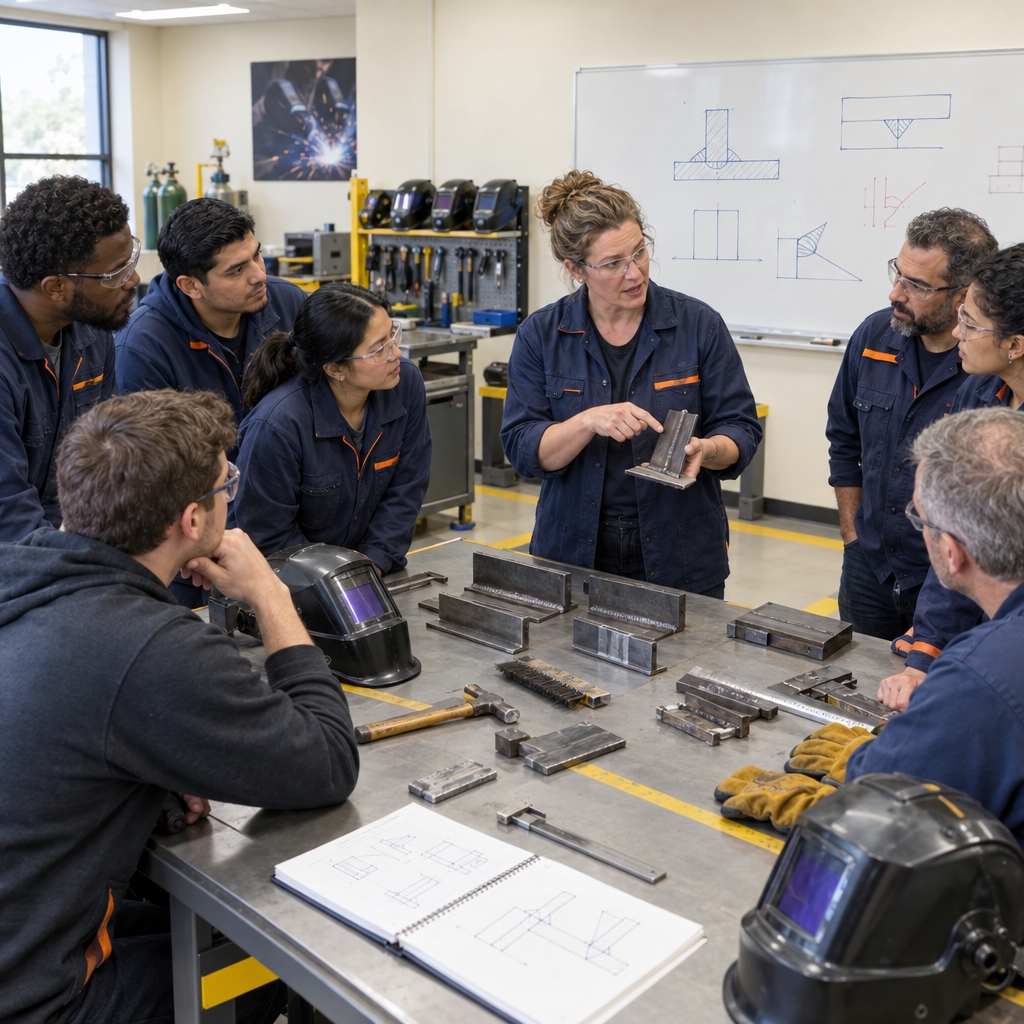
A welder with a basic certificate and a single metal arc welding certification can find steady work in production fabrication. Add ASME Section IX and API 1104 certifications plus an associate degree, and that same welder qualifies for pipeline work, refinery shutdowns, or inspection roles where skilled welders command higher pay. Specialized welders can earn substantially more than the median, particularly in demanding fields such as pipeline, industrial, and underwater welding.
The median annual wage for welders falls in the $50,000 to $60,000 range, with the BLS reporting approximately $53,750 as of May 2025. California welders earn an average of $27.40 per hour, while entry-level welders in California start at about $20 per hour. Career advancement tied to education milestones is measurable: welders who hold multiple industry certifications and an associate degree consistently qualify for foreman, estimator, or project management roles that single-process welders do not.
Welding employment is projected to grow 2% from 2025 to 2035, with the Bureau of Labor Statistics projecting about 40,300 openings each year over the decade. New alloys, robotic welding, and automation mean even experienced welders periodically return to short courses or RTI modules. Lifelong learning is now a practical requirement, not an abstract recommendation.
What to Look For in a Welding Education or Training Program
When choosing among welding programs, evaluate these factors:
- Accreditation and standards alignment: Does the program follow AWS SENSE standards? Is there an on-site or affiliated Accredited Testing Facility? Does curriculum align with ASME, API, or NCCER as relevant to local industry standards?
- Instructor credentials and lab quality: Instructors should have documented field experience. Labs need current welding equipment across processes. Class sizes should allow each student enough arc time in all positions.
- Certification preparation: Ask whether the program prepares students for specific tests like AWS D1.1 plate 3G/4G or pipe tests. A program that does not explicitly prepare you for the certification process has a gap.
- Safety training integration: Safe welding practices are essential in every welding environment. Common welding hazards include arc radiation and electrical shock. Courses like Welding and Cutting Safety Training are crucial for welders, and personal protective equipment (PPE) is vital for welding safety. Welders must follow workplace safety requirements and regulations throughout their careers.
- Tracking and documentation: Ask how the program tracks hands-on training hours and competencies. Can those records transfer to an employer or count toward apprenticeship credit? Programs that capture progress data digitally make it easier to demonstrate what essential skills a graduate actually holds.
Why Structured, Tracked Training Matters for Welders and Employers
From an employer and educator perspective, structured and well-documented welding education is no longer optional. Compliance with state and federal Registered Apprenticeship standards requires proof that apprentices completed specific OJT hours and RTI modules. Safety regulations and quality codes in construction, energy, and manufacturing demand verifiable training records.
Organized tracking of OJT and RTI ensures that apprentices are meeting the welder education requirements outlined in their program standards rather than relying on informal sign-offs. Organizations track data points like OJT hours by process (SMAW, GMAW, GTAW, FCAW), completed competencies (3G plate, 6G pipe), safety modules, and certification attempts and renewals.
When programs capture this data accurately and in real time, compliance during audits becomes straightforward. Career advancement paths for certified welders become visible. Prospective employers can see exactly what education and experience a qualified welder has completed. GoSprout’s platform is built to handle this tracking infrastructure: automating OJT and RTI hour logging, managing skill checklists, and generating compliance reports for RAPIDS, WIPS, and PIRL so that sponsors and employers can focus on training instead of paperwork.
Conclusion: Building a Welding Career on the Right Educational Foundation
To become a welder in 2026, most people start with a high school diploma or GED, add formal education through a certificate or associate degree, build welding skills through intensive hands-on training, and earn one or more industry recognized certifications. There is no single correct path, but clearer documentation of education, on the job training, and certifications leads to faster career advancement and better career prospects over time.
If you are an aspiring welder, take the next concrete step: enroll in a local community college welding course, talk to an employer about an apprenticeship program, or start working toward a GED to meet minimum education requirements. If you are an organization running a welding or apprenticeship program, review whether your education requirements and competencies are clearly defined, and adopt tools that make it easier to track, evaluate, and scale welder training across your workforce.
Want to Learn More About Your Registered Apprenticeship Opportunities?
BOOK A FREE CONSULTATION
Common Questions About Welder Education Requirements
Below are answers to the most frequent questions around welder education requirements, minimum education, time to certification, and whether a trade school or vocational school is necessary.
What is the minimum education required to become a welder?
A high school diploma or GED is the minimum education required for most welding training programs, apprenticeships, and entry-level welding jobs. Employers, unions, and training providers nearly universally expect this baseline because it confirms basic math, reading, and safety comprehension. If you need a GED, most adult education programs can prepare you in three to six months. Completing it early broadens access to vocational training programs, community college enrollment, and Registered Apprenticeship eligibility.
Do I need to attend a trade school or community college to be a welder?
It is technically possible to learn welding purely through on the job training, but in 2026 employers prefer candidates who have completed a formal welding program. A welding school or vocational training program provides structured lab time, access to welding equipment across multiple processes, and direct preparation for certification testing. Pure workplace learning offers flexibility and immediate income but often lacks the range of welding processes and positions that formal education covers.
How long does it take to meet welder education requirements and get certified?
Certificate programs typically last 6 months to 1 year. An associate degree takes about two years. Apprenticeships typically last 1 to 4 years, combining classroom instruction and OJT. Many welders stack these options; for example, completing a certificate first, then entering an apprenticeship. Becoming an AWS certified welder typically happens toward the end of a training program or after several months of documented welding practice, not on day one.
Can I become a welder without a high school diploma?
It is very challenging. Some employers may hire helpers without a diploma, but entry into community college, apprenticeships, and union welding jobs nearly always requires a high school diploma or GED. If you are in this situation, prioritize a GED. Most U.S. communities offer short prep courses and regular test windows through adult education centers.
What kind of math and science do welders actually use on the job?
Welders use fractions and decimals to measure material, basic geometry to calculate bevel angles and fit-ups, and physics concepts for understanding heat input, distortion, and load paths. The heat input formula (volts × amps × 60 ÷ travel speed) is a calculation code welders perform routinely. Welding programs re-teach applied math in a practical, hands-on context, but willingness to improve numeracy is part of meeting welder education requirements.
Are online welding courses enough to meet education requirements?
Online courses are useful for theory: safety protocols, reading weld symbols, metallurgy basics, and code interpretation. They are not sufficient alone because welders must demonstrate hands-on proficiency with welding equipment before being considered qualified welder candidates. Pair any online course with lab time at a local welding school, a bootcamp, or an apprenticeship program to meet both education and practical skills expectations.