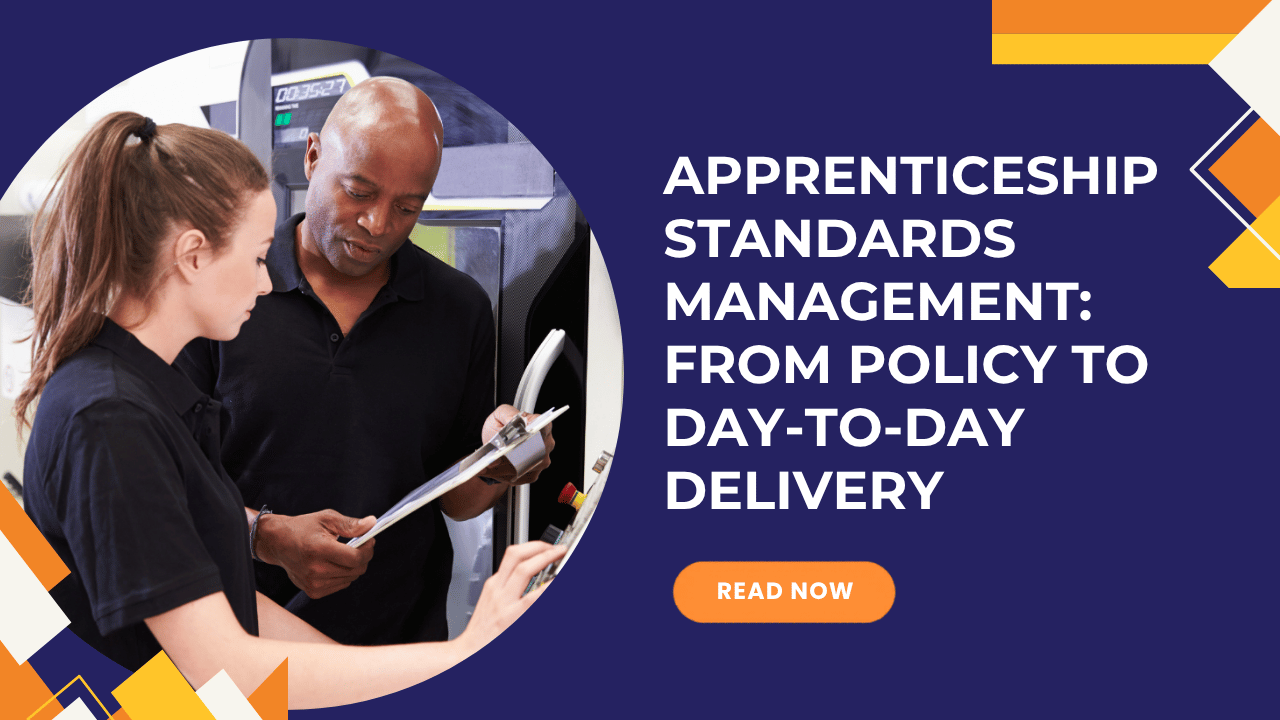
This practical guide covers apprenticeship standards management in 2026, from regulatory frameworks to daily implementation workflows.
Table of Contents
- What is Apprenticeship Standards Management?
- Policy and Governance Framework for Apprenticeship Standards
- Designing Apprenticeship Program Standards
- Implementing and Managing Apprenticeship Standards in Practice
- Quality Assurance, Compliance, and Portability
- Digital Tools for Apprenticeship Standards Management
- Frequently Asked Questions About Apprenticeship Standards Management
What is Apprenticeship Standards Management?
Apprenticeship standards are the written rules—work process schedules, related instruction outlines, wage progression, and completion criteria—while management refers to how organisations maintain, apply, and improve these documents in practice. Apprenticeship Program Standards are an organized, written plan outlining the terms and conditions of employment, training, and supervision for apprentices.
Managing standards means keeping them current, compliant with Department of Labor regulations, and aligned with industry needs. With 25 states independently approving occupations through State Apprenticeship Agencies, this creates significant variability that demands structured oversight. Post-2024 reforms have emphasised portable credentials, competency-based progression, and industry alignment.
The three core aims of apprenticeship standards management are: consistency across programs, portability for apprentices moving between employers or states, and confidence for employers and regulators through auditable records. Standards provide a clear path for career progression, enabling employees to transition from early-career roles to senior management positions.

Our business helps organisations centralise and govern their apprenticeship standards at scale, reducing administrative burden while ensuring compliance across multiple occupations and locations.
Policy and Governance Framework for Apprenticeship Standards
Effective apprenticeship standards management starts with clear policy, national guidance, and internal governance structures. The Office of Apprenticeship within the Department of Labor, along with State Apprenticeship Agencies, issues policies, bulletins, and circulars that program sponsors must follow.
Internal governance should mirror external requirements: policy documents with version control, clear accountability for updates, and documented processes for integrating new regulations. Key artefacts include Bulletins, Circulars, National Guideline Standards (NGS), National Program Standards, and Appendix A templates.
Using National Bulletins and Circulars Effectively
Bulletins and circulars are practical tools for staying current with the national registered apprenticeship system. Bulletins communicate changes to National Guideline Standards, National Program Standards, and occupation-specific updates—including new competency requirements for electrical, metalworking, and digital roles.
Circulars clarify procedures for registration, modification, and compliance in the registered apprenticeship system, covering equal opportunity rules, selection procedures, and reporting deadlines.
Concrete guidance for using these effectively:
- Establish a central digital library for all bulletins and circulars
- Assign an owner to review each publication within 10 business days
- Document impact on each standard in your portfolio
- Track compliance deadlines and reporting requirements
The development of national guideline standards for apprenticeships should be industry-led, with government incentives to facilitate employer participation. Employers must write apprenticeship standards that reflect their industries’ needs to ensure completers have the skills and competencies to excel in the workforce.
Internal Governance: Who Owns the Standards?
Clear ownership prevents standards from becoming outdated or inconsistent across sites or states. A central apprenticeship standards board should include representatives from HR, operations, training providers, and journeyworkers.
Key responsibilities include:
- Drafting and approving standards changes
- Liaising with regulators and registration agencies
- Signing off on new occupational additions
- Maintaining change-control logs and annual review cycles
Essential governance artefacts include a written standards policy, a change-control log, and documented sign-off dates for annual reviews. Our business supports governance with workflows, approval chains, and audit trails for every edit.
Designing Apprenticeship Program Standards
A standard is a written plan covering employment, training, and supervision. Good design improves both learner outcomes and employer ROI. While national templates like Appendix A exist, organisations must customise them for specific occupations and 2026 labour market conditions.
Use data from employers, journeyworkers, and labour market trends—including automation and green jobs—to shape content rather than copying legacy models. Apprenticeship standards ensure that training is industry-vetted and aligned with practical business needs.
Want to Learn More About Your Registered Apprenticeship Opportunities?
BOOK A FREE CONSULTATION
Work Process Schedule and Competencies
The work process schedule outlines the major job functions, competencies, and hours an apprentice completes in a registered apprenticeship program. It details what apprentices are expected to learn on the job.
Break occupations into 8–15 major functions with associated hour ranges. Include both time-based expectations (2,000 hours per year) and competency language (“can install, test, and commission independently”) to support hybrid models.
Apprenticeship programs can be structured as time-based, competency-based, or hybrid programs:
- Time-based programs require apprentices to complete specified hours in on-the-job training and related technical instruction
- Competency-based programs allow apprentices to progress by demonstrating competency through assessments
- Hybrid programs combine both strategies with minimum and maximum hour ranges
Involve journeyworkers and supervisors when drafting schedules, and test with a pilot cohort before full rollout.
Related Instruction and Curriculum Alignment
Related instruction provides theoretical knowledge behind hands-on work, often delivered by colleges or private training providers. Apprentices must spend at least 20% of their working hours on formal learning activities to gain required theoretical knowledge.
Map each work process area to specific course modules, credit hours, and learning outcomes. Current delivery approaches include blended learning, virtual labs, and micro-credentials stackable into degrees. Partner with education providers to ensure syllabi align with codes like NEC and ISO.
The core of management standards is built around Knowledge, Skills, and Behaviours (KSBs). Knowledge includes understanding operational management, financial management, project management, and business development. Skills entail practical applications such as managing teams, leading projects, and problem-solving. Behaviours encompass professionalism, integrity, inclusivity, and continuous personal development.
Wage Progression, Ratios, and Terms of Apprenticeship
Robust standards specify starting wages (typically 35–50% of journeyworker rate), progression milestones, and completion pay. Set ratios of apprentices to journeyworkers for safe supervision—often 1:1 for first-year apprentices, scaling up as skills grow.
Define apprenticeship terms in hours or years (6,000–8,000 OJT hours over 3–4 years) depending on occupation complexity. These standards encourage qualified mentorship, promoting guidance through training rather than simply supervision.

Implementing and Managing Apprenticeship Standards in Practice
Implementation shifts focus from design to day-to-day application: enrolment, supervision, documentation, and adapting standards to local conditions. Effective management standards integrate both on-the-job and off-the-job learning, emphasising practical skills and behavioural competencies.
Consistent documentation of hours, competencies, and related instruction completion proves standards are followed. Management apprenticeship standards serve as a structured framework for developing leadership talent. Data shows structured management lifts completion rates to 70–80% versus 50% in unmanaged programs.
Onboarding Apprentices and Mentors to the Standards
Apprentices and mentors must clearly understand their standard from day one. Provide a plain-language summary, walk through work processes, and explain wage progression and expectations.
Conduct annual orientation sessions highlighting standards changes. Train mentors to use work process schedules as coaching tools, not administrative checklists. These standards have transformed workplace training from passive, classroom-based learning into active, practical development.
Recording Progress Against Standards
Accurate, timely recording of OJT hours, competencies signed off, and related instruction credits demonstrates compliance and supports wage increases. Digital logbooks and mobile apps are preferable to paper logs in 2026.
Set clear rules: weekly updates, journeyworker or supervisor approval, integration with learning management systems and payroll. Use analytics to flag apprentices behind on competencies, allowing targeted support. Participating in an industry-recognized apprenticeship program allows workers to earn a job, gain steadily rising wages, and enter successful careers with little to no debt.
Adjusting Standards Without Disrupting Cohorts
Standards must evolve with new technologies and safety regulations, but mid-course changes need careful management. Use versioning: cohorts enrolled under one version complete under that version, while new cohorts start under updates.
For urgent safety-driven changes, document additional training hours required. Communicate transparently to apprentices and employers about changes and their impact on timelines.
Quality Assurance, Compliance, and Portability
Managing standards involves regulatory compliance and making credentials portable across employers and states. External audits by state apprenticeship agencies expect signed standards, completion records, and EEO documentation. To complete the apprenticeship, learners must pass a final assessment conducted by an independent organisation.
Compliance Monitoring and Audits
Good internal monitoring includes periodic file reviews, cross-checks of hours versus wage progression, and verification of related instruction attendance. Conduct quarterly internal audits and annual comprehensive reviews.
Typical non-conformities include missing signatures on Appendix A, outdated work process schedules, and exceeded apprentice ratios. Independent End-Point Assessment ensures quality and consistency. The implementation of rigorous, standardised assessments allows organisations to measure ROI on training programs.
Using Data for Continuous Improvement
Mature apprenticeship standards management uses data to refine standards. Studies indicate that management apprentices contribute to higher output, with reports suggesting they add an average of £20,900 to revenue annually. Approximately 93%–96% of apprentices remain with their employer long after completion.
Track completion rates, time to completion, exam pass rates, and post-completion retention. Hold annual standards review workshops using data, employer feedback, and apprentice surveys to inform revisions.
Digital Tools for Apprenticeship Standards Management
By 2026, manual spreadsheets are inadequate for complex, multi-occupation programs. A central digital repository reduces duplication and version confusion while integrating with HR systems, learning management systems, and payroll.
Essential Features to Look for in a Standards Management Platform
- Version control and audit trails
- Role-based access for apprentices, mentors, and administrators
- Automated notifications on policy updates
- Configurable templates for new occupations
- Mobile-friendly interfaces for field logging
- Secure hosting with appropriate data retention policies
- Reporting aligned with regulator requirements

In regions like England, the Apprenticeship Levy allows larger employers to fund high-level training through dedicated digital accounts. Many management standards are linked to professional bodies like the Chartered Management Institute, facilitating pathways to professional recognition.
Why Choose Our Business for Apprenticeship Standards Management
We specialise in managing apprenticeship standards across multiple occupations, states, and providers. Our differentiators include deep understanding of national guideline standards, implementation within 60–90 days, and proven results improving audit outcomes and completion rates.
One mid-sized manufacturer centralised 20+ standards with us, cutting admin time by 40% and improving audit preparation significantly. Management apprenticeship standards provide a blueprint for developing future leaders through combined on-the-job training and structured learning.
Employers can customise training to their specific equipment, processes, and culture. Apprenticeships provide structured paths for existing staff to advance into leadership roles, facilitating succession planning. Participating allows employers to build a pipeline of skilled workers, meet demand for skilled labour, and improve productivity.
Contact us or visit our apprenticeship standards management page to discuss your specific programs.
Frequently Asked Questions About Apprenticeship Standards Management
A standard is the written blueprint defining competencies, hours, wages, and training requirements. The program is the live implementation—enrolled apprentices, mentors, and ongoing delivery against that standard.
Conduct annual reviews minimum, with additional reviews when new bulletins or circulars are published. Safety-related changes may require immediate action.
Yes. Standards focus on occupational competence, and modern platforms support hybrid models tracking both hours and demonstrated competencies simultaneously.
Use version control. Current cohorts complete under their enrolled version while new intakes start under updated standards, unless safety requirements mandate immediate changes.
Signed Appendix A documents, completion records, apprentice-to-journeyworker ratio verification, related instruction attendance, and equal opportunity documentation.
Absolutely. We streamline apprenticeship standards management for complex organisations across multiple occupations and states, reducing admin burden while ensuring compliance.
Have questions specific to your occupation or region? Contact us to discuss your apprenticeship program needs.


